From Monday to Friday morning, focusing on macro trends, U.S. stocks, AI, precious metals, and crude oil, we use data to review the markets and trends to seize opportunities. Produced by PANews.
Policy Temporarily Caps Oil Prices, But Cannot Disperse Fiscal Clouds
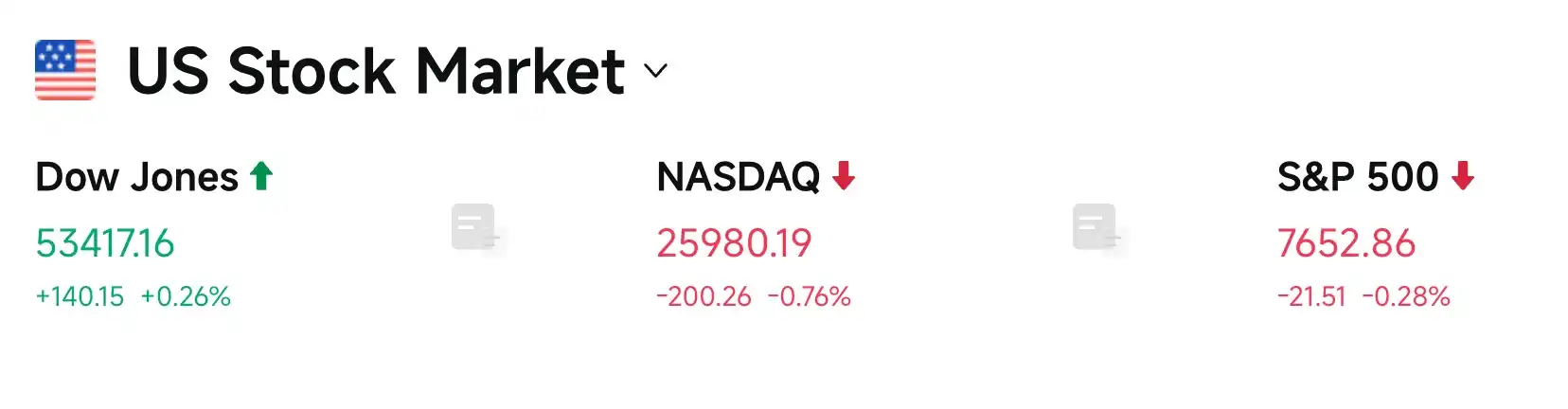
The three major U.S. stock indices diverged: the Dow Jones Industrial Average rose 0.26%, supported by financials, consumer staples, and defensive blue chips; the S&P 500 fell 0.28%; and the Nasdaq Composite fell 0.76%, with the AI hardware sector becoming the center of selling pressure.
Bessent launched the "Economic Orphan Action" on Monday, targeting five "lifelines" of Iran's digital assets, technology, gold, aviation, and shipping, and threatening secondary sanctions on countries that continue dealings with Tehran. Trump is communicating with leaders of various countries, demanding they sever economic interactions. Relevant parties will be given a grace period for rectification, otherwise the Treasury will act unilaterally. Iranian Supreme Leader's advisor Mohber swiftly countered: the response will be more resolute than ever. Sanctions and wars over the past 47 years have not worked; now they are facing internal unity and the Strait of Hormuz deterrent. The parliamentary speaker said trade partners "will not take seriously" the U.S.'s nonsense.
The market quickly "bought the rumor and sold the news": Brent crude fell 2.35% to $92.17 per barrel, with WTI falling in tandem to around $85.01, temporarily easing inflation premiums. Goldman Sachs warned that if the Strait of Hormuz crisis persists into winter, pressure on European natural gas inventories could further intensify, with TTF natural gas prices potentially needing to rise above €100 per megawatt-hour to attract sufficient LNG supplies. Current European gas storage is only about 62%, the lowest for this time of year in nearly two decades.
On the same day, Bessent remained restrained regarding U.S. Treasury operations: "We haven't even bought a single bond yet," with the next buyback not scheduled until September 9. Previous reports suggested the Treasury might use nearly $1 trillion from the TGA (Treasury General Account, balance approx. $935-950 billion) to fund the expanded long-term bond buyback. Morgan Stanley interest rate strategist Martin Tobias estimated the available scale between $80 billion and $200 billion. Goldman Sachs, Deutsche Bank, and Citadel Securities collectively poured cold water on the idea: buybacks cannot fundamentally reset long-term rates; the root causes are the U.S.'s $40 trillion debt, fiscal deficit, and inflation. Citadel Securities bluntly called this move "financial repression," stating pressure would only shift to the dollar, inflation, and other assets. The 10-year Treasury yield fell about 3 basis points to around 4.70%, with the 30-year also falling to 5.24%.
The U.S. Dollar Index rose slightly by about 0.20% to near 99. The dollar's strength mainly stemmed from safe-haven demand due to the Iran sanctions, but the market is also starting to worry that if the Treasury forcibly depresses long-term rates, the dollar could face pressure in the future. Data shows the premium of dollar put options over call options for the next month has risen to its highest level since February.
Gold continued to strengthen, hitting an intraday high of $4,696, reaching a nearly three-month high; New York gold futures were further pushed to $4,755. Citigroup has raised its 0-3 month gold target price to $4,800 per ounce and maintains its 6-12 month target of $5,000 per ounce. JPMorgan cautions that if PCE inflation exceeds expectations, gold may first pull back, but if the data is mild and Jackson Hole doesn't signal a strongly hawkish stance, gold prices could quickly approach $5,000.
Additionally, Trump continues to create pressure on the trade market, criticizing Canada for "taking advantage of the U.S." and warning of more serious consequences if Canada doesn't play by the rules. Market sources suggest the U.S. may raise tariffs on Canadian autos, parts, and steel to 50% starting in 2027, which would affect North American auto supply chain costs.
AI Hardware Sector Bleeds Out Comprehensively; Memory and Optical Communication Hit Hard, Funds Shift to More Stable Tech Platforms
Last night and this morning, U.S. AI hardware and semiconductor stocks faced intense selling pressure. The Philadelphia Semiconductor Index plunged nearly 3%, the memory sector fell about 5.5% overall, with the optical communication sector leading the decline.
Nvidia fell 2.91%, marking its seventh consecutive day of decline, its longest losing streak since 2022. The stock decline shows a clear divergence from fundamental expectations: Nvidia executives stated the Groq 3 LPX racks are now in full production, focusing on low-latency AI inference, and will be deployed alongside Vera CPU and Rubin GPU in Nebius data centers. Moreover, Wall Street earnings estimates for the past three months have actually been revised upward by about 13%, with the vast majority of 82 analysts maintaining buy ratings.
However, traders are more focused on risks ahead of earnings. Nvidia reports earnings this week, and the market worries that even if the results are strong, they might not be strong enough to support current valuations. Goldman Sachs believes Nvidia's demand data in Wednesday's earnings report might be "absurdly strong," but the real issues lie in memory costs and AI infrastructure financing. If hardware costs continue to rise, Nvidia will ultimately have to choose between absorbing costs, raising prices to customers, and reducing memory dependency.
Wall Street is increasingly alert to the credit risks of AI infrastructure. Broadcom's 5-year CDS has risen 28 basis points since August, with the yield on its bonds maturing in 2031 rising about 14 basis points over the same period; its risk premium even exceeds that of Oracle and SpaceX. JPMorgan strategists warn that off-balance-sheet credit support involved in the AI ecosystem—such as lease contracts, purchase commitments, and residual value guarantees—could ultimately reach trillions of dollars, raising deep concerns about "compute loans" and off-balance-sheet leverage risks.
The memory chain was a disaster area. Samsung Electronics' shareholder return plan falling short of expectations triggered a second wave of selling in global memory stocks. Micron, SanDisk, Seagate, Western Digital, and SK Hynix all plunged significantly. The market worries that the previous price increase cycle driven by HBM and AI servers has already been overpriced into stock valuations. The optical communication sector also faced pressure. Applied Optoelectronics fell nearly 14% after announcing its third ATM financing this year, planning to raise $600 million, raising investor concerns about cash flow and equity dilution. This dragged down Ciena, Lumentum, and Coherent.
Specific Project Actions and Stock Price Movements:
-
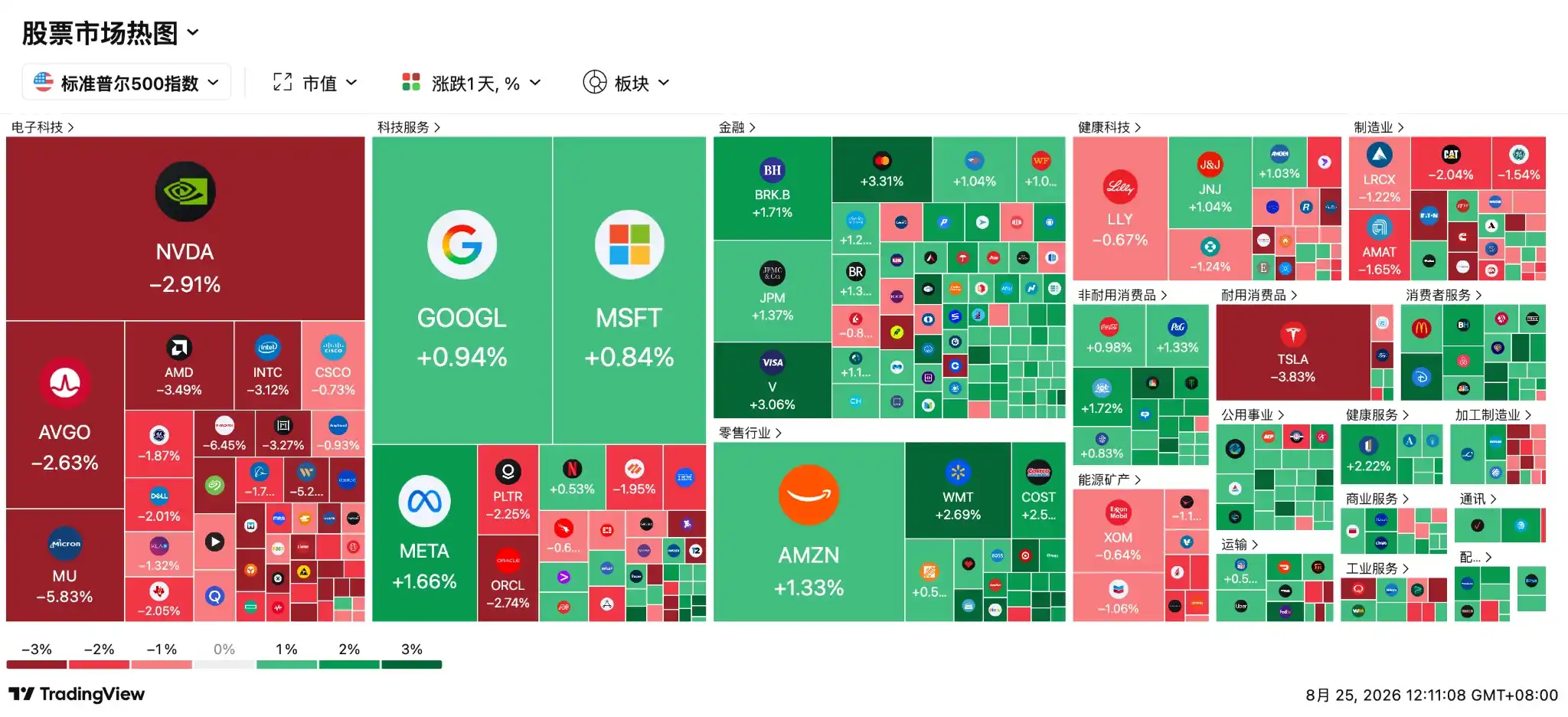
Nvidia closed down 2.91%, its seventh consecutive day of decline, marking its longest losing streak since 2022, with a cumulative drop of over 7% during the period. Risk-off selling dominated ahead of earnings, despite analysts raising earnings estimates by 13% over the past three months, most maintaining buy ratings, and target prices implying over 50% upside, with forward P/E having fallen to around 18x.
-
Semiconductor sector fell in unison, Broadcom down 2.63%: The yield on its 2031 bonds surged 14 basis points, and its CDS jumped 28 basis points in a month. Wall Street warns of massive off-balance-sheet credit risk accumulating from the residual value guarantees it provides for AI data center leases and purchase contracts. The Philadelphia Semiconductor Index fell 2.7%; AMD fell over 3%, Intel fell over 3%, TSMC fell over 2%.
-
Memory chips collectively sold off, Micron down nearly 6%: Samsung's shareholder returns falling short of expectations exacerbated market concerns about the memory cycle peaking. SanDisk down 6.45%, Seagate down over 6%, Western Digital down over 5%, SK Hynix down nearly 5%.
-
Optical communication was a disaster area, Applied Optoelectronics down nearly 14%: The company plans to raise $600 million via ATM financing, raising market concerns about equity dilution and funding pressure. Ciena down over 6%, Lumentum down over 4%, Coherent down over 4%, Marvell Technology down over 3%.
-
Tesla closed down 3.83%: Mainly impacted by a voluntary recall of about 3 million cars in China due to door handle and driving monitor hazards (a single-brand record). Despite the company scheduling a Cybercab event for September 3, traders predict only a 17% probability of delivering to retail customers this year. Related sectors: XPeng down over 8%, NIO down nearly 6%, Chinese new energy vehicle chains under pressure overall.
-
Meta rose 1.66% against the trend: Meta plans to launch the "Hatch" AI agent platform in the coming weeks, an intelligent shopping tool on Instagram, and plans to release the latest AI model "Watermelon" in October; the premium subscription version may cost up to $199.99 per month. Related sectors: Amazon up 1.33% (AWS launched Glue 6.0 with a 30% price reduction), Microsoft up 0.84%, Google up nearly 1%, Apple up 0.32%. Major platform stocks showed clear resilience.
-
SpaceX down 1.44%: SpaceX AI will adopt Nvidia Vera CPU to advance Agentic AI and plans to extend the optimized Vera Rubin NVL72 to space for Starmind AI satellites. Meanwhile, NASA's Roman Space Telescope is scheduled for launch on August 30 via a Falcon Heavy rocket.
-
Other giants: Bloom Energy up 1.28%, as Pelosi disclosed for the first time buying Bloom Energy stocks and options while adding to Intel, betting on AI power and chips; Boeing down 1.75%, with after-hours news that Boeing secured a U.S. Air Force F-15 contract worth up to $131.2 billion; Visa up 3.07%, Walmart up 2.69%, Disney up 2.62%, providing important support for the Dow's two-day gain against the trend.
What to Watch Next:
August 25 (Tuesday)
-
Jefferies Semiconductor, IT Hardware & Communications Tech Summit, August 25-26: Many well-known semiconductor and tech companies including TSMC, FormFactor, Aehr Test Systems, Arbe Robotics will participate. Industry discussions will focus on AI accelerators, HBM, advanced packaging, data center demand, and automotive semiconductor iteration.
August 26 (Wednesday)
-
Gamescom in Cologne, Germany, August 26-30, Opening at 02:00: Microsoft, Nintendo, Tencent, NetEase, CDPR and others will gather. Market focus on new game releases, AI game tools, cloud gaming, and hardware ecosystem news, potentially affecting sentiment in gaming, graphics cards, consoles, and content platforms.
-
Deutsche Bank California Technology Conference, August 26-27 in Dana Point, California.
-
Shenzhen AGIC General Artificial Intelligence Expo, August 26-28, overlapping with the Digital Expo (August 28-30) in Tongzhou. Dense AI industry conferences, focus on embodied intelligence and AI application progress.