‘Uninformed FUD’ – White House on claims of Coinbase stalling the CLARITY Act again

ambcryptoPublicado a 2026-03-26Actualizado a 2026-03-26

Resumen

The White House has dismissed speculation that Coinbase is opposing the latest stablecoin yield deal and blocking the CLARITY Act, calling the claims "uninformed FUD." Patrick Witt, a digital asset advisor to the President, expressed confidence that the recent agreement between the Senate and the White House would revive momentum for the bill. Rumors of Coinbase CEO Brian Armstrong's opposition originated from a Punchbowl News report, though it was noted his stance was less severe than his previous public objections. The new deal limits stablecoin yields to account activity rather than passive interest earned via intermediaries, a change seen as favorable to banks. As of writing, neither the banking industry nor Armstrong had publicly commented on the compromise. Senator Cynthia Lummis emphasized the urgency of passing the bill under the current pro-crypto administration. Meanwhile, the proposed yield restrictions caused Circle's stock (CRCL) to drop 20% before partially recovering.

The White House has dismissed ongoing speculation that Coinbase has opposed the latest stablecoin yield deal and could block the crypto bill, the CLARITY Act, from moving forward again.

In an X (formerly Twitter) post, Patrick Witt, the executive director of the President’s Council of Advisors for Digital Assets, discredited the claims as ‘uninformed FUD.’


Source: X/Patrick Witt

He seemed confident that the stablecoin yield deal made last week between the Senate and White House would reignite momentum for the CLARITY Act.

Rumors on the Coinbase holdout

The speculation that Coinbase CEO Brian Armstrong opposed the stablecoin yield proposal was sparked by a Punchbowl News (PBN) report.

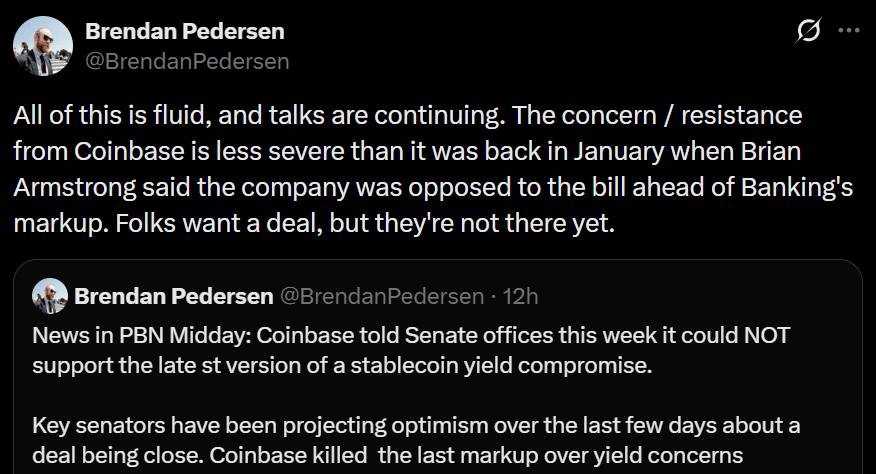
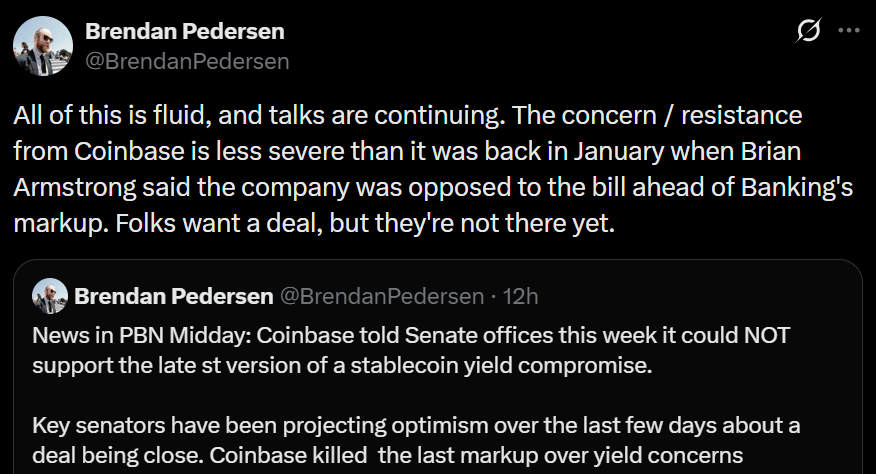
According to Brendan Pedersen, a reporter at PBN, representatives at the exchange told the Senate on Monday that Coinbase could not support the latest stablecoin yield deal. However, Pedersen clarified that the holdout was not as strong as Armstrong’s public opposition to the bill in January.
Source: X/Brendan Pedersen

Although some stablecoin yield supporters stood by the alleged Armstrong holdout, others pleaded with him to allow the bill to pass and refine it later.

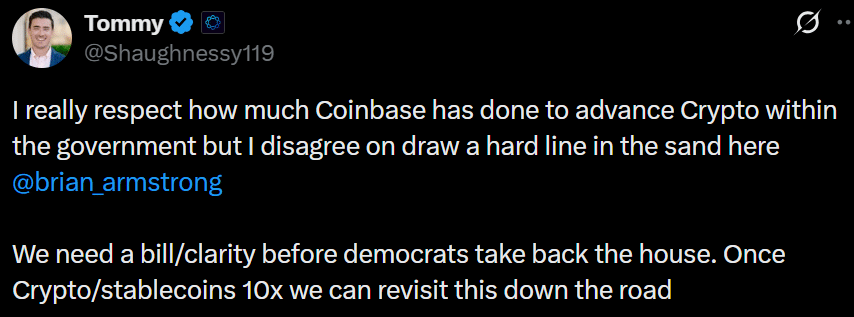
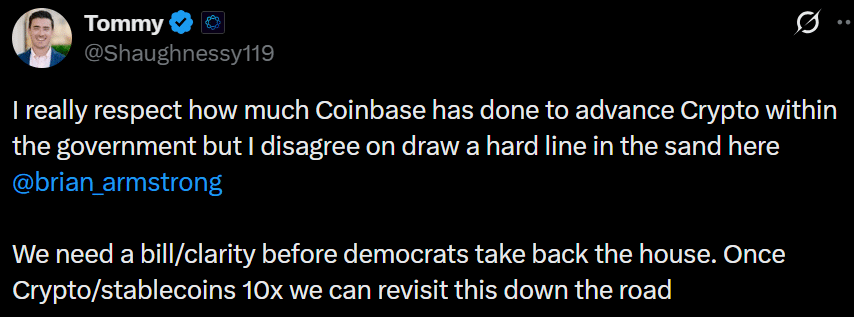
For his part, Tommy Shaughnessy, founder of crypto VC firm Delphi Ventures, implored Armstrong to reconsider his strong stance against the yield compromise and the crypto bill.
Source: X/Shaughnessy119

The recent deal narrowed stablecoin yield to account activity rather than the current passive interest earned on balances via intermediaries.

Although this was a win for the banks, as of writing, there was no public statement from the industry on whether they were okay with the yield compromise or not.

Likewise, as of writing, Brian Armstrong had not made a public statement on the alleged opposition to the stablecoin yield compromise.
Source: X/Senator Cynthia Lummis

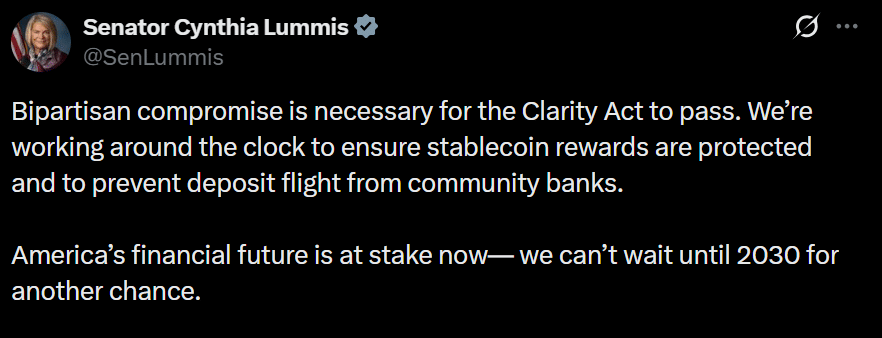
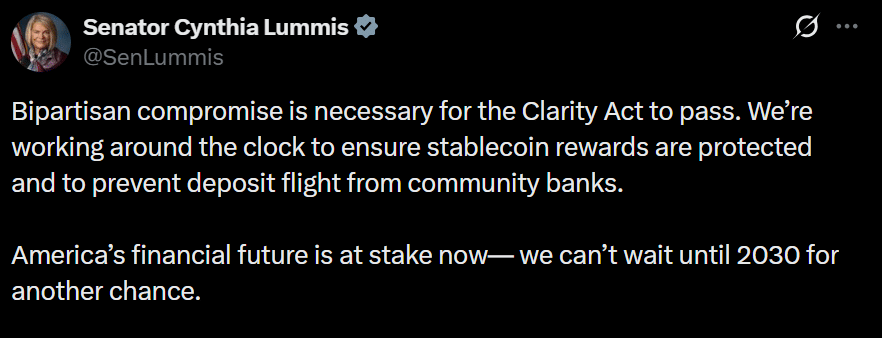
However, Senator Cynthia Lummis stressed that the bill can’t be postponed, underscoring the current pro-crypto regime as the best to advance clear rules for the sector.

Meanwhile, the details on the limited stablecoin yield in the latest CLARITY Act draft made traders turn bearish on Circle stock, CRCL. The stock fell 20% on Tuesday, from $127 to $98, before easing back to over $100 on Wednesday.


Final Summary

  • Trump’s crypto advisor dismissed rumors that Coinbase is opposing the latest stablecoin yield deal, calling the speculation “uninformed FUD.”
  • The proposed stablecoin yield restriction sent Circle stock tumbling 20% this week.

Criptos en tendencia

Preguntas relacionadas

QWhat did the White House call the claims about Coinbase stalling the CLARITY Act?

AThe White House, through Patrick Witt, dismissed the claims as 'uninformed FUD'.

QWho is Patrick Witt and what is his role?

APatrick Witt is the executive director of the President's Council of Advisors for Digital Assets.

QWhat was the main change in the latest stablecoin yield deal?

AThe recent deal narrowed stablecoin yield to account activity rather than the passive interest earned on balances via intermediaries.

QWhat was the market reaction to the proposed stablecoin yield restrictions?

ACircle's stock (CRCL) fell 20% on Tuesday, from $127 to $98, before recovering to over $100 on Wednesday.

QAccording to the article, had Brian Armstrong made a public statement on the alleged opposition at the time of writing?

ANo, as of the time of writing, Brian Armstrong had not made a public statement on the alleged opposition to the stablecoin yield compromise.

Lecturas Relacionadas

Por qué el Bitcoin se mantiene en $64,000 tras la dura pausa de la Fed

Bitcóin cierra julio cerca de los 64.000 dólares tras una volátil reacción a la decisión de la Fed de mantener las tasas sin cambios, aunque sin indicar un pronto aflojamiento monetario. Esto ha provocado una rotación de capital hacia los ETF de Bitcoin, que registraron una entrada neta de 32,1 millones de dólares, mientras que los fondos de Ethereum experimentaron salidas. El mercado de criptomonedas, con una capitalización de unos 2,29 billones de dólares, se mantiene en un rango lateral, con Bitcoin encontrando soporte en 63.000-63.500 dólares y resistencia en 66.000 dólares. La Fed mantuvo su tasa clave, pero tres miembros votaron a favor de un aumento, señalando una postura más dura de lo esperada. En este entorno macroeconómico incierto, los inversores institucionales parecen favorecer a Bitcoin como activo principal, aunque persiste el interés selectivo en activos como Solana. Mientras, la aprobación de la ley CLARITY en EE.UU. se retrasa hasta después del receso de agosto. Para el último día de julio, el enfoque estará en los datos macro de EE.UU. El escenario base para Bitcoin es la consolidación entre 63.000 y 66.000 dólares, con su ruptura superior dependiendo de nuevos flujos institucionales. La estabilidad por encima de 63.000 dólares para BTC, el mantenimiento de Ethereum sobre 1.860 dólares y las entradas continuas en ETF son claves para una posible base de recuperación en la segunda mitad del año.

cryptonews.ruHace 3 hora(s)

Por qué el Bitcoin se mantiene en $64,000 tras la dura pausa de la Fed

cryptonews.ruHace 3 hora(s)

Parker Lewis responde por qué bitcoin sigue siendo el mejor dinero

El influyente analista de Bitcoin, Parker Lewis, critica las estrategias de marketing de corporaciones que actúan como tesorerías cripto. Advierte que la venta de "crédito digital" mediante acciones preferentes perpetuas distorsiona la esencia de la criptomoneda. Lewis enfatiza que Bitcoin no genera rendimiento fiduciario por diseño y que las promesas de dividendos son riesgosas, dependiendo de nuevos inversores. Destaca el riesgo de estos derivados, señalando que el mercado de acciones preferentes perpetuas es minúsculo comparado con el crédito global, lo que demuestra que los grandes actores evitan estos riesgos, trasladándolos a minoristas. Rechaza la idea de que Bitcoin es "demasiado volátil", argumentando que la volatilidad es una consecuencia natural de la adopción masiva de un activo con oferta fija e inelástica. En lugar de comprar derivados corporativos como acciones de MicroStrategy, recomienda adquirir Bitcoin directamente, considerándolo más seguro. Lewis alerta que este enfoque distrae de la verdadera amenaza: la rápida devaluación del dinero fiduciario. Ilustra la inflación real con su "Índice Ribeye", mostrando un aumento del 90% en el precio de un filete desde 2020, muy superior a las cifras oficiales. Concluye que la estrategia más prudente es la posesión directa de Bitcoin y el control total de las claves privadas, protegiendo así los ahorros de la inflación y los riesgos sistémicos de los derivados corporativos.

cryptonews.ruHace 3 hora(s)

Parker Lewis responde por qué bitcoin sigue siendo el mejor dinero

cryptonews.ruHace 3 hora(s)

Trading

Spot

Artículos destacados

Cómo comprar HOUSE

¡Bienvenido a HTX.com! Hemos hecho que comprar Housecoin (HOUSE) sea simple y conveniente. Sigue nuestra guía paso a paso para iniciar tu viaje de criptos.Paso 1: crea tu cuenta HTXUtiliza tu correo electrónico o número de teléfono para registrarte y obtener una cuenta gratuita en HTX. Experimenta un proceso de registro sin complicaciones y desbloquea todas las funciones.Obtener mi cuentaPaso 2: ve a Comprar cripto y elige tu método de pagoTarjeta de crédito/débito: usa tu Visa o Mastercard para comprar Housecoin (HOUSE) al instante.Saldo: utiliza fondos del saldo de tu cuenta HTX para tradear sin problemas.Terceros: hemos agregado métodos de pago populares como Google Pay y Apple Pay para mejorar la comodidad.P2P: tradear directamente con otros usuarios en HTX.Over-the-Counter (OTC): ofrecemos servicios personalizados y tipos de cambio competitivos para los traders.Paso 3: guarda tu Housecoin (HOUSE)Después de comprar tu Housecoin (HOUSE), guárdalo en tu cuenta HTX. Alternativamente, puedes enviarlo a otro lugar mediante transferencia blockchain o utilizarlo para tradear otras criptomonedas.Paso 4: tradear Housecoin (HOUSE)Tradear fácilmente con Housecoin (HOUSE) en HTX's mercado spot. Simplemente accede a tu cuenta, selecciona tu par de trading, ejecuta tus trades y monitorea en tiempo real. Ofrecemos una experiencia fácil de usar tanto para principiantes como para traders experimentados.

870 Vistas totalesPublicado en 2025.04.27Actualizado en 2026.06.02

Cómo comprar HOUSE

Discusiones

Bienvenido a la comunidad de HTX. Aquí puedes mantenerte informado sobre los últimos desarrollos de la plataforma y acceder a análisis profesionales del mercado. A continuación se presentan las opiniones de los usuarios sobre el precio de HOUSE (HOUSE).

活动图片













