Twitter Tags Lead Directly to Market Quotes, Is Trading Far Behind?

marsbitPublicado a 2026-01-12Actualizado a 2026-01-12

Resumen

X is advancing its "Everything App" vision with the upcoming launch of Smart Cashtags, a feature that allows users to tag specific financial assets and view real-time prices directly within posts. This enhancement addresses issues like ambiguous ticker symbols in crypto by enabling precise asset identification via smart contract addresses. It aggregates discussions and may integrate one-click buy/sell functionality, potentially compressing the traditional financial decision-making process into a seamless social-to-trading experience. This move aligns with Elon Musk’s ambition to transform X into an all-in-one platform encompassing social, media, payment, and trading services. The feature could also support AI agents in processing asset information more accurately. However, challenges include ensuring reliable data sources, mitigating market manipulation risks (e.g., pump-and-dump schemes), and navigating complex global financial regulations. The announcement by X product lead Nikita Bier—who has a background in crypto, including an advisory role at Solana—hints at potential ecosystem biases, as evidenced in demo visuals featuring tokens like BONK and a speculative Base token. Ultimately, Smart Cashtags may accelerate the convergence of social media and financial trading, positioning X as a central hub for global capital flow and decision-making.

When asset tags represent a real-time money interface, X takes another step closer to its "Everything App" dream.

On January 11, 2016, X Product Lead Nikita Bier announced the launch of the Smart Cashtags feature next month. At first glance, this seems like a minor improvement allowing users to precisely tag assets and view real-time prices. But when placed within X's grand financial ecosystem strategy, this is undoubtedly a key move in building the "Everything App".

What is Smart Cashtags?

According to the content and screenshots released by Nikita Bier, the upcoming Smart Cashtags brings several fundamental changes:
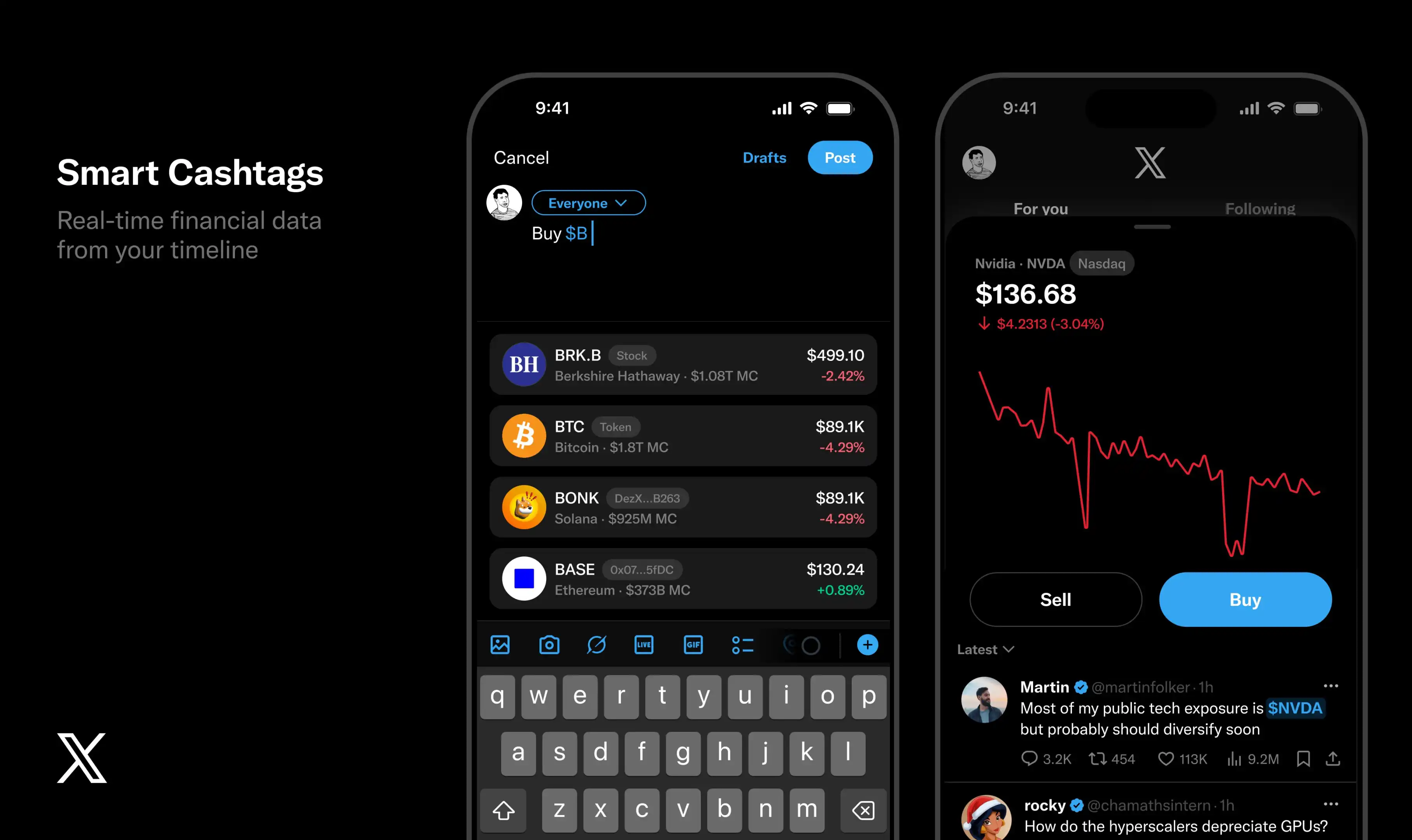
1. Precise Asset Anchoring: Posters can assign a tag to a specific asset or smart contract address. This means that when multiple assets or tokens with the same name exist, especially a common pain point in the crypto market with rampant同名代币 (Ticker), clicking the tag will directly point to the unique target asset.

2. One-Click Real-Time Price Viewing: Cashtags in the timeline can be clicked directly to instantly display real-time prices.

3. Aggregated Discussion: Aggregates all tweets mentioning that asset, forming a complete discussion view.

4. Trading Closed-Loop: The screenshot shown by Nikita Bier displayed one-click buy or sell buttons after opening the NVDA tag. Although it's not yet clear if this feature will cover crypto assets, it sends a strong signal: X is experimenting with embedding trading functions directly into the information feed.

In response to a question about "Does this mean we will be able to use self-custody wallets or even CEX widgets to trade on X in the future?", Nikita Bier replied with an Emoji "".

When the information flow and price flow merge into one, X is no longer just a chat box, but a financial trading terminal in its infancy. The traditional financial decision path is: see news → switch apps to search → check quotes → find analysis → decide to trade. Smart Cashtags compresses this to: see news / discussion → click tag (check quotes / view sentiment)→ one-click trade.

The Larger Game: From Social Media to "Everything App"

Musk has repeatedly stated his desire to build X into an Everything App encompassing social, media, payment, and trading. On January 11, 2026, he emphasized again that X is the set of all things.

It's worth emphasizing that in June 2025, former X CEO Linda Yaccarino, before stepping down, stated that users would "soon" be able to invest or trade on X, and that X was also exploring the launch of an X credit or debit card. X had previously stated it would launch a digital wallet and peer-to-peer payment service X Money, with Visa as its first partner.

On the other hand, what's active on X in the future might not just be people, but also AI agents. Smart Cashtags can help these AI agents more accurately identify and process asset information.

What are the Potential Challenges?

Of course, this feature is not without challenges. First is the credibility of the data source. For cryptocurrencies, where does the real-time price come from? Centralized exchanges, decentralized oracles, or multi-source aggregation?

Secondly, Smart Cashtags and the ensuing trading functions could also exacerbate market manipulation risks. If a KOL tweets promoting a small-cap coin, and fans can just "click to buy", FOMO sentiment can be amplified instantly, potentially making Pump and Dump easier than ever. How X limits malicious tags will be a huge challenge.

Last but not least, there's the minefield of regulatory compliance. When X starts providing real-time financial data, pushing related assets through algorithms (could this be considered asset recommendation?), and trading functions, could it be classified as an "exchange" or "investment advisor" by regulators? Regulatory attitudes vary greatly across different jurisdictions, and X needs to balance innovation and compliance globally.

Key Figure: Nikita Bier's Crypto Background

Nikita Bier is not just X's product lead; he previously founded the social apps tbh app and Gas, which were acquired by Meta and Discord respectively. He is also an investment partner at Lightspeed and began serving as a Solana advisor in March 2025.

In Nikita Bier's Smart Cashtags announcement screenshot today, the dropdown list after typing "$B" included BTC" and the Solana ecosystem's BONK token. Some community users believe that BONK, as a leading Solana Meme, being placed in such a prominent position is clearly not a coincidence, reflecting Nikita Bier's preference and push for the Solana ecosystem.

Another point is that the screenshot also showed a Base token, displaying a market cap of $373 billion and a single token price of $130, which was interpreted by some community users as an abstract prophecy of an upcoming Base token issuance. Previously, in mid-September at the BaseCamp 2025 conference in Stowe, Vermont, Base network lead Jesse Pollak stated that Base was exploring the possibility of issuing a network token to accelerate Base's decentralization process.

Summary

The boundary between social media and financial terminals is completely dissolving. The launch of Smart Cashtags will mark the official arrival of the era of "social-driven trading".

For ordinary users, this means more transparent information and faster tools; but for regulators and traditional financial institutions, this may mean a "new battlefield" that is harder to control, more volatile, and entirely driven by community sentiment.

Nikita Bier stated bluntly, "X is the best platform for financial information—what users read here influences the allocation of trillions of dollars."

Whoever controls the financial information flow controls the entry point for capital movement. When X completes the closed loop of "information + payment + trading", it will become one of the operating systems of the global financial market. At that time, decisions on the allocation of hundreds of billions of dollars will not only be based on information on X, but will happen directly on X.


Preguntas relacionadas

QWhat is the core function of the newly announced Smart Cashtags feature on X?

ASmart Cashtags allows users to precisely tag specific financial assets or smart contract addresses, view real-time prices directly within the timeline, aggregate discussions about the asset, and potentially execute buy/sell orders through an integrated interface.

QHow does Smart Cashtags contribute to X's broader strategic vision?

AIt is a key step in X's plan to become an 'Everything App' by integrating social interaction, media, payment services, and financial trading into a single platform, effectively merging information flow with capital flow.

QWhat are some potential challenges associated with Smart Cashtags?

AChallenges include ensuring reliable data sources (especially for crypto assets), mitigating market manipulation risks like pump-and-dump schemes facilitated by quick trading access, and navigating complex regulatory compliance across different jurisdictions.

QWho is Nikita Bier and why is his role significant for this feature?

ANikita Bier is X's Product Lead, a former founder of social apps acquired by Meta and Discord, a Lightspeed investment partner, and a Solana advisor. His crypto background and product expertise signal X's serious intent to integrate financial and blockchain elements.

QWhat does the integration of trading functionality via Smart Cashtags imply for the future of financial interactions?

AIt signifies the arrival of 'social-driven trading,' where users can seamlessly transition from seeing news/discussions to executing trades without leaving the platform, potentially making X a global financial operating system that influences trillion-dollar capital allocation decisions.

Lecturas Relacionadas

El nodo taiwanés en la cadena industrial de la IA: las 9 acciones taiwanesas que recomienda el 'nuevo dios de las acciones' Serenity

El "nuevo gurú bursátil" Serenity ha compartido su visión sistemática sobre la cadena de suministro de IA en Taiwán, destacando 9 acciones que cubren tres áreas clave: CPO (óptica en co-paquete), ASIC (circuitos integrados específicos) y semiconductores compuestos. Considera el CPO como "el mayor tema industrial de la próxima fase", citando proyecciones de Goldman Sachs de un crecimiento explosivo del mercado óptico global. Serenity afirma que no existe una burbuja en la cadena de suministro de IA taiwanesa y que el riesgo real no es geopolítico, sino que depende de los gastos de capital de los grandes proveedores de servicios en la nube. La columna vertebral de su tesis del CPO es la plataforma COUPE de TSMC, programada para producción en masa en 2026. Serenity identifica cinco acciones taiwanesas posicionadas en los cuellos de botella de esta cadena: **FOCI** (socio clave en FAU), **Shunsin Technology** (ensamblaje y prueba), **Xintec** (pruebas a nivel de oblea), **MSSCorps** (inspección y monopolio funcional en pruebas CPO) y **Nextronics** (conectores y disipación térmica). En la línea ASIC, destaca tres empresas vinculadas a chips personalizados de grandes hyperscalers: **Alchip** (diseño para los chips de AWS), **Unimicron** (sustratos ABF para NVIDIA, Google y AWS) y **MediaTek** (posible colaboración en diseño para los TPU de Google). Su inversión más firme es **Win Semiconductor**, un duopolio global en fundición de semiconductores compuestos (InP/GaAs), subestimado por el mercado a pesar de su papel crucial en futuras aplicaciones como comunicaciones ópticas de IA. Finalmente, señala que el riesgo principal para esta cadena de suministro no son las tensiones geopolíticas, sino una posible reducción en los gastos de capital de los grandes proveedores de nube como Microsoft, Amazon y Google. Una señal de alerta temprana fue la reciente caída de los semiconductores tras las guías de Broadcom. La dirección futura de los gastos de capital de estos hyperscalers será la variable clave a monitorizar.

marsbitHace 1 hora(s)

El nodo taiwanés en la cadena industrial de la IA: las 9 acciones taiwanesas que recomienda el 'nuevo dios de las acciones' Serenity

marsbitHace 1 hora(s)

La próxima evolución de las finanzas en cadena en la visión de Vitalik: ¿Cómo reestructurar DeFi con el 'pensamiento de opciones'?

Si has pasado más de un ciclo en la industria, reconocerás este patrón recurrente: durante movimientos extremos del mercado, los oráculos fallan, los bots de liquidación atacan y las posiciones se cierran en cadena en minutos, amplificando la presión vendedora y provocando crisis de liquidez en todo el ecosistema. Desde el "312" de 2020, eventos como el "519" o el "1011" han demostrado que la liquidación forzosa es un punto débil clave. Vitalik Buterin propone una idea disruptiva: ¿puede DeFi reemplazar el modelo tradicional de Posiciones de Deuda Colateralizada (CDP) y liquidaciones forzadas con un mecanismo basado en opciones? En su diseño, la exposición del usuario a un índice se desviaría de forma gradual (similar a una curva cuadrática) en lugar de sufrir una liquidación instantánea. Esto reduciría drásticamente la dependencia de oráculos en tiempo real y el riesgo de manipulación. El modelo CDP, pilar de protocolos como MakerDAO o Aave, permite usar criptoactivos como colateral para préstamos. Aunque fue fundamental para la composabilidad de DeFi, tiene desventajas claras: depende de oráculos precisos, amplifica las crisis en mercados volátiles y crea una ilusión de liquidez al asumir que siempre habrá compradores durante liquidaciones. La propuesta de Vitalik cambia el enfoque: en lugar de construir sobre deuda, se construiría sobre opciones. Un activo subyacente (por ejemplo, 1 ETH) se dividiría en dos instrumentos con perfiles de riesgo complementarios. Esto eliminaría las "liquidaciones duras", ya que el usuario no sería forzosamente cerrado en un umbral específico, sino que tendría un período para rebalancear su posición. Además, reduciría la exposición a ataques de MEV y la dependencia de oráculos de alta frecuencia. En un contexto donde surgen ecosistemas que priorizan la velocidad y experiencia de usuario, Ethereum debe responder por qué los usuarios deberían seguir usando su DeFi. La ventaja no está en replicar productos tradicionales con mayor apalancamiento, sino en ofrecer diseños con límites de riesgo más transparentes, mayor autonomía para el usuario y estructuras más robustas ante escenarios extremos. La evolución de DeFi no consiste solo en trasladar las finanzas tradicionales a la cadena, sino en usar la programabilidad para crear nuevas estructuras de riesgo.

marsbitHace 1 hora(s)

La próxima evolución de las finanzas en cadena en la visión de Vitalik: ¿Cómo reestructurar DeFi con el 'pensamiento de opciones'?

marsbitHace 1 hora(s)

Trading

Spot
Futuros
活动图片




