Turning $50 into a Million by Age 18 Through Wallet Tracking

深潮Publicado a 2025-12-30Actualizado a 2025-12-30

Resumen

At 18, the author turned $50 into over $1 million in less than a year using wallet tracking strategies after initially losing $80 in meme coin trades. Early mistakes included buying based on hype, narratives, or social media buzz, which often led to losses. The key shift was focusing on tracking "smart money" movements—wallets of insiders, KOLs, teams, market makers, or coordinated groups—rather than relying on subjective judgments. The author’s methods evolved over time: - Initially tracking influential KOLs’ wallets, turning $50 into $5,000 in a month. - Later monitoring coordinated groups (e.g., turning $4,000 into $600,000 on $ROCKY). - Advanced techniques included tracking new wallets, project team wallets, and market maker wallets for early entry (e.g., $BARRON and $HOOD trades yielding 50x returns). Strict rules were followed: no more than 5% of capital per trade, avoiding large positions to prevent being targeted, and maintaining emotional discipline. The author emphasizes that success came from replicable strategies, not luck, and advises understanding the motives and patterns of tracked entities. The journey is shared as inspiration, with gratitude to those indirectly involved and a focus on ethical, data-driven trading.

Written by: Ugo

Compiled by: Luffy, Foresight News

In February 2024, I entered the world of Meme coin trading with $80 and lost everything. I had this kind of disastrous experience twice.

It was at that time that I realized I hadn't figured out the way of this market at all and had been using the wrong methods.

Later, I re-entered the market with $50. This time, I used a wallet tracking strategy. In less than a year, by February 2025, that $50 had grown to over $1 million.

Early Pitfalls

My previous logic for buying Meme coins was simple: "This coin has a funny meme, good promotional content, and a clean-looking website. Just buy it."

Admittedly, this method could occasionally make some money, but most of the time, it was no different from pure gambling. You had no solid basis and couldn't find objective reasons to judge how high the price could specifically go.

If you want stable profits, you must find a way to get key information *before* the market moves, not just follow the hype after it pumps.

I was once addicted to all sorts of rumors on X and Telegram: "This coin will definitely hit a $100 million market cap this week, just you wait." I later learned that most people who post these things are paid shills, or they had already accumulated 15% of the token supply at low prices. You rush in excitedly, only to end up as the bag holder.

If your profit-taking targets aren't based on real information, then your actions are merely reacting to someone else's interests, not truly following market规律 (laws/patterns).

Turning the Tide with Wallet Tracking

I quickly realized a critical piece was missing from my previous approach. I would look at the operations of top traders and wonder, "How can he predict the market moves, but I can't?" So I had to find a solution.

And wallet tracking completely颠覆 (overturned) my understanding of trading. I stopped trying to guess market tops and bottoms, stopped chasing various narrative hotspots, and stopped being led by the nose by hype on X. Instead, I focused on just one thing: where is the smart money flowing?

The origin of any major market move isn't on social media, but in a small number of wallets. These wallets are either the project's initial wallets, large holding wallets, or early institutional wallets. Insiders, KOLs, industry big shots, market makers, newly created anonymous wallets... are all hidden in these addresses.

My success wasn't based on the luck of one single trade, but on repeatedly capturing replicable market patterns.

At that moment, I completely understood: I don't need to be smarter than the entire market, I don't need to incorporate any subjective judgment, and I don't need to pay attention to market炒作 (hype/speculation). I just need to closely watch the data, analyze fund movements, and then decisively execute my trading strategy.

From then on, my goal became extremely clear: build a trading system that reacts solely based on the movements of smart money, not on hearsay.

My Practical Wallet Tracking Methods

Watch KOL Wallets Closely

When I first started in February 2024, the wallet tracking method was actually very simple. Back then, almost no one frequently changed wallet addresses.

All you had to do was find the stealth wallet addresses of KOLs who truly had influence, and then follow their moves. That's it.

They accumulate at low prices → Pump aggressively → Price instantly pumps 10x.

Using this method, I turned $50 into $5,000 in the first month. Immediately in the second month, $5,000 became $30,000.

For example, on February 24th: A project team specifically launched a token for a certain KOL. This industry big shot quietly accumulated positions using multiple stealth wallets when the token's market cap was only $20,000. I followed his moves and bought in when the market cap reached $30,000. Subsequently, he aggressively promoted it in Telegram groups and on X, and the token's market cap instantly broke through $400,000. I took partial profits at this level.

Later that day, the market cap surged to $1 million, and I cashed out again. All calculated, my entry capital increased about 30 times in just a few hours.

My capital base was still very small at that time, so I didn't have to worry about liquidity issues at all and could exit cleanly.

Tracking Cabal Wallets

A few months later, I stopped focusing on individual KOLs and switched to tracking the wallet movements of cabals (pump groups). At that time, people were changing wallet addresses more and more frequently. Tracking the operational consensus of a group of people was much more reliable than looking at a single wallet. For example, 10 different people's wallets, all belonging to the same circle, were synchronizing the same operations.

This kind of signal gave me far more confidence than a single wallet could.

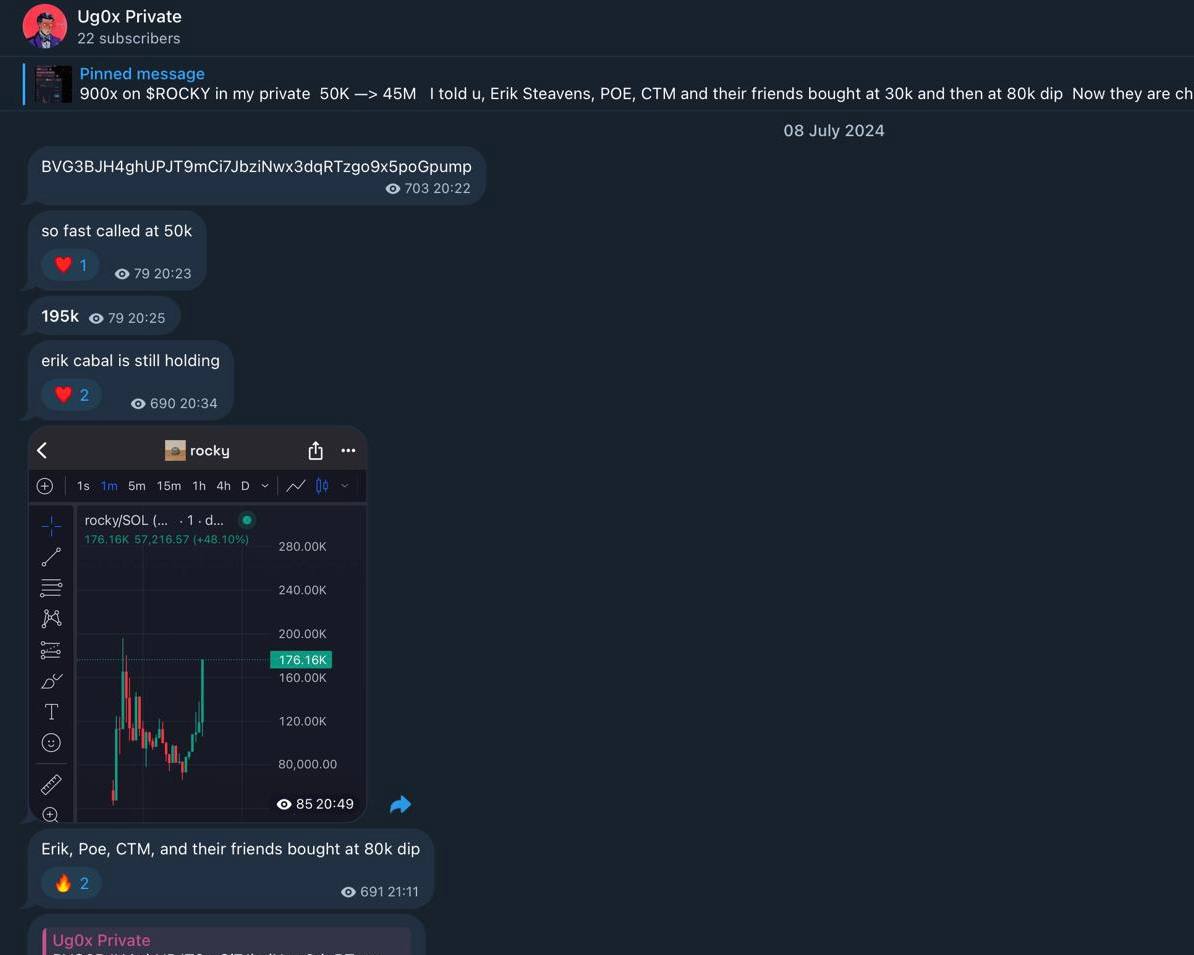
July 8, 2024, the operation around the $ROCKY token was a perfect case study. At that time, people like Erik Steavens, POE, DOGEN, and CTM were all quietly buying in the range of $10,000 to $80,000 market cap.

Seeing this signal, I knew it was no coincidence; they were definitely planning a pump.

I bought 2.8% of the circulating supply when the market cap was $40,000.

In the following days, this group of big shots联合发力 (joined forces) to pump the price, and the token's market cap soared to $45 million.

I took profits in batches between a $2 million and $10 million market cap, averaging an exit around $6 million.

In this trade, my entry capital increased 150 times. Although holding to the peak could have yielded 1100x, I strictly executed my exit plan. I was more than satisfied with making my first six-figure profit from this trade.
Tracking New Wallets, Project Wallets & Large Holding Wallets

By January 2025, the crypto market trading atmosphere was unprecedentedly hot, but wallet tracking was also becoming increasingly difficult. To continuously get first-hand insider information, I had to constantly optimize my methods and adapt.

The key to tracking these insiders' wallets was finding their new wallets that had just withdrawn funds from centralized exchanges like Binance. This meant accurately tracing fund transfer records and timestamps between multiple Binance addresses. This process was time-consuming but absolutely worth it.

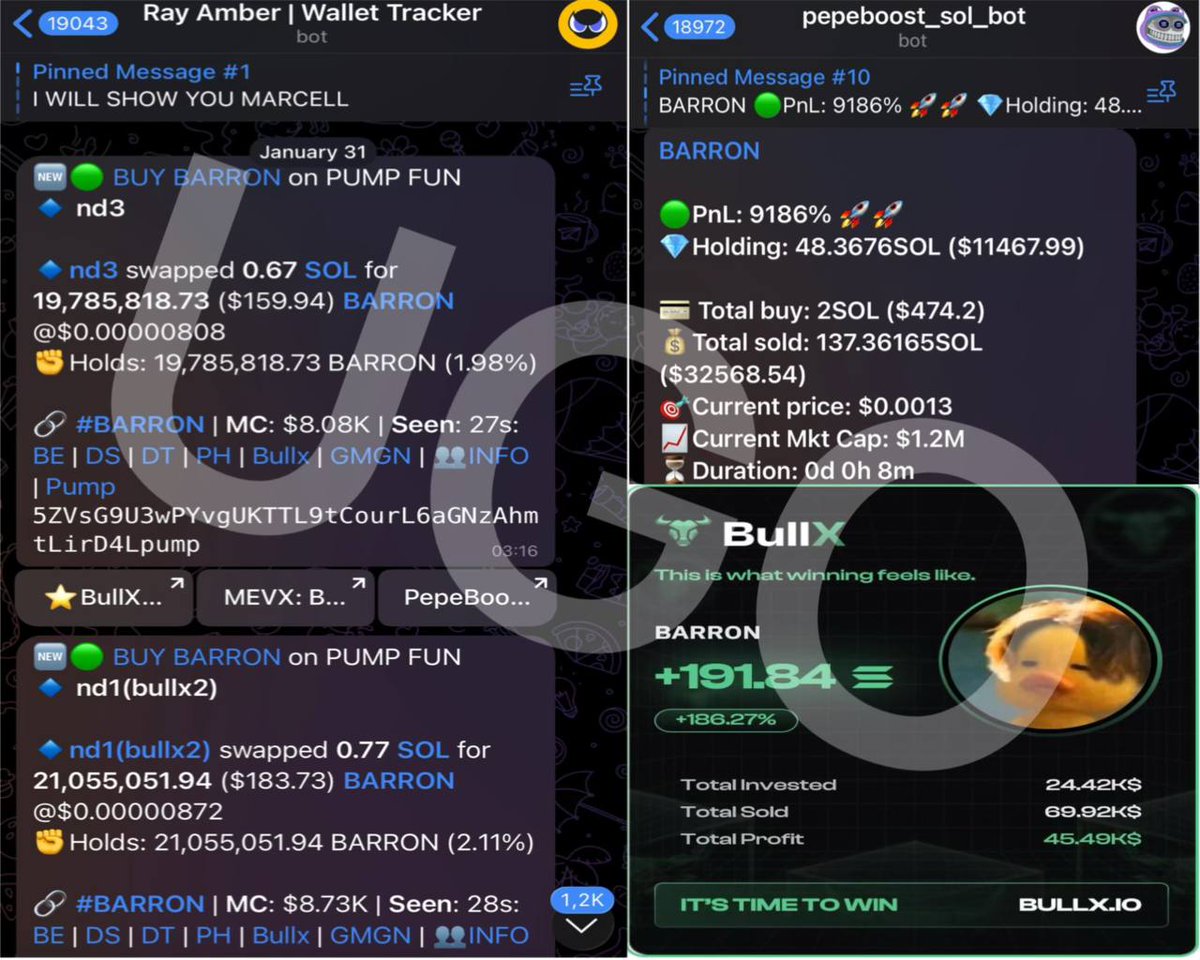
For example, I was closely tracking Marcell's wallet movements, so I could see his newly funded wallets every day. On January 31st, he personally launched and took a large position in the $BARRON token.

I built my position across 3 wallets in the market cap range of $15,000 to $25,000. About three minutes later, Marcell started posting to pump it. I quickly took profits and exited between a $1 million and $2.5 million market cap.

This was one of the fastest trades I ever executed: an initial investment of $1,300 eventually yielded over $110,000. (The trading platform BullX showed my buy amount as $24,000 because I later bought the dip in this wallet, maximizing the profit).
Tracking Market Maker Wallets

Market maker wallets are wallet addresses directly controlled by the token project team, primarily used to manipulate the token price for the benefit of the project team or the token itself.

Common manipulation tactics include: triggering stop-loss orders by placing big buy/sell orders, or dumping the price 30% in minutes to cause panic selling, allowing new investors to enter at low prices.

However, market makers often transfer tokens between wallets shortly after the token is launched. If these wallets aren't newly created or are easily identifiable, we can directly track the project team's movements and accurately capture every new token launch opportunity.

This is how I operated the $HOOD token trade on January 31, 2025.

This project team大概 (roughly) launches a new token every month. They completed their large position allocation when the market cap was pumped to around $2 million, and I bought in decisively at this level, getting in before the top KOLs started promoting it. A few hours later, I took profits between an $80 million and $120 million market cap, achieving roughly a 50x return on this trade.

Meanwhile, during the gap while managing the initial position profit-taking, I also used the market maker's large sell-offs to re-enter heavily, making 40% to 70%差价 (price difference/profit) in just a few minutes.

The total profit for this day was a whopping $152,000. Until the ASTER token trade in September of the same year, January 31st was my highest profit day.

My Ironclad Trading Rules

I always strictly adhere to capital management rules. For example, the capital投入 (input/allocated) to each trade never exceeds 5% of the total portfolio. I also flexibly adjust risk exposure based on the quality of the trading opportunity and my own level of confidence.

When trading with a wallet tracking strategy, you absolutely cannot use heavy leverage (or: take large positions). Once the target you are tracking discovers your presence, they can easily turn around and rug you.

You also need to learn to think from their perspective, understand their interests, operating habits, and rhythm control. This is how you minimize the risk of being rugged and achieve consistent, stable profits.

Of course, I strictly follow my own trading plan and never let emotions dictate decisions. I actually rarely have trouble with this because I started learning forex trading at age 14, and discipline is already deeply ingrained.

That said, I have also experienced several painful lessons of profit drawdowns. But these setbacks didn't crush me; instead, they became motivation for me to move forward. Driven by this unwillingness, I studied even harder, constantly refining my trading edge.

Finally

I am writing this article not to show off. On one hand, I want to use it as a diary to look back on my growth in 5 years. On the other hand, I also hope to inspire and help more people, letting everyone understand: as long as you are willing to主动求变 (actively seek change) and put in the effort, there is always a way to achieve your goals.

I must clarify one point: I never use these tracking techniques against friends or people around me. Everything I do is purely to understand the underlying logic of market operation and then go with the flow.

I am also very grateful to those I track, and to the project teams that truly work hard. I always trade with敬畏之心 (awe and respect), without any hostility. I am also sincerely grateful to all the friends I have met on this journey, they have given me so much help. Thank you all, and thank heaven's blessing.


Criptos en tendencia

Preguntas relacionadas

QWhat was the key strategy the author used to turn $50 into over $1 million in less than a year?

AThe author used a wallet tracking strategy, focusing on following the money flow of 'smart money'—such as KOLs, insider groups, project teams, market makers, and large holders—instead of relying on social media hype or subjective judgments.

QWhat were the four main types of wallets the author tracked to identify profitable trading opportunities?

AThe author tracked four types of wallets: KOL wallets, conspiracy group (insider circle) wallets, new/project team/large holder wallets, and market maker wallets.

QHow did the author's approach to trading change after realizing the limitations of following social media hype?

AThe author stopped guessing market tops and bottoms, chasing narratives, or being influenced by social media trends. Instead, they focused solely on analyzing data and capital movements to execute trades based on the actions of informed investors.

QWhat was the author's strict rule regarding risk management in each trade?

AThe author never risked more than 5% of their total portfolio on a single trade and adjusted their risk exposure based on the quality of the opportunity and their confidence level.

QWhy did the author avoid using large positions when employing the wallet tracking strategy?

AThe author avoided large positions to prevent being noticed and targeted by the tracked entities, who could reverse their actions and exploit the follower's position.

Lecturas Relacionadas

Atención obligatoria para la próxima semana|Se espera una votación en el Senado sobre el proyecto de ley CLARITY; SpaceX y Circle publicarán resultados financieros (3-9 de agosto)

**Resumen: Próximos eventos clave en cripto y tecnología (3-9 de agosto de 2026)** La semana del 3 al 9 de agosto trae eventos importantes. En política estadounidense, el **CLARITY Act**, un proyecto de ley bipartidista que busca establecer un marco regulatorio federal para las criptomonedas, podría someterse a votación en el Senado. Los negociadores tienen hasta el **7 de agosto** para conseguir los 60 votos necesarios. En resultados corporativos, **SpaceX** publicará sus resultados del Q2 el **4 de agosto**, seguido de un importante desbloqueo del 8% de sus acciones para accionistas internos el **6 de agosto**. **Circle**, la empresa detrás de USDC, informará el **5 de agosto**. Otras empresas como la minera de Bitcoin **Hut 8** y **American Bitcoin**, vinculada a la familia Trump, también presentarán resultados. En otros anuncios, **Zapper** y **Ctrl Wallet** cerrarán sus servicios el **3 de agosto**. **LayerZero** descontinuará sus relés para la versión v1 ese mismo día. **Upbit** dejará de cotizar los tokens AQT y AERGO. Además, **Elon Musk** anunció que **Grok 4.6** se lanzará alrededor del **7 de agosto**. Finalmente, los mercados estarán atentos al **informe de nóminas no agrícolas de EE.UU. de julio**, que se publicará el **7 de agosto**, y al inicio de la señalización obligatoria para **BIP-110** en la red Bitcoin alrededor del **8 de agosto**.

marsbitHace 1 hora(s)

Atención obligatoria para la próxima semana|Se espera una votación en el Senado sobre el proyecto de ley CLARITY; SpaceX y Circle publicarán resultados financieros (3-9 de agosto)

marsbitHace 1 hora(s)

Las acciones caen más que las criptomonedas, ¿a dónde se fue el dinero?

Los días 28 y 29 de julio, el índice Kospi de Corea del Sur activó el mecanismo de suspensión de contratación ("circuit breaker") de forma consecutiva, algo sin precedentes. Acciones clave como SK Hynix cayeron bruscamente, y ETF apalancados vinculados a ellas sufrieron pérdidas devastadoras, con caídas superiores al 80% en un mes. La narrativa global de desapalancamiento forzado golpeó con mayor dureza a las operaciones más concurridas, como las acciones tecnológicas y semiconductores. Paradójicamente, Bitcoin, conocido por su alta volatilidad, mostró una relativa estabilidad durante este período, recuperándose cerca de un 15% desde mínimos de julio. El artículo argumenta que esto no se debió a una entrada de capital desde el mercado bursátil, sino a que Bitcoin ya había sufrido su propia corrección significativa entre mayo y junio, con salidas récord de los ETF estadounidenses. El dinero que salió del mercado de valores buscó principalmente refugio en efectivo, bonos del Tesoro estadounidense y, sobre todo, en oro. Los datos muestran una correlación negativa récord entre Bitcoin y el oro, desafiando la narrativa del "oro digital". En esta crisis, el oro cumplió el rol de activo refugio, mientras que Bitcoin permaneció en el extremo más riesgoso de la curva. Para que llegue una entrada de capital sostenida a Bitcoin, el artículo identifica tres condiciones clave: alivio en la presión de liquidez global, recortes de tasas por la Fed sin recesión, y la aprobación de una legislación clara (como el CLARITY Act en EE.UU.) que elimine las incertidumbres regulatorias. Aunque Bitcoin actualmente no es un refugio, su baja correlación con los mercados tradicionales lo posiciona favorablemente para cuando el capital global vuelva a buscar diversificación una vez que pase la tormenta.

marsbitHace 1 hora(s)

Las acciones caen más que las criptomonedas, ¿a dónde se fue el dinero?

marsbitHace 1 hora(s)

Diálogo con Ray Dalio: Nos encontramos en una burbuja de IA actualmente, el 1% de mi cartera de inversiones está en Bitcoin

**Fuente: The Diary Of A CEO** **Resumen: Felix, PANews** Ray Dalio, fundador de Bridgewater Associates, advierte sobre una burbuja en la inteligencia artificial actual, comparable a burbujas históricas como la de Internet en 2000. Según Dalio, los signos clásicos están presentes: precios inflados, endeudamiento basado en ganancias especulativas y una posible corrección brusca si suben las tasas de interés o cambian las condiciones económicas. Dalio explica que esta burbuja se enmarca en un "gran ciclo" más amplio —de unos 80 años— caracterizado por tres dinámicas: creciente desigualdad interna, déficits fiscales gubernamentales y cambios en el orden geopolítico mundial. Estados Unidos y otros países occidentales se encuentran en una fase de declive relativo dentro de este ciclo. Para proteger la riqueza personal, Dalio recomienda diversificar las inversiones más allá del efectivo, incluyendo activos como oro, acciones y bonos. Aunque revela que alrededor del 1% de su cartera está en Bitcoin —considerándolo un activo escaso—, prefiere el oro físico por su seguridad histórica y su rol como reserva de los bancos centrales. Sobre el impacto laboral de la IA, Dalio prevé que aumentará la desigualdad, beneficiando sobre todo a los dueños de capital. Sin embargo, destaca que las habilidades humanas —como la intuición y la emoción— seguirán siendo valiosas y complementarias a la IA. En el ámbito geopolítico, Dalio anticipa un mundo más regionalizado, con EE.UU. y China como potencias líderes en sus respectivas esferas, y advierte que conflictos como el de Irán han expuesto debilidades estratégicas de Estados Unidos, acelerando un cambio en el equilibrio global de poder.

marsbitHace 5 hora(s)

Diálogo con Ray Dalio: Nos encontramos en una burbuja de IA actualmente, el 1% de mi cartera de inversiones está en Bitcoin

marsbitHace 5 hora(s)

Trading

Spot

Artículos destacados

Cómo comprar O

¡Bienvenido a HTX.com! Hemos hecho que comprar O1 exchange (O) sea simple y conveniente. Sigue nuestra guía paso a paso para iniciar tu viaje de criptos.Paso 1: crea tu cuenta HTXUtiliza tu correo electrónico o número de teléfono para registrarte y obtener una cuenta gratuita en HTX. Experimenta un proceso de registro sin complicaciones y desbloquea todas las funciones.Obtener mi cuentaPaso 2: ve a Comprar cripto y elige tu método de pagoTarjeta de crédito/débito: usa tu Visa o Mastercard para comprar O1 exchange (O) al instante.Saldo: utiliza fondos del saldo de tu cuenta HTX para tradear sin problemas.Terceros: hemos agregado métodos de pago populares como Google Pay y Apple Pay para mejorar la comodidad.P2P: tradear directamente con otros usuarios en HTX.Over-the-Counter (OTC): ofrecemos servicios personalizados y tipos de cambio competitivos para los traders.Paso 3: guarda tu O1 exchange (O)Después de comprar tu O1 exchange (O), guárdalo en tu cuenta HTX. Alternativamente, puedes enviarlo a otro lugar mediante transferencia blockchain o utilizarlo para tradear otras criptomonedas.Paso 4: tradear O1 exchange (O)Tradear fácilmente con O1 exchange (O) en HTX's mercado spot. Simplemente accede a tu cuenta, selecciona tu par de trading, ejecuta tus trades y monitorea en tiempo real. Ofrecemos una experiencia fácil de usar tanto para principiantes como para traders experimentados.

559 Vistas totalesPublicado en 2026.06.19Actualizado en 2026.06.29

Cómo comprar O

Cómo comprar PROS

¡Bienvenido a HTX.com! Hemos hecho que comprar Pharos (PROS) sea simple y conveniente. Sigue nuestra guía paso a paso para iniciar tu viaje de criptos.Paso 1: crea tu cuenta HTXUtiliza tu correo electrónico o número de teléfono para registrarte y obtener una cuenta gratuita en HTX. Experimenta un proceso de registro sin complicaciones y desbloquea todas las funciones.Obtener mi cuentaPaso 2: ve a Comprar cripto y elige tu método de pagoTarjeta de crédito/débito: usa tu Visa o Mastercard para comprar Pharos (PROS) al instante.Saldo: utiliza fondos del saldo de tu cuenta HTX para tradear sin problemas.Terceros: hemos agregado métodos de pago populares como Google Pay y Apple Pay para mejorar la comodidad.P2P: tradear directamente con otros usuarios en HTX.Over-the-Counter (OTC): ofrecemos servicios personalizados y tipos de cambio competitivos para los traders.Paso 3: guarda tu Pharos (PROS)Después de comprar tu Pharos (PROS), guárdalo en tu cuenta HTX. Alternativamente, puedes enviarlo a otro lugar mediante transferencia blockchain o utilizarlo para tradear otras criptomonedas.Paso 4: tradear Pharos (PROS)Tradear fácilmente con Pharos (PROS) en HTX's mercado spot. Simplemente accede a tu cuenta, selecciona tu par de trading, ejecuta tus trades y monitorea en tiempo real. Ofrecemos una experiencia fácil de usar tanto para principiantes como para traders experimentados.

540 Vistas totalesPublicado en 2026.06.22Actualizado en 2026.06.29

Cómo comprar PROS

Qué es VERONA

I. Introducción al Proyecto VERONA es una blockchain construida para todos, en cualquier lugar, a través de la abstracción de la cadena. Utilizando su capa de Abstracción Generalizada, VERONA se distingue por integrar funcionalidades complejas de blockchain, como cuentas, firmas e interoperabilidad, directamente a nivel de protocolo. Este enfoque permite interactuar con aplicaciones de blockchain sin necesidad de entender las tecnologías subyacentes.1) Información Básica Nombre: VERONA (VERONA)III. Enlaces Relacionados Enlace al sitio web oficial: https://xion.burnt.com/ Libro Blanco: https://xion.burnt.com/whitepaper.pdf Exploradores: https://explorer.burnt.com/ Redes Sociales: https://x.com/burnt_xion Nota: La introducción del proyecto proviene de los materiales publicados o proporcionados por el equipo oficial del proyecto, que es solo para referencia y no constituye asesoramiento de inversión. HTX no se hace responsable de ninguna pérdida directa o indirecta resultante.

578 Vistas totalesPublicado en 2026.06.22Actualizado en 2026.06.22

Qué es VERONA

Discusiones

Bienvenido a la comunidad de HTX. Aquí puedes mantenerte informado sobre los últimos desarrollos de la plataforma y acceder a análisis profesionales del mercado. A continuación se presentan las opiniones de los usuarios sobre el precio de A (A).

活动图片













