The Other Side of XMR's Surge: Regulation, Black Market, and Real Demand

比推Publicado a 2026-01-14Actualizado a 2026-01-14

Resumen

Monero (XMR), a leading privacy-focused cryptocurrency, reached a new all-time high of over $690 on January 13, 2025, marking a 262% surge from around $200 a year prior. This rally occurred amid a broader market downturn and increasing global regulatory pressure, including its delisting from major exchanges like Binance and a recent ban on privacy coins in Dubai. Analysis reveals that the price surge was not primarily driven by trading on centralized exchanges, as spot and derivatives trading volumes remained relatively modest. Instead, key factors include significant capital deployment in mining, with network difficulty rising sharply throughout 2025 despite temporary volatility, indicating strong interest from large-scale miners. On-chain data shows a substantial increase in average transaction fees—tripling since mid-2025—suggesting growing real demand for private transactions. Users are willing to pay higher fees for Monero’s privacy features, especially as regulatory crackdowns intensify. This has created a counterintuitive effect where bans may have strengthened demand among users seeking censorship-resistant transactions. The rally reflects both “white” (legitimate privacy needs) and “black” (asymmetric information and potential market manipulation) factors. The opaque nature of Monero’s ecosystem means retail investors face significant risks, as evidenced by high volatility and the potential for sharp corrections, similar to those seen with other privacy coins like...

Author: Frank, PANews

Original Title: The More It's Banned, The More It Rises? Unpacking the Black and White Truth Behind XMR's Surge


XMR (Monero), one of the leading players in the privacy sector, hit a new all-time high on January 13, with its price peaking at over $690, reigniting discussions about privacy coins.

From January 2025 to now, over the past year, XMR has surged from around $200, achieving a maximum gain of 262%. Amid widespread weakness in mainstream altcoins, such a rise is exceptionally rare. More intriguingly, this rally occurred against a backdrop of unprecedented global regulatory tightening.

Due to compliance pressures, major centralized exchanges like Binance had already delisted XMR spot trading. Then, on January 12, the Dubai Virtual Assets Regulatory Authority (VARA) officially announced a ban on the trading and custody of privacy tokens throughout Dubai and its free zones. However, far from casting a shadow over XMR, this ban was met with defiance as the coin hit a new high, almost mocking the Dubai government.

So, who is the real driving force behind XMR's rise, caught between dwindling exchange liquidity and regulatory crackdowns? PANews peels back the surface to find the real demand behind this market movement.

Exchanges Are Not the Core Pricing Venue

Despite the hot market, it is not primarily driven by funds within exchanges.

In terms of spot trading, while XMR's recent trading volume has increased with the price rise, it has generally remained in the range of tens of millions to $200 million, without any particularly dramatic spikes. Looking back, the significant peak in spot trading volume was actually on November 10, reaching $410 million. This means that during this recent doubling rally, spot trading (or buying pressure on centralized exchanges) was not the main driver.

The situation is similar for futures. The volume peak also occurred on November 10. Until about a week ago, futures trading volume did not show a significant surge and even showed some signs of decline. Observing the open interest data, the change curve in USD terms almost perfectly overlaps with the price movement. The number of XMR positions in the market did not abnormally spike; the increase in open interest value was solely due to the rising coin price, not a large influx of new capital opening positions.
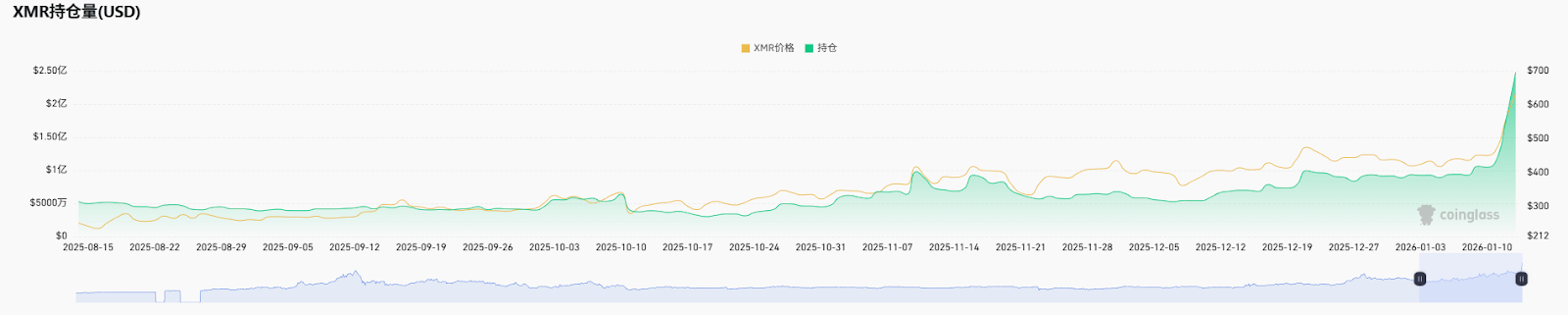
Clearly, mainstream exchanges are not the core pricing venue for XMR currently.

Undercurrents on the Supply Side: Miner Shake-up and Early Positioning

Since the "visible" funds are unremarkable, we need to turn to the "invisible" on-chain world. As the network with the strongest privacy, XMR offers very little information to mine, but changes in mining difficulty and mining rewards allow us to glimpse the capital布局 (layout) on the supply side.

Historical mining difficulty typically represents capital's enthusiasm for participating in the network ecosystem. Data shows that XMR's mining difficulty began to climb rapidly at the end of 2024 and was in a state of rapid growth throughout the first half of 2025. Although it fluctuated between September and November, it recently began a new round of difficulty increase.
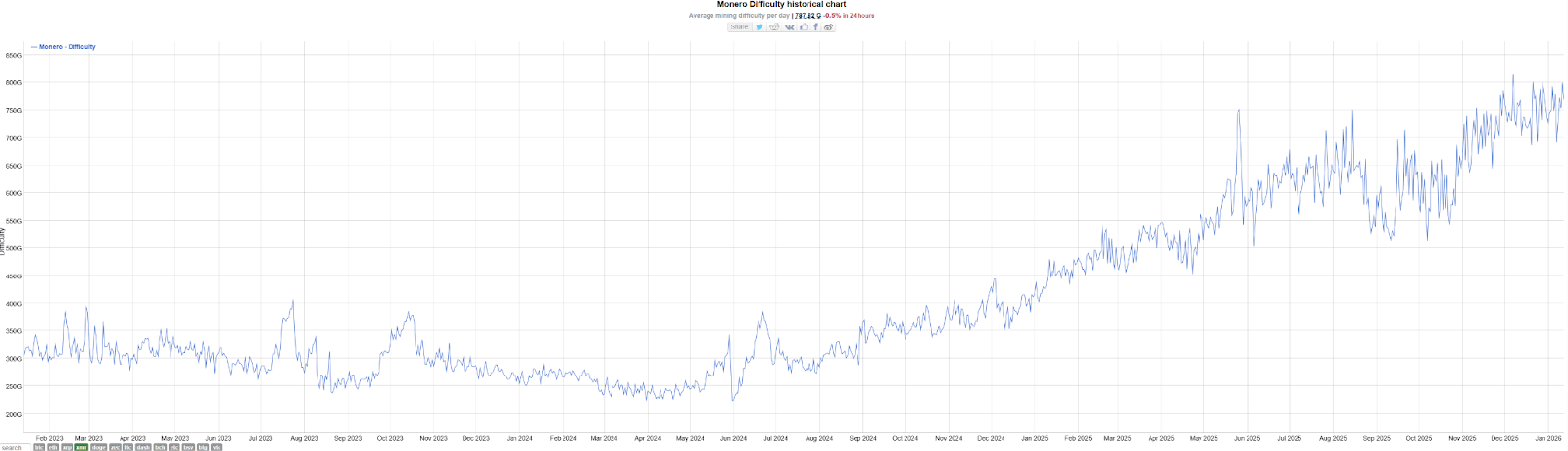
An interlude must be mentioned here: In September, the Qubic project claimed it controlled over 51% of XMR's total network hash rate and performed a "demonstration attack," causing a chain reorganization spanning 18 blocks on the XMR network. This event served as a wake-up call for the community, after which a large number of miners migrated their hash rate to the established mining pool SupportXMR. This incident was the main reason for the剧烈波动 (violent fluctuations) in mining difficulty around the end of 2025, but it also侧面印证了 (serves as side evidence of) the activity and resilience of the hash rate market.

More noteworthy is the联动 (linkage) between the mining reward curve and the difficulty.

Before April 2025, the mining rewards on the Monero network experienced a significant drop. Correlating with the difficulty chart from that time, the hash rate rose sharply while the price remained震荡 (volatile). This divergence led to diluted rewards, likely forcing some smaller miners with higher costs out of the market. Data showing a回调 (pullback) in mining difficulty in April supports this猜想 (conjecture).
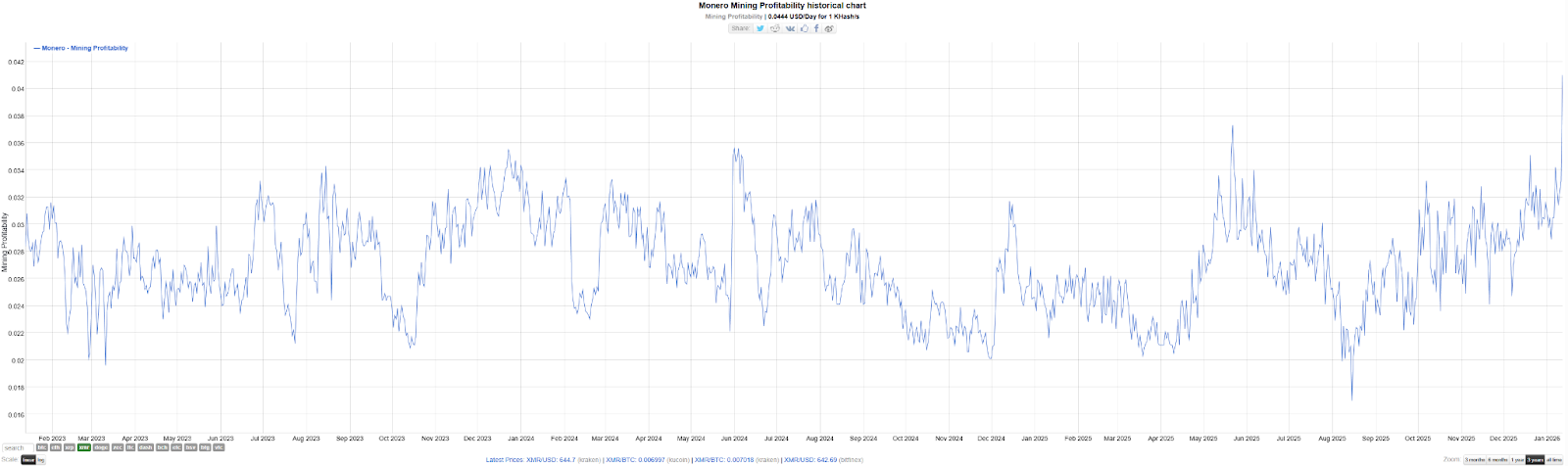
This was a classic case of "miner capitulation" and "筹码交换 (chips exchange/churn)." After this, as prices rose significantly, mining rewards and difficulty resumed同步上涨 (synchronous growth). Judging from the data changes in this phase, as early as the beginning of 2025, some large mining enterprises or capital with strong risk resistance might have started positioning early in Monero token mining despite the low rewards.

Demand-Side Verification: Paying a High Premium for Privacy

If miners represent confidence on the supply side, then the average transaction fee most accurately reflects demand on the user side.

Looking at the chart, Monero's average transaction fee was relatively stable before the first half of 2025, basically staying below $0.1. But starting in June, a growth trend emerged; by December 11, the highest average fee一度达到 (once reached) over $0.3, more than triple the level from six months prior.
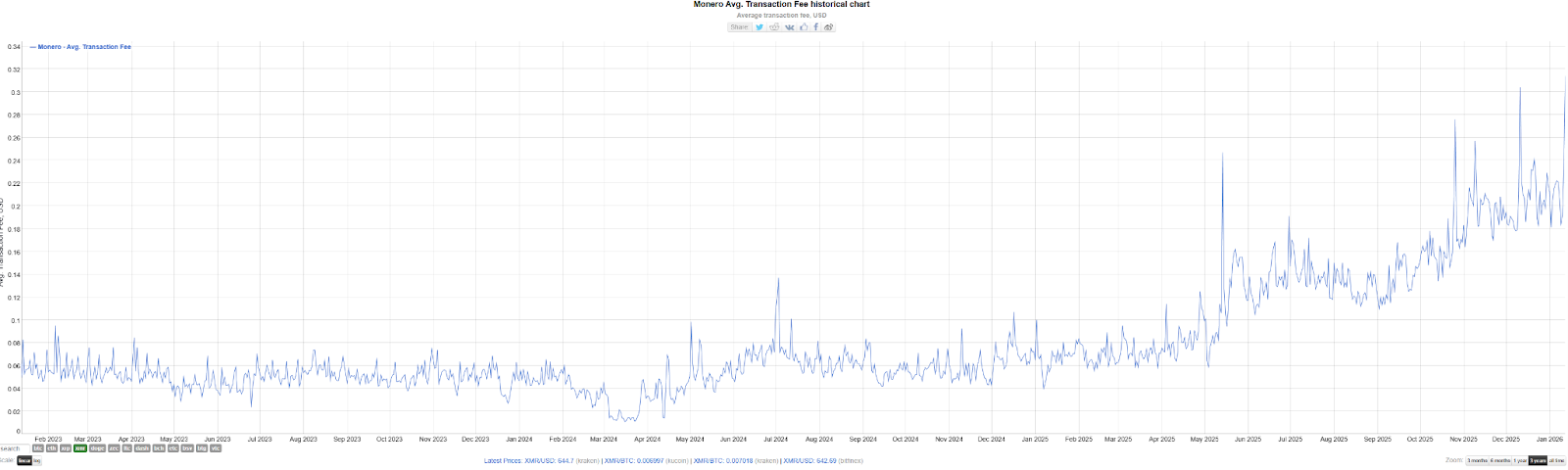
Because Monero has a dynamic block size adjustment mechanism, a surge in fees means a large number of users are trying to send transactions quickly and are willing to pay high fees to compensate miners for the cost of block expansion. This侧面证明 (serves as indirect proof) that starting from the second half of 2025, the real on-chain transaction demand for Monero began to increase significantly.

However, we also discovered an interesting pattern: spikes in on-chain fees often coincide with sharp price increases.

For example, on April 28, XMR suddenly rose 14%, and the average transaction fee that day surged to $0.125; during the subsequent period of slow price爬升 (climb), fees fell back to a trough (lowest at $0.058 on May 4). This indicates that while market volatility can drive on-chain demand in the short term, when the volatility subsides, on-chain demand also returns to calm. Although sometimes they are not synchronized (e.g., fees rose on May 14 but the price didn't move), overall, during these more than six months, price increases briefly drove on-chain demand, and the growth in real on-chain demand in turn triggered market optimism about XMR, with the two互为因果 (being mutually causal).

The Truth in Black and White

Combining the above data, the truth behind XMR's surge likely has "black and white" aspects.

The so-called "white" truth is the "antifragile" rebound of privacy demand under high regulatory pressure.

The反向推动 (reverse driving effect) of regulation is becoming increasingly apparent. The VARA ban not only failed to crush XMR but made market participants realize: regulatory agencies can ban exchanges, but they cannot ban the protocol itself. As major exchanges退出 (exit) the XMR trading环节 (segment), the logic of pricing reliant on market makers and derivative contracts was rewritten. XMR returned to a model controlled by real users or certain heavyweight players. After脱离 (detaching from) the exchange system, privacy coins have developed an independent rhythm completely different from the mainstream market.

The so-called "black" truth is the capital game under information asymmetry.

Behind this opacity, there might be an "iceberg" of whales. The "unimpressive" trading data (even on January 13, when it hit a new high, futures open interest was only $240 million, and liquidation volume was just over $1 million) indicates that mainstream institutions almost failed to predict and participate in this rally in advance, only following along.

This information asymmetry, held by a few, leads to extreme price volatility. Especially when the market starts paying attention to such a rise, it often signals short-term emotional overheating. Referring to the privacy coin ZEC in November, it experienced a retracement of over 50% after its surge. Ultimately, in the privacy coin market, there is a large amount of "information asymmetry," which puts ordinary retail investors at an absolute disadvantage.

Amid the剧烈波动 (violent fluctuations) of privacy coins, on-chain data is perhaps our only reliable guide. But in the depths without transparency, the high premium of freedom always comes with unknown risks.


Twitter:https://twitter.com/BitpushNewsCN

Bitpush TG Discussion Group:https://t.me/BitPushCommunity

Bitpush TG Subscription: https://t.me/bitpush

Original Link:https://www.bitpush.news/articles/7602643

Criptos en tendencia

Preguntas relacionadas

QWhat was the peak price of XMR (Monero) on January 13th, and what was its maximum percentage increase from its price at the beginning of 2025?

AXMR reached a peak price of over $690 on January 13th. Its maximum percentage increase from its price of around $200 at the beginning of 2025 was 262%.

QDespite the price surge, why were mainstream centralized exchanges like Binance not considered the core pricing venues for XMR?

ABecause the spot trading volume on these exchanges did not see a significant, exaggerated increase during the rally, and the open interest in futures contracts only rose in dollar value due to the price increase, not from a large influx of new capital opening positions.

QWhat event in September 2025 caused significant volatility in XMR's mining difficulty, and what was the community's response?

AThe Qubic project claimed to control over 51% of XMR's network hashrate and performed a 'demonstrative attack,' causing an 18-block chain reorganization. In response, a large number of miners migrated their hashrate to the established mining pool, SupportXMR.

QWhat on-chain metric is cited as the most authentic reflection of user-side demand for Monero, and what was its trend in the latter half of 2025?

AThe average transaction fee is cited as the most authentic reflection of user-side demand. It began to show a growth trend starting in June 2025, with the highest average fee reaching over $0.30 by December 11th, a more than 3x increase from six months prior.

QAccording to the article, what are the 'white' and 'black' truths behind XMR's price surge?

AThe 'white' truth is the 'anti-fragile'反弹反弹 of privacy demand under high regulatory pressure, where the asset became less dependent on exchanges. The 'black' truth is capital博弈博弈 in an environment of information asymmetry, where a few major players ('whales') with an information advantage could be driving the volatile price action, putting retail investors at a significant disadvantage.

Lecturas Relacionadas

Por qué el Bitcoin se mantiene en $64,000 tras la dura pausa de la Fed

Bitcóin cierra julio cerca de los 64.000 dólares tras una volátil reacción a la decisión de la Fed de mantener las tasas sin cambios, aunque sin indicar un pronto aflojamiento monetario. Esto ha provocado una rotación de capital hacia los ETF de Bitcoin, que registraron una entrada neta de 32,1 millones de dólares, mientras que los fondos de Ethereum experimentaron salidas. El mercado de criptomonedas, con una capitalización de unos 2,29 billones de dólares, se mantiene en un rango lateral, con Bitcoin encontrando soporte en 63.000-63.500 dólares y resistencia en 66.000 dólares. La Fed mantuvo su tasa clave, pero tres miembros votaron a favor de un aumento, señalando una postura más dura de lo esperada. En este entorno macroeconómico incierto, los inversores institucionales parecen favorecer a Bitcoin como activo principal, aunque persiste el interés selectivo en activos como Solana. Mientras, la aprobación de la ley CLARITY en EE.UU. se retrasa hasta después del receso de agosto. Para el último día de julio, el enfoque estará en los datos macro de EE.UU. El escenario base para Bitcoin es la consolidación entre 63.000 y 66.000 dólares, con su ruptura superior dependiendo de nuevos flujos institucionales. La estabilidad por encima de 63.000 dólares para BTC, el mantenimiento de Ethereum sobre 1.860 dólares y las entradas continuas en ETF son claves para una posible base de recuperación en la segunda mitad del año.

cryptonews.ruHace 2 hora(s)

Por qué el Bitcoin se mantiene en $64,000 tras la dura pausa de la Fed

cryptonews.ruHace 2 hora(s)

Parker Lewis responde por qué bitcoin sigue siendo el mejor dinero

El influyente analista de Bitcoin, Parker Lewis, critica las estrategias de marketing de corporaciones que actúan como tesorerías cripto. Advierte que la venta de "crédito digital" mediante acciones preferentes perpetuas distorsiona la esencia de la criptomoneda. Lewis enfatiza que Bitcoin no genera rendimiento fiduciario por diseño y que las promesas de dividendos son riesgosas, dependiendo de nuevos inversores. Destaca el riesgo de estos derivados, señalando que el mercado de acciones preferentes perpetuas es minúsculo comparado con el crédito global, lo que demuestra que los grandes actores evitan estos riesgos, trasladándolos a minoristas. Rechaza la idea de que Bitcoin es "demasiado volátil", argumentando que la volatilidad es una consecuencia natural de la adopción masiva de un activo con oferta fija e inelástica. En lugar de comprar derivados corporativos como acciones de MicroStrategy, recomienda adquirir Bitcoin directamente, considerándolo más seguro. Lewis alerta que este enfoque distrae de la verdadera amenaza: la rápida devaluación del dinero fiduciario. Ilustra la inflación real con su "Índice Ribeye", mostrando un aumento del 90% en el precio de un filete desde 2020, muy superior a las cifras oficiales. Concluye que la estrategia más prudente es la posesión directa de Bitcoin y el control total de las claves privadas, protegiendo así los ahorros de la inflación y los riesgos sistémicos de los derivados corporativos.

cryptonews.ruHace 2 hora(s)

Parker Lewis responde por qué bitcoin sigue siendo el mejor dinero

cryptonews.ruHace 2 hora(s)

Trading

Spot

Artículos destacados

Cómo comprar XMR

¡Bienvenido a HTX.com! Hemos hecho que comprar Monero (XMR) sea simple y conveniente. Sigue nuestra guía paso a paso para iniciar tu viaje de criptos.Paso 1: crea tu cuenta HTXUtiliza tu correo electrónico o número de teléfono para registrarte y obtener una cuenta gratuita en HTX. Experimenta un proceso de registro sin complicaciones y desbloquea todas las funciones.Obtener mi cuentaPaso 2: ve a Comprar cripto y elige tu método de pagoTarjeta de crédito/débito: usa tu Visa o Mastercard para comprar Monero (XMR) al instante.Saldo: utiliza fondos del saldo de tu cuenta HTX para tradear sin problemas.Terceros: hemos agregado métodos de pago populares como Google Pay y Apple Pay para mejorar la comodidad.P2P: tradear directamente con otros usuarios en HTX.Over-the-Counter (OTC): ofrecemos servicios personalizados y tipos de cambio competitivos para los traders.Paso 3: guarda tu Monero (XMR)Después de comprar tu Monero (XMR), guárdalo en tu cuenta HTX. Alternativamente, puedes enviarlo a otro lugar mediante transferencia blockchain o utilizarlo para tradear otras criptomonedas.Paso 4: tradear Monero (XMR)Tradear fácilmente con Monero (XMR) en HTX's mercado spot. Simplemente accede a tu cuenta, selecciona tu par de trading, ejecuta tus trades y monitorea en tiempo real. Ofrecemos una experiencia fácil de usar tanto para principiantes como para traders experimentados.

541 Vistas totalesPublicado en 2024.12.10Actualizado en 2026.06.02

Cómo comprar XMR

Discusiones

Bienvenido a la comunidad de HTX. Aquí puedes mantenerte informado sobre los últimos desarrollos de la plataforma y acceder a análisis profesionales del mercado. A continuación se presentan las opiniones de los usuarios sobre el precio de XMR (XMR).

活动图片













