Strategy Watch #5

insights.glassnodePublicado a 2026-06-26Actualizado a 2026-06-26

Resumen

Strategy Watch #5 analyzes institutional digital asset trends in May, highlighting diverging flows. While corporate treasuries continued accumulating Bitcoin (BTC) and Ethereum (ETH), spot ETF investors reduced exposure. Market-neutral strategies benefited as CME basis yields turned positive, reviving cash-and-carry trades. A deep dive into DeFi notes that while outflows slowed, total value locked (TVL) continued declining. The report also covers fund performance, on-chain vault yields, manager positioning as cash balances rise, and new institutional expansion initiatives.

The full report is freely available in PDF format.

Download PDF version

Welcome to Strategy Watch #4

Strategy Watch was built to address a clear demand for high-signal, impartial analysis of fund-level performance and allocation trends in digital assets.

Our objective is straightforward — to make Strategy Watch a must-read monthly publication for the digital asset investment community.

This publication is strengthened by direct input from market participants. Funds and allocators that contribute data and insights help shape a more complete and valuable view of the landscape. If you have insights, data, or allocation updates worth sharing, we welcome your contribution.

Present your latest initiatives and updates to a curated audience of institutional allocators.

Share updates ↗

Inside the Latest Strategy Watch

The report is structured across six core sections, each focused on a distinct dimension of institutional activity in digital assets:

01 Institutional Flow Monitor | Institutional demand split by vehicle in May. ETF allocators reduced exposure while digital asset treasuries kept accumulating. What does this divergence signal for allocator positioning?

02 Fund and SMA Performance | Market-neutral strategies kept compounding gains, while the strongest directional returns came from stock selection rather than market beta.

03 Strategy Deep Dive: DeFi/Yield | A CIO's perspective on why fundamentals matter more than ever, and where the next wave of crypto value creation will accrue.

04 On-chain Vault Performance | On-chain credit continues to stabilize, but can vault yields compete with Treasury rates and native ETH staking?

05 Manager Monitor | Find out how managers are positioning as cash balances rise and fundraising conditions remain subdued.

06 Allocation Updates | Institutional expansion continued through new investment firms, dedicated crypto divisions, and quant fund launches.

in partnership with

The Premier Digital Assets Allocator Platform. Learn more


Institutional Flow Monitor

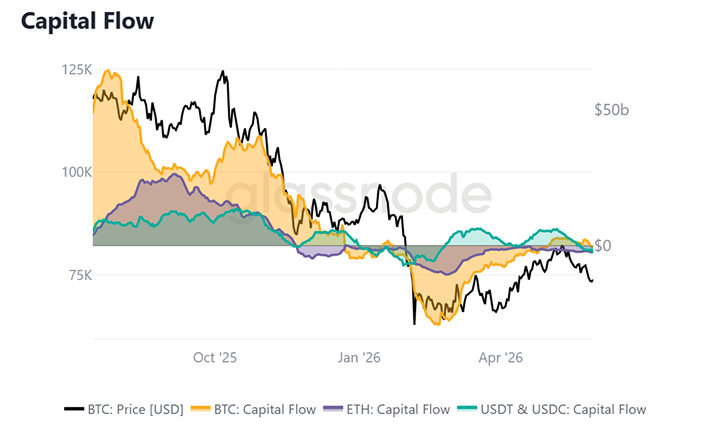
  • Bitcoin flows hovered near neutral while Ethereum outflows deepened and stablecoin inflows reversed sharply into month-end.

April's tentative stabilization carried into May for Bitcoin alone. BTC flows held close to neutral, spiking to +$2.9B on May 07 before drifting back to -$0.3B at the close. Ethereum again diverged, deepening from -$1.7B to a -$2.4B trough late in the month before ending at -$2.1B. The sharper signal came from stablecoins, which reversed from a +$6.1B peak early in May to -$2.5B by month-end, a decisive swing into net outflow. That rotation out of dollar liquidity points to allocators trimming risk into June rather than redeploying into spot.
ETF & DAT Net Flows

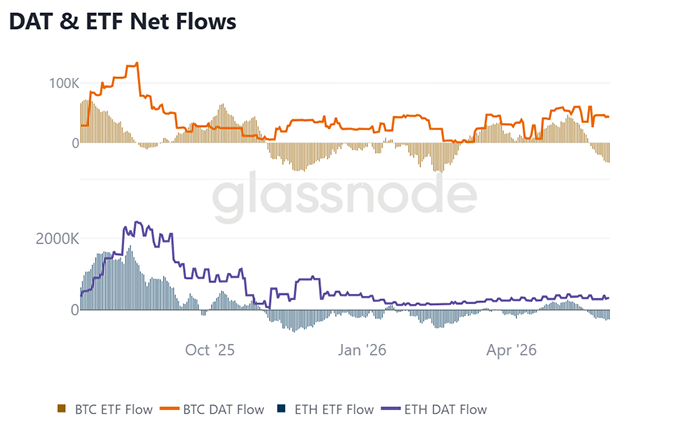
  • Spot ETF flows for both Bitcoin and Ethereum swung from early-month highs into outflows while treasury vehicles kept accumulating.

Institutional demand split by vehicle in May. Spot ETF flows peaked early, with Bitcoin at +46.8k BTC and Ethereum at +283.4k ETH on May 05, before both rolled over into net redemptions, closing at -33.1k BTC and -261.5k ETH as ETF outflows reached a monthly record. Digital asset treasuries told the opposite story and stayed positive throughout. BTC DAT flows held between +26.1k and +60.4k BTC, ending at +42.9k, while ETH DAT flows ran from +302.4k to +439.2k ETH before settling at +330.8k. The divergence suggests balance-sheet buyers kept accumulating into weakness even as ETF allocators de-risked.
DeFi TVL & Stablecoin Cap

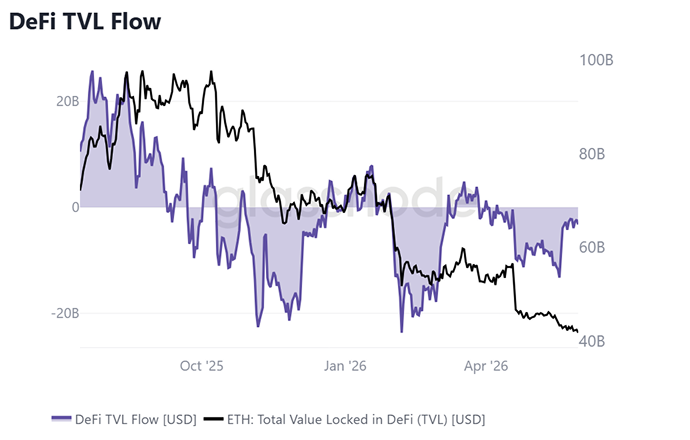
  • Ethereum DeFi TVL ground to new monthly lows even as the pace of net outflows eased through the second half of May.

The contraction that followed April's lending exploit persisted through May, though its intensity faded. Ethereum TVL slipped from $45.1B to $41.7B, closing at the monthly low after peaking at $46.1B on May 11. The flow picture was more constructive than the level implied. Thirty-day net flows stayed negative throughout but recovered from a -$13.3B trough on May 18 to -$3.2B by month-end, the shallowest outflow pace since the exploit. The combination of a falling TVL base alongside decelerating outflows suggests the forced deleveraging phase is largely complete, though fresh inflows remain absent.
CME Basis Yield

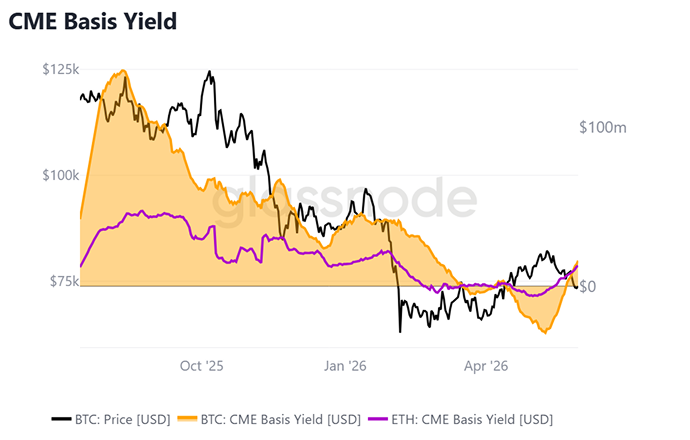
  • CME basis yields for both Bitcoin and Ethereum climbed back into positive territory through May, reviving the cash-and-carry trade.

Here we measure the return available to institutions running cash-and-carry trades. After April left both curves in backwardation, May delivered a clean reversal. BTC basis yield bottomed at -$29.3M on May 09 before rising steadily to +$16.0M, the monthly high reached at the close. ETH followed the same path, recovering from -$6.2M at the open to +$12.8M by month-end. Both series finished May at their peaks, with futures reclaiming a premium to spot for the first time since March. The rebuild restores a positive carry to market-neutral strategies, and a continuation into June would mark the firmest premium environment in several months.


Disclaimer: This report does not provide any investment advice. All data is provided for information and educational purposes only. No investment decision shall be based on the information provided here and you are solely responsible for your own investment decisions.
Exchange balances presented are derived from Glassnode’s comprehensive database of address labels, which are amassed through both officially published exchange information and proprietary clustering algorithms. While we strive to ensure the utmost accuracy in representing exchange balances, it is important to note that these figures might not always encapsulate the entirety of an exchange’s reserves, particularly when exchanges refrain from disclosing their official addresses. We urge users to exercise caution and discretion when utilizing these metrics. Glassnode shall not be held responsible for any discrepancies or potential inaccuracies. Please read our Transparency Notice when using exchange data.

Preguntas relacionadas

QWhat is the primary objective of the Strategy Watch publication, and how does it seek to strengthen its content?

AThe primary objective of Strategy Watch is to become a must-read monthly publication for the digital asset investment community by providing high-signal, impartial analysis of fund-level performance and allocation trends. It is strengthened by direct input and contributions of insights and data from funds and allocators.

QAccording to the report, how did the demand for Bitcoin and Ethereum ETFs versus Digital Asset Treasuries (DATs) diverge in May?

AIn May, demand diverged significantly. ETF flows for both Bitcoin and Ethereum peaked early before rolling over into net outflows. Conversely, Digital Asset Treasuries (DATs) kept accumulating throughout the month, with BTC and ETH DAT flows staying positive. This suggests balance-sheet buyers accumulated assets while ETF allocators were de-risking.

QWhat trend was observed in the CME basis yields for Bitcoin and Ethereum in May, and what is its significance?

AIn May, CME basis yields for both Bitcoin and Ethereum climbed from negative territory back into positive territory, reviving the cash-and-carry trade. This reversal restores a positive carry to market-neutral strategies, marking the firmest premium environment in several months.

QWhat is the current state of Ethereum DeFi Total Value Locked (TVL) based on the May data, and how did the outflow trends change?

AEthereum DeFi TVL continued to decline in May, grinding to new monthly lows, slipping from $45.1B to $41.7B. However, the pace of net outflows decelerated through the second half of the month, recovering from a -$13.3B trough to -$3.2B by month-end, suggesting the forced deleveraging phase is largely complete.

QWhat sharp signal from stablecoin flows did the report highlight as a key indicator of allocator behavior in late May?

AThe report highlighted that stablecoin inflows reversed sharply into month-end, swinging from a +$6.1B peak early in May to a -$2.5B net outflow by month-end. This decisive swing into net outflow points to allocators trimming risk into June rather than redeploying capital into spot markets.

Lecturas Relacionadas

Xing Bo vuelve a actuar: después de 'criticar' los modelos mundiales, ahora le toca a los agentes inteligentes

L'any passat, el professor Xing Bo de MBZUAI i CMU va criticar els models mundials. Ara, ell i els seus col·legues publiquen "Crítica del Model d'Agent" a arXiv, qüestionant el terme sobretitlitzat "agent" en IA. El treball distingeix entre sistemes "agentics" (amb aparença d'agent) i "agentius" (veritablement autònoms), argumentant que la majoria dels anomenats agents actuals només segueixen fluxos de treball i indicacions externes, sense autonomia real. L'article analitza cinc dimensions clau: objectius, identitat, presa de decisions, profunditat del raonament i aprenentatge. Proposa que un agent veritable hauria de descompondre objectius a llarg termini, ajustar la seva identitat amb l'experiència, utilitzar models mundials per a una planificació simulada, tenir un mòdul metacognitiu (anomenat Sistema III) per regular la profunditat del pensament i aprendre de manera autònoma i contínua. Com a solució, presenta l'arquitectura GIC (Goal-Identity-Configurator), que integra sis components: un codificador de creences, un descomponedor d'objectius, un evolucionador d'identitat, un configurador (Sistema III), un planificador simulat (Sistema II) i un executor (Sistema I). Aquesta estructura pretén internalitzar l'autonomia. Finalment, el document aborda la seguretat, argumentant que en GIC, els comportaments problemàtics es poden atribuir a objectius humans incorrects o mòduls mal entrenats. Destaca la "revisabilitat" de la seva arquitectura modular com a avantatge clau per a la seguretat, tot i admetre que el repte de formar correctament aquests mòduls persisteix.

marsbitHace 8 min(s)

Xing Bo vuelve a actuar: después de 'criticar' los modelos mundiales, ahora le toca a los agentes inteligentes

marsbitHace 8 min(s)

Cómo Collector Crypt crea una ilusión de crecimiento con la "compra de recompra cíclica"

**Resumen en español europeo:** El informe analiza Collector Crypt (CC), una plataforma de cromos coleccionables digitales, y revela que su rápido crecimiento en volumen bruto de mercancías (GMV) se basa en una ilusión de crecimiento. Los hallazgos clave son: * **Rentabilidad en declive:** Aunque el GMV se multiplicó por 4.7 entre Q3 2025 y Q2 2026, el margen neto de CC cayó a la mitad (del 11.2% al 5.6%). Esto se debe a que el crecimiento proviene de paquetes de cromos de mayor valor (250, 1000, 2500 $), que tienen tasas de retención por dólar para la plataforma más bajas que los paquetes pequeños. * **Crecimiento impulsado por pocos usuarios:** El gasto medio por usuario se triplicó, indicando que el aumento del GMV es impulsado por un pequeño grupo de usuarios que realizan transacciones grandes y frecuentes ("ciclo de recompra"), no por una ampliación de la base de usuarios general. * **Impacto de las redenciones físicas:** Cuando los usuarios canjean cromos digitales por físicos, estos salen del "vault" (bóveda) de CC y dejan de poder reutilizarse, generando una necesidad costosa de reabastecimiento. En mayo, este coste consumió el 41.6% de los ingresos netos previos al canje. * **Modelo económico vulnerable:** El modelo de CC se vuelve insostenible si coinciden dos de estas tres presiones: 1) el coste de reabastecer inventario se acerca al precio de mercado, 2) la tasa de canjes supera el ~9%, 3) se mantiene una alta tasa de recompra (~93%) en paquetes caros. * **Estrategia B2B no probada:** Los ingresos por partners son bajos y concentrados en un evento pasado con Moonbirds. Las integraciones actuales funcionan principalmente como canales de distribución que siguen dependiendo del inventario, la logística y el sistema de recompra de CC, sin generar un flujo de ingresos recurrente y ligero para la plataforma. En conclusión, CC ha impulsado sus métricas superficiales (GMV) incentivando a grandes usuarios a reciclar capital en paquetes de alto valor con alta recompra, pero esto erosiona la rentabilidad y depende de un inventario reutilizable que se ve amenazado por los canjes físicos y la creciente competencia (como GameStop). Para un crecimiento sostenible, necesita atraer a más coleccionistas genuinos, fomentar un mercado secundario más profundo y demostrar que su capa B2B puede generar valor más allá de ser un mero distribuidor.

Foresight NewsHace 30 min(s)

Cómo Collector Crypt crea una ilusión de crecimiento con la "compra de recompra cíclica"

Foresight NewsHace 30 min(s)

¿Cuál es el próximo motor de crecimiento de Solana según el último estudio de Grayscale?

**Informe de Grayscale: El próximo motor de crecimiento de Solana** Un reciente informe de Grayscale señala un cambio significativo en la narrativa sobre Solana, pasando de ser vista como una blockchain de alto rendimiento a ser considerada un "bazar financiero de las criptomonedas". El foco ya no está principalmente en su TPS (transacciones por segundo), sino en su capacidad para sostener actividades económicas a gran escala. La competencia entre blockchains de Capa 1 ha evolucionado: ya no se trata solo de velocidad, sino de la actividad económica real en la red. Solana muestra fortalezas en este nuevo paradigma, con más de 1.000 dApps, transacciones diarias que superan los 100 millones y alrededor de 4.3 millones de usuarios activos únicos diarios. El informe destaca tres aplicaciones representativas que esbozan su potencial: * **Jupiter:** Ha evolucionado de un agregador DEX a un centro de liquidez crucial para el ecosistema DeFi de Solana, funcionando como infraestructura financiera integral. * **Pump.fun:** Más allá del auge de los memecoins, este modelo demuestra la capacidad de Solana para atraer usuarios masivos y generar modelos de negocio sostenibles con ingresos significativos. * **Helium (y el sector DePIN):** Representa la expansión de Solana hacia la coordinación de infraestructura física del mundo real (redes inalámbricas, geolocalización), conectando la blockchain con la economía tangible. La fundación de Solana está orientando su estrategia futura hacia áreas como los **agentes de IA, stablecoins, pagos, activos del mundo real (RWA) y DePIN**. El objetivo es posicionar la red no solo para transacciones financieras, sino como infraestructura de liquidación para la economía de la IA y los pagos digitales globales. Este renovado interés institucional se basa en la maduración de los modelos de negocio en la capa de aplicación, el crecimiento del ecosistema de pagos con stablecoins y la continua actividad de los desarrolladores. Sin embargo, persisten desafíos clave, como la captura efectiva de valor para el token SOL, la sostenibilidad del ecosistema más allá de ciclos de modas y la intensa competencia de otras blockchains como Ethereum, BNB Chain y Base. En resumen, el valor a largo plazo de Solana dependerá cada vez menos de su velocidad teórica y más de su capacidad para atraer desarrolladores, retener usuarios y fomentar aplicaciones con efectos de red y valor comercial sostenible.

marsbitHace 52 min(s)

¿Cuál es el próximo motor de crecimiento de Solana según el último estudio de Grayscale?

marsbitHace 52 min(s)

Trading

Spot
活动图片