Kelp DAO Vulnerability Triggers Exodus of Hundreds of Billions; Two Major DeFi Lending Pathologies Clash Head-On

marsbitPublicado a 2026-05-29Actualizado a 2026-05-29

Resumen

Title: Kelp DAO Exploit Triggers $15 Billion Exodus, Exposing a Clash Between Two DeFi Lending Models. In April 2026, a hacker exploited a LayerZero bridge vulnerability in the Kelp DAO project, minting $292 million in fake rsETH tokens. These were deposited into Aave as collateral to borrow real Ethereum, draining the protocol's liquidity. Within three and a half days, Aave saw $15 billion in deposits flee, forcing a costly $160 million bailout. The root cause was identified as Aave's governance, which had previously voted to set rsETH's loan-to-value ratio to a risky 93%, leaving minimal safety margin. This incident starkly contrasts with the experience of Morpho, the second-largest DeFi lending protocol. Some fake rsETH also flowed into Morpho, but the exposure was limited to $1 million across isolated, pre-configured markets, preventing systemic contagion. The event highlights a fundamental divergence in DeFi lending architectures. Aave employs a shared liquidity pool model, where all deposits back all approved collateral assets, governed by DAO vote. This creates systemic risk, as seen when even users who never interacted with rsETH faced frozen funds. Furthermore, Aave's governance, influenced by leveraged borrowers, prioritized their interests during the crisis, even lowering borrowing rates for frozen markets at the expense of safer depositors. Its supplemental insurance mechanism, Umbrella, also failed as providers withdrew capital when needed. Morpho operates on...

Author: Vaidik Mandloi

Compilation: Saoirse, Foresight News

The underlying principles of all lending protocols in DeFi are largely similar: users deposit stablecoins or Ethereum into a shared liquidity pool, and borrowers draw funds from it after pledging assets; decentralized autonomous organizations (DAOs) vote to decide which assets can serve as collateral and their corresponding loan-to-value (LTV) ratios. Aave has developed a deposit scale of $500 billion precisely by relying on this model. For most of DeFi's development, this has been the industry's sole operating model, and its rationality has never been truly questioned.

However, on April 18, 2026, a hacker exploited a vulnerability in the LayerZero cross-chain bridge of the Kelp DAO project to forge rsETH tokens worth $292 million. The hacker deposited these counterfeit tokens into Aave as collateral to borrow real Ethereum. Within hours, the utilization rates of Aave's major mainstream lending markets reached 100%, meaning all available funds within the protocol had been fully borrowed. Over the next three and a half days, the platform lost $15 billion in deposits. Ultimately, Aave had to collaborate with various ecosystem parties to conduct a rescue, raising $160 million to cover the losses.

Although this vulnerability originated from the Kelp DAO project, the root cause of such massive losses lies in Aave's governance mechanism. As early as January of this year, a community vote decided to raise the collateral factor for rsETH to 93%, leaving only a 7% safety margin for such assets. It was this single decision that brewed one of the largest bank runs in the history of DeFi lending.

On the same day, some of the forged rsETH tokens also flowed into Morpho, the second-largest DeFi lending protocol. However, the risk exposure was only $1 million and dispersed across two independent, small isolated markets, failing to trigger a chain-reaction crisis.

Upon conducting in-depth research into this incident, I discovered that behind this event lies far more than a simple security attack.

Core Differences Between the Two Models

To understand why Aave hemorrhaged billions while Morpho remained largely unscathed, we must first clarify the fund placement and operational logic of the two protocol types.

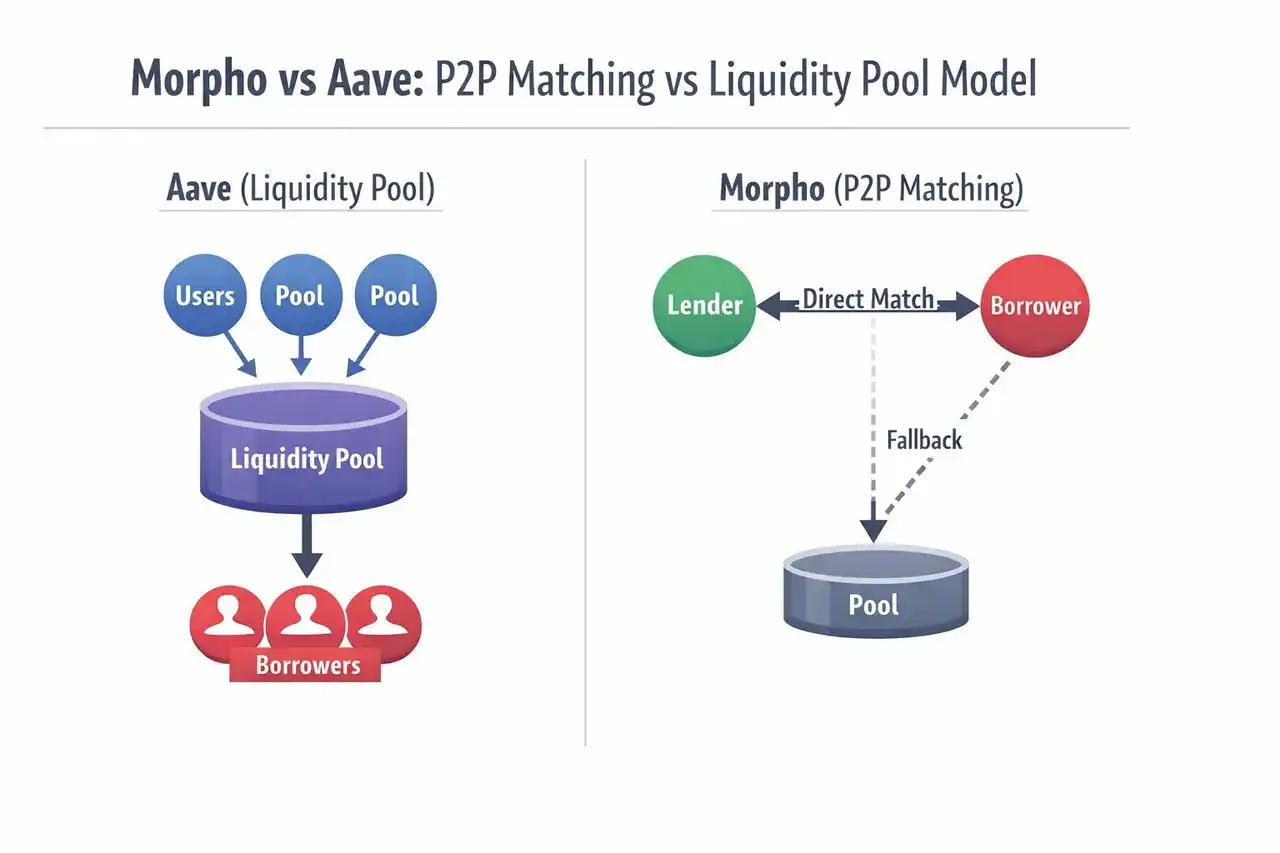
When you deposit USDC into Aave, the funds flow into a single master liquidity pool, supporting lending activities for all community-approved assets like Ethereum and staked tokens. Depositors cannot choose the type of collateral asset their funds correspond to; all related rules are set by DAO votes. Therefore, when rsETH faced collapse risk, even ordinary users who had only deposited USDC and never touched rsETH found their assets frozen—everyone's funds were in the same risk pool, suffering collective losses.
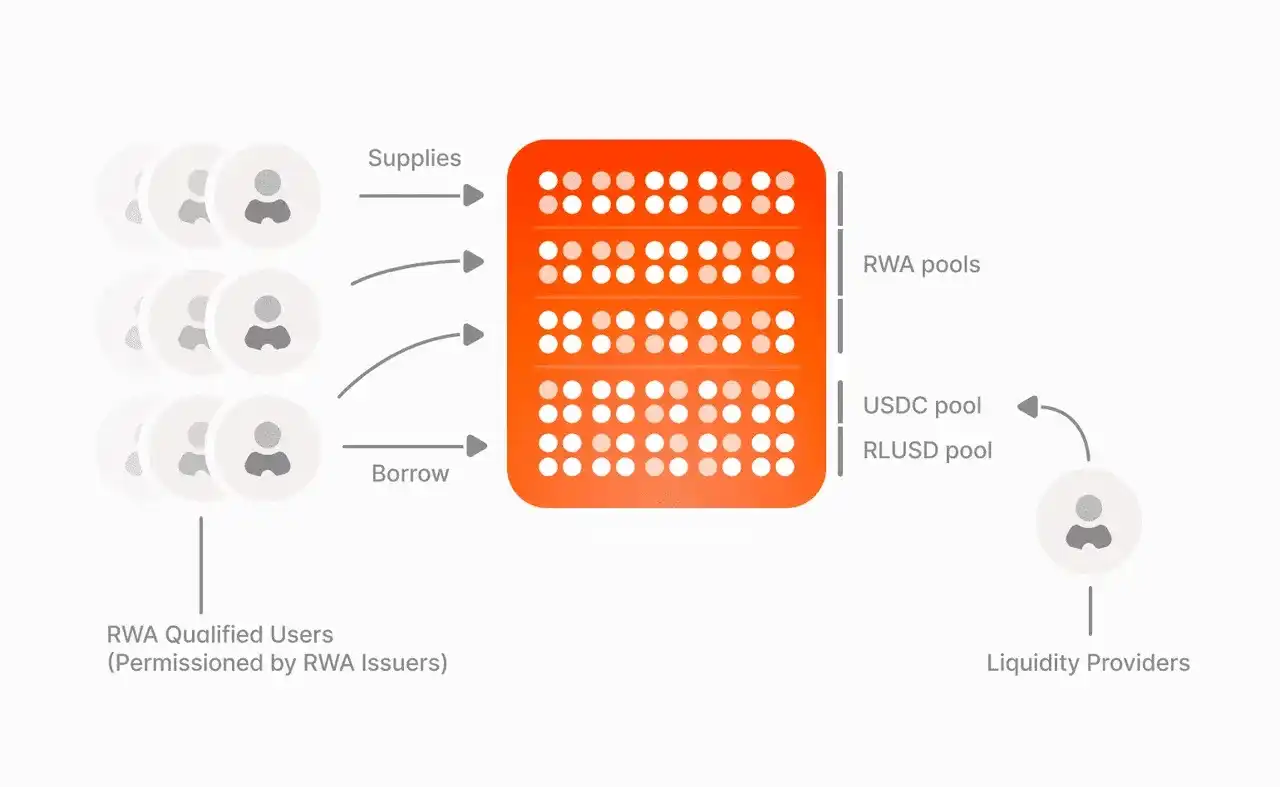
Source: BingX

More critically, while the market was halted and users couldn't withdraw, Aave's governance layer actually lowered the borrowing rates for the frozen Ethereum markets, aiming to protect borrowers who had leveraged rsETH. Since deposit rates are directly linked to borrowing rates, depositors with the lowest risk and principal security saw their deposit yields shrink further.

In traditional credit systems, lenders with the lowest risk enjoy priority in repayment. However, Aave completely inverted this rule. The reason is that borrowers engaged in rsETH leveraged trading are also the most active voting group in community governance. When risk erupts, high-risk participants holding governance power naturally prioritize protecting their own interests.

Aave launched an insurance mechanism called Umbrella in late 2025, attempting to address such bad debt risks. Users could stake Ethereum; if the protocol incurred bad debts, the staked assets would be used for compensation. However, after the Kelp DAO crisis erupted, 18,922 out of 23,507 staked aWETH positions entered an unstaking waiting period, with nearly 80% of the insurance pool's funds withdrawing collectively.

This mechanism ultimately failed completely. On-chain insurance relies on voluntary user participation, and capital providers inevitably choose to exit when real risk materializes—after all, their assets only face substantial loss when a crisis occurs. This leads to such insurance often existing during peaceful times but becoming ineffective precisely when protection is needed.

Morpho's operational model is entirely different. It abandons the unified shared liquidity pool. Anyone can create an independent, isolated lending market, pre-setting the loan asset, collateral asset, price oracle, and interest rate model. Once parameters are deployed, they cannot be modified. To adjust risk levels, one can only create a new market.
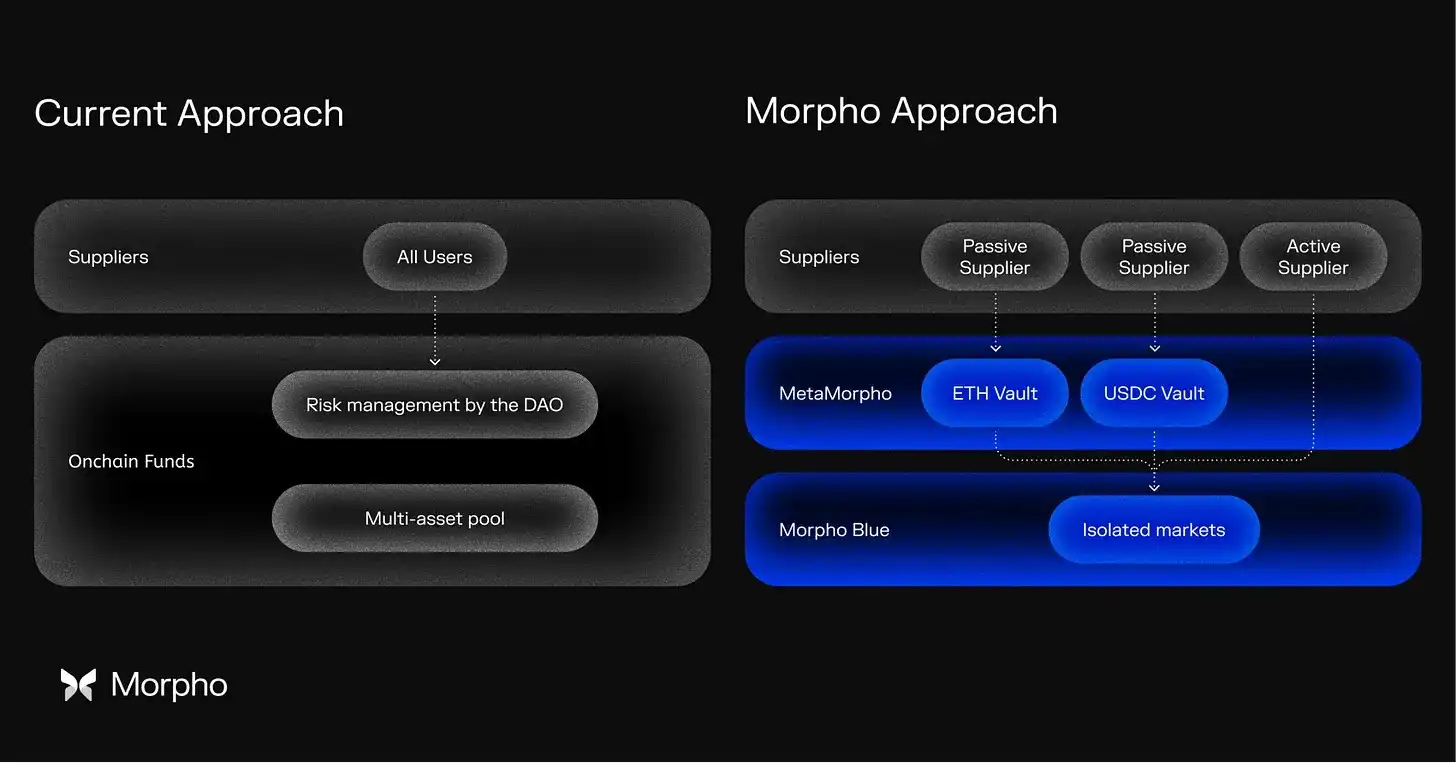
Differences in underlying architecture between the traditional DeFi lending model (represented by Aave) and Morpho's "Morphological" model.

Furthermore, Morpho introduces independent risk management institutions (Stewards), such as Gauntlet and Steakhouse Financial. These entities establish vaults, allocate funds to different markets based on their own analysis, and charge performance fees; if losses occur, they are confined within their own vaults. Gauntlet also provided risk advice for Aave, but in Aave's system, its professional opinions were often overruled by token holders seeking high yields through voting, a situation Morpho prevents at its root.

The Overlooked Hidden Cost

Aave and Morpho are currently the two most widely applied lending models in the crypto space: Aave uses the shared liquidity pool model where all deposits are aggregated, with risk rules set by community votes; Morpho advocates the isolated market model, where each lending pair is independent, with risks managed autonomously by professional institutions.

The Kelp DAO vulnerability exposed the flaws and weaknesses of the shared pool model. But even during stable periods without security incidents, this model harbors a long-overlooked hidden cost. Aave's three core markets on Ethereum (Ethereum, USDT, USDC) contribute 89% of the platform's lending volume. In these three markets, deposit rates are consistently 25% to 35% lower than borrowing rates. This spread essentially represents idle funds lying dormant in the liquidity pool; depositors cannot profit from them, yet borrowers still bear the full borrowing cost.

The interest rate mechanism adjusted based on utilization rates can push rates higher when risk increases but cannot activate idle funds when lending demand is low, leaving large amounts of assets stranded in the pool generating no yield. In these three markets alone, the annual value erosion due to idle funds amounts to approximately $52 million, close to a quarter of Aave's annualized revenue for one quarter. Even zeroing out the reserve ratio and canceling platform fees cannot solve the idle fund issue—it's an inherent shortcoming of the shared pool architecture.

Morpho's interest rate model aims to maintain a utilization rate of around 90%, significantly higher than Aave's 60% to 80% range. This model can sustain high utilization because deposits within the platform are not re-used as collateral for other loans, avoiding chain-liquidation risks at the source and thus eliminating the need to reserve large amounts of capital as a risk buffer. When lending demand is strong and funds are heavily borrowed, rates automatically increase, attracting more depositors; when lending demand is weak, rates decrease, stimulating borrowing. The entire system achieves dynamic balance without requiring community votes.
Source: Gate.com

Actual data confirms its advantage: even after deducting Steward fees, the yield offered to depositors by Morpho's top USDC vaults still exceeds that of Aave and Compound. Currently, Morpho's deposit-to-loan ratio is 41%, while Aave's is 39%, and the former's scale reaches tens of billions of dollars, meaning the yield advantage benefits all depositors on the platform day after day.

Institutional Choice: Which is More Trustworthy?

Surprisingly, all of Coinbase's crypto asset lending services are built on Morpho. The related loan scale has now surpassed $2 billion, and over 100 million platform users are indirectly enjoying the returns provided by Morpho.

Most users aren't even aware they are using DeFi services. Coinbase did not develop its own lending system nor choose another platform. The core reason is that Morpho's underlying architecture allows the platform to independently set risk parameters, select partner risk institutions, and maintain full control over the entire product experience.

Apollo Global Management, a global asset manager with over $1 trillion in assets under management and 30 years of experience in private credit, recently signed a four-year cooperation agreement, planning to acquire up to 90 million MORPHO tokens, accounting for 9% of the total token supply. The institution is connecting its tokenized fund assets to Morpho as collateral, with Gauntlet responsible for vault management and market stress testing.

Beyond that, Anchorage Digital, the first federally chartered native crypto bank in the US, has connected its institutional clients managing hundreds of billions to Morpho vaults; SG-FORGE, the compliant arm of French banking giant Société Générale, is the first licensed bank to implement DeFi lending business through Morpho.

These heavily regulated traditional financial institutions collectively chose Morpho, with a highly consistent core demand: the isolated market model allows them to meet their own compliance and risk control requirements without relying on DAO decisions. In contrast, all market rules in Aave inevitably involve community voting, completely incompatible with institutions' need for autonomous control.

Changes in the regulatory environment have further amplified this trend. The US "GENIUS Act" stipulates that stablecoin issuers cannot directly distribute investment returns, meaning stablecoin institutions require neutral underlying infrastructure to activate vast amounts of idle assets. US-related projections show that by 2028, the scale of stablecoin reserves invested in US Treasury bonds will surge from the current $120 billion to over $1 trillion. This massive pool of capital urgently needs a lending foundation that allows asset custodians to control their own risks, and Morpho is currently the most fitting choice.

Criptos en tendencia

Preguntas relacionadas

QWhat was the root cause of the massive $15 billion deposit outflow from Aave following the Kelp DAO exploit?

AThe root cause was Aave's governance mechanism. Earlier, the community had voted to increase the loan-to-value (LTV) ratio for rsETH to 93%, leaving a very thin safety margin of 7%. When fake rsETH tokens were deposited as collateral, it quickly drained the shared liquidity pool, causing the massive withdrawal.

QWhat is the fundamental difference in the operational models between Aave and Morpho as described in the article?

AAave uses a shared liquidity pool model where all deposits are pooled together to back all approved assets, with rules set by DAO governance. Morpho uses an isolated market model, where each lending market is separate with its own parameters set at creation, managed independently by professional risk stewards.

QWhy did Aave's Umbrella insurance mechanism fail during the crisis, according to the article?

AThe mechanism failed because it relies on voluntary participation. When the crisis hit, nearly 80% of the staked insurance funds (aWETH) entered the unstaking period and were withdrawn. Participants were incentivized to leave to avoid losses, rendering the insurance pool ineffective when it was needed most.

QWhat 'hidden cost' does the shared pool model like Aave's incur during normal market conditions?

AA significant hidden cost is idle capital due to low capital efficiency. In Aave's top three markets, the spread between deposit and borrow rates (25-35%) represents idle funds that earn no yield for depositors but whose cost is still borne by borrowers, leading to an estimated annual value drain of $52 million.

QWhy are regulated traditional financial institutions like Coinbase and Apollo Global Management choosing Morpho over Aave for their DeFi lending operations?

AThey choose Morpho because its isolated market model allows them to set their own risk parameters and choose their risk stewards, giving them full control and compliance. This is essential for meeting regulatory requirements, unlike Aave's model where all market rules are subject to community DAO votes.

Lecturas Relacionadas

Operador veterano relata: ¿Cómo operar con las expectativas erróneas del mercado?

**Resumen en español europeo:** Un trader experimentado explica cómo operar basándose en las "expectativas erróneas" del mercado, tomando como ejemplo una operación reciente de venta en corto del índice Nasdaq (NQ). El caso se desencadenó tras la publicación de datos débiles de inflación (IPC) en EE.UU. Inicialmente, el mercado reaccionó con optimismo, haciendo subir el Nasdaq, asumiendo que un IPC bajo conduciría a un relajamiento general de las tasas de interés, incluidos los tipos a largo plazo ("relajamiento del denominador"). Sin embargo, el trader identificó una falla clave en esta cadena de expectativas del mercado: mientras que las tasas de interés a corto plazo bajaron, las tasas reales a largo plazo (como la del bono a 30 años) alcanzaron máximos de 20 años. Este escenario de "relajamiento a corto plazo pero negativa a largo plazo" no apoya la valoración de acciones tecnológicas, que dependen de financiación a largo plazo barata para su crecimiento. La metodología central presentada consiste en no limitarse a los datos mismos, sino analizar tres capas: 1. **Expectativa del dato:** ¿Cuál era el consenso? 2. **Expectativa de transmisión:** ¿Cómo se supone que el dato afecta a otras variables del mercado (política monetaria, tasas, crédito)? 3. **Expectativa de valoración de activos:** Dado lo anterior, ¿cómo debería repreciarse un activo? El autor argumenta que el "error" más común y explotable ocurre en la segunda capa: el mercado asume que un mecanismo de transmisión anterior sigue siendo válido cuando ya no lo es. En este caso, asumió que un IPC débil relajaría todas las tasas, pero la nueva realidad macroeconómica impide que las tasas a largo plazo bajen. El trader actuó vendiendo en corto el NQ (más sensible a las tasas largas) en lugar del S&P 500 (ES), y estructuró la operación en varias entradas. Define que la mejor oportunidad surge cuando las "variables rápidas" (como el precio del activo) se han recuperado, pero las "variables lentas" (como las condiciones de financiación subyacentes) se niegan a hacerlo, creando una discrepancia entre el precio y su lógica causal implícita. La ventaja (alpha) no proviene necesariamente de tener información mejor, sino de tener un "modelo de reacción" más actualizado que el del consenso del mercado.

marsbitHace 20 min(s)

Operador veterano relata: ¿Cómo operar con las expectativas erróneas del mercado?

marsbitHace 20 min(s)

Opinión: La relación de cobertura entre la deuda estadounidense y el mercado de valores ha fallado, el BTC como activo de riesgo soporta una doble presión

Durante las últimas dos décadas, la relación de cobertura entre los bonos del Tesoro estadounidense y las acciones, donde uno subía cuando el otro caía, se ha roto. Ahora, ambos caen simultáneamente, eliminando el "amortiguador" clave en las carteras de inversión. Bitcoin, como activo de riesgo en el extremo de la curva, soporta una doble presión. La correlación negativa entre el S&P 500 y la rentabilidad de los bonos a 10 años ha alcanzado su nivel más bajo desde 1996 (-0,69), lo que indica un movimiento sincronizado sin precedentes en 30 años. Este cambio se debe a que la inflación, y especialmente su volatilidad, se ha convertido en el factor dominante del mercado, perjudicando tanto a bonos como a acciones, a diferencia de cuando el crecimiento económico era el principal motor. Los inversores buscan ahora seguridad sin riesgo de duración, optando por efectivo en dólares y letras del Tesoro a corto plazo, mientras venden bonos a largo plazo. El rendimiento del bono a 30 años superó el 5%, reflejando un déficit creciente, mayores pagos de intereses y una demanda extranjera decreciente. Bitcoin es ahora tan sensible a las condiciones macroeconómicas como el dólar o el oro. Se ve perjudicado por el aumento de los rendimientos libres de riesgo (que elevan su costo de oportunidad) y por la disminución de la aversión al riesgo (que reduce la financiación para posiciones especulativas). Los factores que sustentan su lógica a largo plazo (como la emisión fija frente a la deuda soberana en expansión) lo perjudican a corto plazo en el entorno actual. Para que los bonos recuperen su papel tradicional de cobertura, la volatilidad inflacionaria debe ceder, permitiendo que los riesgos de crecimiento vuelvan a ser dominantes y que la Fed tenga margen para relajar la política. Hasta entonces, en un mercado donde la clase de activos más profunda ya no absorbe los impactos, los activos que no generan rendimiento, como Bitcoin, quedan más expuestos.

marsbitHace 22 min(s)

Opinión: La relación de cobertura entre la deuda estadounidense y el mercado de valores ha fallado, el BTC como activo de riesgo soporta una doble presión

marsbitHace 22 min(s)

Resumen Semanal de Financiación | Crypto.com obtiene 400 millones de dólares de inversión, los sectores CeFi y de stablecoins siguen atrayendo capital

**Resumen Financiero Semanal: Cripto y IA Acaparan Grandes Inversiones** La semana pasada, los mercados de capitales de cripto y IA experimentaron una actividad significativa. En el sector cripto, se registraron 17 rondas de financiación, sumando más de 812 millones de dólares, mostrando una concentración de capital en transacciones grandes. El titular principal fue la ronda de 400 millones de dólares para el exchange **Crypto.com**, respaldada por Citadel Securities, valorando la empresa en 200.000 millones. Otras operaciones destacadas en finanzas centralizadas (CeFi) e infraestructura incluyeron 135 millones para el bróker API **Alpaca** y 70 millones para la plataforma bancaria transfronteriza **Flex**. El sector de **infraestructura y herramientas** recaudó fuertes sumas, con proyectos enfocados en pagos con stablecoins y liquidación, como **Cyclops** (20 millones) y **Pact Labs** (7 millones liderados por Tether). **Glacis Labs**, una plataforma de liquidación, levantó 6,8 millones. La **IA y la robótica** dominaron las megainversiones fuera del ámbito cripto. **Fireworks**, servicio en la nube para IA, recaudó 1.500 millones con respaldo de NVIDIA. En robótica, **Walden Robotics** (separada de Toyota) y la china **逐际动力 (Climber Robotics)** completaron rondas de 300 y casi 200 millones, respectivamente, para el desarrollo de robots humanoides. Otras áreas con actividad fueron DeFi, mercados de predicción y AI+Web3, con rondas menores. Además, se reportaron varias adquisiciones estratégicas, como la de MoonPay sobre la startup de depósitos Glide. En general, el capital continúa fluyendo hacia segmentos maduros como CeFi, stablecoins e infraestructura de trading en cripto, mientras que la IA y la robótica atraen apuestas masivas de capital riesgo para su comercialización.

marsbitHace 1 hora(s)

Resumen Semanal de Financiación | Crypto.com obtiene 400 millones de dólares de inversión, los sectores CeFi y de stablecoins siguen atrayendo capital

marsbitHace 1 hora(s)

¿El mercado bajista más moderado? Los bajistas del BTC cierran posiciones, ARK y Bitwise colectivamente son optimistas

**Resumen:** El 20 de julio, BTC se mantenía cerca de 75.000 USD, mientras que ETH retrocedía a 1.900 USD tras acercarse a los 2.000 USD. El mercado altcoin se mostraba mayormente débil. En las últimas 24 horas, se liquidaron 116 millones de USD en contratos, principalmente posiciones cortas (62.7 millones). El índice de miedo se sitúa en 35, indicando un sentimiento de pánico. Las perspectivas de diversas instituciones y analistas sugieren un posible punto de inflexión. **Polymarket** indica una probabilidad del 33% de que BTC caiga por debajo de 50.000 USD este año. **ARK Invest** señala señales de agotamiento de los vendedores, como el aumento de la ofente en manos de "hodlers" a largo plazo y del suministro en pérdidas (~54%). **Bitwise** describe esta caída como el "mercado bajista estructuralmente más suave" registrado, con una corrección del ~50% desde máximos, menor que en ciclos anteriores. Destaca que los inversionistas institucionales están comprando en la baja y que la base de cada ciclo es más alta. El análisis técnico de **Bit** sugiere que el mínimo de la onda C podría haberse formado, con un rango de soporte clave entre 59.000 y 70.000 USD. Sin embargo, **Glassnode** advierte que si BTC no logra superar con fuerza los 66.000 USD, el riesgo de un techo local aumenta. El analista **Darkfost** resalta la intensa zona de soporte entre 59.000 y 70.000 USD, donde se ha intercambiado el 50% del suministro circulante. Finalmente, el trader **Doctor Profit** anunció haber cerrado todas sus posiciones cortas (reportando grandes ganancias) y haber comenzado a comprar BTC spot desde los 64.000 USD, su primera compra para largo plazo desde septiembre de 2025. Argumenta que el consenso del mercado que espera mínimos más bajos en septiembre/octubre podría estar equivocado, y que el fondo del ciclo podría llegar antes de lo esperado, citando también avances regulatorios e institucionales como motivos estructurales para su cambio de postura.

Foresight NewsHace 2 hora(s)

¿El mercado bajista más moderado? Los bajistas del BTC cierran posiciones, ARK y Bitwise colectivamente son optimistas

Foresight NewsHace 2 hora(s)

Trading

Spot

Artículos destacados

Cómo comprar DAO

¡Bienvenido a HTX.com! Hemos hecho que comprar DAO Maker (DAO) sea simple y conveniente. Sigue nuestra guía paso a paso para iniciar tu viaje de criptos.Paso 1: crea tu cuenta HTXUtiliza tu correo electrónico o número de teléfono para registrarte y obtener una cuenta gratuita en HTX. Experimenta un proceso de registro sin complicaciones y desbloquea todas las funciones.Obtener mi cuentaPaso 2: ve a Comprar cripto y elige tu método de pagoTarjeta de crédito/débito: usa tu Visa o Mastercard para comprar DAO Maker (DAO) al instante.Saldo: utiliza fondos del saldo de tu cuenta HTX para tradear sin problemas.Terceros: hemos agregado métodos de pago populares como Google Pay y Apple Pay para mejorar la comodidad.P2P: tradear directamente con otros usuarios en HTX.Over-the-Counter (OTC): ofrecemos servicios personalizados y tipos de cambio competitivos para los traders.Paso 3: guarda tu DAO Maker (DAO)Después de comprar tu DAO Maker (DAO), guárdalo en tu cuenta HTX. Alternativamente, puedes enviarlo a otro lugar mediante transferencia blockchain o utilizarlo para tradear otras criptomonedas.Paso 4: tradear DAO Maker (DAO)Tradear fácilmente con DAO Maker (DAO) en HTX's mercado spot. Simplemente accede a tu cuenta, selecciona tu par de trading, ejecuta tus trades y monitorea en tiempo real. Ofrecemos una experiencia fácil de usar tanto para principiantes como para traders experimentados.

384 Vistas totalesPublicado en 2024.12.11Actualizado en 2026.06.02

Cómo comprar DAO

Discusiones

Bienvenido a la comunidad de HTX. Aquí puedes mantenerte informado sobre los últimos desarrollos de la plataforma y acceder a análisis profesionales del mercado. A continuación se presentan las opiniones de los usuarios sobre el precio de DAO (DAO).

活动图片