From Grunt Engineer to Crypto Billionaire: Solana's Leader Toly's Wealth Exposed

marsbitPublicado a 2026-02-15Actualizado a 2026-02-15

Resumen

Anatoly Yakovenko, creator of the Solana blockchain, has become a leading figure and billionaire in the crypto industry. Born in the Soviet Union and later immigrating to the U.S., he studied computer science and worked over a decade at Qualcomm, gaining expertise in distributed systems. His early Bitcoin mining experience exposed him to scalability issues in existing blockchains, inspiring him to develop the "Proof of History" concept, which became the foundation of Solana. Yakovenko co-founded Solana Labs in 2018. He holds an estimated 12.5% of the initial SOL token supply, with on-chain analysis suggesting he controls wallets containing millions of SOL, valued between tens to hundreds of millions of dollars. He also owns an estimated 5-10% of Solana Labs, which is valued between $5-8 billion, adding billions to his net worth. His wealth is highly volatile with SOL's price; it peaked around $20-30 billion during the 2021 bull market but fell below $1 billion during the 2022 bear market. As of early 2026, his net worth is estimated between $500 million and $1.2 billion. Additionally, he is an active angel investor in over 40 crypto projects. Despite market fluctuations, Yakovenko remains a central architect in the digital economy.

This article is from:Arkham

Compiled by|Odaily Planet Daily(@OdailyChina); Translator|Moni

Anatoly Yakovenko(@toly), the creator of the Solana blockchain, has become a leading figure in the blockchain industry and a well-known billionaire. This article will delve into his personal wealth.

As one of the most influential figures in the cryptocurrency space, Anatoly Yakovenko founded Solana, one of the most widely used blockchain platforms. Based on available information, the number of tokens he personally holds, and his equity stake in Solana Labs, his estimated net worth in 2026 could be between $500 million and $1.2 billion. The wide range is primarily due to significant recent fluctuations in the price of Solana's token.

Anatoly Yakovenko's Early Life

Anatoly Yakovenko was born in the Soviet Union and immigrated to the United States with his family in the early 1990s, settling in Illinois. He showed an early talent for computer science and engineering, eventually earning a degree in computer science from the University of Illinois at Urbana-Champaign, a top-tier institution in the field in the United States.

Yakovenko's academic background focused on distributed systems and compression algorithms, technical areas that later proved crucial for his innovations in blockchain. According to his LinkedIn profile (shown below), after graduation, he joined Qualcomm, where he worked on operating system-level software and distributed systems for over a decade, a period he describes as being a "grunt" or workhorse. However, this experience at a leading communications technology company gave him deep expertise in building systems that handle large-scale, high-throughput operations.
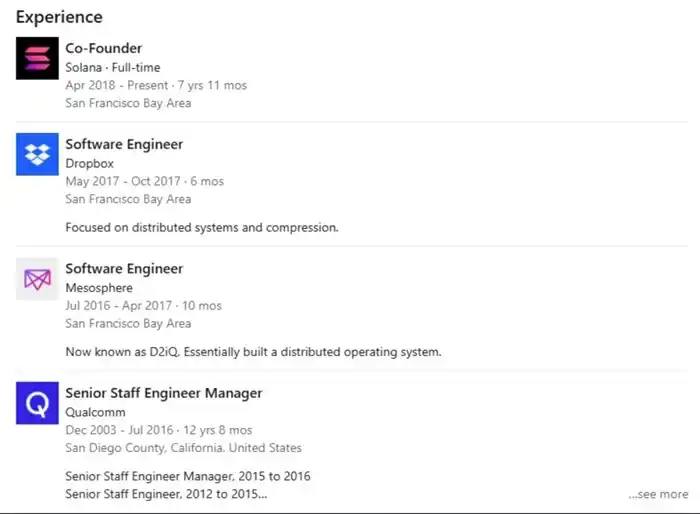
During his time at Qualcomm, Yakovenko also worked on technologies that required coordination across multiple devices and maintaining precise timing—a challenge conceptually similar to blockchain consensus mechanisms. He later had a brief stint at Dropbox, further deepening his understanding of distributed computing challenges in consumer-facing applications.

How Did Anatoly Yakovenko Get Involved in Cryptocurrency?

Like many others, Anatoly Yakovenko's initial foray into cryptocurrency began with Bitcoin mining. It is reported that he and a friend used the profits from mining to subsidize the cost of graphics processors for a side project they were developing together. This experience also gave him firsthand insight into the scalability limitations of Bitcoin and Ethereum, networks that could only process a small number of transactions per second, creating bottlenecks and high fees that seemed incompatible with mainstream adoption.

Rather than seeing these limitations as inherent flaws in blockchain technology, Yakovenko began exploring whether techniques from other fields could solve the throughput problem. He drew inspiration from his telecommunications background, specifically the concept of using time itself as a reliable reference point in a distributed system.

In November 2017, Anatoly Yakovenko published a white paper detailing the "Proof of History" technology, a cryptographic method for creating verifiable passage of time between events. This innovation allows network validators to process transactions in a predetermined order without requiring extensive communication between nodes, significantly increasing potential throughput. The Solana blockchain is fundamentally built upon this concept.

Soon after, Yakovenko recruited former Qualcomm colleagues Greg Fitzgerald and Stephen Akridge to help build a prototype. The team formally established Solana Labs in 2018 and secured initial funding to develop the protocol. Another co-founder of Solana, Raj Gokal, joined the project shortly after the Proof-of-History white paper was released, becoming the Chief Operating Officer of Solana Labs (Solana's core founding team is shown in the image above). Solana Labs launched its first testnet in 2018, followed by the mainnet beta in March 2020, entering the market during the early stages of the COVID-19 pandemic.

Tracking Anatoly Yakovenko's On-Chain Holdings

At its launch, Solana minted 500 million SOL tokens, with 12.5% allocated to the founding team, including Anatoly Yakovenko. A Solana address starting with "9QgXq" is widely rumored to be associated with Anatoly Yakovenko (as pictured below), though this has not been confirmed. This wallet holds over 136,725 SOL tokens, most of which are staked. Early transactions transferred millions of dollars worth of SOL to this address. This wallet address is over five years old. If it indeed belongs to Solana co-founder Anatoly Yakovenko, his held SOL would be worth over $11 million.

Furthermore, by tracking the history of transactions from Anatoly Yakovenko's suspected staking accounts, it appears that related accounts have conducted large SOL transactions to multiple Solana addresses. For example, between August 2024 and November 2024, over 3 million SOL tokens were unstaked and transferred. Over 1.5 million SOL tokens remain staked across multiple addresses, including 9E8zG, JQ5jC, A6mJn, and 7pgzZ. If these addresses also belong to Anatoly Yakovenko, his SOL holdings would far exceed current estimates, approaching a value of nearly $122 million at current prices.

Another address suspected to be linked to Anatoly Yakovenko is the Solana domain name toly.sol, as Anatoly Yakovenko's username on X is Toly. Tracing this domain reveals its owner is an address beginning with "86xCn". This address currently holds various tokens worth over $1.3 million, but its value is primarily in illiquid tokens, so its actual liquid value is only about $16,500, equivalent to 203.8 SOL.

Tracking Anatoly Yakovenko's Off-Chain Holdings

In addition to holding tokens, Anatoly Yakovenko holds a significant equity stake in Solana Labs, the company primarily responsible for developing the Solana protocol and its related infrastructure. Although the exact percentage of his ownership is not publicly disclosed, it is estimated that he holds approximately 5% to 10% of Solana Labs.

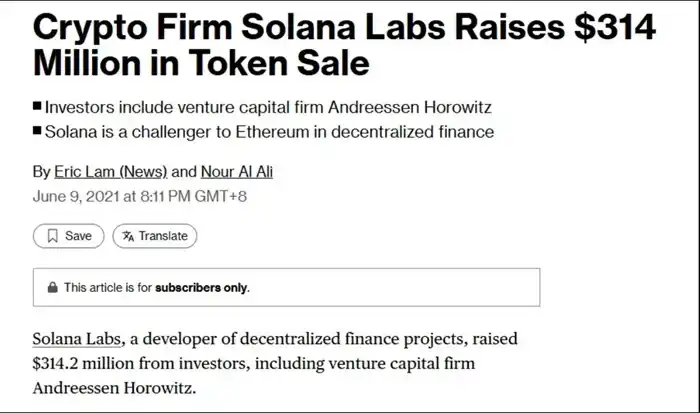
As a private company, Solana Labs' valuation has not been publicly disclosed. Solana Labs has conducted multiple funding rounds in the past, with investments from prominent venture capital firms like a16z (Andreessen Horowitz), Polychain Capital, and Multicoin Capital. These investments have valued the company in the billions of dollars, with many estimating its worth between $5 billion and $8 billion. Based on these valuations, Yakovenko's equity stake could be worth between $250 million and $800 million, not including his personal token holdings.
Although the company's valuation is still partially tied to the market performance of the SOL token, this dual ownership structure—personal tokens and company equity—provides a degree of diversification for Anatoly Yakovenko's wealth. SOL token prices can be highly volatile, but company equity represents a more stable asset, especially as Solana Labs' business expands beyond protocol development to other blockchain infrastructure projects.

Beyond his stake in Solana Labs, Anatoly Yakovenko is an active angel investor and has invested in over 40 companies to date. Some of these have grown into giants within the Solana ecosystem, including liquid staking service providers Jito Labs and Solayer, perpetual DEX Drift Protocol and Infinex, and staking infrastructure project Helius.

Who Owns the Most Solana?

As an emerging blockchain, Solana has come a long way since its inception. Today, Solana token distribution is diverse, including institutional investors, exchanges, founders, and retail participants. Major institutional holders include the Solana Foundation Treasury, cryptocurrency exchanges holding tokens on behalf of users, Solana ETFs, and staking service providers.

However, based on available data, the largest holder of SOL tokens is likely the winning bidder(s) from the FTX bankruptcy auction. Following the collapse of the centralized exchange FTX, the SOL tokens held in its assets were auctioned off as part of the liquidation process. In this process, 41 million SOL tokens were sold, with Galaxy Digital and Pantera Capital acquiring the majority. Although these tokens were subject to lock-up and vesting schedules, about 60-70% of the sold SOL has likely been unlocked and may have been sold. Considering this, Galaxy Digital might still hold approximately 6-8 million SOL, while Pantera might hold around 3-5 million SOL.

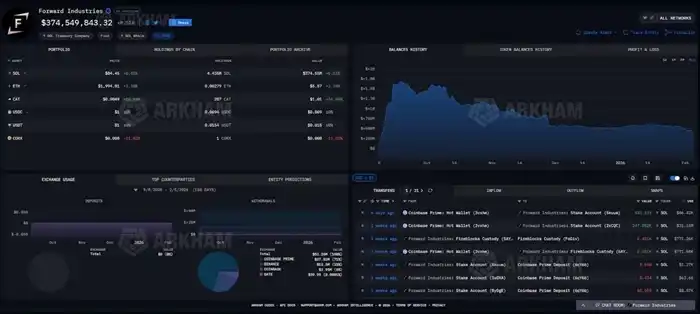
In 2025, the Solana Foundation Treasury companies came into focus. Due to highly publicized holdings, the largest SOL holder among these is the Solana Foundation Treasury company Forward Industries (pictured below), which currently holds 6.9 million SOL tokens (worth $583 million), representing 1.115% of the total SOL supply. Other Solana Foundation Treasury companies lag far behind; the next nine companies combined hold only about 1.5% of the total SOL supply.
Regarding custody service providers, some centralized exchanges also hold SOL tokens on behalf of users. For instance, Binance's latest proof-of-reserves shows the exchange holds over 24.2 million SOL tokens. Similarly, ETF providers have become major holders of SOL. The Bitwise Solana Staking ETF (BSOL) holds over 5.5 million SOL tokens and is currently the largest spot SOL ETF.

Among individual holders, while Anatoly Yakovenko likely ranks highly, he may not be the individual holding the most SOL tokens. Other Solana Labs co-founders and early team members also received significant allocations of SOL tokens. Furthermore, some early private investors may hold larger quantities of SOL than the Solana Labs co-founders themselves.

Anatoly Yakovenko's Net Worth Fluctuates Significantly with the Market

Over time, Anatoly Yakovenko's net worth has likely been closely tied to Solana's market performance, experiencing its dramatic volatility (the chart below shows the price movement of Solana's token in recent years). In November 2021, when the SOL price reached a cycle high of around $260, his combined token holdings and company equity could have pushed his net worth over $2 billion, potentially even approaching $3 billion, depending on the valuation of his Solana Labs equity.
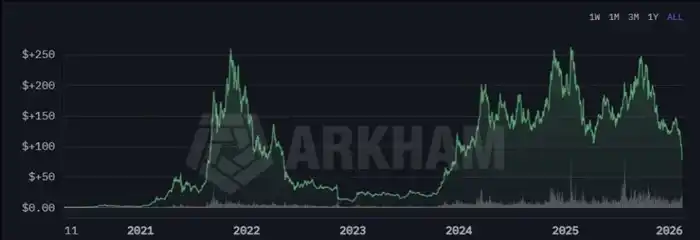
Conversely, the crypto bear market of 2022 severely compressed the value of Anatoly Yakovenko's assets. With the SOL price dropping below $10 at one point, the value of his token holdings fell more than 95% from their peak. Network outages during this period, coupled with Solana's close association with FTX and Alameda Research, created additional negative pressure on the token's price and ecosystem sentiment. Assuming his net worth moved in line with market fluctuations, it might have dipped below $100 million during the bear market.

However, as the market returned to a bull run between 2023 and 2025, Anatoly Yakovenko's net worth likely grew accordingly. Combined with the increasingly mature equity value of Solana Labs (currently estimated between $4 billion and $10 billion), it likely pushed his net worth back into the multi-billion dollar range.

At the beginning of 2026, the cryptocurrency market experienced a sharp crash, and the Solana price fell below $100. Estimates for Anatoly Yakovenko's net worth are generally maintained between $500 million and $1.2 billion, depending on the liquidity of the held tokens and the valuation of the Solana Labs equity stake.

Conclusion

As of early 2026, Anatoly Yakovenko remains one of the core architects of the digital economy, with a net worth that has fluctuated alongside the maturation of the Solana ecosystem. Although the crypto market crash in early 2026 reduced his wealth from its multi-billion dollar peak, his financial situation remains robust, bolstered by his equity in Solana Labs and a portfolio of early-stage investments.

From a grunt engineer working hard for a decade in networking companies to a crypto billionaire building a blockchain that rivals Bitcoin and Ethereum, Anatoly Yakovenko's influence on the crypto industry is evident. Solana has evolved from a high-speed blockchain into a hub encompassing institutional finance, stablecoin payments, trading, and more. Yet, it seems like everything is just beginning.

Preguntas relacionadas

QWho is Anatoly Yakovenko and what is his role in the blockchain industry?

AAnatoly Yakovenko is the creator of the Solana blockchain and a leading figure in the blockchain industry. He is known as a billionaire and has significantly influenced the crypto space through his work on Solana, one of the most widely used blockchain platforms.

QWhat is Anatoly Yakovenko's estimated net worth in 2026, and why is there a range?

AAnatoly Yakovenko's estimated net worth in 2026 is between $500 million and $1.2 billion. The range is due to the significant volatility in the price of Solana (SOL) tokens, which affects the value of his holdings.

QWhat key innovation did Anatoly Yakovenko introduce in the Solana blockchain?

AAnatoly Yakovenko introduced the 'Proof of History' (PoH) technology, a cryptographic method that creates verifiable time delays between events. This innovation allows the network to process transactions in a predetermined order without extensive node communication, significantly increasing throughput.

QWhat are the main components of Anatoly Yakovenko's wealth?

AAnatoly Yakovenko's wealth primarily consists of his personal holdings of SOL tokens and his equity in Solana Labs, the company behind the Solana protocol. He also has investments in over 40 companies, including key projects within the Solana ecosystem like Jito Labs and Drift Protocol.

QHow has the volatility of Solana's token affected Anatoly Yakovenko's net worth over time?

AAnatoly Yakovenko's net worth has experienced significant fluctuations due to Solana's token volatility. At its peak in November 2021, his net worth可能 exceeded $2 billion, but during the 2022 crypto bear market, it may have dropped below $100 million. By early 2026, it stabilized between $500 million and $1.2 billion after a crash.

Lecturas Relacionadas

La acción de Circle se desploma un 76%, el stablecoin vinculado al dólar de Hong Kong se lanzará en dos semanas

El precio de las acciones de Circle ha caído un 76%, tras alcanzar un máximo de 260 dólares en junio del año pasado hasta situarse en 62 dólares a mediados de julio. Esta fuerte corrección refleja una revaluación profunda del mercado, impulsada por la creciente competencia y las presiones sobre los márgenes, lo que llevó a Mizuho a rebajar su calificación y precio objetivo. Heath Tarbert, presidente de Circle, destacó la ejecución a largo plazo de su estrategia y la sólida posición de USDC (730 mil millones de dólares en circulación). Sin embargo, el ecosistema enfrenta desafíos: el nuevo stablecoin Open USD, respaldado por unas 140 empresas, busca captar partners mediante el reparto de rendimientos de las reservas. Además, Visa, con su enorme red de pagos, ha lanzado una plataforma que inicialmente da soporte a Open USD, aunque sigue siendo compatible con USDC. Mientras tanto, Tether (USDT) tiene aproximadamente dos años para ajustar sus reservas y cumplir con la Ley GENIUS, que exige activos de alta liquidez como efectivo y bonos del Tesoro de EE.UU., algo que podría complicarse dado su actual exposición a metales preciosos, préstamos y Bitcoin. En Hong Kong, el ritmo se acelera: se espera que Standard Chartered y su asociada, Anchor Financial Technology, lancen pronto un stablecoin vinculado al dólar de Hong Kong (HKDAP), tras recibir una de las primeras licencias del regulador local. La clave será si pueden transformar esa licencia en flujos de capital reales, especialmente en comercio transfronterizo. La caída de Circle simboliza la transición del mercado de stablecoins de un posible "winner-takes-all" a una competencia multifacética, donde la ventaja de escala ya no garantiza por sí sola una prima de valoración. La ejecución concreta de las estrategias a largo plazo será decisiva en los próximos dos años.

marsbitJusto ahora

La acción de Circle se desploma un 76%, el stablecoin vinculado al dólar de Hong Kong se lanzará en dos semanas

marsbitJusto ahora

Bajo el asedio del capital, la descentralización es la única línea de defensa de las cadenas públicas

**Resumen:** En un mundo impulsado por el poder y la codicia, el autor, un realista de mentalidad maquiavélica, argumenta que la **descentralización es la única característica fundamental e irremplazable de una cadena de bloques pública**. Mientras que otros priorizan la escalabilidad, las asociaciones comerciales o la financiación, él sostiene que estas son derivadas o incluso contraproducentes. La lógica central es que cualquier sistema que logre una adopción masiva atraerá inevitablemente intentos de captura por parte de corporaciones y capitales, motivados por el interés propio de proteger sus rentables modelos de negocio. El riesgo principal no son los ataques externos como el de 51%, sino la **usurpación interna del control**. La historia de plataformas como Visa, Mastercard o Google muestra una trayectoria inevitable de "degeneración" hacia herramientas monopolísticas. Una capa base pública y programable representa un premio mucho mayor. Por ello, las cadenas de consorcio o "permissioned", las L1 con validadores centralizados o las L2 con un único secuenciador son inherentemente vulnerables y serán cooptadas, sirviendo solo para consolidar el poder de los oligarcas existentes. La evidencia del mundo real, como ciertas redes de consorcio que excluyen a competidores clave, confirma este patrón. Las grandes empresas promueven soluciones pseudo-descentralizadas principalmente como una **táctica dilatoria** para frenar la adopción de la tecnología verdaderamente abierta que amenaza sus modelos basados en fricción e ineficiencia. Sin embargo, a largo plazo, el mercado, como el agua, fluirá hacia la infraestructura más segura y descentralizada. Concluye que, a pesar de sus defectos, una cadena como **Ethereum, con su alto grado de descentralización, sigue siendo la mejor defensa contra la captura corporativa y la solución práctica óptima disponible**.

Foresight NewsHace 8 min(s)

Bajo el asedio del capital, la descentralización es la única línea de defensa de las cadenas públicas

Foresight NewsHace 8 min(s)

¿Quién decide las reglas de Bitcoin? El BIP-110 desencadena la división en su gobernanza

BIP-110, una propuesta de "bifurcación suave temporal de datos reducidos", ha reavivado un profundo debate de gobernanza en la comunidad de Bitcoin. Su objetivo es imponer nuevas restricciones de consenso durante un año para limitar datos no monetarios (como inscripciones Ordinals y Runes) en la cadena, tras los cambios en la política de reenvío por defecto en Bitcoin Core v30. Los partidarios argumentan que los datos arbitrarios sobrecargan a los nodos y desvían la atención del propósito central de Bitcoin como red monetaria. Alegan que las políticas de nodos ya no son efectivas y que se necesita una regla de consenso. Los opositores, incluidos Michael Saylor (quien enumeró 110 razones en contra) y Adam Back de Blockstream, sostienen que cambiar el consenso para imponer juicios de valor contradice el principio de "sin permiso" y erosiona la neutralidad del protocolo. Back enfatiza que el lento proceso de consenso técnico actúa como un sistema inmunológico. La propuesta también enfrenta desafíos prácticos: puede ser eludida técnicamente y presenta un riesgo de consenso ("BlockSlop") para nodos que se actualicen tarde. Su mecanismo de activación (señalización del 55% de los mineros) ha reabierto viejas tensiones entre mineros, nodos (como Bitcoin Knots) y grupos como el pool Ocean (a favor) y Foundry (que consulta a sus clientes). El debate trasciende lo técnico, poniendo sobre la mesa la pregunta fundamental: ¿quién decide las reglas de Bitcoin? BIP-110 enfrenta la visión de un protocolo neutral y sin permiso contra el deseo de proteger su función monetaria, revelando las complejas dinámicas de poder entre desarrolladores, mineros, operadores de nodos y ahora, grandes holders institucionales como Saylor, cuyo capital y narrativa influyen en el proceso.

marsbitHace 22 min(s)

¿Quién decide las reglas de Bitcoin? El BIP-110 desencadena la división en su gobernanza

marsbitHace 22 min(s)

¿Quién decide las reglas de Bitcoin? BIP-110 desencadena una división en la gobernanza

BIP-110, una propuesta de "bifurcación suave temporal de datos reducidos", ha reavivado un profundo debate de gobernanza en la comunidad de Bitcoin. La propuesta busca imponer nuevas restricciones en el protocolo de consenso durante aproximadamente un año, limitando el tamaño de datos en scripts y transacciones para dificultar la inscripción de datos arbitrarios (como en Inscriptions y Runes). Sus defensores argumentan que estos datos saturan bloques, aumentan la carga de los nodos completos y desvían la atención del propósito principal de Bitcoin como red monetaria. Creen que los mecanismos de política a nivel de nodo (como los ajustes en Bitcoin Core v30) ya no son efectivos, por lo que las reglas deben llevarse al nivel de consenso. Oponentes destacados como Michael Saylor y Adam Back rechazan este enfoque. Saylor enumera 110 razones, advirtiendo que cambiar el consenso para invalidar transacciones actualmente válidas establece un peligroso precedente de gobernanza y podría crear incertidumbre. Adam Back sostiene que la base de Bitcoin es su permisividad; nadie debe imponer su juicio de valor a los demás. El proceso de consenso técnico, aunque lento, actúa como un sistema inmunológico. La discusión también expone tensiones subyacentes sobre quién decide las reglas: los mineros (con su poder de hash), los operadores de nodos (con su soberanía), los desarrolladores centrales (con privilegios de fusión de código) o los grandes poseedores (como Saylor). Además, se han señalado posibles riesgos técnicos, como un error de consenso en la ruta de actualización, y dudas sobre si BIP-110 realmente puede bloquear todos los métodos de inscripción de datos. En esencia, BIP-110 ha actuado como una prueba de estrés para la gobernanza de Bitcoin, forzando a la comunidad a enfrentar la pregunta central: ¿quién tiene la autoridad para definir qué es Bitcoin?

链捕手Hace 34 min(s)

¿Quién decide las reglas de Bitcoin? BIP-110 desencadena una división en la gobernanza

链捕手Hace 34 min(s)

Una ballena misteriosa apuesta 2500 millones de dólares a que el BTC superará los 72,000 dólares en agosto, y la marca de 70,000 dólares se convierte en clave

Un operador anónimo ha realizado una apuesta masiva en opciones de Bitcoin, comprando 20.000 calls con strike de 70.000 dólares y vendiendo 20.000 calls con strike de 72.000 dólares para el vencimiento del 31 de julio en Deribit. Esta estrategia de "bull call spread" tiene un valor nocional de unos 25.000 millones de dólares y apuesta a que el BTC, actualmente en 64.289 dólares, superará los 70.000 dólares en los próximos días. La operación expira justo después de la próxima reunión de la Fed, programada para el 29 de julio, lo que convierte la decisión de política monetaria en un factor clave. Para que la apuesta sea exitosa, Bitcoin necesita superar una resistencia crítica identificada alrededor de los 69.000 dólares, nivel que coincide con el coste base de muchos compradores recientes. El flujo de los ETFs de Bitcoin en EE.UU., aunque netamente positivo en las últimas dos semanas con 272 millones de dólares de entrada, ha mostrado volatilidad, incluyendo una salida de 424 millones en un solo día. Esta inconsistencia añade incertidumbre a la posibilidad de un impulso alcista sostenido. Mientras tanto, las perspectivas a más largo plazo varían. Algunos analistas, como NYDIG, sugieren una posible corrección hasta los 38.000-39.000 dólares para octubre, siguiendo patrones de ciclos anteriores. Otros, como Citi, han recortado su objetivo a 12 meses a 82.000 dólares. En contraste, Bernstein mantiene un objetivo alcista de 150.000 dólares para finales de año. El mercado de criptomonedas en su totalidad tiene una capitalización de 2,23 billones de dólares, con Bitcoin representando el 58,73% del total. El éxito de esta enorme apuesta a corto plazo dependerá de si la demanda post-Fed puede superar las resistencias inmediatas y sostener un rally.

marsbitHace 43 min(s)

Una ballena misteriosa apuesta 2500 millones de dólares a que el BTC superará los 72,000 dólares en agosto, y la marca de 70,000 dólares se convierte en clave

marsbitHace 43 min(s)

Trading

Spot
活动图片