Interfold today announced two major milestones: the FOLD second round auction is now live, Network Alpha is officially running on mainnet, and FOLD's general transfer functionality has also been enabled.

The second round auction, utilizing Uniswap's continuous clearing auction mechanism, offers a limited allocation of 2% of the total FOLD supply. The auction began on August 17th at 14:06 UTC and will run until August 19th at 13:06 UTC, with a starting price of 0.02154816 USDC per FOLD, matching the clearing price from the first auction.
This auction is positioned as the final limited distribution before FOLD's full transferability, aiming to broaden access to the token and enhance market infrastructure around the network. 50% of the auction proceeds will be dedicated to supporting long-term on-chain liquidity.
The Larger Vision: Confidential Coordination
The launch of FOLD serves a larger purpose.
As more global collaboration moves digital and computational, various organizations need to work together while preventing exposure of sensitive information to each other. Markets need to process private information, institutions need to analyze sensitive data, and communities need to hold verifiable elections without revealing individual voting preferences.
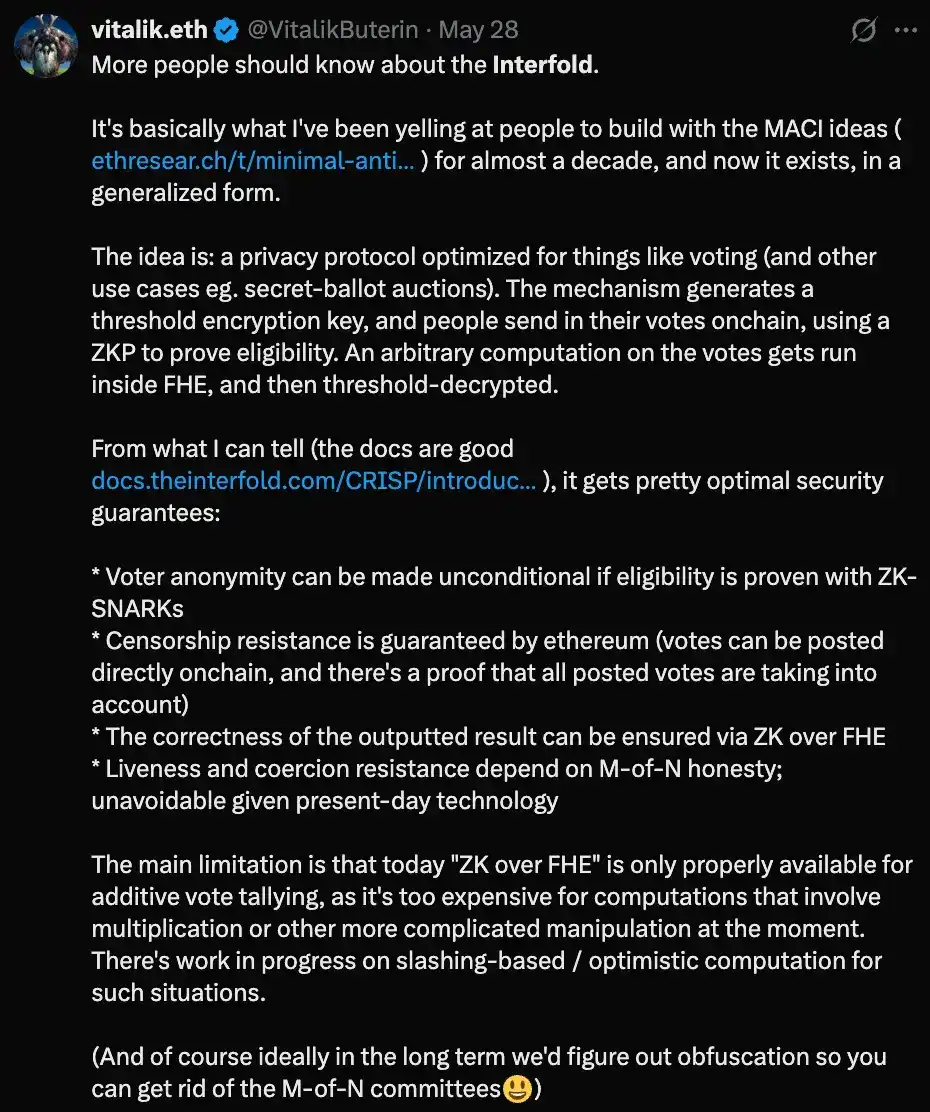
Today, such processes often require participants to hand over sensitive information, computational power, or control to centralized intermediaries. Interfold aims to change that.
Interfold is a decentralized network for confidential coordination: enabling independent parties to generate shared, verifiable outcomes from information they cannot directly reveal to each other.
The goal is simple: to collaboratively achieve a shared outcome without requiring anyone to reveal their underlying information.
Network Alpha Brings the Vision to Mainnet
Network Alpha is the first production version of this vision. On mainnet, encrypted execution environments (E3s) can complete their full lifecycle from deployment to operation. Participants can submit encrypted inputs, computation can proceed on those inputs, and authorized results are released through a distributed threshold process.
No single cryptographic node holds the complete decryption key or can independently control result release. Instead, cryptographic authority is distributed among multiple independent operators.
Through distributed key generation (DKG) and threshold decryption, the network collectively establishes the conditions under which private computation occurs and when authorized results can become public.
This constitutes a novel model for confidential computation: inputs are private, computation is shared, results are publicly verifiable, and the entire process is not controlled by any single machine. Network Alpha is now running this architecture on mainnet.
FOLD Becomes Part of the Network
With the opening of FOLD's general transfer functionality, FOLD enters a new phase. It is more than a transferable asset—cryptographic node operators can stake FOLD to participate in network duties, providing security for the distributed cryptographic processes that E3s rely on.
This directly ties the token to the network's underlying infrastructure. As Interfold grows, FOLD will play roles in distribution, liquidity, and network participation, linking economic incentives closely to the node operators responsible for confidential coordination.
A Network Designed for Real Use Cases
Network Alpha is already in practical use through its integration with Aragon for confidential governance. Votes remain encrypted throughout, while the network can generate end-to-end verifiable results. The system also features 'receipt-freeness,' meaning participants cannot prove their vote choice to others, effectively mitigating risks like coercion and vote-buying.
This is an early example of the broader problem Interfold solves: enabling multiple parties to feed private information into a shared process, while ensuring the original information remains confidential and the final outcome is verifiable.
The same architecture can readily extend to other collaborative scenarios requiring both privacy and verifiability.
Second Round Auction: Limited in Scale, Significant in Meaning
The second auction deliberately limits its size to 2% of the total FOLD supply. Its purpose is not to replicate the first auction, nor is it another large-scale funding round; it's a transitional step connecting initial token distribution to full network operation.
Starting at the clearing price of 0.02154816 USDC per FOLD established in the first round maintains launch continuity. Proceeds are allocated as follows: 25% is directly injected into a Uniswap liquidity pool, 25% is reserved for supplementary liquidity, and 50% goes to the Interfold Foundation treasury for continued protocol development.
This structure clearly points to Interfold's next phase: broader distribution, easier participation, robust liquidity, and a live network where FOLD can truly be used to solve significant privacy problems.
From Token Launch to Network Building
The significance at this moment extends far beyond the auction itself—Interfold is moving from 'building the protocol' into a new phase of 'operating the network.'
This means independent operators are starting to run infrastructure, developers are building confidential applications, participants are contributing to network processes, and organizations are using encrypted computation to collaborate around information that cannot be publicly disclosed.
Network Alpha intentionally starts at a manageable scale, allowing the ecosystem of node operators, supporting tooling, system performance, and use cases to evolve gradually in a live mainnet environment.
A protocol can be deployed at a moment, but a network grows through sustained participation.
The FOLD second round auction and the launch of Network Alpha are the starting points for this journey.
The FOLD second round auction is now open. Network Alpha is live on mainnet. Interfold is building the infrastructure for a world where information can stay private, yet collaboration remains verifiable.
Official Notice
Users should only participate in auctions, claims, transfers, and obtain contract and release information through official Interfold channels. Any unofficial links claiming to offer access to FOLD tokens, registration, verification, or auction participation may be fraudulent. Please exercise extreme caution.
About Interfold
Interfold is a decentralized network for confidential coordination. It enables independent parties to generate shared, verifiable outcomes from private inputs, without third-party custody, data exposure, or reliance on trusted hardware.
Interfold can support secret voting, sealed-bid auctions, and other coordination systems that require private inputs to produce verifiable results without relying on trusted operators.