CARV Deep Dive: Cashie 2.0 Integrates x402, Transforming Social Capital into On-Chain Value

深潮Publicado a 2025-12-10Actualizado a 2025-12-10

Resumen

CARV's Cashie 2.0 integrates x402 protocol to bridge social interactions with on-chain value, enabling AI agents and users to transform social capital into verifiable economic incentives. Built on CARV's modular AI infrastructure—including CARV ID (ERC-7231), Model Context Protocol, and Shielded Mind privacy—Cashie 2.0 automates reward distribution based on authenticated social behaviors like retweets and engagements, eliminating bots and manual processes. Its three core pillars are: x402 Payment for gasless pledge commitments, CARV ID as a social-to-economic identity oracle, and ERC-8004 Agent for trustless execution. The system supports AI-native APIs, allowing agents to programmatically initiate campaigns, and offers ERC-20 compatibility via txHash verification. Cashie 2.0 launches with a $45,000 campaign, enabling creators to set up automated giveaways while participants earn rewards without gas fees or wallet暴露. Future upgrades include self-hosted facilitators, AI-driven campaigns, and enterprise SDKs, positioning Cashie as key infrastructure for programmable social economies and CARV’s Sovereign AI Beings vision.

In CARV's exploration of Sovereign AI Beings, we have gradually come to realize a crucial fact: future value stems not only from data and computing power, but even more so from every real individual.

The AI Being roadmap outlined by CARV depicts a future vision:

AI will no longer be just a tool, but will become an autonomous extension of the individual in the digital world—driven by verifiable identity and private context, capable of participating in real economic activities on behalf of the user.

To achieve this, AI must connect two previously separate systems:

The Social Ledger and the Economic Ledger.

Cashie is the product born from the process of bridging these two worlds.

Cashie was initially built as a "social-native on-chain payment tool," but its capabilities have far exceeded the original vision. Today, Cashie has evolved into a programmable execution layer, enabling AI agents, creators, and communities not only to participate in markets but also to proactively initiate and drive the construction and growth of markets.

Within CARV's more complete modular agent infrastructure—including CARV ID (ERC-7231), Model Context Protocol (MCP), and the new Shielded Mind privacy upgrade—Cashie 2.0 can transform social behaviors into verifiable, automatically executable, and privacy-preserving on-chain incentives.

It is no longer just a tool, but a protocol.

Core Pain Point: The Insurmountable Gap Between Social Ecosystems and On-Chain Ecosystems

Over the past decade, Web3 teams have consistently attempted to convert attention into genuine action through airdrops, quests, incentives, and other methods. However, most attempts fail to be simultaneously precise, scalable, and trustworthy:

  • Airdrops often reward bots, not genuine supporters.

  • On-chain operations cannot capture real influence, which remains off-chain.

  • Manual distribution lacks automation, complicating developer workflows and creating opportunities for Sybil attacks.

The two systems have always spoken different languages:

  • Social Ledger: Recorded through likes, reposts, follows—full of authentic human signals, yet confined within Web2 platforms.

  • Economic Ledger: Transparent and programmable blockchains, yet disconnected from real-world context.

Cashie is the bridge connecting the two.

Cashie's Position in the CARV AI Being Tech Stack

In CARV's AI Being architecture, an agent's capability depends on the context it can access and the environment in which it can execute tasks. Through the Shielded Mind mainnet upgrade, AI agents have gained private inference capabilities; relying on CARV ID (ERC-7231), they possess verifiable identities; and with Cashie, they can finally execute truly meaningful, socially-grounded actions on-chain.

This unlocks new capabilities:

  • AI Beings can monitor social sentiment in real-time and trigger community incentives programmatically.

  • Users can link their Twitter/X accounts to CARV ID to receive automatically distributed on-chain rewards.

  • Projects can build communities based on verifiable activities, rather than relying on guesswork or broad predictions.

Cashie elevates AI from a "passive responder" to a true "economic participant."

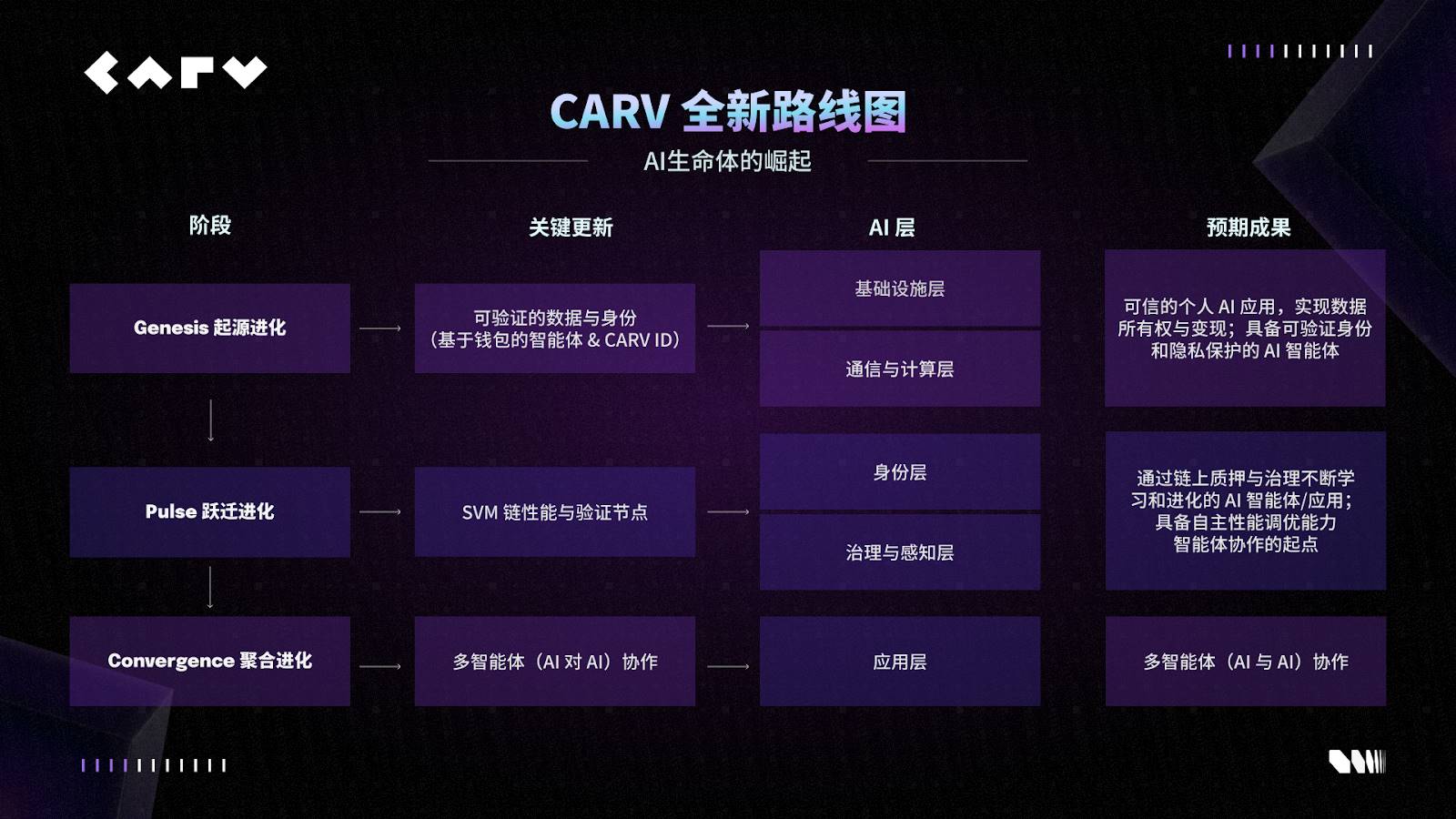
This marks a critical step forward on CARV's roadmap to creating Sovereign AI Beings, holding milestone significance especially in the Genesis Evolution phase.
How Cashie 2.0 Works: Three Core Pillars
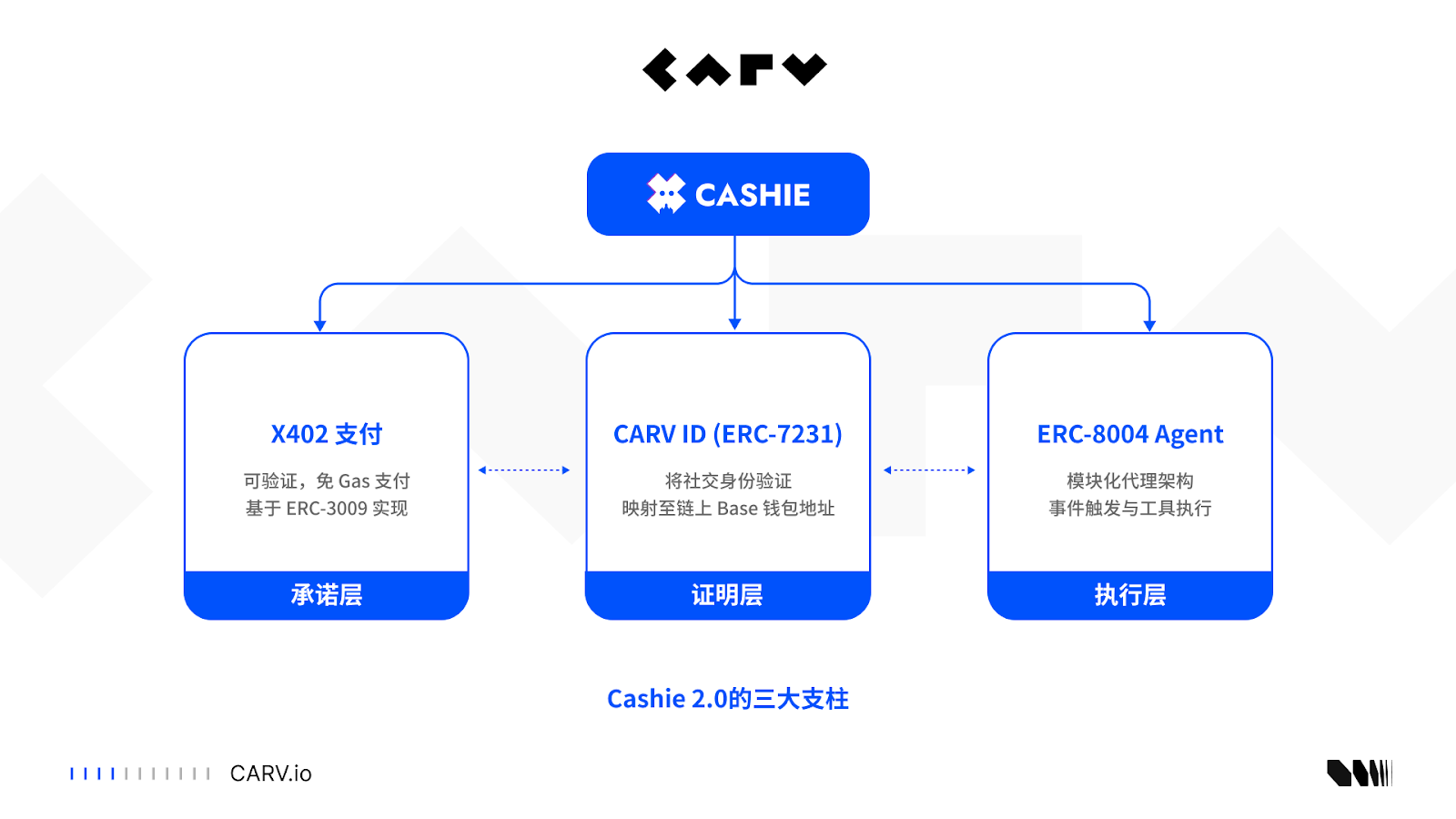
The architecture of Cashie 2.0 consists of three core pillars:

  1. x402 Payment — The Pledge Mechanism

Every Cashie activity begins with an ERC-3009 signature, where a project or KOL pledges funds for the activity. This signature serves as the "X-Payment" proof and is verified on-chain. Gasless, no manual transfers required—it ensures funds are locked and enables a fully automated distribution process later.

  1. CARV ID — The Proof

How do you reward a repost or other social interaction? Traditional wallets cannot recognize a @username on social media, making it difficult to correlate on-chain incentives with off-chain behavior.

Cashie solves this with CARV ID: it can map social behaviors (e.g., a repost by @user) to on-chain identities (e.g., 0xABC). CARV ID is the identity oracle connecting the Social Ledger and the Economic Ledger.

  1. ERC-8004 Agent — The Executor

Cashie is not a single-function bot, but an AI execution agent composed of various modular tools, including:

  • Payment Tool: Used to verify fund pledges and automatically execute fund transfers.

  • Twitter Tool: Used to monitor and analyze interaction behaviors on Twitter/X in real-time.

  • Raffle / Quest Tool: Used to automatically draw winners or check if users have completed tasks.

  • Distribution Tool: Used to automatically distribute on-chain rewards to eligible users.

All processes are completed under a trustless, fully automated mechanism, requiring no manual intervention and effectively preventing abuse like Sybil attacks.

Developer Breakthrough: Fueling the Rise of the Agents-to-Agents Autonomous Economy

To truly unleash the potential of Sovereign AI Beings and promote decentralized collaboration, the underlying infrastructure must evolve quietly, yet thoroughly. While external attention focuses more on AI agents and social activities, it is the innovation deep in the underlying layers that makes everything work.

With the release of Cashie 2.0, CARV introduces a new developer stack:

An infrastructure that is not only programmable but is agent-native.

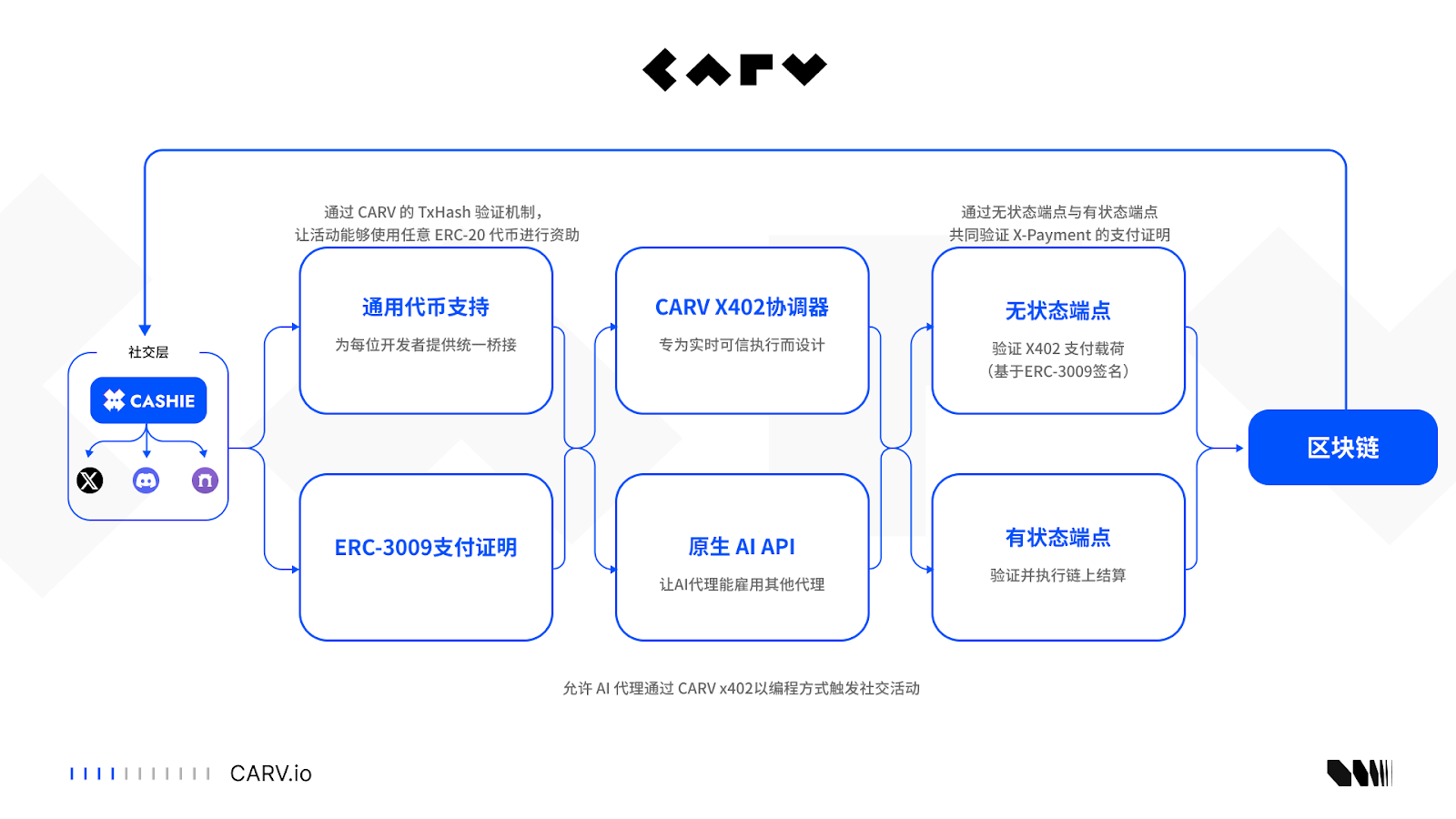
  1. CARV x402 Facilitator: Protocol Enhancement Layer

In Cashie, every operation begins with a cryptographic pledge. But the trustworthiness of the pledge depends on the system verifying it. Therefore, we built the CARV x402 Facilitator—a self-hosted, high-performance facilitator service specifically designed for social activity scenarios.

We solved a key challenge in the standard x402 (ERC-3009) process for this facilitator: payment proof state management.

Through our verify endpoint, we introduced a more robust state and nonce management layer, capable of instantly rejecting replayed signatures, intercepting repeated settlement attempts at high speed before gas is spent on transactions, providing high-throughput security protection.

We have opened the facilitator's interface, allowing any developer on Base to build their own x402-powered applications. Developers can connect to our online endpoints today:

Stateless Endpoint: For validating x402 paymentPayload (ERC-3009 signature)

https://interface.carv.io/cashie/protocol/verify

Stateful Endpoint: For verifying and executing on-chain settlement

https://interface.carv.io/cashie/protocol/settle

  1. AI-Native API: Enabling "Agent Hires Agent" via x402

True to the vision of ERC-8004 (Trustless Agents), Cashie 2.0 is not just a platform; it is a programmable tool for other AI agents to call upon.

We have opened an AI-native HTTP API that fully implements the x402 protocol. This means any other AI agent (from Virtual, Base, or any other ecosystem) can programmatically "hire Cashie" to run a campaign.

The process is as follows:

  1. An AI agent sends a request to our API

  2. Receives a 402 Payment Required challenge

  3. Resubmits the request carrying its own X-Payment proof

  4. Thereby achieving automated fund pledging and campaign initiation

The entire process is completed autonomously by the agent, forming a true agent-to-agent social business model.

  1. Universal ERC-20 Support via TxHash Verification

The Web3 world is fragmented by different token standards; not every ERC-20 supports gasless approval or signature-based authorization. But Cashie's design philosophy is universality and compatibility. We built Cashie for the entire Base ecosystem, not just for tokens supporting ERC-3009.

Cashie has a built-in independent txHash verification API, allowing any project to launch incentive campaigns with any ERC-20 token: the project simply needs to complete a regular on-chain transfer and submit the transaction's txHash as proof of funds. The system will automatically perform on-chain verification, fund confirmation, and replay protection.

This makes Cashie the most flexible and compatible social growth engine on Base, and we will gradually open universal token support capabilities to all developers.
What Does This Mean for Users and Developers?

For Users (KOLs, community members, even ordinary individuals):

  • Frictionless Incentives: Simply interact on X (e.g., repost, complete tasks) to receive crypto rewards, no need to manually submit wallet addresses.

  • Identity Sovereignty: CARV ID ensures your rewards are tied to a verified identity, not an empty wallet.

  • Native Privacy Protection: Thanks to the Shielded Mind runtime environment, your behaviors and intentions are protected.

For Developers:

  • Programmable Social Growth: You can build your own agents or use the Cashie API to launch automated campaigns, raffles, quests, etc.

  • No Need to Collect Wallet Addresses: With ERC-7231 and CARV ID, user identities are verifiable on-chain, eliminating manual collection or management of wallets.

  • Composable Infrastructure: Build upon Cashie to create x402-based content permissions, bounty boards, or AI agent-driven incentive layers.

Cashie 2.0 Campaign

To truly bring this model to users, CARV officially launches the Cashie 2.0 Campaign, with a $45,000 reward pool to encourage creators and users to jointly experience the new paradigm of on-chain social incentives. Creators (such as KOLs and projects) can set their own reward pools, campaign duration, and participation logic, and publish a campaign link via a single social media post. Funds are authorized and automatically escrowed via gasless x402 signatures, followed by the agent runtime environment monitoring social behaviors in real-time, judging eligibility, determining winners, and directly settling on-chain.

Participants only need to verify their identity once using their social account, without disclosing wallet information. The system automatically identifies eligibility and sends rewards to their linked Base wallet, enabling a truly frictionless participation experience with no manual wallet collection, spreadsheets, or gas fees.

How the Cashie 2.0 Campaign Works

For Creators (KOLs / Projects)

  1. Connect Wallet

Go to the campaign page: https://carv.io/cashie, log in with your wallet, and link your X account.
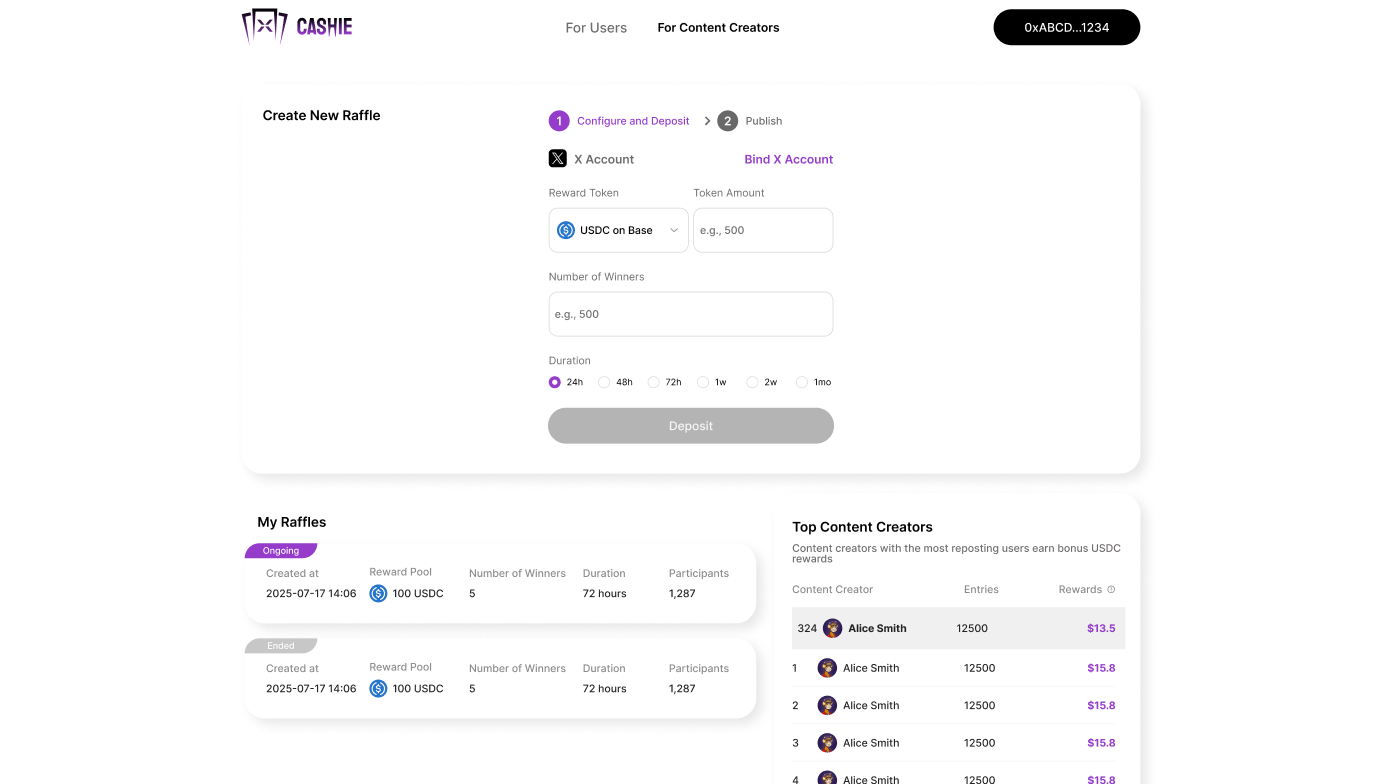
  1. Create a Campaign (Giveaway)

  • Set the reward amount, number of winners, and campaign duration.

  • Authorize the prize pool via a gasless x402 signature.

  • Automatically generate a tweet template ready for posting.

  1. Post the Tweet

Post the template with one click to start accumulating interaction data.

  1. Let the System Run Automatically

Cashie will automatically verify reposts, follows, and all participation criteria; the more participants the campaign attracts, the higher the creator's ranking and the greater the potential rewards.

  1. Automatic Raffle and Reward Distribution

After the campaign ends, the AI agent will automatically conduct a fair draw and send rewards directly to the winners' Base wallets—no scripts, no spreadsheets, no manual work.

Creator Incentives (Creating Raffle Campaigns)
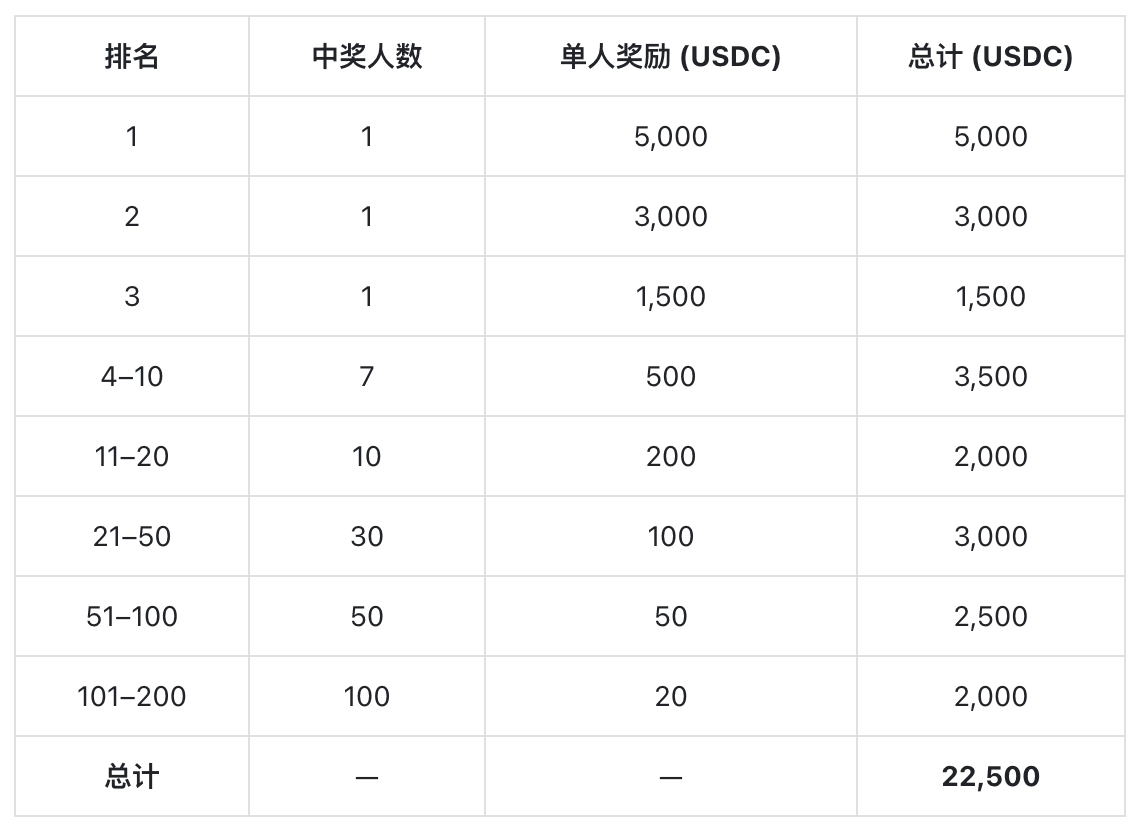
The more people your campaign attracts, the higher your ranking, and the more rewards you can receive.

How Participants Join

  • Participate directly via X (Twitter)

  • Log in with Twitter and link your wallet address

  • No gas fees required throughout the process

  • If selected, rewards are automatically sent to your Base wallet linked to your X account

Participant Incentives (Participating in Raffles)
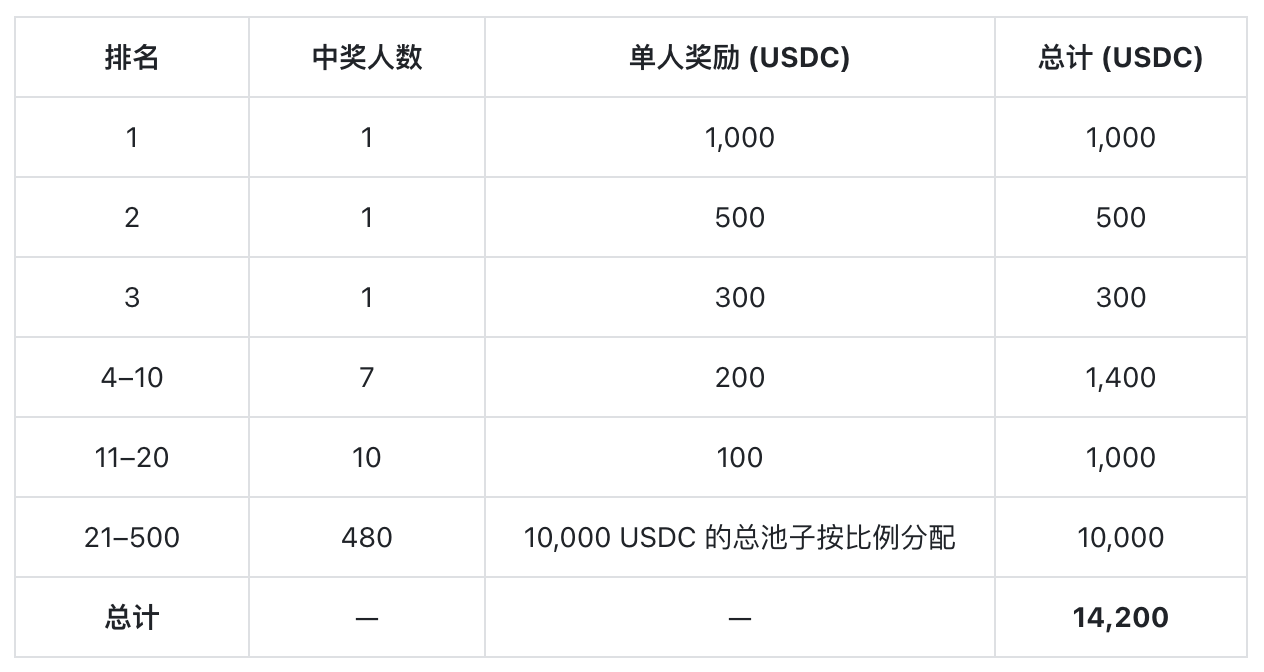
The more campaigns you participate in, the larger your share of the incentive pool.

Next Steps

Cashie is already powering campaigns for numerous creators and projects within the Base ecosystem, but this is just the beginning. Next, Cashie will undergo a series of capability upgrades:

  • Self-Hosted Facilitators: Developers can independently deploy x402 services to build flexible social payment logic on Base.

  • AI Campaign Agents: Based on real-time trends and sentiment changes, AI agents will be able to autonomously launch campaigns, achieving truly data-driven automated growth.

  • Enterprise Integrations: Launch on-chain social growth SDKs for marketing and growth teams, with deep integration solutions for channels like Telegram and Discord.

  • Cashie SDK: Help developers build their own incentive campaign layers more quickly.

These capabilities will propel Cashie to become the core entry point for CARV's Agentic AI and Base's SocialFi ecosystem, moving beyond simple token incentives to allocating resources to truly valuable, verifiable participation.

The birth of Cashie 2.0 signifies a true paradigm shift: for the first time, it precisely connects social attention with on-chain incentives, bringing social capital into a new era that is programmable and verifiable. Cashie is not just a tool, but the infrastructure for a programmable social economy:

  • AI agents execute tasks with clear intent,

  • Users receive fair rewards for genuine interaction,

  • Developers can build new models of collaboration and growth.

As the CARV AI Being roadmap advances to the next stage, Cashie will become the key engine connecting "People ↔ Machines" and "Influence ↔ Value," opening up new spaces for trustless collaboration.

The Social Ledger is finally truly on-chain.

About CARV

CARV is the birthplace of Sovereign AI Beings, where they live, learn, and evolve.

What are AI Beings? They are sovereign intelligences natively born on-chain, possessing purpose, autonomy, and the capacity for continuous growth. AI Beings have memory, identity, perception, and interaction capabilities; they don't just execute commands but can make independent decisions, adapt over time, and pursue self-defined goals.

Relying on CARV's core infrastructure—the CARV SVM chain, the D.A.T.A. framework, and the CARV ID / Agent ID system (ERC-7231)—CARV enables AI Beings to be verifiable, user-authorized, capable of continuous learning and co-creation. Based on CARV's AI-first tech stack, consumer AI applications incubated by CARV Labs have landed on mainstream app markets like Google Play and App Store, reaching billions of users and bringing agent-driven experiences with real-world incentives into global digital life.

To date, CARV has issued 8M+ CARV IDs, has 60K+ verifier nodes, and has integrated 1000+ project ecosystems, connecting AI agents, Web3 infrastructure, and real-world application scenarios to jointly promote the rise of the agent-driven economy. In this system, the $CARV token serves core functions of staking, governance, and coordination, making CARV the "operating system" for AI Beings on Web3.

  • X (Twitter): https://x.com/carv_official

  • Discord: https://discord.com/invite/carv

  • Telegram: https://t.me/carv_official_global

  • Whitepaper: https://docs.carv.io/

Criptos en tendencia

Preguntas relacionadas

QWhat is the core innovation of Cashie 2.0, and how does it bridge the gap between social and economic ledgers?

ACashie 2.0 is a programmable execution layer protocol that bridges the gap between the Social Ledger (recording human signals like likes and retweets on Web2 platforms) and the Economic Ledger (transparent, programmable blockchains). It achieves this by using CARV ID (ERC-7231) as an identity oracle to map social behaviors to on-chain identities, and an AI execution agent (ERC-8004) to automatically verify social interactions and distribute on-chain incentives, transforming social capital into verifiable, executable value.

QWhat are the three core pillars of the Cashie 2.0 architecture?

AThe three core pillars of Cashie 2.0 are: 1) x402 Payment (Pledge Mechanism): An ERC-3009 signature that acts as a gasless, cryptographically secured commitment of funds for an activity. 2) CARV ID (The Proof): An identity system (ERC-7231) that maps social media usernames to on-chain identities, connecting the social and economic ledgers. 3) ERC-8004 Agent (The Executor): A modular AI execution agent comprising tools for payment verification, social monitoring (e.g., Twitter), raffles/quests, and automated reward distribution.

QHow does Cashie 2.0's integration with x402 and its facilitator service enhance security and scalability for developers?

AThe CARV x402 Facilitator service enhances security and scalability by solving a key challenge in the standard x402 (ERC-3009) flow: payment proof state management. Its verify endpoint introduces a robust state and nonce management layer that can instantly reject replayed signatures, providing high-throughput protection by intercepting duplicate settlement attempts before any gas is spent on-chain. This allows for secure, high-performance social payment applications on Base.

QWhat capabilities does the 'AI-native API' provide, and how does it enable an 'agent-to-agent' economy?

AThe AI-native HTTP API fully implements the x402 protocol, allowing any AI agent (from Virtual, Base, or other ecosystems) to programmatically 'hire Cashie' to execute a campaign. The agent sends a request to the API, receives a '402 Payment Required' challenge, resubmits the request with its own X-Payment proof, and thus autonomously initiates the activity with locked funds. This creates a trustless, automated agent-to-agent social business model where AI agents can engage in economic activities on behalf of users.

QWhat is the main value proposition of the Cashie 2.0 Campaign for creators and participants?

AFor creators (KOLs/projects), the campaign allows them to set up reward pools with gasless x402 signatures, automatically generate promotional tweets, and have an AI agent handle all verification, winner selection, and on-chain reward distribution—eliminating manual processes and Sybil attacks. Participants simply engage with the tweet using their social account (linked to a CARV ID and Base wallet) and, if selected, receive rewards automatically without paying gas or revealing wallet addresses, enabling a frictionless experience for converting social engagement into on-chain value.

Lecturas Relacionadas

Luno reduce un 20 % de su plantilla a nivel mundial ante el cambio de prioridades de la plataforma de criptomonedas debido a la automatización

El 28 de julio, James Lanigan, director general de Luno, anunció que la plataforma de intercambio de criptomonedas reducirá el 20 % de su plantilla global. La reestructuración se produce debido a la contracción cíclica del comercio minorista y al aumento de la automatización, aunque la empresa no especificó el número total de empleados afectados. Entre los despedidos hay empleados sudafricanos. Luno, con sede en Londres y operativa en África y Asia, pertenece al grupo estadounidense Digital Currency Group. Esta es la segunda ronda importante de despidos en tres años y medio. En enero de 2023, Luno despidió al 35 % de sus entonces 960 empleados. La empresa está iniciando consultas formales con los afectados en Sudáfrica, donde fue fundada en 2013, siguiendo las leyes laborales locales. La dirección citó el retroceso en la actividad de usuarios minoristas y las inversiones en herramientas automatizadas como factores clave para esta decisión, señalando que la automatización ha transformado las necesidades de recursos. Paralelamente, Luno se reorganiza en tres unidades operativas: una plataforma unificada para consumidores y API institucionales; una división centrada en stablecoins vinculadas a monedas locales, como Zaru (lanzada en febrero de 2026); y un área institucional para operaciones OTC y liquidación transfronteriza. Esta reestructuración sigue a la reducción reciente de la presencia global de Luno, con cese de servicios en algunos mercados a partir del 1 de septiembre de 2026.

cryptonews.ruHace 35 min(s)

Luno reduce un 20 % de su plantilla a nivel mundial ante el cambio de prioridades de la plataforma de criptomonedas debido a la automatización

cryptonews.ruHace 35 min(s)

El volumen de operaciones de UDX de Underdog alcanza los 1,2 millones de dólares en un día, lo que representa aproximadamente el 5% del volumen total estimado de la compañía

Según datos publicados por la bolsa y reportados primero por InGame, la nueva plataforma de predicciones UDX de Underdog registró un volumen nominal de operaciones de 1,2 millones de dólares el 27 de julio. Este hito se alcanzó solo diez días después de sus primeras operaciones de prueba. El volumen nominal contabiliza ambas partes de cada transacción, por lo que no equivale al monto real apostado por los clientes. Este volumen diario representa aproximadamente un 5,4% del volumen medio diario de 22,2 millones de dólares proyectado por Underdog para 2026, según declaraciones de su CEO. Sin embargo, esta cifra es una estimación. Factores como el impulso de la Copa del Mundo (que aumentaría el volumen total) y el enfoque inicial de UDX en contratos simples de béisbol (mientras el volumen total incluye productos combinados en otras plataformas) afectan la comparación directa. Underdog lanzó UDX con ventajas operativas, como una aplicación existente para sus clientes y un programa de creadores de mercado certificado por la CFTC el 2 de julio, evitando así el problema típico de liquidez inicial. La compañía sigue colaborando con bolsas externas (Kalshi, Crypto.com/Nadex) bajo un modelo de múltiples proveedores, por lo que gran parte del volumen histórico reportado por Underdog se canalizó a través de esas plataformas y no en su propia bolsa. Se espera que UDX liste pronto contratos de apuestas combinadas, lo que podría impulsar significativamente su volumen. El principal desafío comercial para Underdog será redirigir una parte sustancial de su flujo de operaciones diario desde las bolsas externas hacia su propia plataforma, UDX.

cryptonews.ruHace 35 min(s)

El volumen de operaciones de UDX de Underdog alcanza los 1,2 millones de dólares en un día, lo que representa aproximadamente el 5% del volumen total estimado de la compañía

cryptonews.ruHace 35 min(s)

«Wrapped XRP» de Coinbase expande las posibilidades de DeFi gracias a la integración con Doppler Finance en la plataforma Base

Doppler Finance, una infraestructura de generación de ingresos de nivel institucional construida sobre XRP Ledger (XRPL), anunció el 29 de julio su expansión a la red Base, comenzando con el Coinbase Wrapped XRP (cbXRP). Esta integración permite que el XRP "envuelto" por Coinbase, un token respaldado 1:1 por XRP, sea utilizado dentro del ecosistema DeFi de Base para préstamos, créditos, garantías y otras aplicaciones financieras descentralizadas. La expansión forma parte de una estrategia multired más amplia de Doppler. En su primera fase, se centrará en soportar cbXRP, con planes de añadir más activos tokenizados en el futuro. Según datos publicados, aproximadamente 105.64 millones de XRP respaldan una cantidad equivalente de cbXRP en circulación, garantizando su plena garantía. Este movimiento se alinea con la expansión de Coinbase de su plataforma Base para soportar pagos, inversiones tokenizadas y servicios DeFi. Representantes de Doppler y Base destacaron que el siguiente paso para las finanzas en cadena es hacer que los activos tokenizados sean productivos de nuevas maneras, como usándolos como colateral. La funcionalidad de XRP continúa creciendo, tanto en su ledger nativo, que recientemente superó un millón de transacciones de sus agentes, como a través de expansiones como esta en ecosistemas compatibles con Ethereum como Base.

cryptonews.ruHace 37 min(s)

«Wrapped XRP» de Coinbase expande las posibilidades de DeFi gracias a la integración con Doppler Finance en la plataforma Base

cryptonews.ruHace 37 min(s)

El Ministerio de Justicia de EE.UU. acusa a un inversor de criptomonedas en relación con un presunto fraude de 20 millones de dólares que afectó a decenas de personas

El Departamento de Justicia de EE.UU. ha acusado al inversor en criptomonedas Benjamin Paul Weiner, de 43 años, por un presunto fraude que causó pérdidas de unos 20 millones de dólares a decenas de víctimas en varios estados. Según la acusación federal de 29 cargos, Weiner habría engañado a inversores con declaraciones falsas para que invirtieran en empresas bajo su control, utilizando después nuevos fondos para gastos personales y pagos a inversores anteriores, en un esquema Ponzi. Los cargos incluyen fraude electrónico, lavado de dinero, fraude bancario y robo de identidad agravado. El caso refleja tácticas similares a otros fraudes con criptomonedas, donde los fondos se mueven a través de múltiples cuentas bancarias y exchanges para ocultar su origen. Las autoridades destacan que, aunque las transacciones de criptoactivos pueden ser complejas, dejan rastros que permiten a los investigadores rastrear los flujos de dinero. Las pérdidas por fraude con criptomonedas siguen aumentando en EE.UU., superando los 11.360 millones de dólares en 2025, según el FBI. La agencia recomienda a los inversores verificar minuciosamente las oportunidades de inversión y reportar cualquier sospecha de fraude. Weiner, que se declaró inocente en su primera comparecencia, se enfrenta a posibles penas de hasta 20 años por fraude electrónico, 30 años por fraude bancario y dos años adicionales por robo de identidad. Su juicio está programado para septiembre de 2026.

cryptonews.ruHace 38 min(s)

El Ministerio de Justicia de EE.UU. acusa a un inversor de criptomonedas en relación con un presunto fraude de 20 millones de dólares que afectó a decenas de personas

cryptonews.ruHace 38 min(s)

Turquía bloqueó 47 493 sitios de apuestas ilegales mientras amplía las medidas contra las cuentas de criptomonedas

Turquía ha bloqueado 47.493 sitios web de apuestas ilegales desde el 1 de enero, ampliando su campaña nacional contra operadores en línea y sus redes de pago. Según el Ministerio del Interior, en 680 operaciones se detuvo a 5.629 sospechosos, con 3.231 en prisión preventiva y 1.515 bajo control judicial. Las autoridades patrullan constantemente sitios de apuestas, anuncios en redes sociales y canales de pago digitales, e investigan cuentas bancarias, de dinero electrónico y de criptoactivos vinculadas a estas actividades. La investigación reveló una red que, coordinada por un sospechoso identificado como İ.Ö.Ö., habría movido unos 4.000 millones de dólares a través de siete carteras de criptomonedas en el extranjero. Los fondos, procedentes de apuestas ilegales y partidos amañados, se habrían blanqueado mediante casas de cambio y joyerías del Gran Bazar antes de llegar a las carteras digitales. Se han bloqueado todas las cuentas bancarias y de criptomonedas relacionadas. En una operación en Adana, se bloquearon 4.742 cuentas bancarias y seis de criptoactivos, con actividad por valor de unos 104 millones de dólares. Los fiscales estiman que durante el Mundial de 2022 se hicieron apuestas ilegales por unos 35.000 millones de dólares, y prevén que para el de 2026 alcancen los 50.000 millones. Para el último partido del Mundial 2022, se identificaron y congelaron simultáneamente 6.314 cuentas bancarias gracias a un sistema de inteligencia artificial llamado AVCI. El ministro de Justicia, Yılmaz Tunç, subrayó la necesidad de "secar el pantano" en lugar de depender de procesamientos aislados, y ordenó a los fiscales provinciales priorizar la coordinación, la recogida de pruebas digitales y el embargo de activos.

cryptonews.ruHace 40 min(s)

Turquía bloqueó 47 493 sitios de apuestas ilegales mientras amplía las medidas contra las cuentas de criptomonedas

cryptonews.ruHace 40 min(s)

Trading

Spot

Artículos destacados

Cómo comprar CARV

¡Bienvenido a HTX.com! Hemos hecho que comprar Carv (CARV) sea simple y conveniente. Sigue nuestra guía paso a paso para iniciar tu viaje de criptos.Paso 1: crea tu cuenta HTXUtiliza tu correo electrónico o número de teléfono para registrarte y obtener una cuenta gratuita en HTX. Experimenta un proceso de registro sin complicaciones y desbloquea todas las funciones.Obtener mi cuentaPaso 2: ve a Comprar cripto y elige tu método de pagoTarjeta de crédito/débito: usa tu Visa o Mastercard para comprar Carv (CARV) al instante.Saldo: utiliza fondos del saldo de tu cuenta HTX para tradear sin problemas.Terceros: hemos agregado métodos de pago populares como Google Pay y Apple Pay para mejorar la comodidad.P2P: tradear directamente con otros usuarios en HTX.Over-the-Counter (OTC): ofrecemos servicios personalizados y tipos de cambio competitivos para los traders.Paso 3: guarda tu Carv (CARV)Después de comprar tu Carv (CARV), guárdalo en tu cuenta HTX. Alternativamente, puedes enviarlo a otro lugar mediante transferencia blockchain o utilizarlo para tradear otras criptomonedas.Paso 4: tradear Carv (CARV)Tradear fácilmente con Carv (CARV) en HTX's mercado spot. Simplemente accede a tu cuenta, selecciona tu par de trading, ejecuta tus trades y monitorea en tiempo real. Ofrecemos una experiencia fácil de usar tanto para principiantes como para traders experimentados.

754 Vistas totalesPublicado en 2024.12.11Actualizado en 2026.06.02

Cómo comprar CARV

Discusiones

Bienvenido a la comunidad de HTX. Aquí puedes mantenerte informado sobre los últimos desarrollos de la plataforma y acceder a análisis profesionales del mercado. A continuación se presentan las opiniones de los usuarios sobre el precio de CARV (CARV).

活动图片