Bitcoin Stabilizes At $68K as Fund Flow Ratios Signal An Institutional Standstill

bitcoinistPublicado a 2026-02-27Actualizado a 2026-02-27

Resumen

Bitcoin is testing the $69,000 resistance level after rebounding from $64,000, though the broader market shows limited conviction. Analyst Darkfost notes that February is set to record the lowest spot trading volumes of 2024, indicating a defensive market posture rather than expansion. Major exchanges like Binance, Gate.io, and Bybit have seen significant volume declines since October, reflecting reduced participation and systemic caution. Shrinking spot volumes suggest weaker conviction and delayed trend formation, as sustained recoveries typically require expanding spot demand. The market's direction hinges on whether spot activity stabilizes or continues to contract amid ongoing liquidity constraints.

Bitcoin is currently testing the $69,000 level as resistance after rebounding from the $64,000 zone, attempting to recover from its recent corrective phase. While the short-term momentum appears constructive, broader market conditions suggest that conviction remains limited. The move higher is unfolding in an environment characterized by reduced participation and compressed liquidity.

According to top analyst Darkfost, February is on track to close as the month with the lowest Bitcoin spot trading volumes since the beginning of 2024. This contraction in activity coincides with BTC revisiting price levels last observed last year, reinforcing the perception of a market stuck in a defensive posture rather than entering a renewed expansion phase.

Despite the slowdown, Binance continues to dominate spot trading with nearly $75 billion in monthly volume, significantly ahead of Gate.io at $25 billion and Bybit at $20 billion. However, overall liquidity across the crypto market remains constrained, particularly following the October 10 shock that saw open interest decline by more than 70,000 BTC — roughly $8 billion in notional value.

Spot Volume Contraction Signals Market Caution

The ongoing decline in spot trading activity provides a useful lens for understanding current Bitcoin market dynamics. Darkfost notes that participation across major exchanges has fallen markedly since the October peak, with aggregate spot volumes roughly halved. Binance’s monthly volume has dropped from about $198 billion to $75 billion, Gate.io from $53 billion to $25 billion, and Bybit from $41 billion to roughly $20 billion. The fact that this pattern spans multiple leading venues suggests a systemic shift rather than exchange-specific behavior.
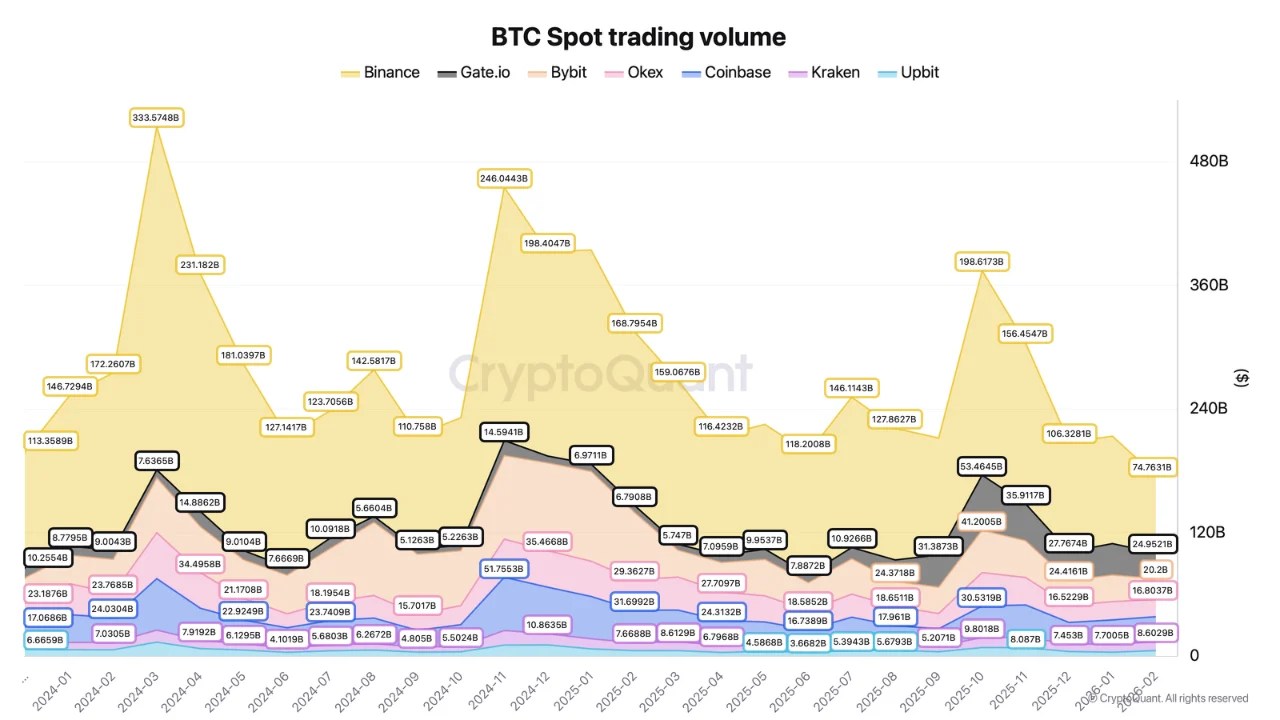
Bitcoin Spot Trading Volume | Source: CryptoQuant

From a market-structure perspective, shrinking spot volumes typically indicate reduced conviction. When liquidity thins, price moves can become less reliable because they are driven by smaller capital flows. This environment often coincides with consolidation phases, where both buyers and sellers adopt a wait-and-see approach rather than aggressively positioning.

Importantly, weaker spot participation can delay trend formation. Sustained bullish recoveries historically require expanding spot demand, as derivatives-driven rallies alone tend to lack durability. Conversely, declining spot flows may also reflect capital rotation toward other asset classes amid macro uncertainty.

The key variable will be whether spot participation stabilizes or begins to recover. A meaningful rebound in volumes would signal renewed confidence, whereas continued contraction would reinforce the current defensive market posture.


Criptos en tendencia

Preguntas relacionadas

QWhat is the current resistance level Bitcoin is testing, and from which zone did it rebound?

ABitcoin is currently testing the $69,000 level as resistance after rebounding from the $64,000 zone.

QAccording to the analyst Darkfost, what is significant about Bitcoin spot trading volumes in February 2024?

AFebruary is on track to close as the month with the lowest Bitcoin spot trading volumes since the beginning of 2024.

QWhich exchange dominates the spot trading market, and what is its approximate monthly volume?

ABinance dominates the spot trading market with nearly $75 billion in monthly volume.

QWhat does a decline in spot trading volume typically indicate from a market-structure perspective?

AShrinking spot volumes typically indicate reduced conviction and can make price moves less reliable as they are driven by smaller capital flows, often coinciding with consolidation phases.

QWhat event in October caused a significant decline in open interest, and what was the approximate notional loss?

AThe October 10 shock caused open interest to decline by more than 70,000 BTC, which is roughly $8 billion in notional value.

Lecturas Relacionadas

Los retiros de Bitcoin continúan: 8 años de almacenamiento en una cartera fría Coldcard terminaron en cero

Retirada de bitcoin continúa: 8 años en cartera fría Coldcard terminan en cero La cartera hardware Coldcard ha sido vulnerada, provocando una nueva oleada de retiradas de fondos de dispositivos afectados. Galaxy Research informa que el volumen total robado asciende a 1.367,05 BTC (unos 88,6 millones de dólares) desde 4.585 direcciones, superando ampliamente los 594,5 BTC reportados inicialmente el 30 de julio de 2026. La mayor parte de lo robado permanece inactiva en las direcciones de los atacantes. El problema no reside en el firmware, que ya fue actualizado por Coinkite, sino en las frases semilla (seed phrases) generadas desde marzo de 2021 debido a un error de programación. Estas frases son fácilmente descifrables, y actualizar el firmware no las cambia. Solo transferir los fondos a una nueva dirección con una nueva frase semilla elimina la vulnerabilidad. El fallo se originó al integrar la biblioteca libNgU, lo que hizo que los dispositivos dejaran de usar el generador de números aleatorios por hardware STM32 y pasaran a usar el generador software Yasmarang, inicializado con datos públicamente accesibles como el número de serie del chip. Afecta a frases semilla creadas en dispositivos Mk2/Mk3 (firmware 4.0.1–4.1.9 y hasta 5.0.3), Mk4/Mk5 (hasta v5.6.0) y Q (hasta v1.5.0Q). Se excluyen aquellas creadas con al menos 50 lanzamientos de dados independientes o una passphrase BIP-39 fuerte y única. Los usuarios deben generar una nueva frase semilla en firmware corregido y transferir sus activos. Un caso ilustrativo es el de un inversor de 39 años que perdió 2 BTC (unos 130.000 dólares) en minutos, ahorrados durante ocho años mediante trabajo físico como protección contra la hiperinflación en su país, con el objetivo de una jubilación anticipada a los 50 años. Su estrategia conservadora de "comprar y mantener en frío" se vio truncada, dejándolo devastado y decidido a abandonar las criptomonedas. Este incidente recuerda vulnerabilidades históricas por generadores de números aleatorios débiles, como la de la biblioteca BitcoinJS (2011-2015), que causó grandes pérdidas. Subraya que el almacenamiento offline no garantiza automáticamente seguridad criptográfica, especialmente cuando la entropía se ve comprometida dentro del propio dispositivo "cerrado".

cryptonews.ruHace 2 hora(s)

Los retiros de Bitcoin continúan: 8 años de almacenamiento en una cartera fría Coldcard terminaron en cero

cryptonews.ruHace 2 hora(s)

Trading

Spot

Artículos destacados

Cómo comprar FLOW

¡Bienvenido a HTX.com! Hemos hecho que comprar Flow (FLOW) sea simple y conveniente. Sigue nuestra guía paso a paso para iniciar tu viaje de criptos.Paso 1: crea tu cuenta HTXUtiliza tu correo electrónico o número de teléfono para registrarte y obtener una cuenta gratuita en HTX. Experimenta un proceso de registro sin complicaciones y desbloquea todas las funciones.Obtener mi cuentaPaso 2: ve a Comprar cripto y elige tu método de pagoTarjeta de crédito/débito: usa tu Visa o Mastercard para comprar Flow (FLOW) al instante.Saldo: utiliza fondos del saldo de tu cuenta HTX para tradear sin problemas.Terceros: hemos agregado métodos de pago populares como Google Pay y Apple Pay para mejorar la comodidad.P2P: tradear directamente con otros usuarios en HTX.Over-the-Counter (OTC): ofrecemos servicios personalizados y tipos de cambio competitivos para los traders.Paso 3: guarda tu Flow (FLOW)Después de comprar tu Flow (FLOW), guárdalo en tu cuenta HTX. Alternativamente, puedes enviarlo a otro lugar mediante transferencia blockchain o utilizarlo para tradear otras criptomonedas.Paso 4: tradear Flow (FLOW)Tradear fácilmente con Flow (FLOW) en HTX's mercado spot. Simplemente accede a tu cuenta, selecciona tu par de trading, ejecuta tus trades y monitorea en tiempo real. Ofrecemos una experiencia fácil de usar tanto para principiantes como para traders experimentados.

426 Vistas totalesPublicado en 2024.12.10Actualizado en 2026.06.02

Cómo comprar FLOW

Discusiones

Bienvenido a la comunidad de HTX. Aquí puedes mantenerte informado sobre los últimos desarrollos de la plataforma y acceder a análisis profesionales del mercado. A continuación se presentan las opiniones de los usuarios sobre el precio de FLOW (FLOW).

活动图片