a16z Releases Top 100 AI Apps List: ChatGPT's Dominance Shakes, Global Market Divides into Three

marsbitPublicado a 2026-03-10Actualizado a 2026-03-10

Resumen

a16z's sixth annual Generative AI Consumer Apps Top 100 reveals a shifting landscape. While it remains the dominant leader with 900M weekly active users, ChatGPT's supremacy is being challenged. Competitors like Gemini and Claude are growing paid subscriptions faster, signaling a battle for the "default AI assistant." The report expands its scope to include established products where AI is now core to the experience, such as Canva, Notion, and CapCut. Key findings include: the market is splitting into three distinct geographic ecosystems (Western, Chinese, and Russian); creative tools are undergoing a major reshuffle as video, music, and voice generation rise while image tools get bundled into larger platforms; agentic AI, capable of taking actions, is emerging with tools like OpenClaw; and AI is increasingly moving beyond browsers and apps into desktops, browsers themselves, and deep integrations into existing software. The competition is evolving from a simple feature war to a strategic battle over building entire ecosystems and operating systems.

Author: ethn, a16z

Compiled by: Deep Tide TechFlow

Deep Tide Guide: a16z has released the sixth edition of its generative AI consumer applications list. ChatGPT has 900 million weekly active users, but Gemini and Claude are growing their paid subscriptions faster. The battle for the "default AI assistant" has officially begun.

The biggest change in this edition is the inclusion of established products like CapCut, Canva, and Notion, where "AI features have become core," alongside the first-time coverage of Agents, AI browsers, and desktop tools.

Author Olivia Moore is a partner on a16z's consumer team. This report is one of the most systematic public datasets currently tracking the landscape of AI consumer applications.

Full text below:

Three years ago, we released the first edition of this list with a simple goal: to figure out which generative AI products were actually being used by mainstream consumers. Back then, the line between "AI-native" companies and others was clear. ChatGPT, Midjourney, and Character.AI were products built from the ground up around foundational models, while the rest of the software world was still figuring out how to use the technology.
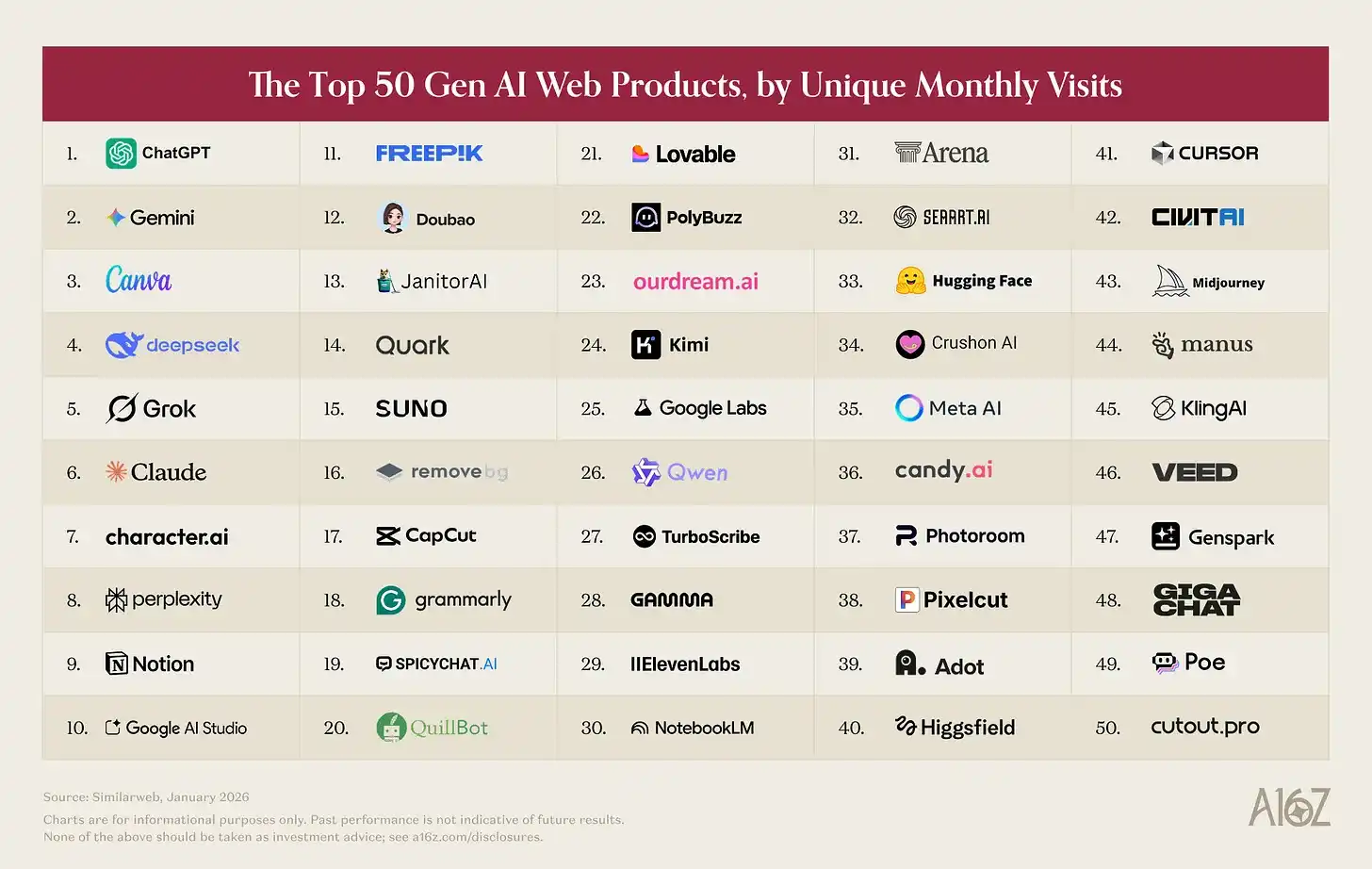
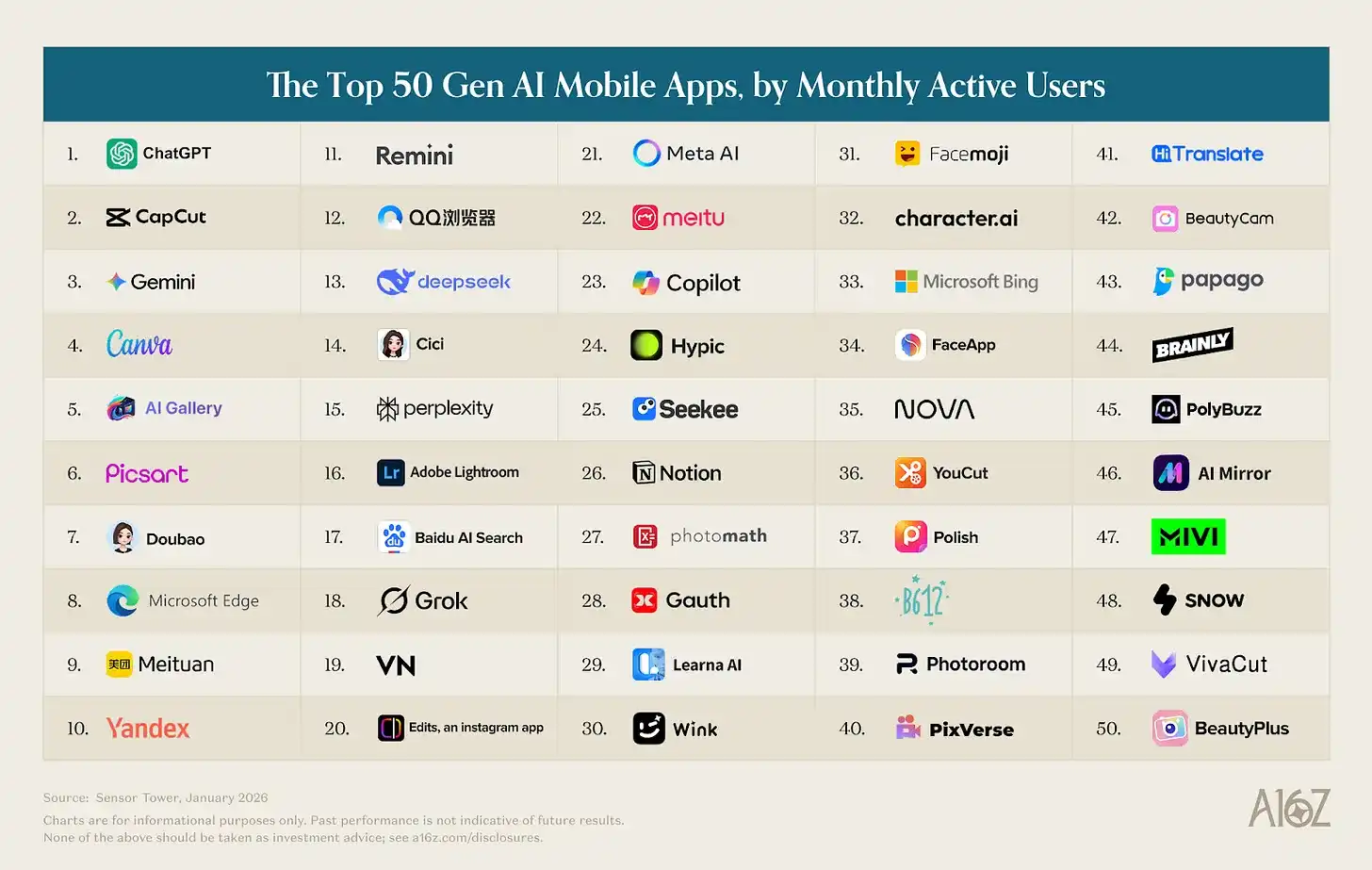
That line no longer holds. CapCut, a video editor with 736 million monthly active mobile users, has its most popular features entirely powered by AI—background removal, AI effects, auto-captions, and text-to-video. Canva's growth engine is completely built on its Magic Suite AI tools. Notion's paid attachment rate for AI soared from 20% to over 50% in a year, with AI features now contributing to about half of the company's ARR.

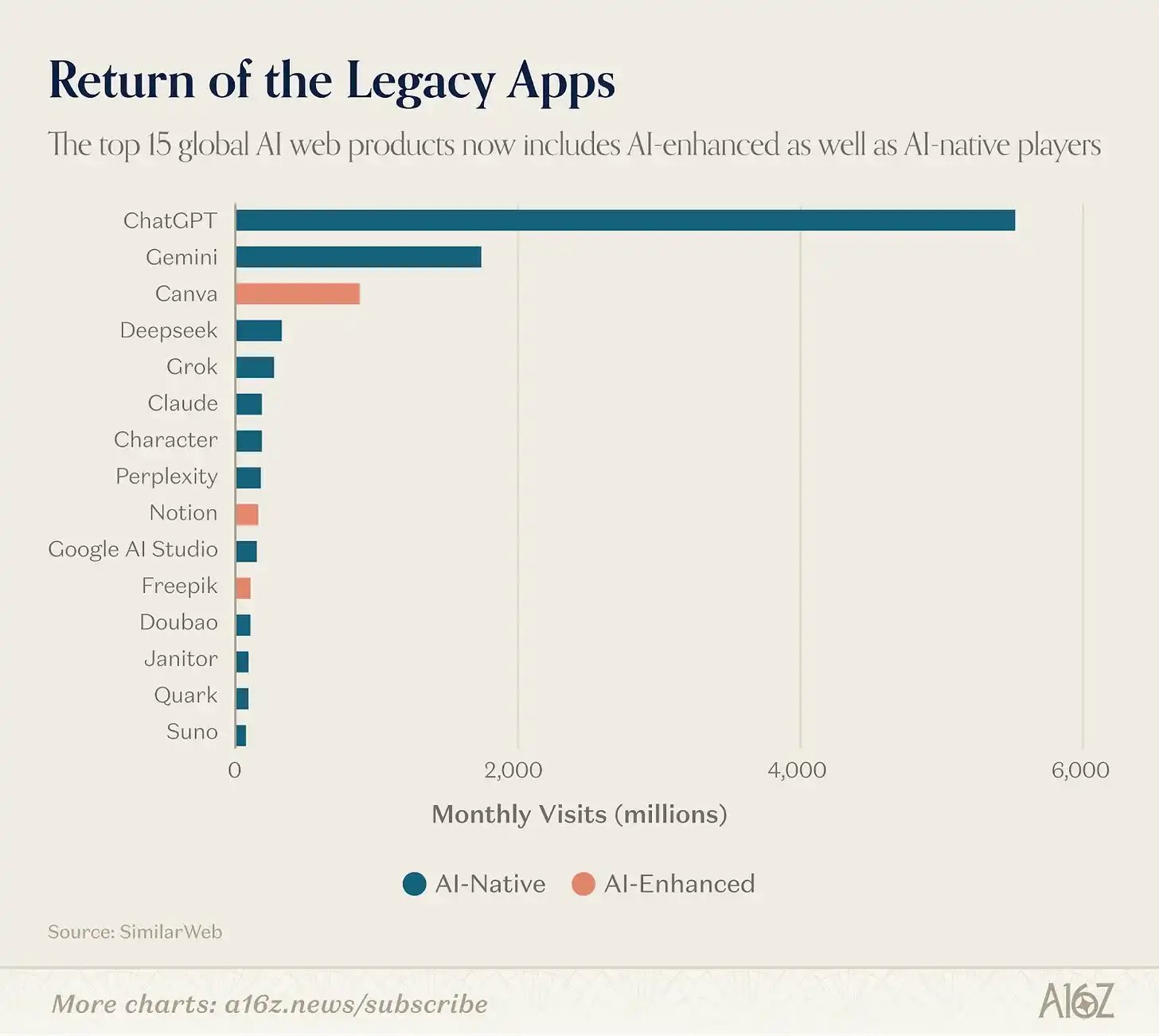
Starting with this edition, we've expanded our scope to include all consumer products where generative AI has become a core part of the experience, including CapCut, Canva, Notion, Picsart, Freepik, and Grammarly. We believe this gives a more accurate picture of how people actually use AI, though the top-ranked products are still mostly AI-native.
Caption: Full Top 100 Generative AI Consumer Applications List, March 2026 Edition

As before, web rankings are based on monthly unique visitors (data source: SimilarWeb, as of January 2026), and mobile rankings are based on monthly active users (data source: Sensor Tower, as of January 2026). Here are our key findings:

1. ChatGPT Leads, But the Battle for the "Default AI" Has Begun

ChatGPT remains the largest consumer AI product by a significant margin. Its web traffic is 2.7 times that of the second-place Gemini, and its mobile MAU is 2.5 times Gemini's. ChatGPT's weekly active users grew by 500 million in the past year, now reaching 900 million. This is staggering given the difficulty of growth at scale—over 10% of the global population uses ChatGPT weekly.
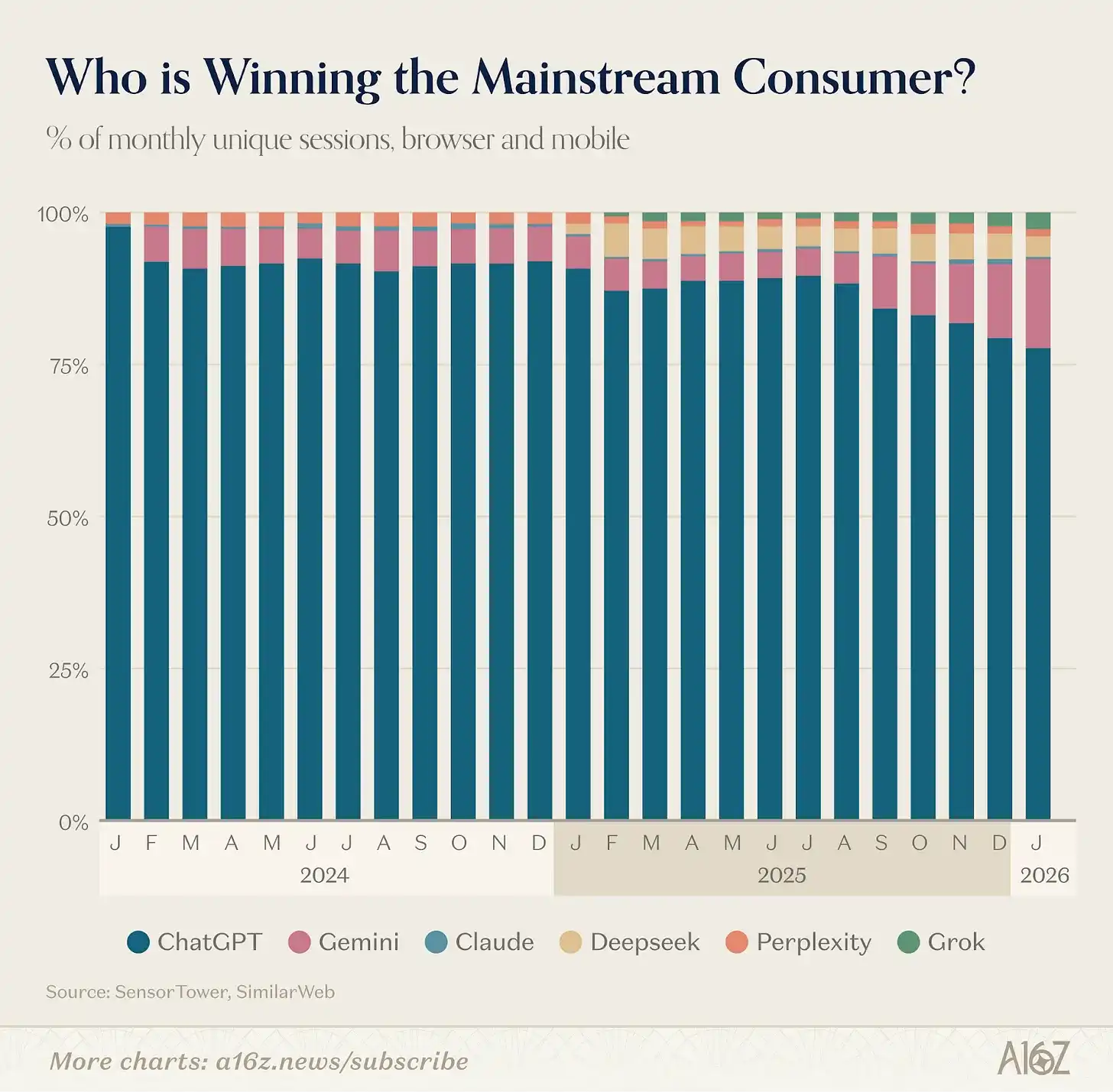
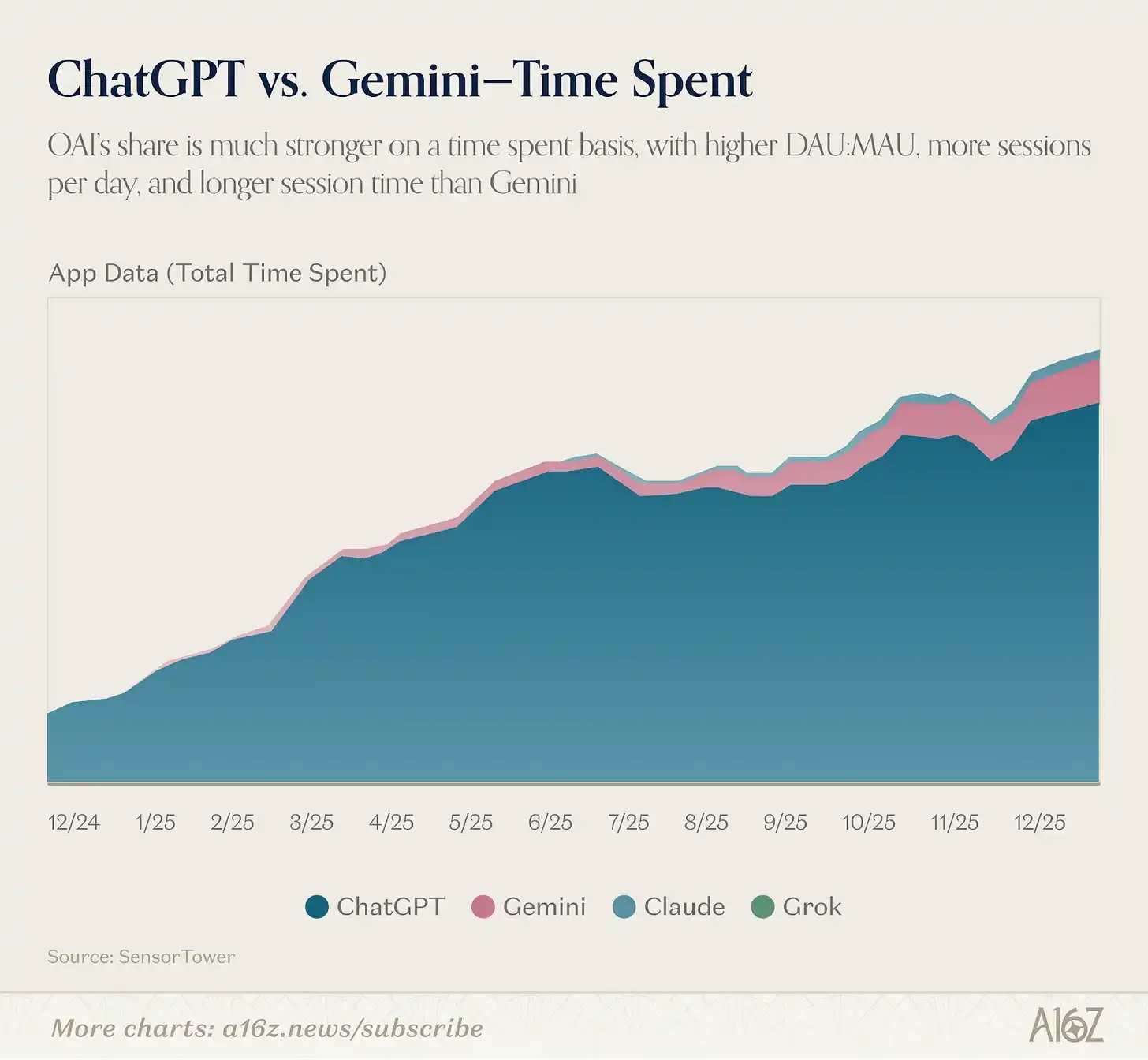
But we're starting to see the field widen, with other general-purpose platforms focusing on specific scenarios. Gemini and Claude's paid subscription growth in the US accelerated over the past year (though they are still far behind ChatGPT in absolute terms—ChatGPT has 8x the paid users of Claude and 4x those of Gemini). According to Yipit Data, as of January 2026, Claude's paid users grew over 200% year-over-year, while Gemini's grew 258%. We also see increasing "multi-platform" behavior—about 20% of ChatGPT's weekly web users also used Gemini in the same week.
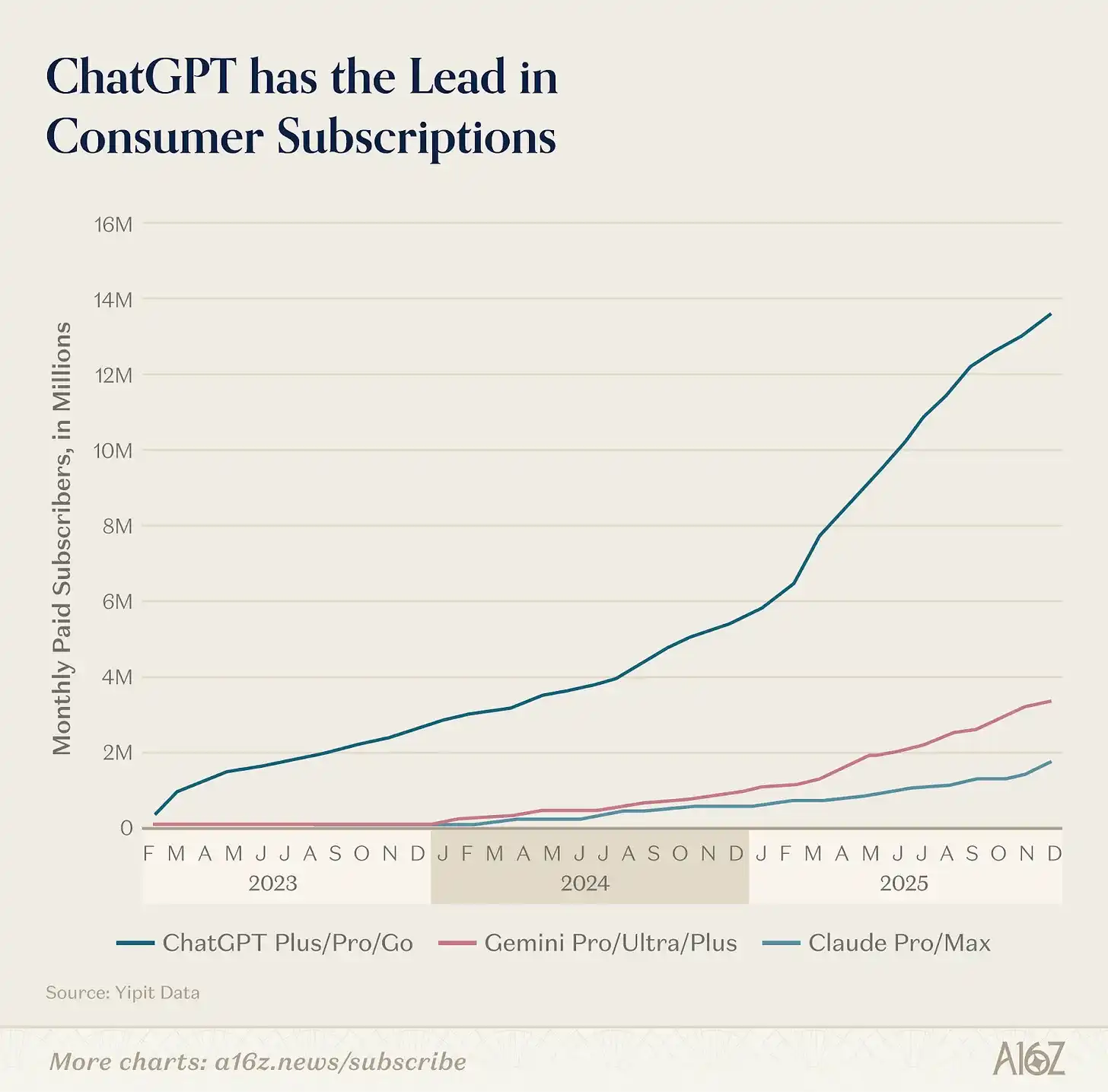
What's happening? Competitors are pushing hard. Google scored a big win with creative models—Nano Banana generated 200 million images in its first week, bringing 10 million new users to Gemini; Veo 3 is widely recognized as a breakthrough moment for AI video. Anthropic is targeting professional users, launching Cowork, Claude in Chrome, Excel and PowerPoint plugins, and most crucially, Claude Code.

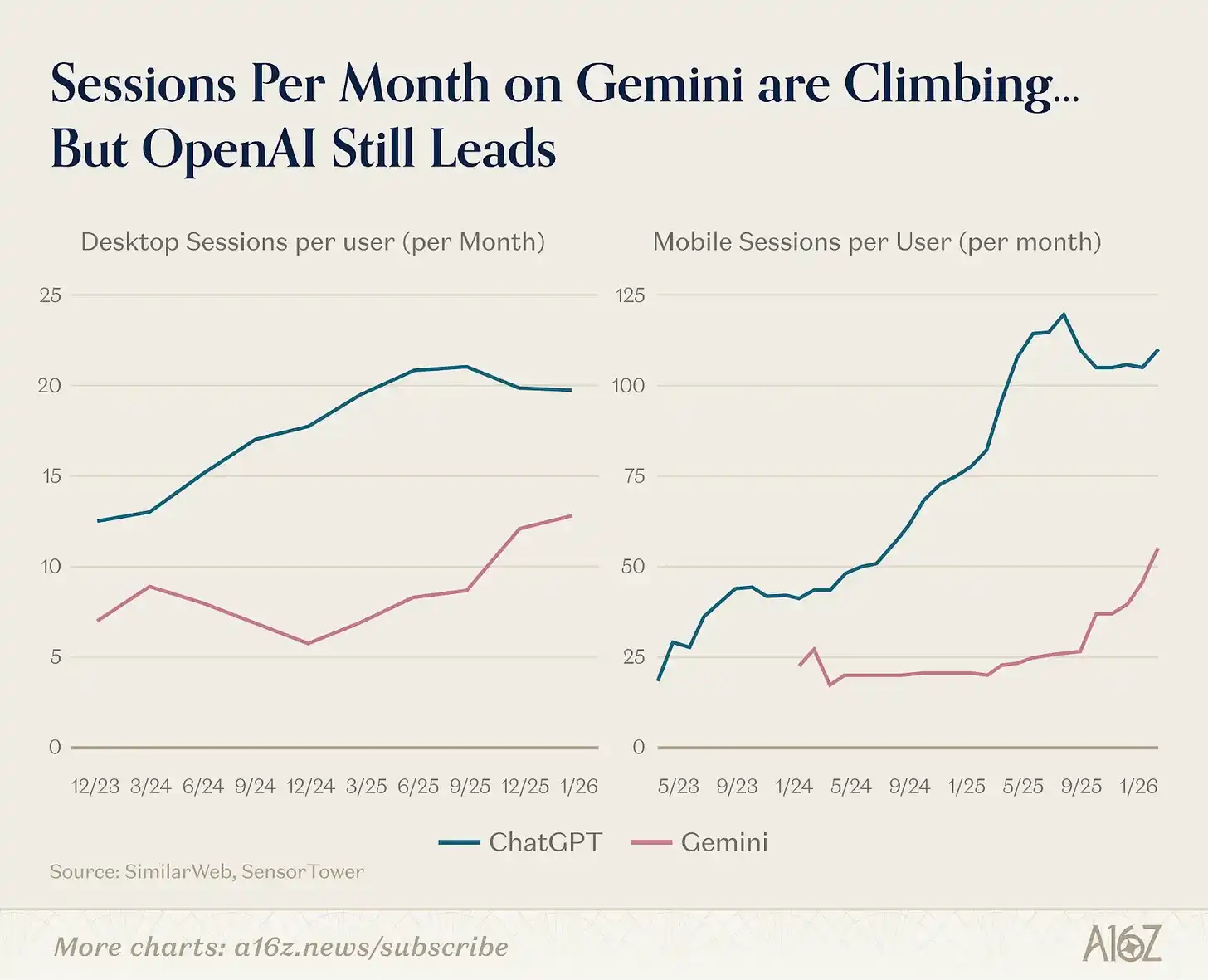
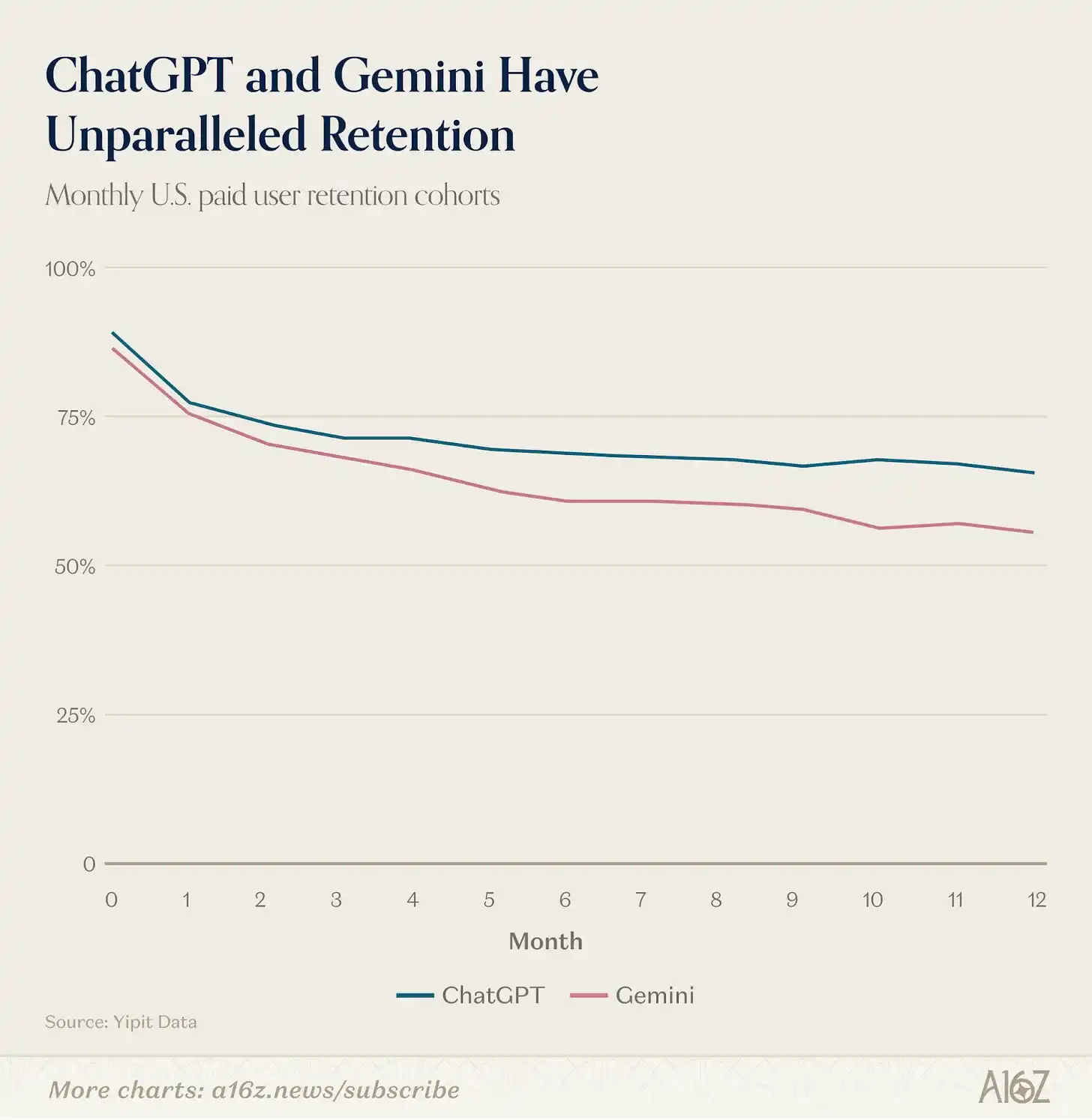
This competition isn't just about who leads today, but who can build structural moats. Context accumulates: the more an LLM knows about you, the better its results, and the more locked-in you become. Early data shows Gemini's average monthly sessions per user on the web are rising, though ChatGPT still leads by 1.3x. On mobile, ChatGPT's advantage is greater, with 2.2x the average monthly sessions per user compared to Gemini. According to Yipit Data, both have top-tier consumer paid user retention rates in the US.
The next layer of lock-in comes from app stores. Both ChatGPT and Claude have launched connector ecosystems—ChatGPT has GPTs and Apps, Claude has MCP integrations and Connectors, allowing users to build workflows on top of the assistants. Once users configure their AI to connect to their calendar, email, and CRM, switching costs rise dramatically. Developers are likely to focus their efforts on the platform with the most users, creating a flywheel effect similar to early platform wars.

We can already see the platforms diverging. Sam Altman previously stated that OpenAI wants to "bring AI to the billions who can't afford a subscription," which is why they started showing ads. He also indicated OpenAI would launch a "Sign in with ChatGPT" identity layer, positioning the AI assistant as the default interface between consumers and the internet. The ambition is to make ChatGPT the starting point for everything: shopping, booking hotels, browsing the web, health management, daily life.

The app directories reflect this divergence. As of late February, ChatGPT's app store covers 13 categories with 220 apps. Claude has about 160 curated connectors plus about 50 community MCP servers. But only 41 apps overlap between the two—roughly 11% of their combined directories—and these 41 are almost all universal productivity tools everyone needs: Slack, Notion, Figma, Gmail, Google Calendar, HubSpot, Stripe.

Beyond core tools, the two platforms are heading in almost completely different directions. ChatGPT has over 85 exclusive apps in categories like travel, shopping, food, health, lifestyle, and entertainment, where Claude has almost none. These are consumer transaction scenarios: booking flights on Expedia, grocery shopping via Instacart, browsing homes on Zillow, tracking nutrition on MyFitnessPal. This is the most aggressive super-app play among all AI companies. Claude's exclusive integrations lean professional: financial data terminals (PitchBook, FactSet, Moody's, MSCI), developer infrastructure (Sentry, Supabase, Snowflake, Databricks), science and medical tools (PubMed, Clinical Trials, Benchling), and an open-source MCP community which has no equivalent on ChatGPT.
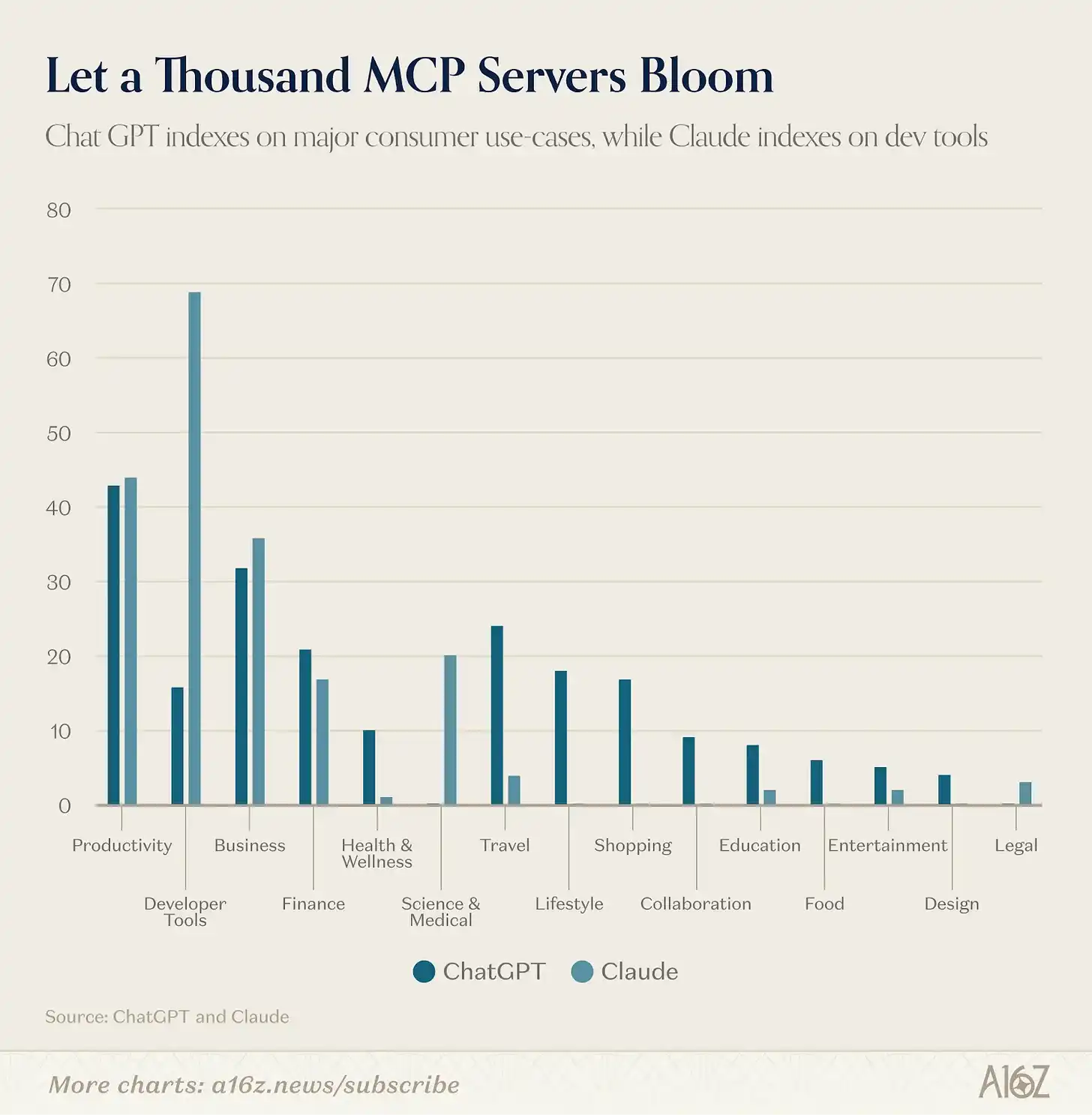
Anthropic seems focused on power AI users (developers, knowledge workers, etc.). These users are more willing and able to pay for expensive direct subscriptions. While ChatGPT also has products for similar audiences (e.g., Codex, Frontier), they are simultaneously aiming to be a platform for truly mass-market users—which could open more monetization paths as the user base grows. They are already testing ads, and transaction fees are a logical extension.

If AI assistants are not just chat windows but OS-level environments, this competition might ultimately resemble the mobile OS wars more than the search wars—two platforms with starkly different philosophies, each building trillion-dollar ecosystems.

2. Global Usage is Splitting Along Product Lines

Geographically, the AI market is splitting into three distinct ecosystems, with the gaps between them widening.
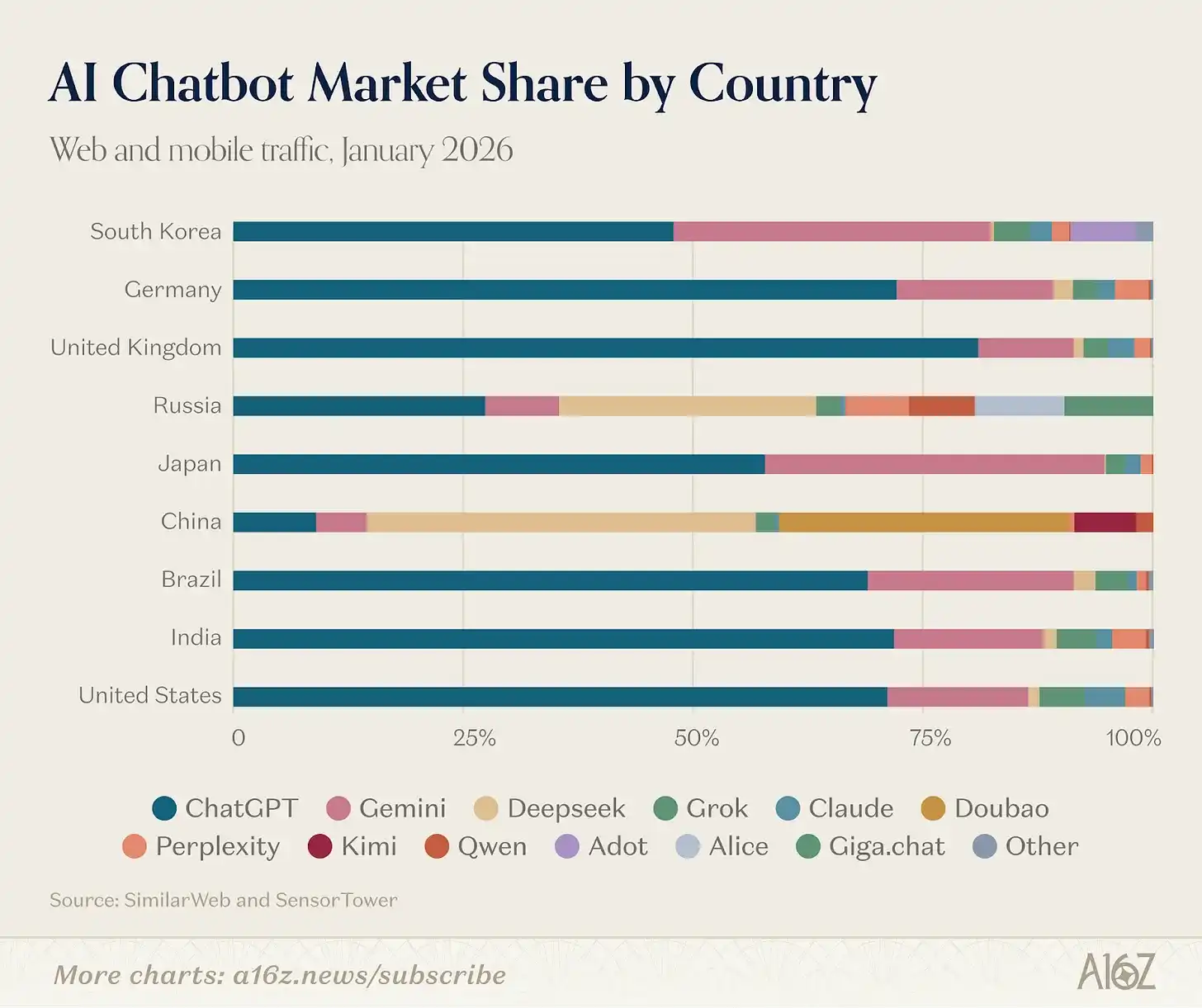
Western AI tools share highly similar user bases. The core markets for ChatGPT, Claude, Gemini, and Perplexity all come from the same pool: the US, India, Brazil, the UK, and Indonesia, just in different orders. None have significant usage in China or Russia. The reason is policy: since 2022, Western tech sanctions have restricted Russian access to US AI tools; China requires AI providers to register, store data locally, and comply with censorship rules.

DeepSeek is the only product that spans multiple camps. Its web traffic is distributed across China (33.5%), Russia (7.1%), and the US (6.6%), with a similar pattern on mobile. Chinese users also heavily use ByteDance's Doubao and local product Kimi.

Russia, which barely registered as a separate market in our early editions, has now become a third pole, with DeepSeek ranking second in penetration. The Yandex browser, integrated with the Alice AI assistant, has 71 million MAU, placing it in the global top 10 mobile AI products. Sber's GigaChat also appears on our web list for the first time. This pattern mirrors China's, just compressed: sanctions created a vacuum, and local products filled it within two years.

To measure AI adoption on a per capita basis, we built a simple index combining web visits per capita and mobile MAU per capita, scored from 0 to 100. The results redefine the geographic landscape. Singapore ranks first, followed by the UAE, Hong Kong, and South Korea. The US—the origin of most AI products—ranks 20th.
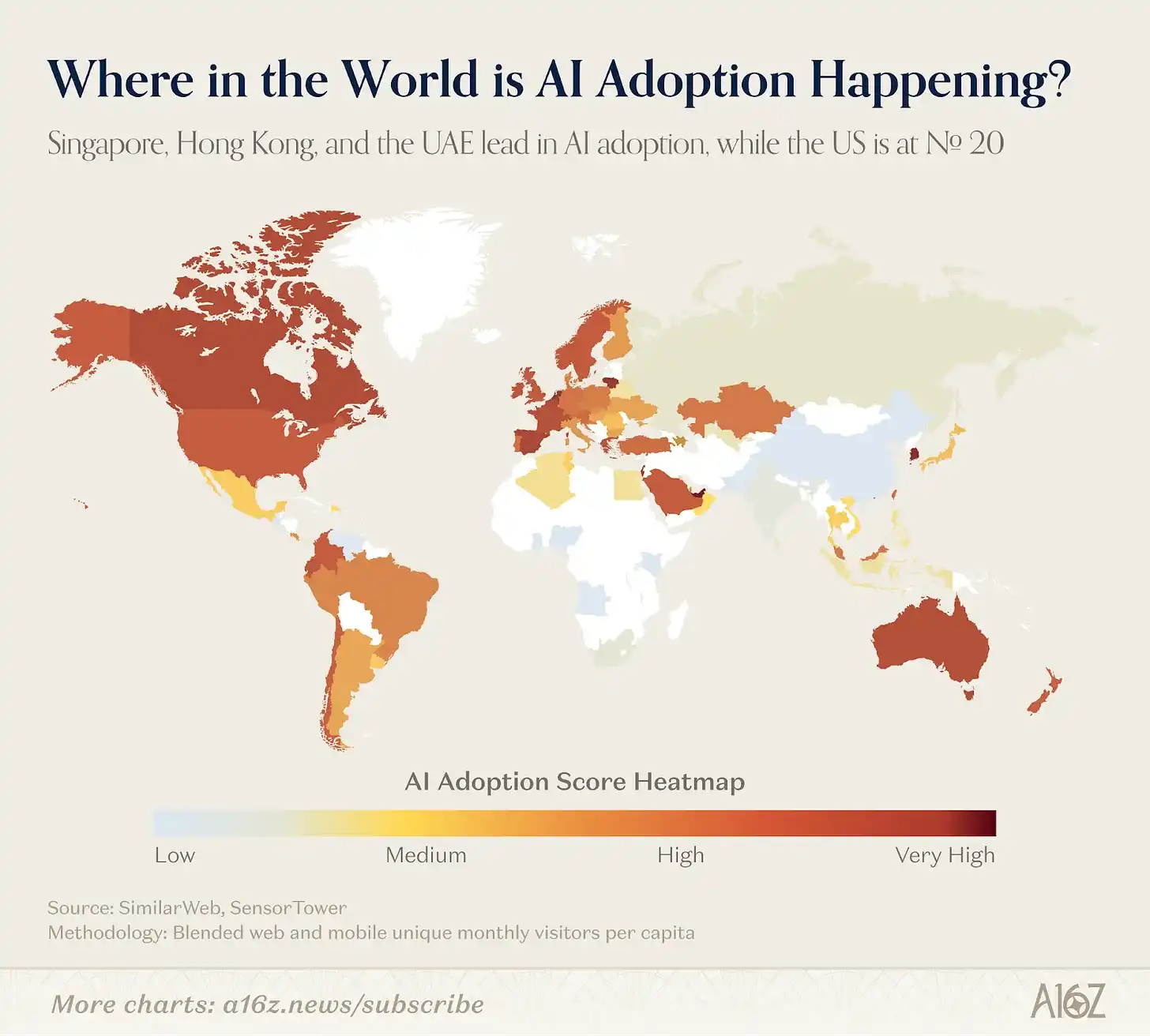
Caption: Generative AI Per Capita Adoption Index (0-100), Singapore leads, US ranks 20th

3. Creative Tools See Major Reshuffle

Midjourney, DALL-E, and Stable Diffusion were the products that brought most early users into the world of generative AI—all three launched before ChatGPT. Image generators not only dominated the creative category (video and audio generation came later) but also held steady positions in the upper tiers of our first three lists. This category has since changed dramatically.

In the first list from September 2023, 7 out of 9 creative tools on the web were image generators. Three years later, only 3 image generators remain on the list, but there are still 7 creative tools. The difference lies in what filled the vacancies: video, music, and voice products have claimed the spots vacated by image generation.
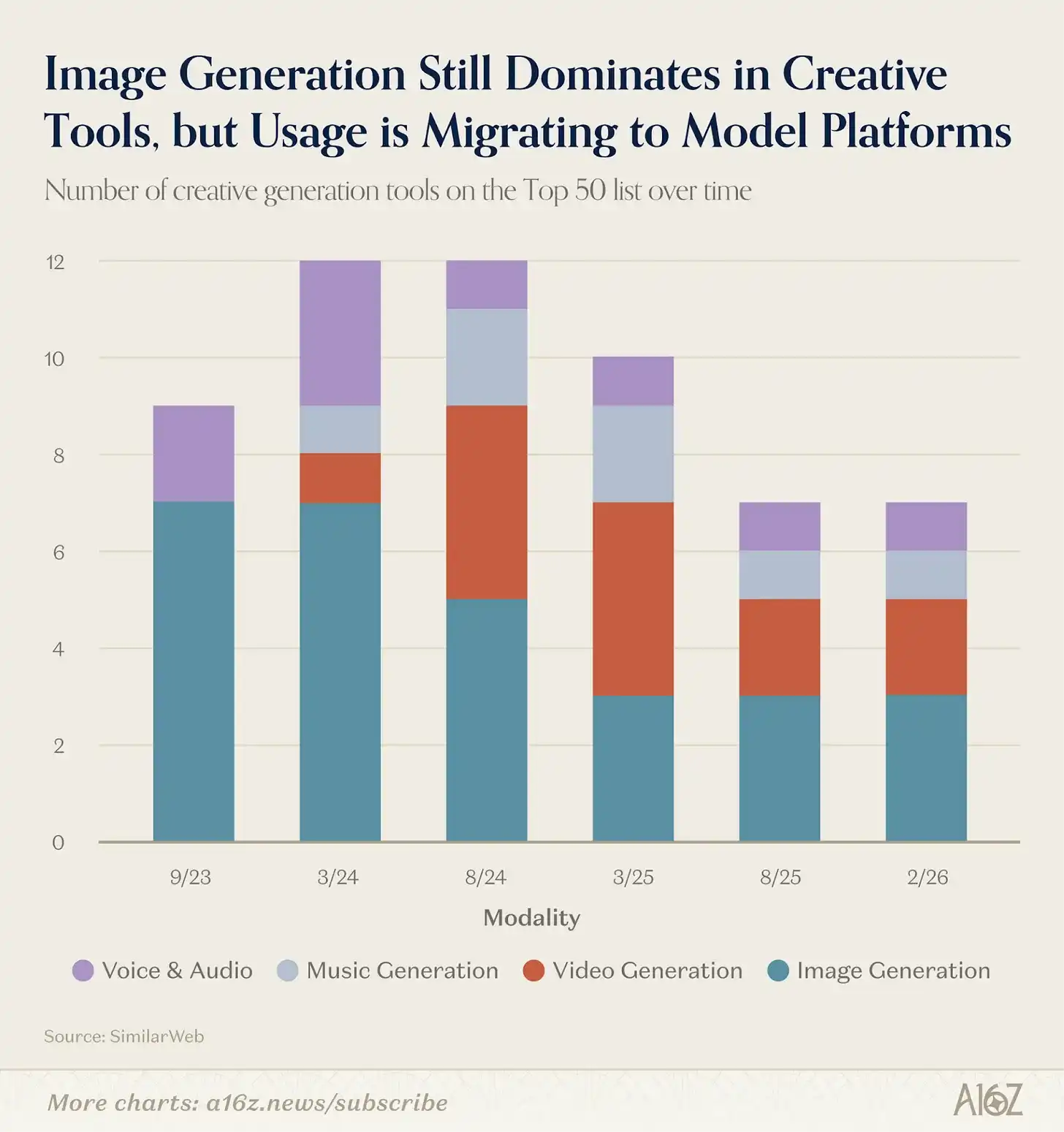
The story of image generation is one of being consumed by bundling. As the quality of built-in image models in ChatGPT (GPT Image 1.5) and Gemini (Nano Banana) improved, the bar for standalone image products rose sharply. Midjourney, which ranked in the top 10 in our first list, has now fallen to 46th place. The products that remain—Leonardo, Ideogram, CivitAI—tend to serve specific creative communities, differentiating with opinionated features rather than competing head-on with general-purpose generators.

Video generation is the area with the most change in this edition. Kling AI, Hailuo, and Pixverse have all built substantial user bases, with Chinese-developed models continuing to lead in output quality. It wouldn't surprise us to see apps based on Seedance 2.0 appear in the next list. Veo 3 was the first US model to close the gap, driving traffic to Google Labs (which rose from rank 36 to 25).

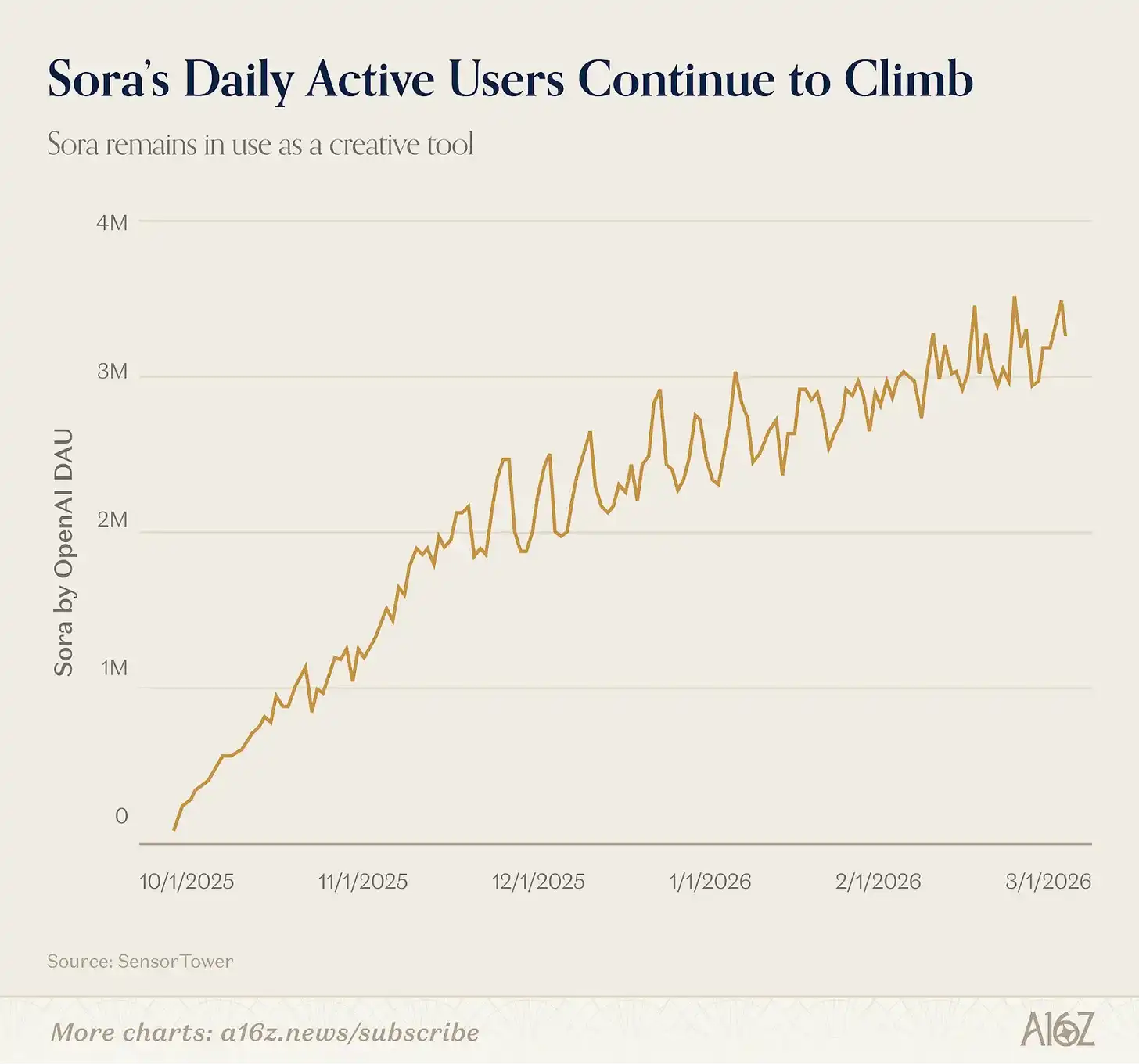
Who's missing? Sora. OpenAI launched Sora 2.0 as a standalone app in September 2025, allowing users to upload their own digital avatars as Cameos to generate videos featuring real people. Sora topped the US App Store charts for 20 consecutive days, reaching 1 million downloads faster than ChatGPT. Downloads subsequently fell back, because Sora failed to sustain viral growth as a social app (no one has cracked the AI × social formula yet), so it didn't make the mobile list this time. But SensorTower data shows Sora still has over 3 million mobile DAU, and AI video creators continue to use the model, even if they publish their work on other platforms.
Music and voice have been more defensible. Suno maintained its ranking from the previous edition (15th). ElevenLabs has been on every list since September 2023; its core capabilities—voice cloning, dubbing, audio production—are specialized enough that they haven't yet been turned into a checkbox feature in a giant's product.

The pattern to summarize: in creative directions where model giants and big players like Google and OpenAI focus (images, and increasingly video), traffic for independent products gets compressed—though there's still room for products targeting niches beyond the mainstream, potentially with higher price points. In directions the giants haven't focused on (music, voice), independent products have more room.

4. Agents Have Arrived

The shift towards agentic AI didn't start with this edition—it began last time, in the form of vibe coding. When Lovable, Cursor, and Bolt appeared on our March 2025 list, they represented something new: AI products that don't just answer questions or generate media, but build things for the user. This is agent behavior, just confined to a vertical.

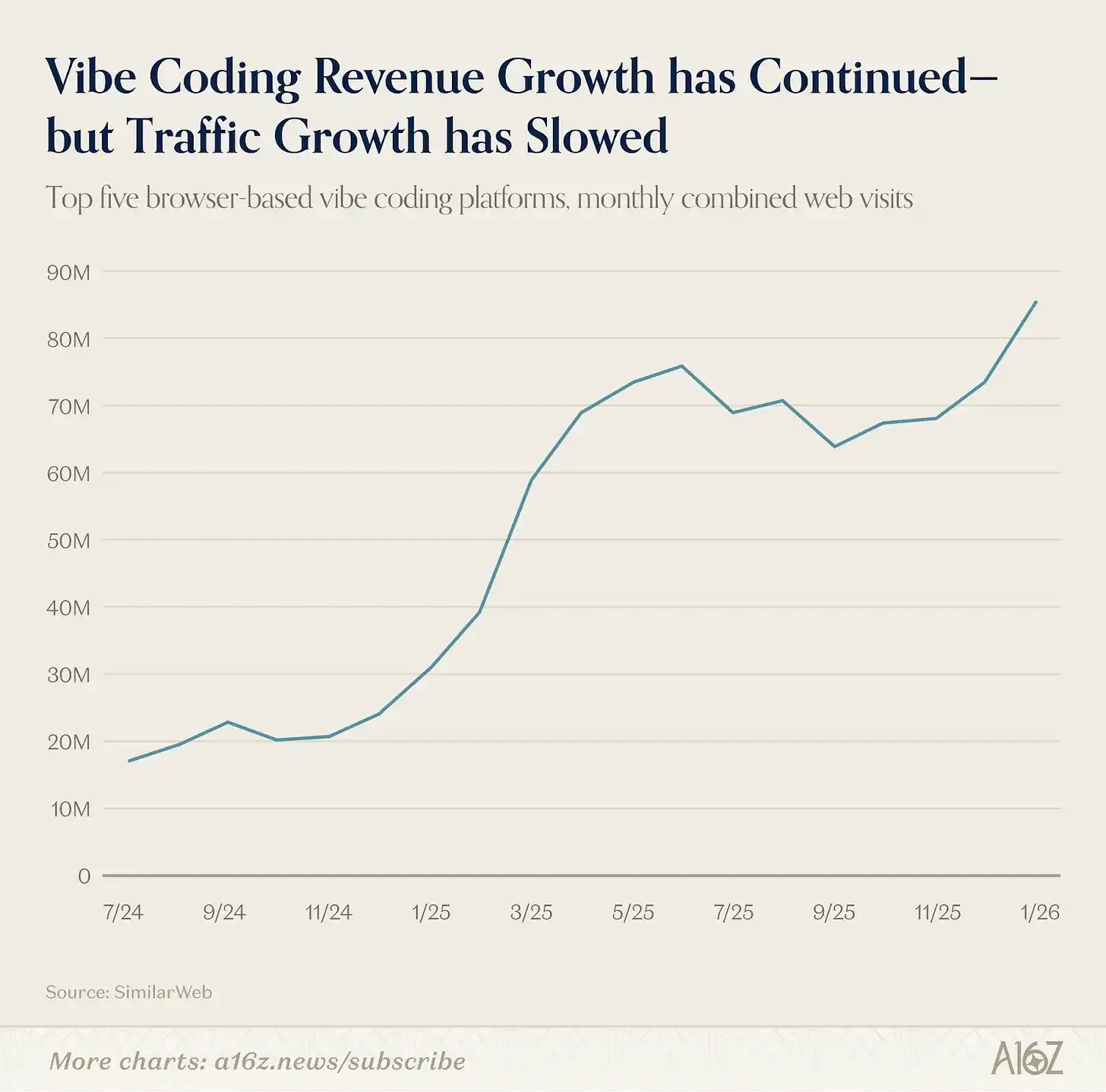
Vibe coding proved its retention capability among technical (and semi-technical) users. Both Replit and Lovable are on this list, as is Claude Code (via Claude). There's more room for growth, as this trend hasn't truly hit the mass market. Traffic for the top five vibe coding platforms is still growing, albeit slower than the initial explosion, but revenue for many products is rising as developers and teams deepen their usage.
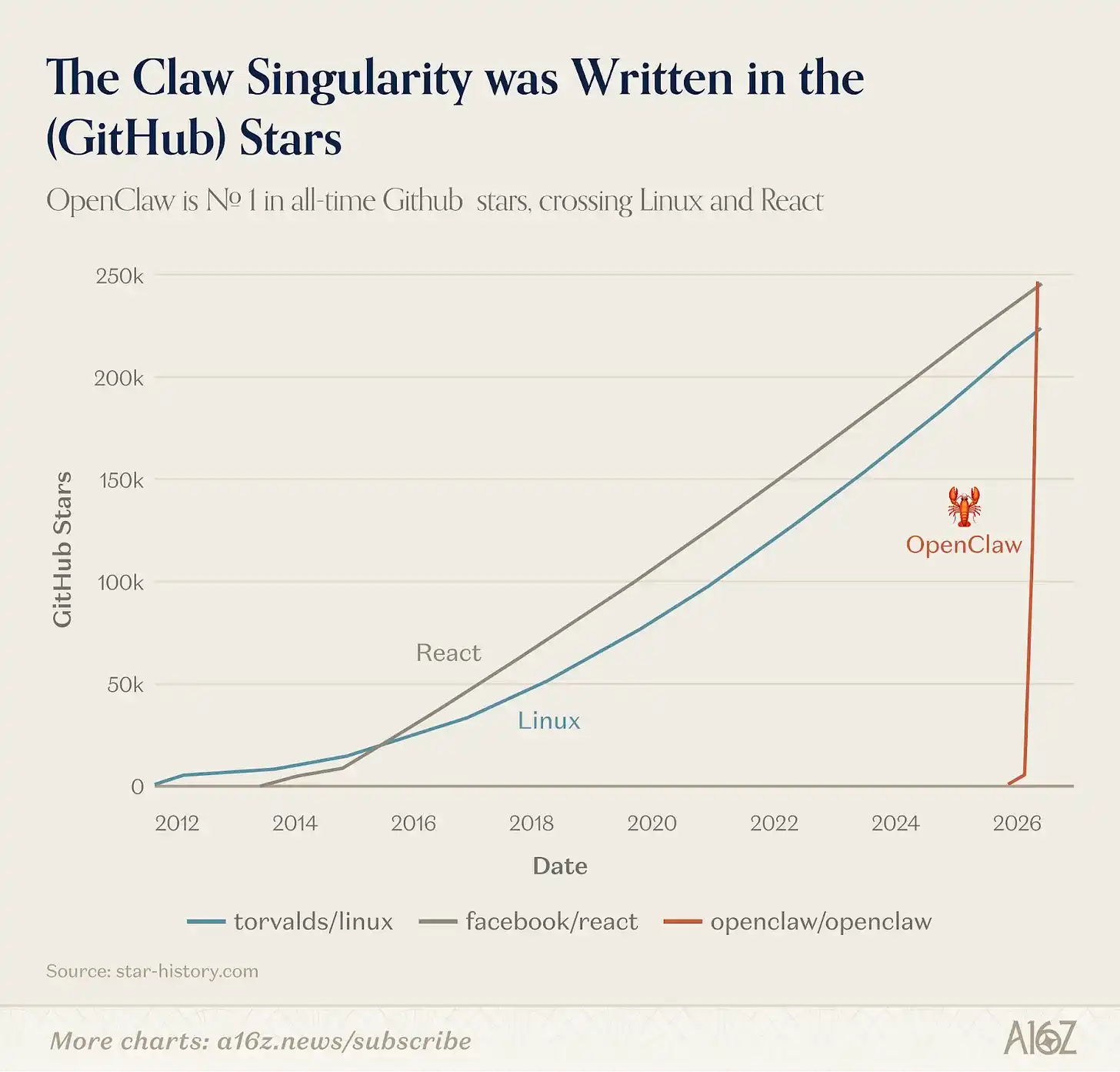
More recently, general-purpose agents have begun to emerge. In January 2026, an open-source project called OpenClaw went from a side project by an independent developer to 68,000 GitHub stars and mainstream media coverage in just weeks. Created by Austrian developer Peter Steinberger, OpenClaw is an AI agent that runs locally, connects to your messaging apps, and performs multi-step tasks on your behalf.

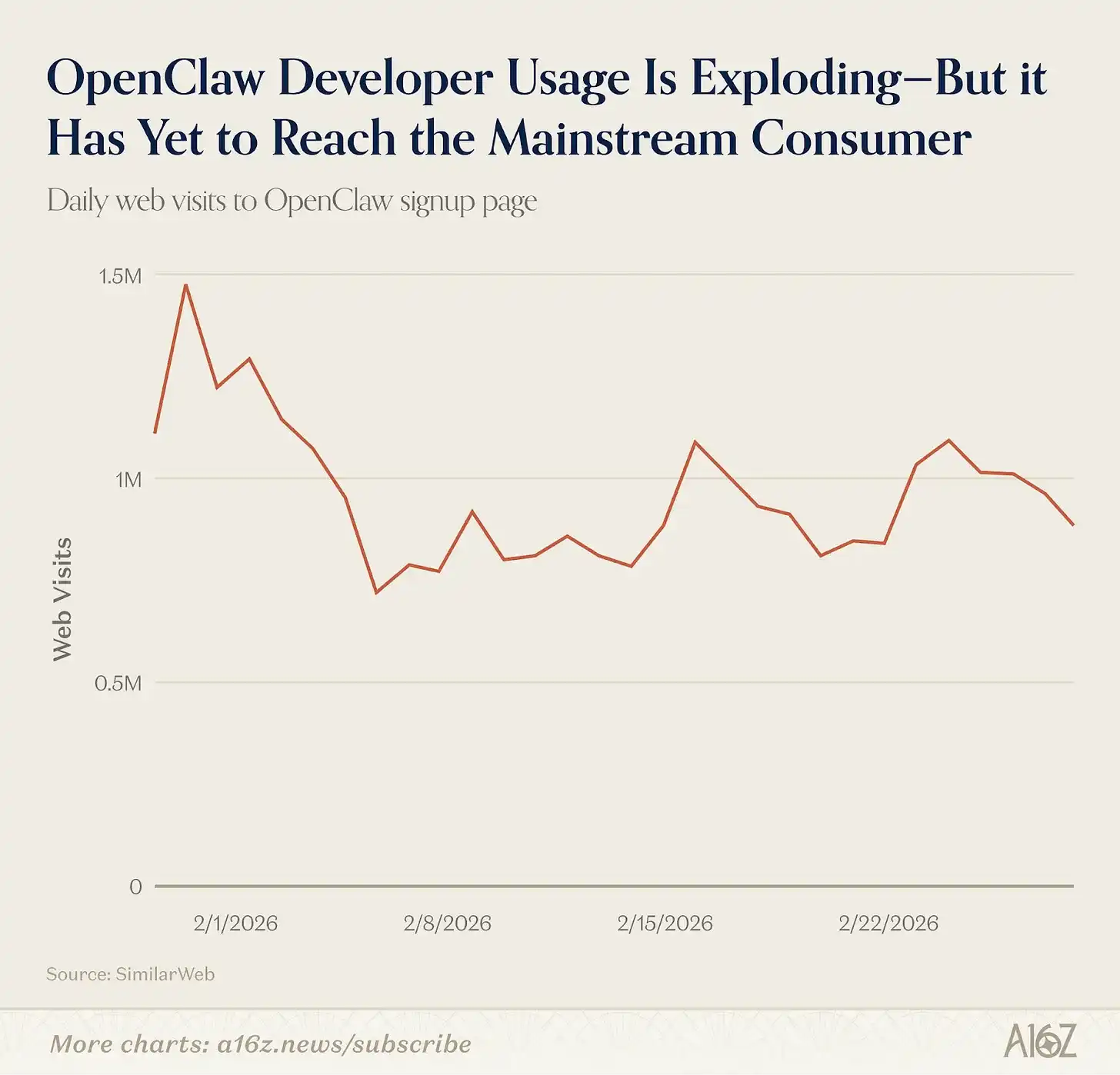
If ChatGPT was the moment consumers discovered AI could converse, OpenClaw might be the moment they discover AI can act. The product exploded in the developer community—if we extended our analysis window to February instead of January, OpenClaw would rank in the web top 30.

But OpenClaw isn't yet a consumer product—installation and maintenance require terminal skills. OpenClaw continues to gain momentum among technical users, becoming the most starred project on GitHub in early March, surpassing React and Linux. But the product hasn't "graduated" to truly mainstream users yet—at least judging by the new visitor data for the OpenClaw installation page, growth has been fairly flat. The project was acquired by OpenAI in February 2026, which might signal a more user-friendly version of OpenClaw is coming.
OpenClaw isn't the only general-purpose agent on the list. Manus and Genspark also made it—both platforms allow consumers to hand off open-ended tasks (research, spreadsheet analysis, slide deck creation) to AI, which completes the entire workflow end-to-end. Manus is on the list for the second time; after its last appearance, it was acquired by Meta for approximately $2 billion in December 2025. Genspark is new to this edition—the company closed a $300 million Series B earlier this year and announced it reached $100 million in annualized revenue.

On mobile, consumers often interact with agents via text, not through a mobile app. Upon installation, users connect OpenClaw to platforms like WhatsApp, Telegram, and Signal, sending it instructions as if messaging a friend, and it executes tasks in the background. Other products like Poke offer similar agent experiences via SMS.

These products will compete directly with the agent capabilities of the general-purpose LLM assistants consumers use every day—ChatGPT, Claude, and Gemini. As these giants build out their own connector and app ecosystems, will consumers choose one as their primary agent? The next six months will give us the answer.

5. AI Moves Beyond the Browser and App

Every previous edition of this list ranked AI products using two metrics: web visits and mobile MAU. But a new class of AI products is emerging that neither metric captures. Some of the most important consumer AI growth over the past year has occurred in products that are completely invisible in these two dimensions.

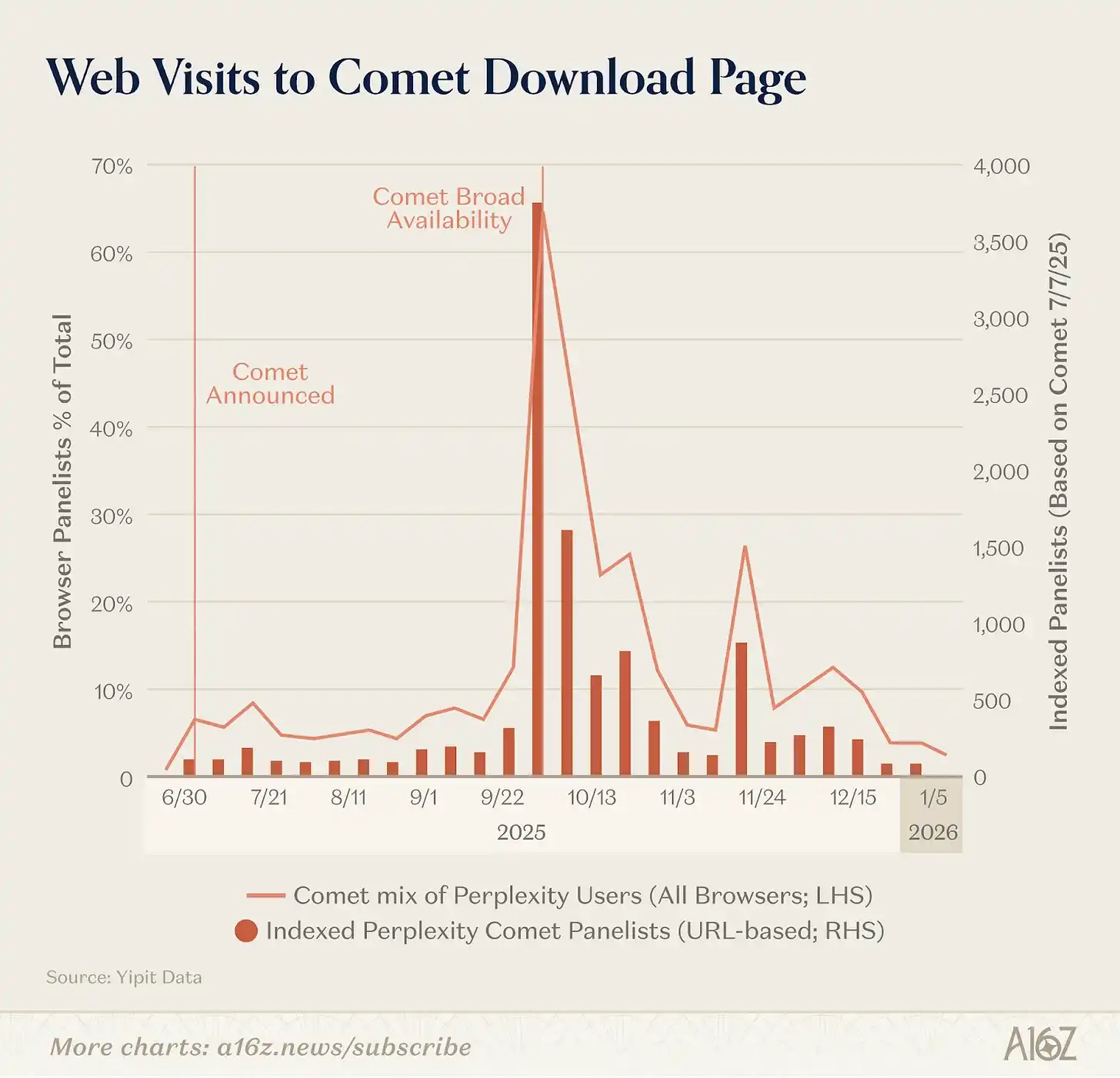
The most obvious change is that the browser itself is becoming an AI product. Over the past nine months, OpenAI released Atlas (a browser with ChatGPT built into every page), Perplexity launched Comet, and Browser Company (later acquired by Atlassian) launched Dia. Yipit data shows Perplexity's Comet has had the biggest impact in the market (measured by download page visits), but no AI browser has yet seen accelerating growth.

Other AI giants have chosen the path of adding AI to existing browsers rather than launching a separate AI browser. Google integrated Gemini into Chrome and released a beta of Disco, which can dynamically generate web apps based on a user's browser tabs. Anthropic released Claude in Chrome, which can connect to a user's Claude or Claude Code session to drive actions on the web.
Growth in native desktop AI tools is even more explosive, especially developer tools. Claude Code—a command-line developer agent—reached $1 billion in annualized revenue in just six months. OpenAI launched a standalone Mac app for Codex, and the company stated Codex had 2 million weekly active users by early March, growing 25% week-over-week. Cursor held its position in the web top 50.

For pure consumers, the most common standalone desktop AI applications are voice-related. Note-taking tools like Fireflies, Fathom, Otter, TL;DV, and Granola reach users through PLG models, gradually penetrating enterprises—the top five players combined have over 20 million visitors. Workspace apps like Notion (on the list for the first time) are also increasingly integrating AI through notetakers, research agents, and even task automation.

Finally, AI is embedding itself more deeply into the tools people already use. Anthropic launched Claude in Excel and Claude in PowerPoint. OpenAI launched ChatGPT for Excel. Google deepened Gemini's integration across the entire Workspace suite—Docs, Sheets, Gmail, and Meet all have native AI features. In January 2026, Google also launched Personal Intelligence, connecting Gemini to Gmail, Google Photos, YouTube, and Search, allowing the assistant to reference your hotel bookings, purchase history, photo library, and watch history without you having to tell it.

The implication for this list: our rankings increasingly underestimate the AI products people use the most. A developer who spends eight hours a day in Claude Code, or a knowledge worker who dictates every email through Wispr, are heavy AI users, but are almost invisible in web traffic data. As AI shifts from a destination to a feature, our methodology needs to evolve too.


Preguntas relacionadas

QWhat are the main findings of a16z's sixth edition of the Top 100 Generative AI Consumer Applications list?

AThe main findings include: 1) ChatGPT remains the dominant AI product but faces growing competition from Gemini and Claude, especially in paid subscriptions; 2) The global AI market is splitting into three distinct ecosystems (Western, Chinese, and Russian); 3) Creative tools are undergoing a major reshuffle, with video, music, and voice generation gaining ground over image generation; 4) AI agents are emerging as a new category, with tools like OpenClaw and Manus gaining traction; 5) AI is increasingly moving beyond browsers and apps into desktop tools, browsers themselves, and embedded integrations.

QHow has the competitive landscape for general AI assistants like ChatGPT, Gemini, and Claude evolved?

AWhile ChatGPT still leads with 900 million weekly active users (2.7x more web traffic than Gemini and 2.5x more mobile MAUs), Gemini and Claude are growing faster paid subscription rates in the U.S. (258% and 200% YoY growth, respectively). About 20% of ChatGPT's weekly web users also use Gemini in the same week. The competition is intensifying around building structural moats through context accumulation, app stores, and differentiated strategies—OpenAI aims for a super-app approach targeting mass consumers, while Anthropic focuses on high-end professional users.

QWhat geographic trends does the report highlight in AI adoption?

AThe global AI market is splitting into three ecosystems: 1) Western tools (ChatGPT, Gemini, Claude, Perplexity) dominate in the U.S., India, Brazil, the U.K., and Indonesia but have negligible usage in China or Russia due to policies; 2) China has its own ecosystem with products like DeepSeek, Doubao, and Kimi; 3) Russia has rapidly developed a local AI market with DeepSeek, Yandex Browser (with Alice AI), and GigaChat. Singapore leads in per capita AI adoption, while the U.S. ranks 20th.

QHow has the creative AI tools category changed since the first edition of the list?

AIn the first list (2023), 7 out of 9 creative tools were image generators. Now, only 3 image generators remain in the top 100, but creative tools still hold 7 spots—with video, music, and voice generation replacing image generation. Image tools like Midjourney declined as giants like ChatGPT and Gemini integrated high-quality image models. Video generation (e.g., Kling AI, Veo 3) saw significant momentum, while music (Suno) and voice (ElevenLabs) tools remain resilient due to their specialized, less-bundled nature.

QWhat are AI agents, and which examples are mentioned in the report?

AAI agents are products that go beyond generating content to taking actions or completing multi-step tasks for users. Examples include: 1) Vibe coding tools like Lovable, Cursor, and Claude Code for developers; 2) General-purpose agents like OpenClaw (an open-source agent for messaging apps), Manus (acquired by Meta), and Genspark (for research and presentations); 3) Mobile agents operating via text (e.g., Poke). These agents compete with the expanding capabilities of major LLM assistants like ChatGPT, Claude, and Gemini.

Lecturas Relacionadas

Bajando las expectativas para el próximo ciclo alcista de BTC

**Resumen del artículo: "Bajar las expectativas para el próximo ciclo alcista de BTC" por Alex Xu** El autor, que tenía a Bitcoin como su mayor activo, ha reducido progresivamente su exposición durante el actual ciclo alcista: eliminó el apalancamiento a 70k y redujo su posición de un 100% a un 30% entre 100k-120k. Recientemente, vendió más a 78k-79k, argumentando una revisión a la baja de las expectativas para el próximo máximo alcista. Las razones principales son: 1. **Narrativa de adopción agotada:** El impulso de adopción masiva (de minorista a institucional vía ETFs) parece agotado. El siguiente paso, la adopción por bancos centrales o fondos soberanos importantes, se ve muy difícil a corto plazo. 2. **Coste de oportunidad:** El autor ha identificado otras oportunidades de inversión en empresas atractivas. 3. **Contracción del ecosistema crypto:** La mayoría de modelos de negocio Web3 (SocialFi, GameFi, DePIN) no han funcionado. Solo DeFi genera valor, pero se contrae por la falta de activos nativos de calidad, lo que reduce la base de usuarios y holders de BTC. 4. **Problemas del mayor comprador:** MicroStrategy, el mayor tenedor corporativo, enfrenta un coste de financiación creciente (11.5% para su préstamo perpetuo), lo que podría ralentizar su ritmo de compra y ejercer presión vendedora. 5. **Competencia del oro tokenizado:** El oro tokenizado ha cerrado la brecha en portabilidad y divisibilidad, erosionando la ventaja competitiva de BTC como "oro digital". 6. **Problema de seguridad:** La reducción de la recompensa por minado (halving) amenaza la seguridad de la red, ya que las nuevas fuentes de ingresos por fees (como las inscripciones) no han podido dar solución. Conclusión: El autor mantiene una posición significativa en BTC y espera que suba, pero es menos optimista sobre su potencial alcista. Vender en la reciente subida fue una decisión táctica. Si sus razones para ser bajista se invalidan, estaría abierto a recomprar, aceptando si se equivoca y el precio sube.

marsbit04/27 02:49

Bajando las expectativas para el próximo ciclo alcista de BTC

marsbit04/27 02:49

Trading

Spot
Futuros

Artículos destacados

Qué es $S$

Entendiendo SPERO: Una Visión General Completa Introducción a SPERO A medida que el panorama de la innovación sigue evolucionando, la aparición de tecnologías web3 y proyectos de criptomonedas juega un papel fundamental en la configuración del futuro digital. Un proyecto que ha llamado la atención en este campo dinámico es SPERO, denotado como SPERO,$$s$. Este artículo tiene como objetivo recopilar y presentar información detallada sobre SPERO, para ayudar a entusiastas e inversores a comprender sus fundamentos, objetivos e innovaciones dentro de los dominios web3 y cripto. ¿Qué es SPERO,$$s$? SPERO,$$s$ es un proyecto único dentro del espacio cripto que busca aprovechar los principios de descentralización y tecnología blockchain para crear un ecosistema que promueva la participación, la utilidad y la inclusión financiera. El proyecto está diseñado para facilitar interacciones entre pares de nuevas maneras, proporcionando a los usuarios soluciones y servicios financieros innovadores. En su esencia, SPERO,$$s$ tiene como objetivo empoderar a los individuos al proporcionar herramientas y plataformas que mejoren la experiencia del usuario en el espacio de las criptomonedas. Esto incluye habilitar métodos de transacción más flexibles, fomentar iniciativas impulsadas por la comunidad y crear caminos para oportunidades financieras a través de aplicaciones descentralizadas (dApps). La visión subyacente de SPERO,$$s$ gira en torno a la inclusividad, buscando cerrar brechas dentro de las finanzas tradicionales mientras aprovecha los beneficios de la tecnología blockchain. ¿Quién es el Creador de SPERO,$$s$? La identidad del creador de SPERO,$$s$ sigue siendo algo oscura, ya que hay recursos públicos limitados que proporcionan información de fondo detallada sobre su(s) fundador(es). Esta falta de transparencia puede derivarse del compromiso del proyecto con la descentralización, una ética que muchos proyectos web3 comparten, priorizando las contribuciones colectivas sobre el reconocimiento individual. Al centrar las discusiones en torno a la comunidad y sus objetivos colectivos, SPERO,$$s$ encarna la esencia del empoderamiento sin señalar a individuos específicos. Como tal, entender la ética y la misión de SPERO es más importante que identificar a un creador singular. ¿Quiénes son los Inversores de SPERO,$$s$? SPERO,$$s$ cuenta con el apoyo de una diversa gama de inversores que van desde capitalistas de riesgo hasta inversores ángeles dedicados a fomentar la innovación en el sector cripto. El enfoque de estos inversores generalmente se alinea con la misión de SPERO, priorizando proyectos que prometen avances tecnológicos sociales, inclusividad financiera y gobernanza descentralizada. Estas fundaciones de inversores suelen estar interesadas en proyectos que no solo ofrecen productos innovadores, sino que también contribuyen positivamente a la comunidad blockchain y sus ecosistemas. El respaldo de estos inversores refuerza a SPERO,$$s$ como un contendiente notable en el rápidamente evolutivo dominio de los proyectos cripto. ¿Cómo Funciona SPERO,$$s$? SPERO,$$s$ emplea un marco multifacético que lo distingue de los proyectos de criptomonedas convencionales. Aquí hay algunas de las características clave que subrayan su singularidad e innovación: Gobernanza Descentralizada: SPERO,$$s$ integra modelos de gobernanza descentralizada, empoderando a los usuarios para participar activamente en los procesos de toma de decisiones sobre el futuro del proyecto. Este enfoque fomenta un sentido de propiedad y responsabilidad entre los miembros de la comunidad. Utilidad del Token: SPERO,$$s$ utiliza su propio token de criptomoneda, diseñado para servir a diversas funciones dentro del ecosistema. Estos tokens permiten transacciones, recompensas y la facilitación de servicios ofrecidos en la plataforma, mejorando la participación y utilidad general. Arquitectura en Capas: La arquitectura técnica de SPERO,$$s$ soporta la modularidad y escalabilidad, permitiendo la integración fluida de características y aplicaciones adicionales a medida que el proyecto evoluciona. Esta adaptabilidad es fundamental para mantener la relevancia en el siempre cambiante paisaje cripto. Participación de la Comunidad: El proyecto enfatiza iniciativas impulsadas por la comunidad, empleando mecanismos que incentivan la colaboración y la retroalimentación. Al nutrir una comunidad sólida, SPERO,$$s$ puede abordar mejor las necesidades de los usuarios y adaptarse a las tendencias del mercado. Enfoque en la Inclusión: Al ofrecer tarifas de transacción bajas y interfaces amigables para el usuario, SPERO,$$s$ busca atraer a una base de usuarios diversa, incluyendo a individuos que anteriormente pueden no haber participado en el espacio cripto. Este compromiso con la inclusión se alinea con su misión general de empoderamiento a través de la accesibilidad. Cronología de SPERO,$$s$ Entender la historia de un proyecto proporciona información crucial sobre su trayectoria de desarrollo y hitos. A continuación, se presenta una cronología sugerida que mapea eventos significativos en la evolución de SPERO,$$s$: Fase de Conceptualización e Ideación: Las ideas iniciales que forman la base de SPERO,$$s$ fueron concebidas, alineándose estrechamente con los principios de descentralización y enfoque comunitario dentro de la industria blockchain. Lanzamiento del Whitepaper del Proyecto: Tras la fase conceptual, se publicó un whitepaper completo que detalla la visión, objetivos e infraestructura tecnológica de SPERO,$$s$ para generar interés y retroalimentación de la comunidad. Construcción de Comunidad y Primeras Interacciones: Se realizaron esfuerzos de divulgación activa para construir una comunidad de primeros adoptantes e inversores potenciales, facilitando discusiones en torno a los objetivos del proyecto y obteniendo apoyo. Evento de Generación de Tokens: SPERO,$$s$ llevó a cabo un evento de generación de tokens (TGE) para distribuir sus tokens nativos a los primeros seguidores y establecer liquidez inicial dentro del ecosistema. Lanzamiento de la dApp Inicial: La primera aplicación descentralizada (dApp) asociada con SPERO,$$s$ se puso en marcha, permitiendo a los usuarios interactuar con las funcionalidades centrales de la plataforma. Desarrollo Continuo y Alianzas: Actualizaciones y mejoras continuas en las ofertas del proyecto, incluyendo alianzas estratégicas con otros actores en el espacio blockchain, han moldeado a SPERO,$$s$ en un jugador competitivo y en evolución en el mercado cripto. Conclusión SPERO,$$s$ se erige como un testimonio del potencial de web3 y las criptomonedas para revolucionar los sistemas financieros y empoderar a los individuos. Con un compromiso con la gobernanza descentralizada, la participación comunitaria y funcionalidades diseñadas de manera innovadora, allana el camino hacia un paisaje financiero más inclusivo. Como con cualquier inversión en el rápidamente evolutivo espacio cripto, se anima a los potenciales inversores y usuarios a investigar a fondo y participar de manera reflexiva con los desarrollos en curso dentro de SPERO,$$s$. El proyecto muestra el espíritu innovador de la industria cripto, invitando a una exploración más profunda de sus innumerables posibilidades. Aunque el viaje de SPERO,$$s$ aún se está desarrollando, sus principios fundamentales pueden, de hecho, influir en el futuro de cómo interactuamos con la tecnología, las finanzas y entre nosotros en ecosistemas digitales interconectados.

74 Vistas totalesPublicado en 2024.12.17Actualizado en 2024.12.17

Qué es $S$

Qué es AGENT S

Agent S: El Futuro de la Interacción Autónoma en Web3 Introducción En el paisaje en constante evolución de Web3 y las criptomonedas, las innovaciones están redefiniendo continuamente cómo los individuos interactúan con las plataformas digitales. Uno de estos proyectos pioneros, Agent S, promete revolucionar la interacción humano-computadora a través de su marco agente abierto. Al allanar el camino para interacciones autónomas, Agent S tiene como objetivo simplificar tareas complejas, ofreciendo aplicaciones transformadoras en inteligencia artificial (IA). Esta exploración detallada se adentrará en las complejidades del proyecto, sus características únicas y las implicaciones para el dominio de las criptomonedas. ¿Qué es Agent S? Agent S se presenta como un marco agente abierto revolucionario, diseñado específicamente para abordar tres desafíos fundamentales en la automatización de tareas informáticas: Adquisición de Conocimiento Específico del Dominio: El marco aprende de manera inteligente a partir de diversas fuentes de conocimiento externas y experiencias internas. Este enfoque dual le permite construir un rico repositorio de conocimiento específico del dominio, mejorando su rendimiento en la ejecución de tareas. Planificación a Largo Plazo de Tareas: Agent S emplea planificación jerárquica aumentada por la experiencia, un enfoque estratégico que facilita la descomposición y ejecución eficiente de tareas intrincadas. Esta característica mejora significativamente su capacidad para gestionar múltiples subtareas de manera eficiente y efectiva. Manejo de Interfaces Dinámicas y No Uniformes: El proyecto introduce la Interfaz Agente-Computadora (ACI), una solución innovadora que mejora la interacción entre agentes y usuarios. Utilizando Modelos de Lenguaje Multimodal Grandes (MLLMs), Agent S puede navegar y manipular diversas interfaces gráficas de usuario sin problemas. A través de estas características pioneras, Agent S proporciona un marco robusto que aborda las complejidades involucradas en la automatización de la interacción humana con las máquinas, preparando el terreno para innumerables aplicaciones en IA y más allá. ¿Quién es el Creador de Agent S? Aunque el concepto de Agent S es fundamentalmente innovador, la información específica sobre su creador sigue siendo elusiva. El creador es actualmente desconocido, lo que resalta ya sea la etapa incipiente del proyecto o la elección estratégica de mantener a los miembros fundadores en el anonimato. Independientemente de la anonimidad, el enfoque sigue siendo las capacidades y el potencial del marco. ¿Quiénes son los Inversores de Agent S? Dado que Agent S es relativamente nuevo en el ecosistema criptográfico, la información detallada sobre sus inversores y patrocinadores financieros no está documentada explícitamente. La falta de información disponible públicamente sobre las bases de inversión u organizaciones que apoyan el proyecto plantea preguntas sobre su estructura de financiamiento y hoja de ruta de desarrollo. Comprender el respaldo es crucial para evaluar la sostenibilidad del proyecto y su posible impacto en el mercado. ¿Cómo Funciona Agent S? En el núcleo de Agent S se encuentra tecnología de vanguardia que le permite funcionar de manera efectiva en diversos entornos. Su modelo operativo se basa en varias características clave: Interacción Humano-Computadora: El marco ofrece planificación avanzada de IA, esforzándose por hacer que las interacciones con las computadoras sean más intuitivas. Al imitar el comportamiento humano en la ejecución de tareas, promete elevar las experiencias de los usuarios. Memoria Narrativa: Empleada para aprovechar experiencias de alto nivel, Agent S utiliza memoria narrativa para hacer un seguimiento de las historias de tareas, mejorando así sus procesos de toma de decisiones. Memoria Episódica: Esta característica proporciona a los usuarios orientación paso a paso, permitiendo que el marco ofrezca apoyo contextual a medida que se desarrollan las tareas. Soporte para OpenACI: Con la capacidad de funcionar localmente, Agent S permite a los usuarios mantener el control sobre sus interacciones y flujos de trabajo, alineándose con la ética descentralizada de Web3. Fácil Integración con APIs Externas: Su versatilidad y compatibilidad con diversas plataformas de IA aseguran que Agent S pueda integrarse sin problemas en ecosistemas tecnológicos existentes, convirtiéndolo en una opción atractiva para desarrolladores y organizaciones. Estas funcionalidades contribuyen colectivamente a la posición única de Agent S dentro del espacio cripto, ya que automatiza tareas complejas y de múltiples pasos con una intervención humana mínima. A medida que el proyecto evoluciona, sus aplicaciones potenciales en Web3 podrían redefinir cómo se desarrollan las interacciones digitales. Cronología de Agent S El desarrollo y los hitos de Agent S pueden encapsularse en una cronología que destaca sus eventos significativos: 27 de septiembre de 2024: Se lanzó el concepto de Agent S en un documento de investigación integral titulado “Un Marco Agente Abierto que Utiliza Computadoras como un Humano”, mostrando las bases del proyecto. 10 de octubre de 2024: El documento de investigación se hizo disponible públicamente en arXiv, ofreciendo una exploración en profundidad del marco y su evaluación de rendimiento basada en el benchmark OSWorld. 12 de octubre de 2024: Se publicó una presentación en video, proporcionando una visión visual de las capacidades y características de Agent S, involucrando aún más a posibles usuarios e inversores. Estos hitos en la cronología no solo ilustran el progreso de Agent S, sino que también indican su compromiso con la transparencia y el compromiso comunitario. Puntos Clave Sobre Agent S A medida que el marco Agent S continúa evolucionando, varios atributos clave destacan, subrayando su naturaleza innovadora y potencial: Marco Innovador: Diseñado para proporcionar un uso intuitivo de las computadoras similar a la interacción humana, Agent S aporta un enfoque novedoso a la automatización de tareas. Interacción Autónoma: La capacidad de interactuar de manera autónoma con las computadoras a través de GUI significa un avance hacia soluciones informáticas más inteligentes y eficientes. Automatización de Tareas Complejas: Con su metodología robusta, puede automatizar tareas complejas y de múltiples pasos, haciendo que los procesos sean más rápidos y menos propensos a errores. Mejora Continua: Los mecanismos de aprendizaje permiten a Agent S mejorar a partir de experiencias pasadas, mejorando continuamente su rendimiento y eficacia. Versatilidad: Su adaptabilidad en diferentes entornos operativos como OSWorld y WindowsAgentArena asegura que pueda servir a una amplia gama de aplicaciones. A medida que Agent S se posiciona en el paisaje de Web3 y criptomonedas, su potencial para mejorar las capacidades de interacción y automatizar procesos significa un avance significativo en las tecnologías de IA. A través de su marco innovador, Agent S ejemplifica el futuro de las interacciones digitales, prometiendo una experiencia más fluida y eficiente para los usuarios en diversas industrias. Conclusión Agent S representa un audaz avance en la unión de la IA y Web3, con la capacidad de redefinir cómo interactuamos con la tecnología. Aunque aún se encuentra en sus primeras etapas, las posibilidades para su aplicación son vastas y atractivas. A través de su marco integral que aborda desafíos críticos, Agent S tiene como objetivo llevar las interacciones autónomas al primer plano de la experiencia digital. A medida que nos adentramos más en los reinos de las criptomonedas y la descentralización, proyectos como Agent S sin duda desempeñarán un papel crucial en la configuración del futuro de la tecnología y la colaboración humano-computadora.

697 Vistas totalesPublicado en 2025.01.14Actualizado en 2025.01.14

Qué es AGENT S

Cómo comprar S

¡Bienvenido a HTX.com! Hemos hecho que comprar Sonic (S) sea simple y conveniente. Sigue nuestra guía paso a paso para iniciar tu viaje de criptos.Paso 1: crea tu cuenta HTXUtiliza tu correo electrónico o número de teléfono para registrarte y obtener una cuenta gratuita en HTX. Experimenta un proceso de registro sin complicaciones y desbloquea todas las funciones.Obtener mi cuentaPaso 2: ve a Comprar cripto y elige tu método de pagoTarjeta de crédito/débito: usa tu Visa o Mastercard para comprar Sonic (S) al instante.Saldo: utiliza fondos del saldo de tu cuenta HTX para tradear sin problemas.Terceros: hemos agregado métodos de pago populares como Google Pay y Apple Pay para mejorar la comodidad.P2P: tradear directamente con otros usuarios en HTX.Over-the-Counter (OTC): ofrecemos servicios personalizados y tipos de cambio competitivos para los traders.Paso 3: guarda tu Sonic (S)Después de comprar tu Sonic (S), guárdalo en tu cuenta HTX. Alternativamente, puedes enviarlo a otro lugar mediante transferencia blockchain o utilizarlo para tradear otras criptomonedas.Paso 4: tradear Sonic (S)Tradear fácilmente con Sonic (S) en HTX's mercado spot. Simplemente accede a tu cuenta, selecciona tu par de trading, ejecuta tus trades y monitorea en tiempo real. Ofrecemos una experiencia fácil de usar tanto para principiantes como para traders experimentados.

1.2k Vistas totalesPublicado en 2025.01.15Actualizado en 2025.03.21

Cómo comprar S

Discusiones

Bienvenido a la comunidad de HTX. Aquí puedes mantenerte informado sobre los últimos desarrollos de la plataforma y acceder a análisis profesionales del mercado. A continuación se presentan las opiniones de los usuarios sobre el precio de S (S).

活动图片













