Breaking: Alibaba Bans Claude Entirely, Mandatory Uninstallation Effective July 10th

marsbitPublicado a 2026-07-03Actualizado a 2026-07-03

Resumen

Alibaba has issued an internal notice to completely ban the use of Claude and all other Anthropic products, effective July 10. The decision follows the discovery of a covert user detection mechanism in Claude Code, starting from version 2.1.91 released in April 2026. The mechanism reportedly operated in three steps: secretly identifying users in China by checking system time zones and proxy/API addresses for keywords related to major Chinese tech and AI firms; silently tagging these users by subtly altering date formats and characters in system prompts to encode status information; and transmitting this modified data back to Anthropic's servers with normal requests. This code was intentionally obfuscated and not mentioned in update logs. Anthropic has acknowledged this "experimental" feature and claims to have removed it in a July 2 update. However, the breach of trust, coupled with a recent wave of account bans for Chinese users—often without refunds—prompted Alibaba's decisive action. The company will promote its self-developed Qoder as an alternative. This move signifies a major shift for Chinese tech giants, from actively adopting powerful external AI tools to prioritizing security and control over core business operations.

Just moments ago, Alibaba issued an internal notice—a complete ban on Claude, officially effective July 10th!

The entire suite, including Sonnet, Opus, Fable, and even the popular Claude Code—all Anthropic products—are blacklisted. Not a single one is allowed to remain on employee computers.

It is reported that due to recently exposed security risks involving implanted backdoors in Claude Code, Alibaba has comprehensively assessed the situation and added it to the high-risk software list, recommending the self-developed Qoder as an alternative.

Earlier this year, to promote AI internally, Alibaba not only provided free quotas for its self-developed models but also offered substantial reimbursement for employee expenses on external models.

Many programmers were burning hundreds of dollars weekly on Claude, GPT, and Gemini.

Claude Code Hides a "Stealth Trojan"

What solidified Alibaba's decision was security.

A few days ago, reverse engineering analysis in the developer community revealed: Starting from version 2.1.91 released in April 2026, Claude Code has included a hidden user detection mechanism.
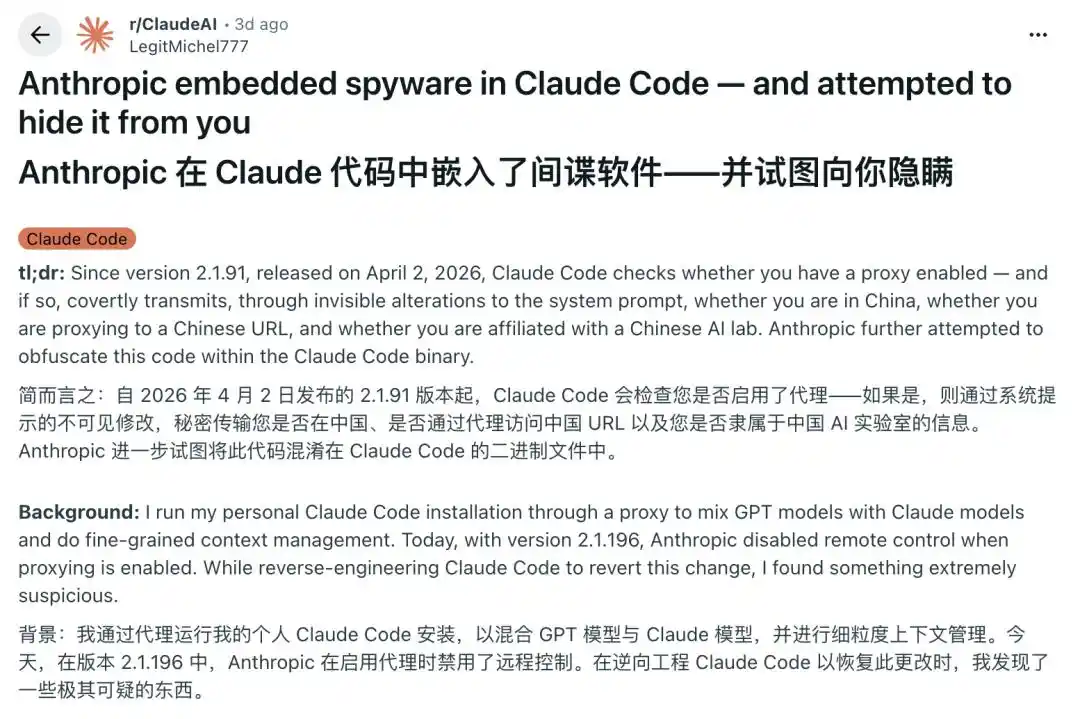
In simple terms, this mechanism does three things—

Step one, quietly checking who you are. It reads your computer's system timezone to see if it's Asia/Shanghai or Asia/Urumqi.

Simultaneously, it checks your proxy address or custom API for keywords related to Chinese cloud providers and AI companies like Alibaba, ByteDance, Baidu, Moonshot AI, and MiniMax.

Step two, tagging you covertly. If a match is found, it won't notify you with a pop-up. Instead, it stealthily alters the system prompt: changing the date format from "2026-06-30" to "2026/06/30".

It replaces the apostrophe in "Today's date is" with Unicode characters that are visually indistinguishable—right single quotation mark (’), modifier letter apostrophe (ʼ), modifier letter prime (ʹ), corresponding to three statuses: "Matched Chinese domain but not AI lab", "Associated with Chinese AI lab", and "Matched both".

Step three, quietly sending it back. These tampered prompts are sent to Anthropic's servers along with your every normal request.

What the user sees is just a normal date; what the server sees is an additional layer of environmental fingerprinting.

What's more unsettling is that this detection code itself was deliberately hidden—the core logic is encrypted and obfuscated, a list of 147 monitored domains is password-protected, and it's never mentioned in the version update logs.

In other words, Anthropic not only did it secretly but also took special care to prevent discovery.

A tool installed on your computer, with filesystem and shell execution permissions, secretly marks and signals your identity, hiding for over two months from deployment until exposure.

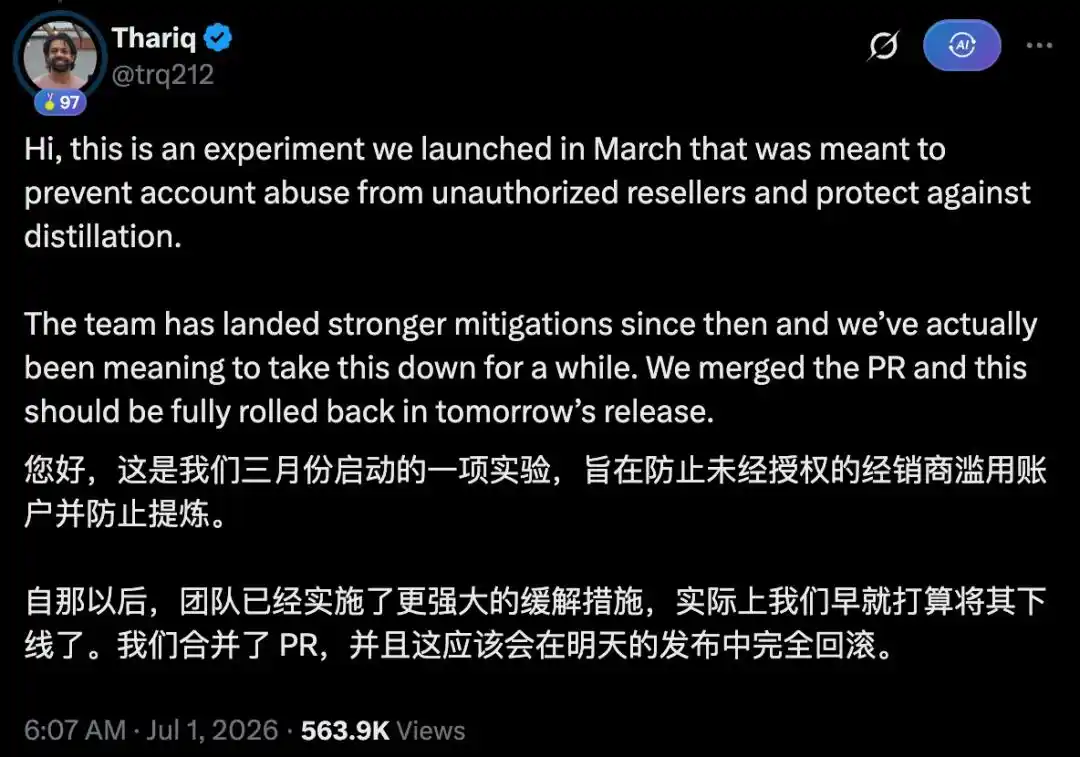
Afterwards, Anthropic Claude Code team member Thariq Shihipar publicly acknowledged this "experimental" measure, stating it was rolled back and removed in the new version released on July 2nd.
For a company that entrusts its most critical engineering code to Claude Code, this is a collapse of trust.

You open up your entire code repository, development environment, and internal logic to it, and it's secretly concerned with who you are, where you're from, and who you're connected to.

Trust, once cracked, cannot be mended by even the strongest model.

Ban Wave Adds Fuel to the Fire

Around the same time this hidden mechanism was exposed, Anthropic launched a new wave of large-scale account bans.

In recent days, a significant number of Chinese users were abruptly locked out, with both personal subscriptions and team accounts affected.

Even more frustratingly, many accounts that paid directly through the official website received no refunds after being deemed non-compliant, with appeal success rates practically zero.

From "Begging to Use" to "Company-Wide Ban"

For the past two years, it was Chinese developers queuing up to "beg to use" Claude: scrambling for quotas, finding relays, enduring the constant risk of bans, all to access that "world's best".

Now, one of China's largest tech companies is the first to decisively show Claude the door.

The once-treasured tool, once used with reimbursement, is now high-risk software. The roles of giver and receiver have been reversed for the first time.

This also signals that leading Chinese tech companies are shifting their attitude towards "building core business on others' closed-source tools" from "borrowing what's available" to "security first".

It's not about not wanting good tools; it's that good tools must also withstand scrutiny.

There are countless tools for writing code, but one principle holds true: Only the tools you can trust in your own hands are truly unremovable.

This article is from the WeChat public account "New Zhiyuan", author: New Zhiyuan

Preguntas relacionadas

QWhat is the main action that Alibaba is taking regarding Claude's products, and when is it effective?

AAlibaba is implementing a comprehensive ban on all Claude products, including Sonnet, Opus, Fable, and Claude Code. The ban is set to officially take effect on July 10th, requiring all employee computers to have the software uninstalled.

QWhat specific security risk prompted Alibaba to ban Claude Code?

AThe ban was prompted by the discovery that Claude Code, starting from version 2.1.91 released in April 2026, contained a covert user detection mechanism. This mechanism secretly identified users from China, tagged them with hidden markers using modified Unicode characters in prompts, and transmitted this data back to Anthropic's servers without user knowledge.

QHow did Anthropic respond to the discovery of the hidden detection mechanism in Claude Code?

AAnthropic's Claude Code team member, Thariq Shihipar, publicly acknowledged the 'experimental' measure. The company stated it had rolled back and removed the feature in a new version released on July 2nd.

QWhat does Alibaba's decision to ban Claude signal about the approach of major Chinese tech companies towards foreign AI tools?

AAlibaba's decision signals a strategic shift from a 'borrowing approach' to a 'security-first' mentality. It indicates that leading Chinese tech companies are becoming more cautious about building core business operations on closed-source, foreign-developed tools, prioritizing security and trustworthiness over perceived performance advantages.

QWhat alternative solution does Alibaba offer to its employees after banning Claude products?

AFollowing the ban on Claude products, Alibaba recommends its employees use the company's self-developed AI coding tool, Qoder, as an alternative solution.

Lecturas Relacionadas

Se acumulan nubes bajistas mientras expiran opciones de Bitcoin y Ethereum por valor de 2.130 millones de dólares

El mercado de criptomonedas enfrentó una sesión crucial el 3 de julio con el vencimiento de opciones por un valor combinado de 2.130 millones de dólares en Bitcoin y Ethereum, lo que ofrece una visión de la posición de los inversores en un entorno desafiante. Vencieron aproximadamente 31.000 opciones de Bitcoin (valor nocional: 1.900 millones de dólares) con un ratio put-call de 0,70 y un "punto máximo de dolor" de 61.000 dólares. Paralelamente, expiraron 135.000 opciones de Ethereum (valor: 230 millones de dólares) con un ratio put-call de 1,29 y un nivel máximo de dolor de 1.650 dólares. El elevado ratio put-call de Ethereum, superior a 1, indica que las opciones de venta superan a las de compra, lo que sugiere que los operadores se cubren ante posibles caídas o mantienen una perspectiva cautelosa. El posicionamiento cerca de niveles clave de exposición a gamma (GEX), alrededor de 60.000 dólares para Bitcoin y 1.700 dólares para Ethereum, refuerza esta actitud defensiva. Aunque Bitcoin recuperó el nivel psicológico de 60.000 dólares, el sentimiento del mercado sigue siendo mixto. Los datos de vencimiento sugieren que los operadores se mantienen prudentes de cara al tercer trimestre, preparándose más para una volatilidad elevada que para un repunte alcista decisivo. Al momento de la información, Bitcoin cotizaba alrededor de 61.932 dólares y Ethereum cerca de 1.738 dólares, ambos con una disminución en el volumen de operaciones y liquidaciones significativas en las últimas 24 horas.

TheNewsCryptoHace 37 min(s)

Se acumulan nubes bajistas mientras expiran opciones de Bitcoin y Ethereum por valor de 2.130 millones de dólares

TheNewsCryptoHace 37 min(s)

La nueva tecnología DeepSeek se adapta a los chips Apple, acelerando el modelo local en Mac un 60%

El proyecto de código abierto DSpark de DeepSeek, originalmente diseñado para acelerar modelos de lenguaje en GPUs de centros de datos, ha sido adaptado por el ingeniero Abdur Rahim para funcionar de forma nativa en chips Apple (mlx-dspark). Esta adaptación logra aceleraciones de aproximadamente 1.6x para Gemma-4 12B y 1.4x para Qwen3-4B en un Mac con M4 Pro, manteniendo una precisión de salida idéntica al modelo original (byte por byte), incluso con muestreo por temperatura. La clave de DSpark es el "decodificado especulativo": un modelo pequeño y rápido (draft) genera varios tokens candidatos que luego son verificados de manera eficiente por el modelo principal (target). Rahim optimizó este proceso para la arquitectura Apple Silicon, utilizando cuantización de 4 bits para el modelo draft (1.8 GB) y 8 bits para el target, logrando una tasa de aceptación del 82%. Posteriormente, el proyecto integró también DFlash, una técnica alternativa de decodificación especulativa que genera bloques de tokens en paralelo. DFlash mostró un rendimiento superior (hasta ~2.1x de aceleración) en tareas estructuradas como código y matemáticas, mientras que DSpark es más eficaz en conversaciones abiertas. La versión mlx-dspark v0.0.3 ahora permite elegir entre ambos métodos según la tarea. Este trabajo demuestra la viabilidad de ejecutar eficientemente LLMs avanzados localmente en hardware Apple, combinando velocidad y precisión.

marsbitHace 50 min(s)

La nueva tecnología DeepSeek se adapta a los chips Apple, acelerando el modelo local en Mac un 60%

marsbitHace 50 min(s)

De SpaceX a facturas comerciales: Cómo la tokenización está cambiando la forma en que el mundo mueve dinero

¿No te molestaría que un mensaje de WhatsApp llegara dos días después por tener que verificarse, autorizarse y pasar por tres etapas? Esperamos comunicación en tiempo real. ¿Por qué no exigimos lo mismo de los mercados financieros? Hoy, cambiar una acción por otra aún implica vender, esperar la liquidación y luego comprar. Las acciones tokenizadas podrían cambiar esto. Tras la OPI histórica de SpaceX (75.000 millones de dólares), plataformas blockchain comenzaron a ofrecer exposición tokenizada a SpaceX, NVIDIA, Google y otras grandes empresas. La NASDAQ también busca aprobación regulatoria para operar valores tokenizados. Una acción tokenizada es una acción en blockchain: misma empresa, mismo valor, mismos derechos, pero se opera a cualquier hora, liquida en segundos, puede fraccionarse y transfiere sin las capas intermedias tradicionales. Aunque las acciones dominan, otros activos se tokenizan: el crédito privado supera los 10.000 millones de dólares en blockchain, y bienes inmuebles, materias primas y deuda estructurada avanzan. Juntos, representan cientos de billones en valor global. Pero no todas las blockchains sirven para liquidación institucional. La tokenización regulada requiere tarifas predecibles, liquidación determinista e infraestructura de grado bancario. XDC Network, por ejemplo, ha procesado más de 1.100 millones de dólares en tokenización de créditos, commodities y deuda. En Brasil, Liqi Digital Assets reportó 1.200 millones de BRL (unos 230 millones USD) en operaciones tokenizadas acumuladas hasta inicios de 2026. Según Atul Khekade, cofundador de XDC Network, "La conversación sobre tokenización se ha centrado en activos ya fáciles de mover. El verdadero desafío son los nunca accesibles. Esos mercados valen órdenes de magnitud más, y la brecha de infraestructura es lo único que nos separa. Estamos al inicio de la verdadera década de la tokenización". BCG y Ripple proyectan un mercado de activos tokenizados de 18,9 billones de dólares para 2033; Standard Chartered lo extiende a 30 billones para 2034 incluyendo crédito transfronterizo. La brecha con la actualidad depende de la infraestructura: qué redes pueden manejar el volumen, cumplimiento y expectativas institucionales. El marco regulatorio también avanza: Brasil, Singapur, Reino Unido y la UE tienen marcos para instrumentos financieros tokenizados. La Ley GENIUS de EE.UU. (julio 2025) creó infraestructura federal para stablecoins. Ya no se cuestiona si la tokenización será permitida, sino qué tan rápido se adoptará a escala. La OPI de SpaceX dio visibilidad a la tokenización, pero la infraestructura para escalarla se construyó durante años, en partes del mercado que nunca fueron noticia. En eso se basará la próxima década financiera.

ambcryptoHace 1 hora(s)

De SpaceX a facturas comerciales: Cómo la tokenización está cambiando la forma en que el mundo mueve dinero

ambcryptoHace 1 hora(s)

Trading

Spot
活动图片