Author: Monday, Shenchao TechFlow
In matchmaking agencies in Seoul, a strange phenomenon has recently emerged.
Some men coming for blind dates deliberately place their business cards in the innermost pocket of their suit jackets, only cautiously pulling out that card printed with their company name after confirming the other person is "decent." The card bears four English letters: SK Hynix.

Source: Korean variety show
Kang Eun-sun, a senior executive at Korean matchmaking company Gayeon, publicly told the media that after the semiconductor supercycle began, the popularity of employees at Samsung Electronics and SK Hynix has continued to rise. "The market clearly prefers engineers whose actual incomes are much higher, surpassing some lawyers whose incomes are no longer as high as before." There's even a social media joke: "When Hynix employees go on blind dates, they modestly claim they work at Samsung. Only when they meet a decent person do they admit they actually work at Hynix."
What has turned a uniform into "blind date attire" is a set of numbers that make workers worldwide envious.
In 2025, SK Hynix's operating profit reached 47.2 trillion won. According to the new agreement reached with the union in September last year, 10% of the operating profit goes into the employee bonus pool. Averaged across approximately 35,000 employees, each person can receive about 1.4 billion won, roughly 650,000 RMB.
In the first quarter of this year, SK Hynix's operating profit grew over 400% year-on-year to 37.6 trillion won. Based on predictions from analysts in different countries, its operating profit for this year is expected to fall between 210 trillion and 250 trillion won. Using this estimate, the per capita bonus this year could reach the range of 2.9 million to 3.3 million RMB.
International investment bank Macquarie Securities further predicts that if the operating profit reaches 447 trillion won in 2027, the per capita bonus could be as high as 12.9 billion won, approximately 6.1 million RMB.
A story even more worth telling than the "6.1 million RMB per capita bonus" is: This company has long been the second player in Korea's semiconductor industry, the little brother standing behind Samsung.
What did it do right, allowing that Samsung—the one whose face even Apple's screens and chips must watch—to be dethroned from its position as the global memory leader?
2008: Recovering from the Brink of Bankruptcy
Rewind to 2008, and no one would have labeled Hynix as the "future leader."
Its predecessor was called Hyundai Electronics. When the dot-com bubble burst in 2001, DRAM prices plummeted. The company, burdened with a staggering $14 billion in debt, was taken over by creditors and entered a five-year "workout program," a state similar to "reorganization trusteeship" in the Korean system. For a full five years, factories, R&D budgets, and staffing were all living on a tight leash.
In 2007, Hynix finally emerged from this "trusteeship" state, not fully recovered, barely clinging on.
It was at this time that a company called AMD from the other side of the Pacific came knocking.
AMD's situation wasn't great either at the time. It was the second player in the GPU market, being heavily suppressed by NVIDIA in the gaming card segment. Its researcher, Bryan Black, was working on a peculiar thing called "High Bandwidth Memory" (HBM), stacking multiple DRAM chips vertically like building floors and connecting them through a technology called TSV (Through-Silicon Via).
Why do this? Because AMD saw a problem few others paid much attention to: CPU/GPU computing speeds were getting faster, but the speed of data movement from memory couldn't keep up. Computing units often finished a batch and had to wait idly for memory to deliver the next batch of data. The industry calls this dilemma the "Memory Wall."
To use an imprecise analogy: a super chef works at a speed of cutting 10 dishes per second, but the server can only bring in 2 batches of ingredients per second. The result is the chef spends 80% of the time waiting for ingredients. No matter how fast the computing chip is, if data doesn't come in, it's just idling.
AMD's idea was straightforward: Instead of widening the delivery channel horizontally (the traditional DDR approach), let the memory "grow taller," stacking chips vertically, allowing data to be delivered over shorter distances with wider buses. This vertically stacked "little skyscraper" is HBM.
This scheme sounds beautiful. The problem was, in 2008, there was no AI demand, no large model training, no so-called "computing power revolution." The only visible application for HBM at the time was for high-end gaming graphics cards. The market was small, manufacturing processes were extremely difficult, and the cost per chip was far higher than ordinary DRAM.
AMD asked around, but no one was willing to take it on. Samsung wasn't willing; it was fully betting on the HMC (Hybrid Memory Cube) technology path, another vertical stacking scheme it was developing with Micron. Micron wasn't willing either; it was following Samsung.
The only one willing to take it on was Hynix, which had just recovered from the brink of bankruptcy and couldn't afford to turn down any big orders.
In 2009, Hynix officially initiated HBM R&D. It wasn't until 2013 that the first HBM chip was born at Hynix's factory in Icheon, Korea.
Back then, who could have imagined that this chip would become something, 15 years later, that all AI giants would queue up to buy, with capacity "sold out until 2030"?
No one could, including Hynix itself.
2012: A Chairman's Bet
In 2012, another key character entered the story.
Led by SK Group Chairman Chey Tae-won, a consortium initiated by SK Telecom acquired a 21.05% stake in Hynix from creditors for approximately 3.4 trillion won (about $3 billion). This semiconductor company was henceforth called SK Hynix.
What kind of person is Chey Tae-won? A description in the Korean book "Super Momentum" goes: After the acquisition, he met one-on-one with 100 Hynix executives in a short period. The first thing he did wasn't layoffs or cost-cutting, but integrating SK Group's management system with Hynix's technical capabilities, then reopening the paused FAB (wafer fab) investments and process improvement funds.
The key to this was timing.
From 2012 to 2014, the entire DRAM industry was still shrouded in the shadow of the 2011-2012 memory downturn cycle. All rational financial models told management, "This is an industry low, be conservative." But Chey Tae-won made a counterintuitive decision: Expand investment.
Even more crucial was HBM.
From 2011 to 2022, over 11 years, SK Hynix cumulatively invested about 860 billion won in HBM-related R&D and about 1.5 trillion won in facilities and equipment. A significant portion of these investments occurred in years when the market was sluggish, and HBM had no visible commercial prospects.
What happened during this time?
HBM2 didn't meet performance expectations, was scrapped and redone, resulting in a revised version called "HBM2 Gen2." The HBM team within the company once became the "department no one wanted to go to," key personnel were rotated out, morale was low. AMD's flagship graphics card, the R9 Fury X, used the first-generation HBM in 2015, but market response was lukewarm because it was too expensive and no one bought it.
What made Hynix even more panicked was: Around 2016-2017, Broadcom approached Samsung, hoping Samsung would supply HBM2 for Google's second-generation TPU. If Samsung could meet 100% of the demand, Broadcom promised exclusive supply rights. This should have been a critical moment for HBM's first entry into the data center.
Unexpectedly, Samsung dropped the ball.
A report from Korea's JoongAng Daily reconstructed the chaos at the time: The Google TPU project involved three companies: Broadcom (design), Samsung (memory), and TSMC (foundry). Samsung's HBM had memory issues. Engineers reported upward that TSMC refused to let them enter the factory for inspection. The three companies blamed each other, leaving the issue unresolved, with delays lasting up to half a year. "Such deadlocks were common between 2016 and 2017," recalled an informed executive afterward.
Google later gradually leaned towards cooperating with SK Hynix. The biggest beneficiary of HBM's first real landing in data centers wasn't Samsung.
But when all this was happening, the world had no idea HBM would become the most critical bottleneck of the AI era.
Chey Tae-won later said only one sentence in an interview for "Super Momentum": "We stood at a crossroads."
He didn't elaborate on why he persisted. But in hindsight, the logic might be this: The fate of Hynix as a company had already been on the brink of bankruptcy in 2001. It didn't have diversified businesses like Samsung to spread risk; it only had memory to focus on. Either become the global leader in this one thing, or forever live in Samsung's shadow.
So, "betting on HBM" wasn't a choice for Hynix; he had no choice.
2022: Jensen Huang Handed Over a Match
In June 2022, SK Hynix began mass-producing HBM3. That year, the first batch of HBM3 chips was installed on a GPU called the H100, from a company with a market cap of about $300 billion at the time, important but not yet world-changing in the gaming GPU and data center markets: NVIDIA.
In November, OpenAI released ChatGPT.
What happened next, everyone knows. The demand curve for AI computing power went from a gentle slope to a near-vertical rocket trajectory. Every GPU used for training large models requires HBM as its closest "data mover."
At that moment, the game Hynix had bet on for 14 years was suddenly revealed.
By Q2 2025, Hynix captured 62% of the global HBM market share. Samsung dropped to 17%, even trailing the later entrant Micron (21%).
For the full year 2025, Hynix's annual operating profit was 47.2 trillion won, while Samsung Electronics' annual operating profit was 43.6 trillion won. This was the first time in Hynix's history that its annual profit surpassed Samsung's.
In August 2025, during Taipei Computex, NVIDIA CEO Jensen Huang visited SK Hynix's booth and left a handwritten line on a display board: "JHH LOVES SK HYNIX!" This photo was subsequently widely circulated by Korean media. In engineering culture, there's no more direct official endorsement than this.
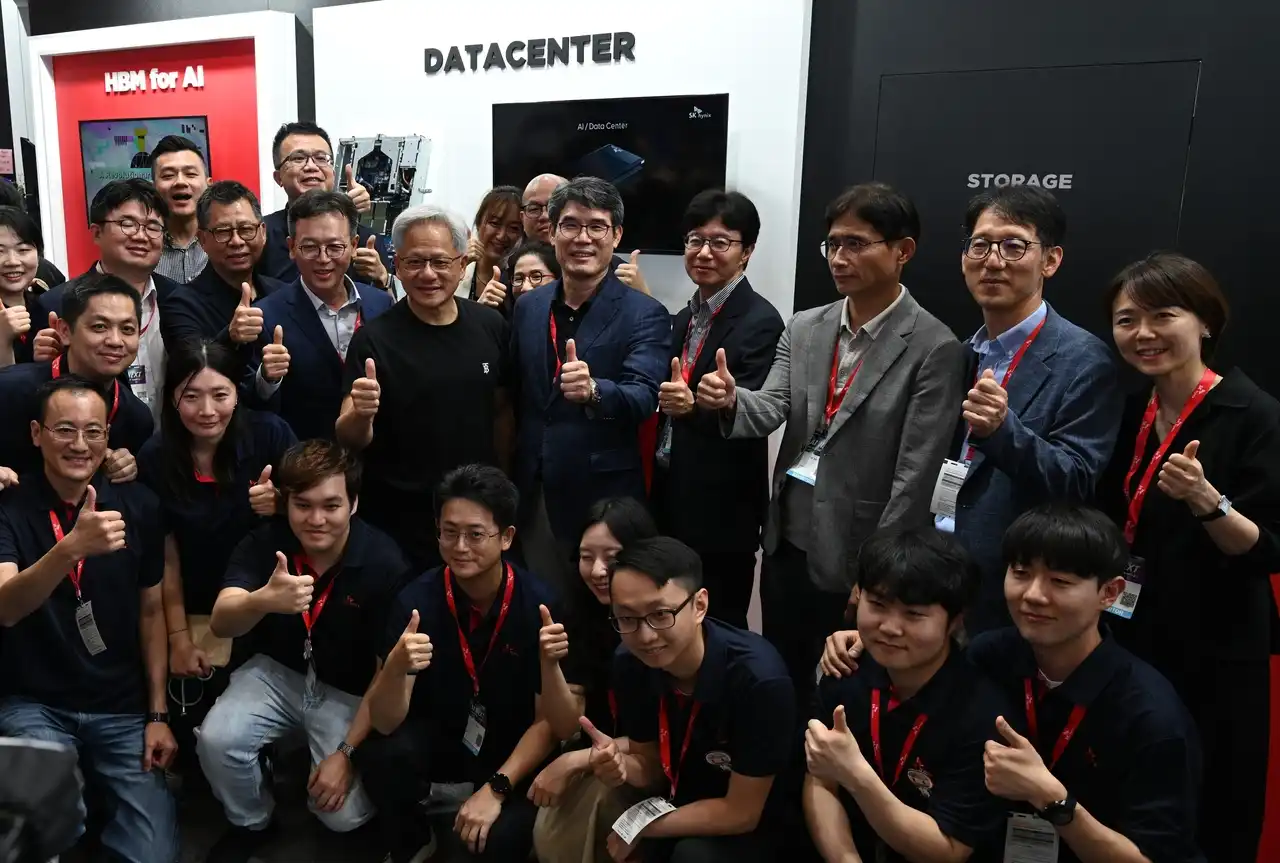
Meanwhile, SK Hynix engineers privately gave HBM a new full name. They say HBM actually stands for "Hynix Best Memory."
Where Did Samsung Lose?
So the question arises: Where did Samsung, the one that once crushed all Japanese DRAM manufacturers and cornered Micron, actually lose?
Samsung missed the early HBM layout, made the wrong technology choice (NCF packaging vs. Hynix's MR-MUF packaging), and HBM3E couldn't pass NVIDIA's certification tests...
These are all facts, but not the root cause. The fundamental reason is something more awkward and ironic: Samsung was too successful, so it couldn't afford to lose and couldn't place bold bets.
Look at both companies at that point in 2008. Hynix had just crawled out of bankruptcy trusteeship, with only the memory business line and no diversified cash cows to rely on.
It bet on HBM not because its vision was accurate, but because it had no choice. Any chance to shed the label of "the little brother behind Samsung" had to be seized.
And Samsung?
In 2008, Samsung was on the eve of its peak. Its mobile business was about to take off with the Galaxy series, its semiconductor business was world-leading in both DRAM and NAND, and its display business was about to secure Apple's iPhone OLED order. Its cash flow was extremely abundant, its business portfolio vast, and the stakeholders it needed to balance were extremely complex.
For such a company, what was HBM in 2008? It was a high-risk, tiny-market, long-return-cycle bet that conflicted with another technology path (HMC) it was pushing. Any rational finance committee wouldn't approve an all-in bet on this.
This is the classic "Innovator's Dilemma": A successful large company is forever bound by its own success. The market it has already won is too big, too important, and too in need of protection, making it impossible to bet its entire stake on a seemingly unreliable new direction like a "challenger pushed into a corner."
The deeper irony is that Samsung didn't fail to see HBM. It started investing in HBM-related research as early as 2011 and even mass-produced HBM2 first in 2016. But each time, Samsung wasn't All-in. Its attention was simultaneously spread across over a dozen fronts: HMC, GDDR, LPDDR, enterprise SSDs, etc. While Hynix's HBM team was "marginalized but still persisted," Samsung's HBM team was also "marginalized," but no one was there to persist for them.
By 2024-2025, Samsung finally realized it had to All-in on HBM, but it was too late. The technology gap had formed, and the customer relationship moat had been built by NVIDIA and Hynix together.
Jun Young-hyun, vice chairman of Samsung Electronics' semiconductor business, said one sentence in his 2026 New Year's address: "Our customers tell us, Samsung is back."
"Back"—these three words are, in themselves, an admission.
Two Questions
What does the story of SK Hynix mean? At least two questions are worth considering.
First, why do similar stories more easily happen in Korea, rather than elsewhere?
SK Hynix's success didn't come out of thin air. Behind it lies a unique industrial soil. Although criticized for decades, Korea's chaebol system objectively allows a company, driven by the will of a single decision-maker, to bet on a venture with a 20-year return cycle and keep funding it during the middle 10 years without seeing any commercial prospects.
When Chey Tae-won acquired Hynix in 2012, there were no Wall Street analysts in his ear yelling "quarterly earnings, quarterly earnings." He didn't need to prove HBM's ROI to the board every quarter.
Such long decision cycles are becoming increasingly scarce in today's US stock market-driven tech companies. It's also a key variable for whether Chinese hard-tech companies like YMTC and CXMT can break through. Technology isn't the biggest barrier; whether capital and decision-makers are willing to sit on the cold bench with you for a decade is.
Second, has Hynix's "second-place fate" completely ended?
Not necessarily.
By Q4 2025, Samsung had already regained its position as the world's number one in total memory revenue. It is accelerating its catch-up on the next generation, HBM4, with key certifications for HBM4 nearing completion. Counterpoint Research Director MS Hwang's judgment is: Samsung might overcome last year's quality issues and achieve a significant turnaround in the HBM4 generation.
In the longer term, Hynix's current moat also has vulnerabilities. Its customer base is highly concentrated (NVIDIA orders account for a huge proportion), its MR-MUF packaging route faces warping issues when stacking exceeds 16 layers, and its capacity expansion costs will drag on free cash flow in 2026-2027. Chinese manufacturers are also catching up; CXMT's HBM is expected to enter mass production in 2027. Once that line breaks through, the global HBM oligopoly will change again.
But none of this changes one thing: SK Hynix has proven a possibility. A company considered forever living in the shadow of a giant can, over a mocked 20 years, transform itself into the definer of a new era.
A market rule is once again validated: When everyone is chasing certainty, betting on a seemingly uncertain long-term direction often yields the greatest alpha.
In 2008, it was HBM; in 2018, it was the new energy vehicle supply chain; in 2026, it might be something else no one values today.
Don't ask "who is today's SK Hynix." Ask instead: Who is doing today what SK Hynix was doing in 2008, but is being laughed at by everyone?