Forbes: These Investors Stand To Lose The Most From FTX’s Implosion

ForbesPublicado a 2022-11-11Actualizado a 2022-11-11

Resumen

o one is set to lose more from FTX’s implosion than Sam Bankman-Fried, the crypto wunderkind who founded the exchange and then drove it into the ground this week. His net worth, once as high as $26.5 billion, has plummeted to less than a billion dollars–one of the fastest falls from the billionaires ranks ever. FTX users and employees may be in for big losses too, with Bankman-Fried now trying to cobble together emergency funding to cover a shortfall of up to $8 billion as customers demand their money back. “I can't make any promises,” he tweeted Thursday. “But I'm going to try.”

No one is set to lose more from FTX’s implosion than Sam Bankman-Fried, the crypto wunderkind who founded the exchange and then drove it into the ground this week. His net worth, once as high as $26.5 billion, has plummeted to less than a billion dollars–one of the fastest falls from the billionaires ranks ever. FTX users and employees may be in for big losses too, with Bankman-Fried now trying to cobble together emergency funding to cover a shortfall of up to $8 billion as customers demand their money back. “I can't make any promises,” he tweeted Thursday. “But I'm going to try.”

Then there are FTX’s investors.

As the crypto exchange ballooned in size, it became a huge draw for venture capitalists eager to get in on the Bitcoin boom. In June 2021, FTX raised $1 billion at an $18 billion valuation from venture investors such as Paradigm, SoftBank and Sequoia Capital. Three months later, FTX brought in a $421 million haul, pushing its valuation to $25 billion, from investors like Singapore-government owned investment firm Temasek, Tiger Global Management and the Ontario Teachers’ Pension Plan. By January of this year, crypto prices were on the decline, but FTX charged ahead. Investors, many of whom had also pumped money into the earlier rounds, put another $400 million into FTX–at a $32 billion valuation.

That $32 billion figure has gone up in smoke. So has the $1.8 billion-plus of capital that investors pumped into FTX over the course of three years: At least two major shareholders are marking their investment in FTX down to $0: venture capital firm Sequoia and, reportedly, crypto-focused firm Paradigm. Forbes did the same, dropping Bankman-Fried and cofounder Gary Wang from our billionaire’s list Wednesday, based on the collapse of both FTX and the pair’s trading firm, Alameda Research.

In a strict sense, FTX’s investors’ losses are limited to the $1.8 billion or so they put into the business. But their paper losses are much, much higher. If any of these investors had cashed out in January, when FTX peaked at the $32 billion valuation, they’d be tens or even hundreds of millions dollars richer. Instead, they could well end up with nothing.

Who will lose the most? Forbes has a list of FTX shareholders, sent to us by Sam Bankman-Fried in August during our reporting for The Forbes 400 list. Here are the venture capital firms, the pension plan–and two celebrity endorsers–who have a lot to lose if FTX can’t be saved.

(This analysis does not include shares of FTX U.S., the exchange’s American operations, which raised $400 million at an $8 billion valuation concurrent with FTX’s series C round in January. It remains unclear how the troubles facing FTX will impact the value of FTX U.S.. It’s possible that losses from FTX U.S. will push some investors’ total investment in Sam Bankman-Fried’s empire even higher.)
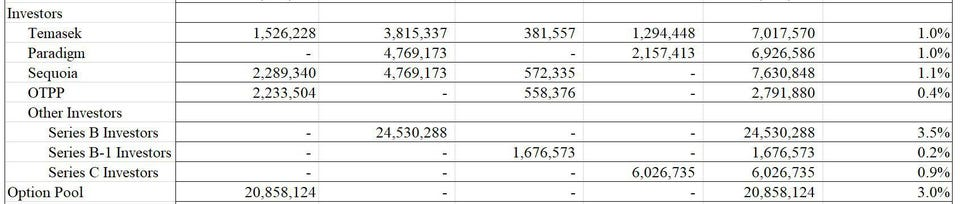
According to the capitalization table Sam Bankman-Fried sent Forbes in August, investors who stand to lose big if FTX goes to zero include employees, investment firms and Ontario teachers'' pensions.FORBES

SEQUOIA CAPITAL

Stake in FTX: 1.1%

Estimated amount invested (FTX only): $200 million

Value at January 2022 peak: $350 million

The Silicon Valley VC fund–famed for its investments in tech giants like Apple, Google and Airbnb–bought into FTX’s series B and B-1 rounds alongside Sequoia Capital Global Equities, a separate entity–to the tune of more than $200 million, according to a letter Sequoia shared on Twitter Wednesday. “FTX is the high-quality, global crypto exchange the world needs,” Sequoia partner Alfred Lin said in June 2021, after the series B round. “Sam is the perfect founder to build this business, and the team's execution is extraordinary.”

The warm feelings were mutual: According to a report published by The Information on Thursday, Alameda Research and Bankman-Fried-backed VC fund FTX Ventures committed “hundreds of millions of dollars” to funds run by Sequoia and two other firms.

The value of Sequoia’s investments in FTX peaked at $350 million earlier this year, marking what is the largest likely loss for an outside investor in the exchange. Sequoia said in its letter to its investors that its FTX stake represented less than 3% of the committed capital of one fund, and the fund’s $150 million loss is offset by about $7.5 billion in realized and unrealized gains.

TEMASEK

Stake in FTX: 1%

Est. amount invested: $205 million

Value at January 2022 peak: $320 million

An investment company owned by the government of Singapore, Temasek is the second-largest outside investor on the capitalization table, with 7 million shares. The $297 billion (assets) business, which owns big stakes in Singapore’s DBS Group and Singapore Airlines, invested in all three of FTX’s major funding rounds. With its $320 million stake on the brink of being worthless, a Temasek spokesperson told Reuters on Wednesday that they were “aware of the developments” and were “engaging FTX in our capacity as shareholder."

PARADIGM

Stake in FTX: 1%

Est. amount invested: $215 million

Value at January 2022 peak: $315 million

Paradigm, an investment firm “focused on supporting the crypto/Web3 companies and protocols of tomorrow,” invested in the exchange’s series B and C rounds and owned nearly 7 million shares of FTX as of August. “There's a bright future ahead for Sam and FTX,” Paradigm cofounder Matt Huang said in July 2021, “and Paradigm is excited to be a part of it."

According to The Information, Alameda Research also invested at least $20 million in Paradigm.

ONTARIO TEACHERS’ PENSION PLAN

Stake in FTX: 0.4%

Est. amount invested: $80 million

Value at January 2022 peak: $125 million

The Ontario Teachers' Pension Plan, which manages the retirement funds of 333,000 teachers in the Canadian province, invested a total of $95 million between FTX and FTX U.S. in late 2021 and early 2022. The FTX portion of that investment alone was worth an estimated $130 million following FTX’s series C round–before the crypto winter and current crisis. “While there is uncertainty about the future of FTX,” Ontario Teachers’ wrote in a statement, “any financial loss on this investment will have limited impact on the plan, given this investment represents less than 0.05% of our total net assets.”


Lecturas Relacionadas

El padre de Claude Code: La "arnés" solo dura seis meses, liberemos las riendas

**Resumen: "El padre de Claude Code: el arnés solo dura seis meses, suelta las riendas"** Boris Cherny, creador de Claude Code de Anthropic, recomienda a los usuarios que **eliminen sus prompts, habilidades y códigos de arnés cada seis meses**. En una entrevista reciente, defiende realizar "estudios de ablación": borrar el prompt del sistema línea por línea y volver a añadirlo para ver el impacto real, ya que los modelos más nuevos como Opus 5 a menudo ya no necesitan instrucciones extensas. Cherny compara los modelos de IA con **organismos vivos con personalidades distintas** que cambian con cada generación, por lo que la clave es un enfoque empírico: probar, observar dónde falla el modelo e iterar, sin prejuicios. Introduce dos conceptos clave: 1. **"Excedente del producto" (Product Overhang):** La capacidad de los modelos avanza más rápido que las funcionalidades que los productos logran aprovechar. 2. **"Desatar" (Unhobbling):** Eliminar restricciones para **"eliciar"** capacidades latentes del modelo dándole tareas más difíciles, tiempo para experimentar y, crucialmente, capacidad de **autoverificación** para que pueda funcionar de forma autónoma durante largos periodos (él mismo tiene un Claude ejecutando una tarea desde hace más de dos semanas). Sus consejos para usuarios y emprendedores: * Ignoren los "trucos mágicos" promocionados en redes sociales. * Traten al modelo como a un colega, sin microgestionarlo. * Para aprender programación, combinen la teoría con la aplicación práctica para resolver problemas reales.

marsbitHace 8 min(s)

El padre de Claude Code: La "arnés" solo dura seis meses, liberemos las riendas

marsbitHace 8 min(s)

Feishu se convierte en Doubao

**Resumen:** El día 30 de julio, ByteDance anunció una reorganización estructural, desmantelando Feishu como negocio independiente e integrándolo dentro de Doubao, su plataforma de IA. Esto marca un cambio estratégico fundamental para el gigante tecnológico. Durante años, Feishu intentó ser una superplataforma integrada de productividad. Sin embargo, la era de la IA ha redefinido las reglas: el valor ya no está en la herramienta aislada, sino en la IA profundamente integrada en el flujo de trabajo. Las métricas lo confirman: más del 90% de los nuevos clientes de Feishu en el segundo trimestre de 2026 también adquirieron sus productos de IA. Doubao, con un enorme volumen de uso y un alto nivel de ingresos anualizados, se convierte en el núcleo. La reestructuración responde a esta nueva realidad. Feishu aporta a Doubao su activo más valioso: escenarios reales de trabajo empresarial y una década de experiencia en productividad. Doubao, especialmente en su versión empresarial, deja de ser un simple chatbot para convertirse en un motor de productividad integrado. Por otro lado, ByteDance unifica todas sus ventas y estrategias empresariales (B2B) bajo un único equipo, "Plataforma de Servicios de Creatividad", eliminando las barreras internas para ofrecer soluciones de IA unificadas. El significado es profundo: Doubao se convierte en el nuevo centro organizativo de ByteDance, al igual que lo fue Douyin (TikTok). Este movimiento muestra que ByteDance está reorganizando toda su empresa en torno al modelo de IA, no alrededor de productos individuales. Por primera vez, actúa como una verdadera compañía B2B, priorizando las necesidades del cliente sobre su estructura interna. No se trata de que Feishu haya "perdido", sino de que la IA está redefiniendo las organizaciones.

marsbitHace 12 min(s)

Feishu se convierte en Doubao

marsbitHace 12 min(s)

La segunda mitad de la competencia de emisión de RWA: dentro del dilema de utilización, miles de millones de activos en cadena esperan ser despertados

Autor: Jae, PANews En pleno verano de julio, los RWA (activos del mundo real) se han convertido en la narrativa más candente del mercado cripto, alcanzando un récord histórico de 32 mil millones de dólares en escala on-chain, un 22% más que a principios de mes. Sin embargo, tras esta aparente prosperidad, se esconde una paradoja estructural: casi el 90% de los RWA on-chain permanecen inactivos, sin participar en préstamos, garantías u otras actividades DeFi. Más del 70% de los activos tokenizados no muestran transferencias en una semana, según un informe de BeInCrypto Intelligence y RWA.xyz. Entre las principales plataformas, Securitize —con 4.9 mil millones de dólares en activos tokenizados— tiene una tasa de uso en DeFi de solo el 0.7%. Ondo Finance, con 3.5 mil millones, ronda el 2.7%. En contraste, Maple Finance, aunque más pequeño (2.3 mil millones), logra una utilización del 62% gracias a su modelo de protocolo de crédito on-chain. Esta brecha entre escala y utilización se debe a varios factores: 1. **Naturaleza de los activos**: Los bonos tokenizados (como BUIDL de BlackRock) se mantienen principalmente para generar rendimientos, no para negociarse. 2. **Barreras regulatorias**: La mayoría de los RWA están clasificados como valores, sujetos a KYC y whitelists, lo que limita su integración en mercados DeFi sin permisos. 3. **Falta de infraestructura**: Mercados secundarios líquidos, mecanismos de liquidación y agentes de mercado aún son incipientes. El enfoque está pasando de la "carrera por emitir" a la "competencia por la aplicación". Plataformas como Maple o Centrifuge demuestran que los RWA pueden ser activos dinámicos en DeFi, mientras que integraciones con UniswapX, Morpho o distribuidores como Robinhood Crypto están abriendo nuevos canales de uso. Los 32 mil millones de dólares en RWA on-chain son solo el primer paso. El verdadero reto no es tokenizar más activos, sino hacer que circulen, se utilicen y generen valor en la cadena.

marsbitHace 12 min(s)

La segunda mitad de la competencia de emisión de RWA: dentro del dilema de utilización, miles de millones de activos en cadena esperan ser despertados

marsbitHace 12 min(s)

Pascal Caversaccio se une a la Junta de la Fundación Ethereum para Avanzar en Seguridad y Privacidad

La Fundación Ethereum ha reforzado su gobernanza con la incorporación del renombrado experto en seguridad blockchain Pascal Caversaccio a su junta directiva. Caversaccio, conocido como pcaversaccio, ocupará un mandato voluntario de un año junto a los miembros existentes, elevando el total a cuatro y aportando su amplia experiencia en investigación técnica y ciberseguridad. La junta es responsable de supervisar la orientación estratégica de la organización. Caversaccio, cofundador y líder de SEAL 911, un programa de respuesta ante emergencias en criptomonedas, aporta un profundo conocimiento en la gestión de incidentes de seguridad. Su trabajo previo, incluyendo la publicación de manifiestos sobre privacidad y soberanía en Ethereum, refleja su compromiso con estos pilares. Su experiencia en SEAL 911, que ha gestionado miles de incidentes y salvaguardado activos digitales por valor de más de 180 millones de dólares, fortalecerá las defensas a largo plazo de la red. La Fundación también ha mejorado su seguridad con ingenieros especializados y tecnología de IA para detectar vulnerabilidades de software. Este nombramiento voluntario no altera la estructura de remuneración, deberes o gobierno del comité, y subraya el enfoque continuo de la Fundación en la privacidad, la resistencia a la censura y la resiliencia del protocolo.

TheNewsCryptoHace 35 min(s)

Pascal Caversaccio se une a la Junta de la Fundación Ethereum para Avanzar en Seguridad y Privacidad

TheNewsCryptoHace 35 min(s)

Trading

Spot
活动图片