When 34% of ETH is Staked: In the Era of Native Compounding, How Should You Choose Staking?

marsbitPublicado a 2026-08-28Actualizado a 2026-08-28

Resumen

As Ethereum staking reaches a record 34.7% of the total supply, it is evolving from a niche technical activity into a standardized asset management practice. This article analyzes four primary staking methods for ETH holders, highlighting their core trade-offs between control, convenience, and risk. The foundational method is solo staking, which requires 32 ETH and running one's own validator node. It offers full control and native rewards but demands significant technical expertise and constant maintenance. Non-custodial native staking, like services offered by imToken, provides a middle ground. Users control their withdrawal keys and assets while outsourcing node operation to professional providers. This maintains self-custody but transfers operational risk. For users without 32 ETH or those prioritizing liquidity, liquid staking protocols like Lido are key. Users deposit ETH to receive a liquid staking token (e.g., stETH), enabling continued participation in DeFi. This introduces additional smart contract and protocol risks but solves liquidity constraints. Exchange-based staking offers the lowest barrier to entry, handling all technical complexities and custody. However, it requires full trust in the platform's management of assets, node operations, and reward distribution. The choice depends on individual priorities: control (solo staking), balanced custody (non-custodial native), liquidity (liquid staking), or simplicity (exchange). With developments like Pectra en...

Recently, two very interesting numbers have emerged in Ethereum Staking.

One is 34.7%.

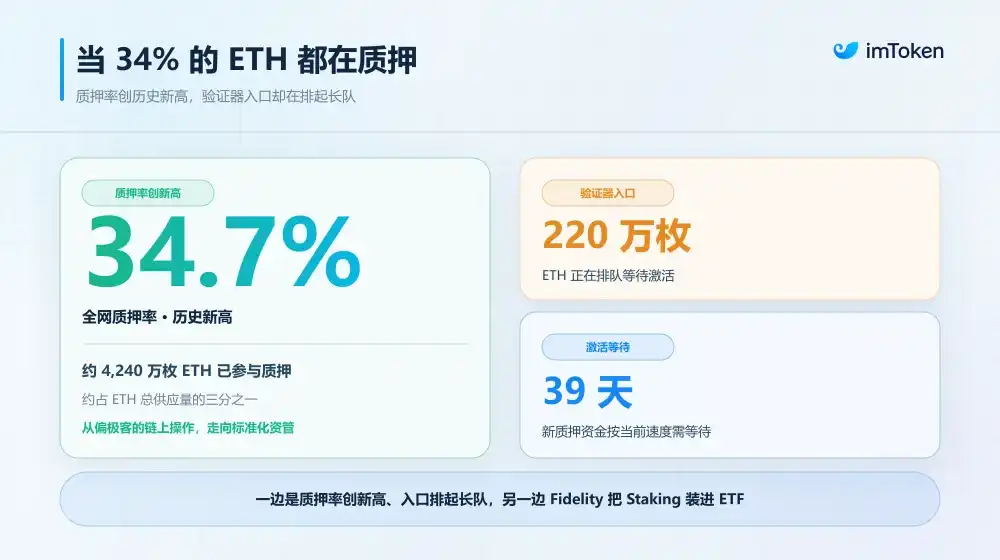
As of late August, approximately 42.4 million ETH have been staked across the Ethereum network, accounting for about 34.7% of the total supply, reaching a record high. Even more striking is that there are still over 2.2 million ETH queued at the validator entry point. At the current rate, new staking funds need to wait nearly 39 days to be formally activated.

Another change comes from traditional finance.

In August, Fidelity further advanced the Staking arrangements for its Ethereum fund, FETH. It has not only signed relevant custody agreements with Anchorage Digital and BitGo but also clearly designed a staking reward distribution mechanism.

These two seemingly unrelated changes are actually a microcosm of a larger trend: in the past six months, Ethereum staking has accelerated its shift from a niche on-chain operation favored by geeks to an increasingly standardized asset management method.

For ordinary ETH holders, a more practical question than "whether to stake" is now emerging:

If you decide to stake, should you run your own node, choose Native Staking, Lido, or simply stake on an exchange?
1. Staking Is No Longer Just About 'Locking Up Assets to Earn Yield'

Let's start with the basics.

After Ethereum completed The Merge, the network no longer relies on miners using computing power to maintain the network. Instead, validator nodes maintain consensus and validate blocks by staking ETH.

The most basic threshold to become an independent validator node is 32 ETH.

Validators receive consensus layer rewards from the Ethereum protocol for staying online, correctly submitting attestations, and participating in block proposals. Conversely, being offline for extended periods incurs penalties, and serious violations like double-signing may lead to Slashing.

From this perspective, staking rewards are not "interest" magically generated out of thin air, but protocol rewards users earn by using their ETH to provide economic security for the Ethereum network.

But over the past few years, there has been a somewhat counterintuitive issue with Staking: rewards don't naturally compound.

In traditional 0x01 validators, even if they earn an extra 0.5 ETH or 1 ETH in consensus layer rewards, any amount exceeding 32 ETH is periodically and automatically withdrawn by the network to the withdrawal address, and does not continue to participate in the next round of staking.

To make this ETH generate rewards again, one would need to gather enough for a new staking amount and deploy it again.

Pectra changes this.

The new 0x02 validator has its maximum effective balance increased to 2048 ETH. Moreover, after exceeding 32 ETH, the balance can continue to gradually increase the effective staking amount according to protocol rules. For long-term stakers, the previous process of "earning rewards -> withdrawing them -> redeploying" can now, for the first time, be automated within the native Ethereum protocol (Extended reading: When 8 Million ETH Starts 'Moving': In the Post-Pectra Era, Staking Undergoes a Structural Transformation?).

If we look at the timeline over the past six months, we find that ETH staking is evolving from a relatively crude early-stage "lock 32 ETH for yield" model into a more sophisticated asset management mechanism.

Fidelity adding staking yield to its ETF addresses the question of "who stakes for me" for traditional finance users; Pectra addresses capital efficiency at the validator level; liquid staking protocols like Lido address liquidity; and professional node operators are beginning to separate operational maintenance from asset control.

Therefore, when comparing staking options today, the focus should no longer be solely on APR, but on comprehensive trade-offs.

2. They're All Staking, But What's the Difference?

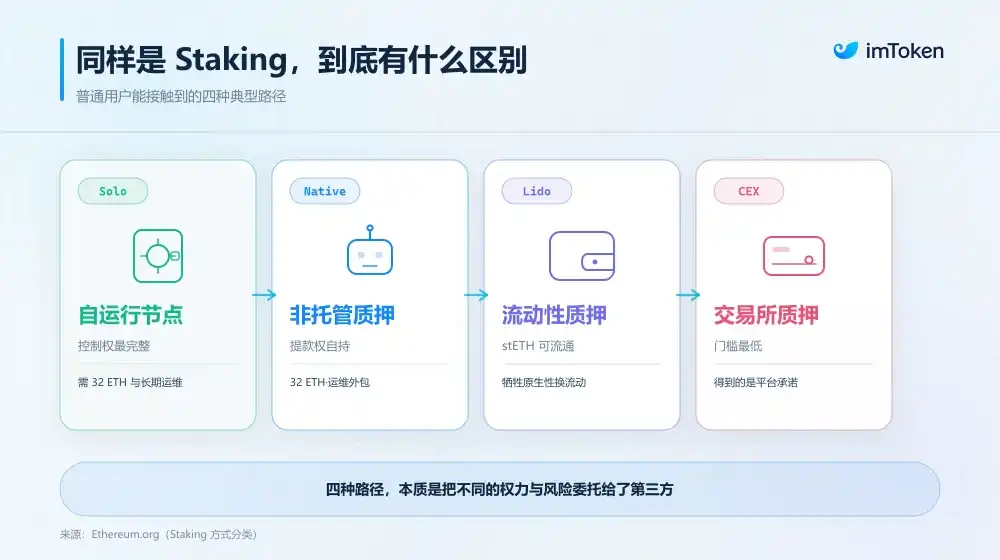
Overall, the typical ETH staking paths accessible to ordinary users today can be broadly categorized into four types.

On the surface, they might seem like just four methods to earn the same yield, but the core difference between these paths lies in which part of the power and risk the user chooses to delegate to a third party.
1. Running Your Own Node: The Most 'Native' Yield, and the Most Complete Control

The purest form of ETH staking is preparing 32 ETH yourself, running execution and consensus layer clients, and maintaining your own validator node.

In this method, everything—from how the node is deployed, which clients are run, to when to exit—is decided by you. The protocol-generated rewards also don't need to be shared with a liquid staking protocol or exchange.

However, the barriers are higher because you need at least 32 ETH, a stably running device, good network conditions, and must continuously maintain client versions, node status, and key security.

Ultimately, running your own node trades the highest level of control and more complete rewards for higher technical and operational costs.

2. Native Staking: Control Your Assets, Outsource the 'Operations'

The second method can be understood as a middle ground between Solo Staking and fully custodial solutions.

The user still uses their own 32 ETH to create an independent validator. The ETH ultimately still enters the native Ethereum staking system and is not exchanged for another token, but the node operation is handled by a professional service provider.

The most important distinction is the separation between withdrawal rights and node operation rights.

The validator itself uses different keys. The Signing Key, used for daily node signatures and block validation, can be managed by a professional node service provider. However, the Withdrawal Credential, which ultimately determines the destination of the principal and rewards, can remain in the hands of the user.

This is also a crucial dividing line between non-custodial Native Staking and custodial exchange staking. For example, imToken's current non-custodial ETH staking service is designed with this concept in mind (Extended reading: What is imToken's Non-Custodial ETH Staking Service?):

Users holding 32 ETH or more can create independent validators. The withdrawal keys are controlled by the user, node operation is handled by professional infrastructure, and different choices like compound validator and auto-withdrawal validator are already available.

This is suitable for users who have at least 32 ETH, want to earn native staking rewards, value self-custody, but don't want to maintain a validator themselves daily.

Of course, "non-custodial" does not mean "no third-party risk." Node operators can still experience downtime, configuration errors, or even Slashing. Therefore, what's transferred here is not asset ownership, but node operational risk.

3. Lido: Sacrifice a Bit of 'Nativity' for Liquidity

If you don't have 32 ETH, or simply don't want your ETH stuck in a validator exit queue for a long time, then liquid staking represents a completely different route.

Lido is the most typical example. Users deposit ETH into Lido, and the protocol allocates the funds to node operators to participate in Ethereum staking, while issuing stETH to the user.

Thus, ETH that was originally staked and couldn't be directly transferred is wrapped into a chain asset that remains liquid. Users can still transfer, trade, and use stETH, or further participate in DeFi scenarios like lending and liquidity provision.

To exit, users can either follow Lido's protocol redemption process to swap back to ETH, or directly sell stETH for ETH on a DEX. The latter doesn't even require waiting for the validator to actually exit, but the trade-off is bearing the current market price and potential slippage.

Simultaneously, stETH continuously reflects the staking rewards earned by the user through mechanisms like Rebase. Therefore, for ordinary users, there's basically no need to handle the issue of "claiming rewards and then re-staking" themselves.

The flip side of convenience is an additional layer of risk. Lido currently charges a protocol fee, distributed among node operators, the DAO Treasury, etc., with users receiving the remainder. More importantly, it introduces additional risks such as Lido's smart contracts, protocol governance, node operator risk, and stETH secondary market liquidity.

It's important to note that there is no forced "1:1 peg" between stETH and ETH like with fiat-backed stablecoins. If the market is eager to sell stETH in the short term, it could very well trade at a discount to ETH. If you then use that stETH to participate in more DeFi protocols, you further layer on new smart contract and liquidation risks.

Currently, imToken's ETH staking portal has also integrated Lido, allowing users to directly participate in liquid staking and hold stETH without needing 32 ETH.

4. Exchange Staking: The Lowest Barrier, But What You Own is a 'Platform Promise'

The last method might be the most familiar for many new users: depositing ETH on an exchange and clicking "Staking."

In terms of user experience, this is undoubtedly the simplest.

No need to have 32 ETH, no need to understand validator nodes, no need to manage Signing Keys or Withdrawal Keys, and no worries about server uptime.

The exchange aggregates ETH from many users to run validators, then credits a portion of the rewards to user accounts according to its own rules.

But precisely because of this, this method requires the most trust. What a user sees as "1 ETH staked" is often first and foremost a record in the exchange's internal accounting system. How validators are deployed at the underlying level, how much asset is actually staked, how rewards are reinvested, what percentage the platform takes, and how liquidity is managed when users request redemption—all depend on the specific platform's product design.

More importantly, the assets themselves are primarily under the custody of a centralized platform. This doesn't necessarily mean exchange staking is "bad." For newcomers who already keep their ETH on an exchange long-term and don't plan to manage an on-chain wallet themselves, it might still be the method with the lowest operational barrier.

It's just that the convenience you gain essentially comes from handing over asset custody, node operation, reward distribution, and even the exit process to the platform.
3. There's No 'Highest Yield' Staking, Only the Right Combination of Risks for You

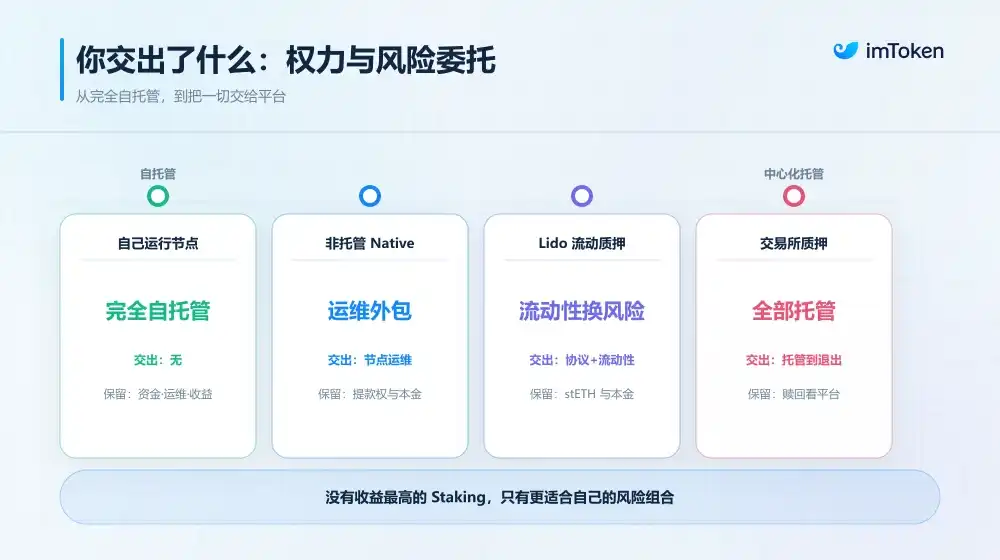
Placing all four methods side by side reveals an interesting phenomenon.

The evolution of Ethereum staking products isn't all solutions converging towards the same endpoint, but rather a continuous process of differentiating the capabilities that different users actually need.

  • Running your own node maximizes control;
  • Native Staking separates "fund ownership" and "node operations";
  • Lido recombines "staking yield" and "fund liquidity";
  • Exchanges further hide complexity, trading centralized custody for the lowest usage barrier;

And Fidelity planning to package Staking into an ETF takes yet another step forward—investors don't even need to hold on-chain ETH or understand how validators work; traditional financial products can handle custody, node operation, yield acquisition, and even final distribution for them.

From this viewpoint, Staking is increasingly resembling a mature financial infrastructure service.

So how should ordinary users choose?

If you have at least 32 ETH, possess some technical skills, highly value self-sovereignty, and wish to directly participate in the Ethereum network, running your own validator is still the choice with the most complete control.

If you also have 32 ETH but don't want to bear the long-term burden of node operation, while still wanting to firmly control withdrawal permissions, non-custodial Native Staking is a natural compromise.

If you hold less than 32 ETH, or have ongoing needs for trading, lending, and other DeFi activities, then Liquid Staking, as represented by Lido, trades an additional layer of protocol risk for significantly greater capital flexibility.

As for exchange Staking, it's more suitable for users who already accept centralized custody and wish to minimize operational barriers, provided they understand that platform risk doesn't disappear just because there's a "Staking" button.
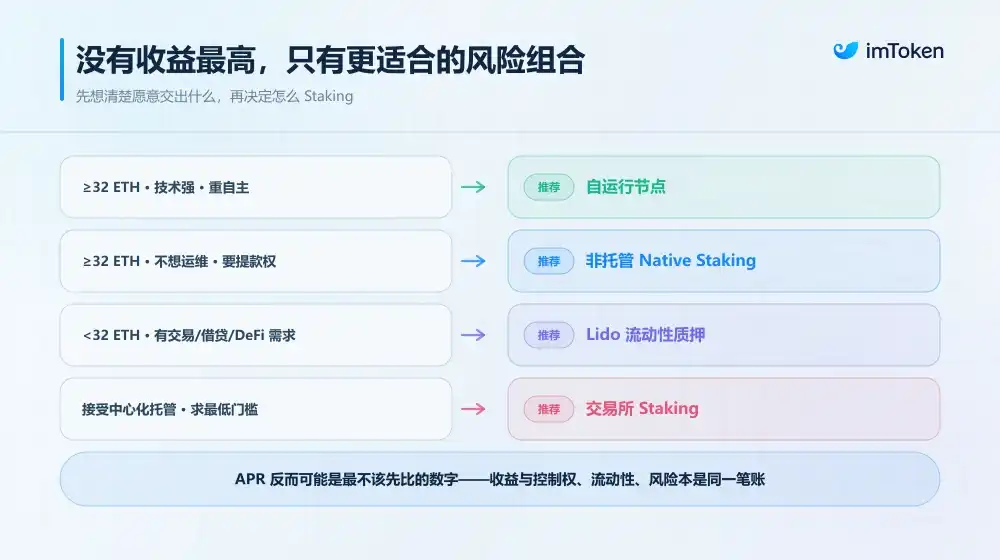
Therefore, looking at Ethereum staking today, APR might actually be the least important number to compare first.

If two products differ by only a few tenths of a percentage point in annualized yield, but one requires handing over assets completely to a third party while the other lets you control withdrawal rights; one requires waiting in the validator exit queue to withdraw, while the other allows selling the LST on the market anytime; one enables native compounding directly, while the other depends on how the platform handles rewards—these differences are often far more significant than the surface-level APR.

After all, staking rewards never exist in isolation.

How much yield you earn, and how much liquidity, control, and additional risk you give up for that yield, are ultimately all part of the same calculation.

Criptos en tendencia

Preguntas relacionadas

QAccording to the article, what are the two key numbers recently observed in Ethereum Staking, and what do they signify?

AThe first number is 34.7%, indicating that approximately 42.4 million ETH is currently staked, a historical high. The second is that there are over 2.2 million ETH in the validator entry queue, with a waiting period of about 39 days. These numbers signify that Ethereum staking is accelerating from a niche on-chain operation towards becoming a standardized asset management method.

QWhat is the fundamental difference in reward mechanisms between traditional 0x01 validators and the new 0x02 validators introduced with Pectra?

AFor traditional 0x01 validators, any consensus rewards earned above the 32 ETH stake are automatically and periodically withdrawn to the withdrawal address and do not automatically re-stake. With the new 0x02 validators introduced with Pectra, the maximum effective balance is raised to 2048 ETH, and any rewards above 32 ETH can automatically increase the validator's effective staking balance, enabling native compounding within the protocol.

QWhat are the four typical paths for ordinary users to engage in ETH Staking as outlined in the article, and what is the core trade-off they represent?

AThe four paths are: 1) Running your own node (full control, high technical cost). 2) Native Staking with a service provider (self-custody of assets, outsourced node operation). 3) Using a liquid staking protocol like Lido (trades some native protocol purity for liquidity via LSTs). 4) Staking through an exchange (lowest barrier, full custody and operational reliance on the platform). The core trade-off for all paths is the degree of control, liquidity, and risk that users delegate to a third party in exchange for convenience and rewards.

QIn the context of Non-Custodial Native Staking, how is the separation of keys a critical distinction from exchange-based staking?

AIn Non-Custodial Native Staking, the user's withdrawal credential (Withdrawal Key) which controls the principal and final rewards remains in the user's self-custody. The node operational key (Signing Key) can be managed by a professional node operator. This separation creates a crucial boundary, ensuring asset ownership is not surrendered, unlike exchange-based staking where the user entrusts both asset custody and all operational control to the platform.

QAccording to the article's conclusion, why is comparing APR (Annual Percentage Rate) alone insufficient for choosing a Staking method?

AComparing only APR is insufficient because the critical differences lie in other factors such as the level of asset control (self-custody vs. platform custody), liquidity (e.g., via Liquid Staking Tokens), exit flexibility (waiting for validator queue vs. selling on the market), and the specific risks introduced (smart contract, protocol, node operator, or platform risk). The article emphasizes that the trade-offs between the rewards earned and the liquidity, control, and additional risks undertaken are integral parts of the overall staking decision.

Lecturas Relacionadas

Los capitales de riesgo de China están pasando de 'elegir personas' a 'elegir ciudades'

La inversión de capital de riesgo en China está pasando de "elegir personas" a "elegir ciudades". En la era de Internet, el capital apostaba por emprendedores destacados como Wang Xing (Meituan), Li Bin (Nio) y Li Xiang (Li Auto), valorando su visión, experiencia y capacidad ejecutiva. Sin embargo, en la era de la tecnología dura (hard tech), como robótica, IA, semiconductores o biotecnología, los recursos necesarios (cadena de suministro, talento, infraestructura de I+D, escenarios de aplicación) están profundamente arraigados en ecosistemas industriales específicos de cada ciudad. Esto ha desplazado el enfoque de los inversores hacia el análisis del historial industrial, capacidades de organización de recursos y credibilidad a largo plazo de las urbes. Ciudades como Shenzhen (robótica), Beijing (IA, especialmente en el distrito de Haidian), Suzhou (biotecnología) y Hefei (semiconductores, ejemplificado por el caso de Changxin) se han convertido en polos de atracción de capital. Su éxito se basa en años de acumulación industrial, clusters de empresas y apoyo continuo de políticas. Además, el creciente protagonismo del capital estatal y los fondos gubernamentales locales, que priorizan el desarrollo industrial a largo plazo sobre el retorno financiero inmediato, refuerza esta tendencia. En esencia, el capital busca mayor probabilidad de éxito en un entorno incierto. Mientras antes un emprendedor excepcional elevaba las posibilidades, ahora una ciudad con un ecosistema sólido ofrece un colchón crítico para que las empresas sobrevivan y crezcan. Por tanto, las ciudades que deseen atraer inversión deben concentrarse en cultivar industrias específicas con claridad, construir un pipeline de proyectos escalonados y garantizar estabilidad política y un entorno favorable, reduciendo barreras como los requisitos excesivos de reinversión ("retorno"). La competencia por el capital se ha convertido en una competencia entre las capacidades industriales integrales de las ciudades.

marsbitHace 32 min(s)

Los capitales de riesgo de China están pasando de 'elegir personas' a 'elegir ciudades'

marsbitHace 32 min(s)

¿64.4 mil millones en opciones de Bitcoin expiran este viernes: ¿Realmente causarán una gran volatilidad en el mercado?

Autor: José Antonio Lanz Compilación: Deep Tide TechFlow Un total de opciones de Bitcoin por valor de 64.400 millones de dólares vencen este viernes en Deribit, correspondientes a 81.700 contratos con una relación put/call de 0,83, lo que indica un sesgo alcista. El "máximo dolor" (max pain) se sitúa alrededor de los 70.000 dólares, muy por debajo del precio actual, aunque la mayoría de los contratos están fuera del dinero y expirarán sin valor. Históricamente, vencimientos de tamaño similar no han alterado significativamente el precio. El evento coincide con el segundo día del simposio de Jackson Hole, donde el nuevo presidente de la Fed, Kevin Warsh, pronunciará su primer discurso clave. Aunque el volumen es grande, los expertos señalan que suena más alarmante de lo que realmente es: el 62% de los contratos expirarán sin valor, y el vencimiento de septiembre ya muestra un volumen casi duplicado. Niveles a viggar incluyen la media móvil de 200 días de Bitcoin (unos 69.000 dólares). A diferencia de vencimientos anteriores de gran tamaño en 2025 que no movieron el mercado, esta vez la presión se centra en los strikes de 75.000 y 80.000 dólares, lo que podría mantener activa la cobertura de los creadores de mercado. La liquidación será a las 08:00 UTC del viernes, coincidiendo con el discurso de Warsh.

marsbitHace 33 min(s)

¿64.4 mil millones en opciones de Bitcoin expiran este viernes: ¿Realmente causarán una gran volatilidad en el mercado?

marsbitHace 33 min(s)

Trading

Spot

Artículos destacados

Qué es ETH 2.0

ETH 2.0: Una Nueva Era para Ethereum Introducción ETH 2.0, conocido ampliamente como Ethereum 2.0, marca una actualización monumental de la blockchain de Ethereum. Esta transición no es solo un cambio de imagen; busca mejorar fundamentalmente la escalabilidad, seguridad y sostenibilidad de la red. Con un cambio del mecanismo de consenso intensivo en energía Prueba de Trabajo (PoW) a una Prueba de Participación (PoS) más eficiente, ETH 2.0 promete un enfoque transformador para el ecosistema de blockchain. ¿Qué es ETH 2.0? ETH 2.0 es un conjunto de actualizaciones distintivas e interconectadas centradas en optimizar las capacidades y el rendimiento de Ethereum. La remodelación está diseñada para abordar desafíos críticos que el mecanismo de Ethereum existente ha enfrentado, particularmente en relación con la velocidad de transacción y la congestión de la red. Objetivos de ETH 2.0 Los objetivos principales de ETH 2.0 giran en torno a mejorar tres aspectos fundamentales: Escalabilidad: Con el objetivo de mejorar significativamente la cantidad de transacciones que la red puede manejar por segundo, ETH 2.0 busca superar la actual limitación de aproximadamente 15 transacciones por segundo, potencialmente alcanzando miles. Seguridad: Las medidas de seguridad mejoradas son fundamentales para ETH 2.0, particularmente a través de una mayor resistencia contra ciberataques y la preservación del ethos descentralizado de Ethereum. Sostenibilidad: El nuevo mecanismo de PoS está diseñado no solo para mejorar la eficiencia, sino también para reducir drásticamente el consumo de energía, alineando el marco operativo de Ethereum con consideraciones medioambientales. ¿Quién es el Creador de ETH 2.0? La creación de ETH 2.0 se puede atribuir a la Fundación Ethereum. Esta organización sin fines de lucro, que desempeña un papel crucial en el apoyo al desarrollo de Ethereum, está liderada por el notable cofundador Vitalik Buterin. Su visión de un Ethereum más escalable y sostenible ha sido la fuerza impulsora detrás de esta actualización, involucrando contribuciones de una comunidad global de desarrolladores y entusiastas dedicados a mejorar el protocolo. ¿Quiénes son los Inversores de ETH 2.0? Aunque los detalles sobre los inversores de ETH 2.0 no se han hecho públicos, se sabe que la Fundación Ethereum recibe apoyo de varias organizaciones e individuos en el ámbito de blockchain y tecnología. Estos socios incluyen firmas de capital de riesgo, empresas tecnológicas y organizaciones filantrópicas que comparten un interés mutuo en apoyar el desarrollo de tecnologías descentralizadas e infraestructura de blockchain. ¿Cómo Funciona ETH 2.0? ETH 2.0 es notable por introducir una serie de características clave que lo diferencian de su predecesor. Prueba de Participación (PoS) La transición a un mecanismo de consenso PoS es uno de los cambios más destacados de ETH 2.0. A diferencia de PoW, que depende de la minería intensiva en energía para la verificación de transacciones, PoS permite a los usuarios validar transacciones y crear nuevos bloques de acuerdo con la cantidad de ETH que apuestan en la red. Esto conduce a una mayor eficiencia energética, reduciendo el consumo en aproximadamente un 99.95%, convirtiendo Ethereum 2.0 en una alternativa considerablemente más ecológica. Cadenas Shard Las cadenas shard son otra innovación crítica de ETH 2.0. Estas cadenas más pequeñas operan en paralelo con la cadena principal de Ethereum, lo que permite procesar múltiples transacciones simultáneamente. Este enfoque mejora la capacidad general de la red, abordando las preocupaciones de escalabilidad que han plagado a Ethereum. Cadena Beacon En el núcleo de ETH 2.0 se encuentra la Cadena Beacon, que coordina la red y gestiona el protocolo PoS. Actúa como una especie de organizador: supervisa a los validadores, asegura que los shards permanezcan conectados a la red y monitorea la salud general del ecosistema blockchain. Cronología de ETH 2.0 El viaje de ETH 2.0 ha estado marcado por varios hitos clave que trazan la evolución de esta significativa actualización: Diciembre 2020: El lanzamiento de la Cadena Beacon marcó la introducción de PoS, preparando el escenario para la migración a ETH 2.0. Septiembre 2022: La finalización de “La Fusión” representa un momento pivotal donde la red Ethereum transicionó exitosamente de un marco PoW a un marco PoS, anunciando una nueva era para Ethereum. 2023: Se espera el lanzamiento de cadenas shard con el fin de mejorar aún más la escalabilidad de la red Ethereum, consolidando ETH 2.0 como una plataforma robusta para aplicaciones y servicios descentralizados. Características Clave y Beneficios Escalabilidad Mejorada Una de las ventajas más significativas de ETH 2.0 es su escalabilidad mejorada. La combinación de PoS y cadenas shard permite a la red expandir su capacidad, permitiendo acomodar un volumen de transacciones muy mayor en comparación con el sistema legado. Eficiencia Energética La implementación de PoS representa un gran paso hacia la eficiencia energética en la tecnología blockchain. Al reducir drásticamente el consumo de energía, ETH 2.0 no solo reduce los costos operativos, sino que también se alinea más estrechamente con los objetivos globales de sostenibilidad. Seguridad Mejorada Los mecanismos actualizados de ETH 2.0 contribuyen a una mayor seguridad en toda la red. El despliegue de PoS, junto con medidas de control innovadoras establecidas a través de las cadenas shard y la Cadena Beacon, asegura un mayor grado de protección contra posibles amenazas. Costos Más Bajos para los Usuarios A medida que la escalabilidad mejora, los efectos sobre los costos de transacción también serán evidentes. Se espera que la mayor capacidad y la reducción de la congestión se traduzcan en tarifas más bajas para los usuarios, haciendo de Ethereum una opción más accesible para transacciones diarias. Conclusión ETH 2.0 marca una evolución significativa en el ecosistema de la blockchain de Ethereum. Al abordar cuestiones clave como la escalabilidad, el consumo de energía, la eficiencia en las transacciones y la seguridad en general, la importancia de esta actualización no puede subestimarse. El cambio a Prueba de Participación, la introducción de cadenas shard y el trabajo fundamental de la Cadena Beacon son indicativos de un futuro donde Ethereum puede satisfacer las crecientes demandas del mercado descentralizado. En una industria impulsada por la innovación y el progreso, ETH 2.0 se erige como un testimonio de las capacidades de la tecnología blockchain para allanar el camino hacia una economía digital más sostenible y eficiente.

419 Vistas totalesPublicado en 2024.04.04Actualizado en 2024.12.03

Qué es ETH 2.0

Qué es ETH 3.0

ETH3.0 y $eth 3.0: Un Examen en Profundidad del Futuro de Ethereum Introducción En el paisaje en rápida evolución de las criptomonedas y la tecnología blockchain, ETH3.0, a menudo denotado como $eth 3.0, ha emergido como un tema de considerable interés y especulación. El término abarca dos conceptos principales que merecen clarificación: Ethereum 3.0: Esto representa una posible actualización futura destinada a aumentar las capacidades de la blockchain de Ethereum existente, centrándose particularmente en mejorar la escalabilidad y el rendimiento. ETH3.0 Meme Token: Este proyecto de criptomoneda distinto busca aprovechar la blockchain de Ethereum para crear un ecosistema centrado en memes, promoviendo la participación dentro de la comunidad de criptomonedas. Entender estos aspectos de ETH3.0 es esencial no solo para los entusiastas de las criptomonedas, sino también para aquellos que observan tendencias tecnológicas más amplias en el espacio digital. ¿Qué es ETH3.0? Ethereum 3.0 Ethereum 3.0 se presenta como una actualización propuesta a la red Ethereum ya establecida, que ha sido la columna vertebral de muchas aplicaciones descentralizadas (dApps) y contratos inteligentes desde su inicio. Las mejoras previstas se concentran principalmente en la escalabilidad, integrando tecnologías avanzadas como el sharding y las pruebas de conocimiento cero (zk-proofs). Estas innovaciones tecnológicas tienen como objetivo facilitar un número sin precedentes de transacciones por segundo (TPS), que podría alcanzar millones, abordando así una de las limitaciones más significativas que enfrenta la tecnología blockchain actual. La mejora no es meramente técnica, sino también estratégica; está destinada a preparar la red Ethereum para una adopción y utilidad generalizada en un futuro marcado por una mayor demanda de soluciones descentralizadas. ETH3.0 Meme Token En contraste con Ethereum 3.0, el ETH3.0 Meme Token se aventura en un dominio más ligero y juguetón al combinar la cultura de memes de internet con la dinámica de las criptomonedas. Este proyecto permite a los usuarios comprar, vender e intercambiar memes en la blockchain de Ethereum, proporcionando una plataforma que fomenta la participación comunitaria a través de la creatividad y los intereses compartidos. El ETH3.0 Meme Token tiene como objetivo demostrar cómo la tecnología blockchain puede intersecarse con la cultura digital, creando casos de uso que son tanto entretenidos como financieramente viables. ¿Quién es el Creador de ETH3.0? Ethereum 3.0 La iniciativa hacia Ethereum 3.0 es impulsada principalmente por un consorcio de desarrolladores e investigadores dentro de la comunidad Ethereum, destacando a Justin Drake. Conocido por sus ideas y contribuciones a la evolución de Ethereum, Drake ha sido una figura prominente en las discusiones sobre la transición de Ethereum a una nueva capa de consenso, conocida como la “Beam Chain.” Este enfoque colaborativo en el desarrollo significa que Ethereum 3.0 no es el producto de un creador singular, sino más bien una manifestación de la ingenio colectivo centrado en avanzar en la tecnología blockchain. ETH3.0 Meme Token Los detalles sobre el creador del ETH3.0 Meme Token son actualmente indetectables. La naturaleza de los tokens de memes a menudo conduce a una estructura más descentralizada y guiada por la comunidad, lo que podría explicar la falta de atribución específica. Esto se alinea con la ética de la mayor comunidad cripto, donde la innovación a menudo surge de esfuerzos colaborativos en lugar de individuales. ¿Quiénes son los Inversores de ETH3.0? Ethereum 3.0 El apoyo a Ethereum 3.0 proviene principalmente de la Fundación Ethereum junto a una entusiasta comunidad de desarrolladores e inversores. Esta asociación fundacional proporciona un grado significativo de legitimidad y mejora la perspectiva de implementación exitosa, ya que aprovecha la confianza y la credibilidad construidas a lo largo de años de operaciones de la red. En el clima cambiante de las criptomonedas, el apoyo de la comunidad juega un papel crucial en impulsar el desarrollo y la adopción, posicionando a Ethereum 3.0 como un serio competidor para los futuros avances en blockchain. ETH3.0 Meme Token Si bien las fuentes actualmente disponibles no brindan información explícita sobre las fundaciones de inversión u organizaciones que respaldan el ETH3.0 Meme Token, es indicativo del modelo de financiamiento típico para los tokens de memes, que a menudo se basa en el apoyo de base y la participación comunitaria. Los inversores en tales proyectos suelen consistir en individuos motivados por el potencial de innovación impulsada por la comunidad y el espíritu de cooperación que se encuentra en la comunidad cripto. ¿Cómo Funciona ETH3.0? Ethereum 3.0 Las características distintivas de Ethereum 3.0 radican en su propuesta implementación de la tecnología de sharding y zk-proof. El sharding es un método de particionamiento de la blockchain en partes más pequeñas y manejables o “shards,” que pueden procesar transacciones de manera concurrente en lugar de secuencial. Esta descentralización del procesamiento ayuda a prevenir la congestión y asegura que la red se mantenga receptiva incluso bajo una carga pesada. La tecnología de prueba de conocimiento cero (zk-proof) añade otra capa de sofisticación al permitir la validación de transacciones sin revelar los datos subyacentes involucrados. Este aspecto no solo mejora la privacidad, sino que también aumenta la eficiencia general de la red. También se habla de incorporar una Máquina Virtual de Ethereum de conocimiento cero (zkEVM) en esta actualización, ampliando aún más las capacidades y la utilidad de la red. ETH3.0 Meme Token El ETH3.0 Meme Token se distingue al capitalizar sobre la popularidad de la cultura de memes. Establece un mercado para que los usuarios participen en el intercambio de memes, no solo por entretenimiento sino también por el potencial de ganancia económica. Al integrar características como staking, provisión de liquidez y mecanismos de gobernanza, el proyecto fomenta un entorno que incentiva la interacción y participación de la comunidad. Al ofrecer una mezcla única de entretenimiento y oportunidad económica, el ETH3.0 Meme Token tiene como objetivo atraer a una audiencia diversa, desde entusiastas de las criptomonedas hasta conocedores de memes casuales. Cronología de ETH3.0 Ethereum 3.0 11 de noviembre de 2024: Justin Drake insinúa la próxima actualización ETH 3.0, centrada en las mejoras de escalabilidad. Este anuncio significa el inicio de discusiones formales sobre la futura arquitectura de Ethereum. 12 de noviembre de 2024: Se espera que la propuesta anticipada para Ethereum 3.0 sea revelada en Devcon en Bangkok, estableciendo el escenario para comentarios más amplios de la comunidad y potenciales próximos pasos en el desarrollo. ETH3.0 Meme Token 21 de marzo de 2024: El ETH3.0 Meme Token se lista oficialmente en CoinMarketCap, marcando su incursión en el dominio público de las criptomonedas y aumentando la visibilidad de su ecosistema basado en memes. Puntos Clave En conclusión, Ethereum 3.0 representa una evolución significativa dentro de la red Ethereum, enfocándose en superar limitaciones relacionadas con la escalabilidad y el rendimiento a través de tecnologías avanzadas. Sus actualizaciones propuestas reflejan un enfoque proactivo hacia las futuras demandas y la usabilidad. Por otro lado, el ETH3.0 Meme Token encapsula la esencia de la cultura impulsada por la comunidad en el espacio de las criptomonedas, aprovechando la cultura de memes para crear plataformas atractivas que fomenten la creatividad y participación de los usuarios. Entender los distintos propósitos y funcionalidades de ETH3.0 y $eth 3.0 es fundamental para cualquier persona interesada en los desarrollos en curso dentro del espacio cripto. Con ambas iniciativas abriendo caminos únicos, subrayan colectivamente la naturaleza dinámica y multifacética de la innovación blockchain.

417 Vistas totalesPublicado en 2024.04.04Actualizado en 2024.12.03

Qué es ETH 3.0

Cómo comprar ETH

¡Bienvenido a HTX.com! Hemos hecho que comprar Ethereum (ETH) sea simple y conveniente. Sigue nuestra guía paso a paso para iniciar tu viaje de criptos.Paso 1: crea tu cuenta HTXUtiliza tu correo electrónico o número de teléfono para registrarte y obtener una cuenta gratuita en HTX. Experimenta un proceso de registro sin complicaciones y desbloquea todas las funciones.Obtener mi cuentaPaso 2: ve a Comprar cripto y elige tu método de pagoTarjeta de crédito/débito: usa tu Visa o Mastercard para comprar Ethereum (ETH) al instante.Saldo: utiliza fondos del saldo de tu cuenta HTX para tradear sin problemas.Terceros: hemos agregado métodos de pago populares como Google Pay y Apple Pay para mejorar la comodidad.P2P: tradear directamente con otros usuarios en HTX.Over-the-Counter (OTC): ofrecemos servicios personalizados y tipos de cambio competitivos para los traders.Paso 3: guarda tu Ethereum (ETH)Después de comprar tu Ethereum (ETH), guárdalo en tu cuenta HTX. Alternativamente, puedes enviarlo a otro lugar mediante transferencia blockchain o utilizarlo para tradear otras criptomonedas.Paso 4: tradear Ethereum (ETH)Tradear fácilmente con Ethereum (ETH) en HTX's mercado spot. Simplemente accede a tu cuenta, selecciona tu par de trading, ejecuta tus trades y monitorea en tiempo real. Ofrecemos una experiencia fácil de usar tanto para principiantes como para traders experimentados.

5.7k Vistas totalesPublicado en 2024.12.10Actualizado en 2026.06.02

Cómo comprar ETH

Discusiones

Bienvenido a la comunidad de HTX. Aquí puedes mantenerte informado sobre los últimos desarrollos de la plataforma y acceder a análisis profesionales del mercado. A continuación se presentan las opiniones de los usuarios sobre el precio de ETH (ETH).

活动图片