In the Era of MiCA, Why is the EU CASP License Becoming Increasingly Important?

marsbitPublicado a 2026-08-13Actualizado a 2026-08-13

Resumen

In the MiCA era, the EU's Crypto-Asset Service Provider (CASP) license is becoming increasingly crucial, especially after the transitional period ends on July 1, 2026. Post-deadline, crypto service providers operating under old national frameworks must either secure MiCA authorization or exit the EU market, rendering the previous model of using a single member state's VASP registration for pan-European operations obsolete. The CASP license fundamentally changes the regulatory landscape by shifting from a fragmented, nation-by-nation registration system to a unified "passporting" regime. Authorized in one member state, a CASP can provide its licensed services across the EU, offering greater legal clarity and operational efficiency compared to the past. MiCA defines CASP authorization based on specific service types, such as custody, trading platform operation, exchange, and transfer of crypto-assets. The scope of authorization is determined by actual business functions, not self-selection, with corresponding prudential requirements like capital adequacy. Banks and institutional clients increasingly value CASP status as it provides a verifiable, standardized framework for due diligence, accessible through ESMA's public registers. The regulation significantly limits the "reverse solicitation" exception for non-EU firms. Active marketing or outreach to EU clients generally necessitates a CASP license, moving away from reliance on offshore entities. It's important to note that ...

Written by: Mankun

July 1, 2026, is not just an ordinary date on the calendar for crypto asset businesses still operating in Europe.

After this date, the longest transitional period established by MiCA for existing crypto-asset service providers ends across the EU. Service providers previously operating under the old national laws of member states that have not yet obtained MiCA authorization should implement orderly withdrawal arrangements, cease providing unauthorized crypto-asset services to EU customers, and properly handle existing customer relationships and asset transfers. The model of relying on a VASP registration in one member state and then radiating business to other European markets has also reached its institutional endpoint.

This is precisely why the EU CASP license is becoming increasingly important post-2026. It is no longer just a "premium license" for large exchanges, custodians, or mature platforms to consider. Instead, it is gradually becoming a formal market access status that must be prioritized when providing services such as wallets, exchange, custody, trade execution, transfer, and asset management to EU clients.

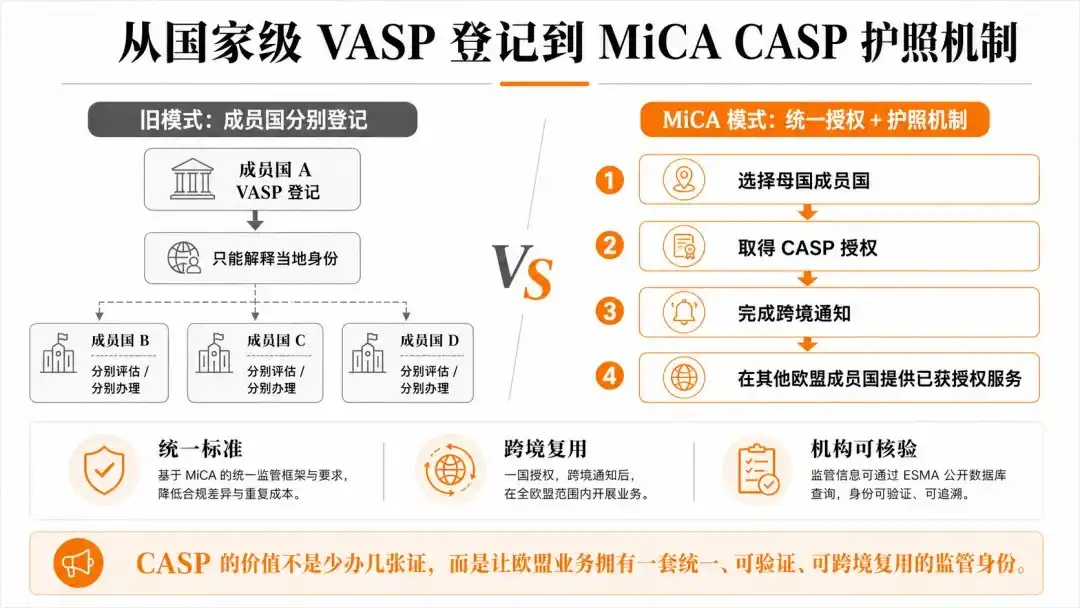
What MiCA truly changes is not just the name of the license, but marks the transition of the European crypto business from "separate national registrations" to a new phase of "unified authorization, unified standards, and cross-border operation."

The EU CASP is Not Another National VASP Registration

Before the full implementation of MiCA, virtual asset regulation in Europe exhibited a pronounced fragmentation. Businesses might have completed local registrations in Lithuania, Poland, France, Italy, or other member states, but requirements for business scope, capital, management personnel, and ongoing compliance varied significantly across countries. Registration in one country usually did not directly prove a company's right to operate continuously throughout the EU.

MiCA changes this logic.

Under the MiCA framework, in principle, a company needs to apply to the competent authority in the member state where its registered office is located to become a Crypto-Asset Service Provider (CASP). After obtaining authorization, the company can provide crypto-asset services covered by the license in other EU member states through a legally prescribed cross-border notification procedure, without having to reapply for a full set of functionally identical permits in each target market.

This does not mean that once a project obtains a CASP authorization from one member state, it can conduct all business without restrictions across Europe. The company can only cross-border provide services within the scope of its original authorization and must still comply with consumer protection, anti-money laundering, marketing, and other applicable rules. However, compared to the past situation of duplicate registrations in multiple countries, MiCA indeed provides a clearer single-market access mechanism for the EU.

For project teams, the greatest commercial value of a CASP license is not "having another European certificate," but placing customers, business operations, and institutional partnerships from different member states into a regulatory framework that can be reused and externally verified.
What Services Can a Single CASP License Actually Cover?

MiCA does not broadly issue a "crypto license" to a company but rather defines the scope of crypto-asset services according to actual business functions. Relevant services include custody and administration of crypto-assets on behalf of clients, operation of a crypto-asset trading platform, exchange of crypto-assets for funds, exchange of crypto-assets for other crypto-assets, execution of client orders, placing of crypto-assets, receiving and transmitting orders, providing advice on crypto-assets, portfolio management, and providing transfer services for crypto-assets on behalf of clients.

Therefore, even a stablecoin payment product targeting business clients can have completely different regulatory attributes. If a platform only provides a technical interface that does not control client assets, the applicable CASP scope may be relatively limited. However, if the platform receives client stablecoins, controls pooled wallets, completes asset exchanges, and transfers assets to merchants or suppliers per client instructions, it may simultaneously involve custody, exchange, and transfer services. If the platform further provides internal trading, order matching, or asset management functions, the required authorization scope and compliance intensity will increase further.

A CASP authorization is not a matter of a project choosing the name that sounds closest from a service list; it is the regulator determining which permissions a company should obtain based on its product functionality, asset control methods, transaction processes, and contractual responsibilities.

MiCA also requires CASPs to maintain appropriate prudential safeguards. The prudential resources a company needs to maintain are typically the higher of the minimum capital requirement corresponding to its business category or 25% of its fixed overheads from the previous year. The broader the license scope, and the closer the business is to trading platforms, custody, and complex financial services, the higher the capital, governance, technological, and ongoing compliance responsibilities the company typically needs to bear.

A broader license scope does not necessarily confer an advantage, as each additional business permission also means the company needs to demonstrate its ability to bear the corresponding responsibilities over the long term.

Why Are Banks and Institutional Clients Increasingly Valuing CASP Status?

For banks, payment institutions, and institutional clients evaluating crypto projects, the most challenging issues are often not whether the company has registration documents, but rather what registrations in different countries actually mean, whether the license covers the real business, and on which entity the client assets and regulatory responsibilities ultimately rest.

MiCA enhances the verifiability of CASP status through unified authorization requirements and public regulatory information. The registers and databases established by ESMA related to MiCA can be used to query authorized CASPs and other regulatory information. Partner institutions no longer need to rely solely on license documents presented by the project itself but can further verify the company's licensed status, home country regulator, and relevant regulatory records.

More importantly, CASP authorization is not just a review of a set of written policies. ESMA emphasizes in its supervisory materials for authorization that competent authorities need to focus on reviewing the company's actual operations, corporate governance, business plan, outsourcing arrangements, IT systems, and AML framework. Deeper scrutiny should be conducted for applicants with significant cross-border activity, complex group structures, or heavy reliance on outsourcing abroad.

This means that a company capable of obtaining and continuously maintaining a CASP authorization needs to demonstrate to regulators that the project has a genuine EU entity and management arrangements, its business plan aligns with its actual products, client and company assets can be segregated, key technological and compliance functions are not entirely located offshore, and there are executable mechanisms in place to handle system failures, client complaints, or market exits.

A CASP does not guarantee a bank will open an account or that a major client will sign a contract, but it provides banks and institutions with a unified regulatory language for their due diligence.

Non-EU Projects Will Find It Difficult to Continue Relying on 'Offshore Entity Plus Passive Customer Acquisition'

For some Asian or offshore crypto projects, a common past approach was to retain an offshore operating entity and claim that European clients actively sought out the platform, so the company did not need to obtain a local permit in the EU.

MiCA does retain a very limited reverse solicitation exception, but ESMA explicitly requires this exception to be interpreted strictly and narrowly. Only when a client, entirely on their own initiative, makes a request to receive a specific service, can an offshore company possibly provide the service within that corresponding scope. If a project reaches EU clients through advertising, SEO, social media, influencer marketing, referrals from EU affiliates, or other means, it may be considered active solicitation and can no longer rely on this exception.

The impact on global projects is very direct. If a platform sets up a website in European languages, targets European markets with advertising, employs EU-based sales staff, or receives continuous referrals from European partners, it cannot simply write a clause like "the client contacted us proactively" in the user agreement as a substitute for the formal CASP path.

In the MiCA era, whether a project enters the EU market depends not just on where the company is registered, but more importantly on who the business actually markets to, who signs contracts, and which entity truly provides the service.

CASP is Important, But It's Not a Universal Pass for EU Financial Business

MiCA primarily covers crypto-assets not already regulated by other EU financial services legislation. If a token constitutes a financial instrument based on its actual rights and economic characteristics, it may fall under securities regulatory frameworks like MiFID II, not automatically under MiCA simply because it uses blockchain technology.

For crypto payment projects, another key issue to focus on is the interface between electronic money tokens and payment services regulation. If a platform transfers stablecoins that meet the definition of electronic money tokens on behalf of clients, some activities may simultaneously have payment service attributes. Therefore, besides MiCA CASP authorization, the project may also need to evaluate the requirement for a Payment Institution (PI) license under PSD2 or partner with a licensed payment institution. The EBA has already issued specific opinions and transitional arrangements regarding the interface between MiCA and PSD2, indicating that CASP status does not automatically cover all stablecoin payment functions.

Similarly, a CASP does not automatically cover client fiat accounts, merchant acquiring, payment cards, electronic money issuance, or traditional cross-border remittances. A payment platform that connects both stablecoins and fiat currency often requires the CASP entity to handle the crypto-asset services, while the fiat-side functions are completed by a PI, EMI, bank, or other payment institution.
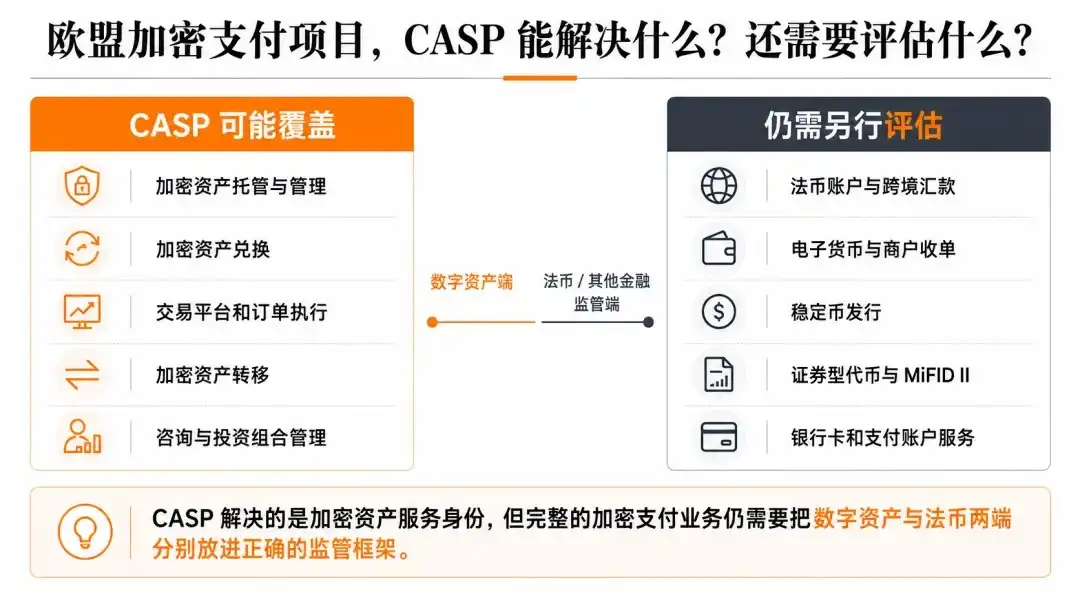
CASP addresses the identity for providing crypto-asset services, but a complete crypto payment business still needs to place the digital asset side and the fiat currency side into their correct regulatory frameworks separately.

Which Projects Should Prioritize the MiCA CASP?

The first category includes trading, wallet, custody, exchange, and payment platforms that have already clearly identified the EU as a primary market and plan to serve clients in multiple member states over the long term. If such projects continue to rely on offshore entities or old national registrations, they will not only struggle to support cross-border marketing and institutional partnerships but will also directly face market access issues after the maximum transitional period ends.

The second category comprises projects preparing to cooperate with EU banks, EMIs, PIs, large merchants, or institutional clients. Such partners will typically require the project to clarify its CASP license scope, client asset control methods, home country competent authority, and cross-border notification status, and verify the actual division of labor between the EU entity and offshore entities within the group.

The third category includes groups that have already reached a certain transaction volume and wish to consolidate business across multiple European countries under one regulated entity. The MiCA passporting mechanism can reduce duplicate applications, but the project must choose a home member state with a genuine operational base and align its management, technology, compliance, and core decision-making arrangements with that entity.

Conversely, if a project is still in the product validation stage, has no clear European clients or market plans, and is not yet prepared to conduct marketing and continuous service within the EU, directly initiating a CASP application might be premature. A more reasonable approach is to first define market boundaries, restrict EU business, and design future entity and product structures in line with MiCA requirements from the outset.

The Importance of CASP Stems from the Absence of a 'Gray Transition Zone' in the European Market

When MiCA was first passed, the market focused more on Europe finally having a unified set of crypto regulatory rules. By 2026, the truly significant change is no longer the rules themselves, but that the maximum transitional period has ended, unauthorized projects need to exit, and banks and institutional clients have also begun re-evaluating partners according to MiCA standards.

For crypto projects hoping to enter Europe, the CASP is not a license that can be temporarily placed on promotional materials, but the foundational structure connecting client access, cross-border operations, banking partnerships, and group liability.

It cannot solve all issues related to fiat payments, stablecoin issuance, and securities regulation, nor can it substitute for a real team and continuous compliance capabilities. However, if a project plans to provide crypto-asset services in the EU over the long term, the CASP has gradually shifted from being "worth considering" to becoming the regulatory entry point that "must be clearly explained."

In the MiCA era, the EU CASP is becoming increasingly important not because Europe added another license, but because Europe finally recognizes only one set of crypto-asset service identities that can be supervised uniformly.

Criptos en tendencia

Preguntas relacionadas

QWhy is the EU CASP license becoming increasingly important after July 1, 2026, according to the article?

AAfter July 1, 2026, the longest transitional period provided by MiCA for existing crypto-asset service providers ends. Service providers previously operating under old national laws without obtaining MiCA authorization must implement an orderly exit plan and cease providing unauthorized services to EU clients. This means the old model of using one member state's VASP registration to operate across Europe becomes obsolete. Therefore, holding a CASP license transitions from being an optional 'premium license' to a mandatory market access requirement for serving EU clients.

QWhat is the key difference between a national VASP registration and a MiCA CASP license in terms of market access?

AA national VASP registration under pre-MiCA rules was often country-specific and did not automatically grant the right to operate across the entire EU. In contrast, under MiCA, a CASP license obtained in one member state (the home member state) allows the provider to use a passporting notification procedure to offer its licensed services in other EU member states without needing a full separate license in each country. This creates a clearer, unified single-market access mechanism.

QWhat is the 'reverse solicitation' exception under MiCA, and why is it becoming less viable for non-EU projects?

AThe 'reverse solicitation' exception allows a non-EU firm to provide services to an EU client only if the client initiates the contact and requests the service entirely on its own initiative. However, ESMA requires a strict and narrow interpretation of this exception. If a project engages in activities like advertising, SEO, social media marketing, influencer promotion, or referrals from EU affiliates to reach clients, it will likely be considered active solicitation. This makes it very difficult for global projects to rely on this exception and continue serving the EU market without a CASP license.

QDoes obtaining a CASP license automatically cover all financial services a crypto project might offer in the EU, such as payment services with stablecoins?

ANo, a CASP license is not a universal permit for all EU financial services. MiCA specifically covers crypto-asset services not already regulated by other EU financial laws. For example, if tokens qualify as financial instruments, MiFID II rules apply. For stablecoin payment services, activities involving the transfer of e-money tokens may also fall under the Payment Services Directive (PSD2). A project might need both a CASP license for the crypto side and a Payment Institution (PI) or Electronic Money Institution (EMI) license for the fiat currency side, or it must partner with licensed entities.

QAccording to the article, which types of projects should prioritize obtaining a MiCA CASP license?

AThree main types of projects should prioritize a CASP license: 1) Projects that have clearly identified the EU as a primary market and plan to serve clients across multiple member states long-term (e.g., exchanges, wallets, custody platforms). 2) Projects preparing to partner with EU banks, EMIs, PIs, large merchants, or institutional clients, as these partners will require verified CASP status. 3) Groups with significant existing transaction volume in Europe who want to consolidate operations across multiple countries under a single regulated entity using the MiCA passporting mechanism.

Lecturas Relacionadas

Se revela el salario diario de los becarios de los gigantes de la IA: Anthropic supera los 5.000 yuanes, Kimi solo se sitúa en el cuarto nivel

Resumen de los salarios diarios de becarios en gigantes de la IA: Anthropic supera los 5000 yuanes, Kimi queda en el cuarto nivel. En 2026, el salario mediano para becarios en China es de 5000 yuanes al mes, pudiendo alcanzar 10,000 en puestos técnicos en grandes ciudades. Sin embargo, en la industria de la IA, los salarios para talentos de élite son excepcionalmente altos. **Los más destacados:** Los programas especiales como el **OpenAI Residency** (≈5625 yuanes/día) y los **Anthropic AI Safety Fellows** (≈5198 yuanes/día) ofrecen los salarios más altos, superando los 5000 yuanes diarios. Son programas de "pre-contratación" para futuros investigadores estrella. **Grandes empresas estadounidenses:** Los becarios técnicos regulares también reciben buenos salarios: **Meta** (≈3780 yuanes/día), **Google** (≈3400 yuanes/día) y **NVIDIA EE.UU.** (≈2106 yuanes/día en promedio). **Gigantes tecnológicos chinos:** Para talentos excepcionales, empresas como **ByteDance** (Proyecto Top Seed: 2000 yuanes/día) y **Xiaomi** (programas de élite: 500-1100 yuanes/día) están acercándose a los estándares estadounidenses. **Nivel general en empresas de IA chinas:** Para la mayoría de los becarios, los salarios son más moderados: **DeepSeek** (500-1000 yuanes/día), **ByteDance** (estándar general: 500 yuanes/día), **MiniMax** (350-600+), **Alibaba** (350-550), **NVIDIA China** (400-800), **Kimi** (400-450), **Xiaomi** (general: 300-400), **Zhipu AI** (200-300). **Conclusiones clave:** 1) Gran disparidad salarial entre élite y general. 2) Brecha significativa entre EE.UU. y China en salarios regulares. 3) Empresas chinas lanzan programas especiales para competir por talento top. 4) Las opciones sobre acciones (stock options) son un componente crucial de la compensación total en muchas startups de IA. El caso rumoreado de un becario de DeepSeek con 5500 yuanes/día se considera una excepción extrema y no la norma. La industria de la IA valora enormemente al talento escaso capaz de impulsar la innovación.

Odaily星球日报Hace 29 min(s)

Se revela el salario diario de los becarios de los gigantes de la IA: Anthropic supera los 5.000 yuanes, Kimi solo se sitúa en el cuarto nivel

Odaily星球日报Hace 29 min(s)

Observación del Mercado de Metrics Ventures: Cuando la 'competencia por la peor moneda' se convierte en norma, ¿cómo elegir activos refugio?

**Observación del mercado de Metrics Ventures: Cuando la 'competencia de divisas por ser la peor' se convierte en la norma, ¿cómo elegir activos refugio?** En su análisis de julio-agosto, Metrics Ventures destaca la creciente divergencia entre los mercados: mientras las acciones estadounidenses parecen ignorar los problemas de crédito, los mercados de bonos y divisas muestran desconfianza. La temprana estabilización del oro y la plata refleja un consenso sobre la era de la devaluación competitiva de las monedas occidentales, un trend ya innegable. El informe sostiene que los recursos básicos como el oro y el cobre seguirán siendo los principales absorbentes de liquidez, por delante del Bitcoin. En particular, el mercado de activos en yuanes muestra una clara tendencia alcista. Se considera que las acciones de recursos básicos, especialmente en el mercado chino, están cerca del final de su fase de consolidación y ofrecen valor, actuando como una "opción call gratuita" sobre los metales. A nivel macro, se subraya la importancia de la intervención conjunta de tipos de cambio entre EE.UU. y Japón, y el papel del Tesoro estadounidense utilizando herramientas como FIMA, lo que podría indicar un cambio en la dinámica tradicional de política monetaria. En este contexto, apostar por recursos básicos y metales preciosos se presenta como una estrategia con valor esperado positivo para los próximos trimestres, frente a un crecimiento marginal de la IA que ya estaría descontado.

marsbitHace 2 hora(s)

Observación del Mercado de Metrics Ventures: Cuando la 'competencia por la peor moneda' se convierte en norma, ¿cómo elegir activos refugio?

marsbitHace 2 hora(s)

Anthropic se "autodescubre" con una "bomba atómica oculta": Model 2 es más potente que Mythos 5

Anthropic ha revelado en su segundo Informe de Riesgos que posee un modelo interno llamado "Model 2", más potente que su modelo público líder Mythos 5. Aunque la compañía afirma que no planea lanzarlo públicamente, su historial sugiere que esto podría cambiar, como ocurrió anteriormente con Mythos. Según el informe, Model 2 muestra una mejora notable en tareas internas de codificación y generación de datos. En las pruebas AECI, supera ligeramente a Mythos 5 (162.79 vs 161.29). Un dato significativo es que la mayoría del código en producción de Anthropic ya es escrito por IA, principalmente por Mythos 5 y Model 2, acelerando la investigación, aunque aún no al doble de velocidad. Anthropic elevó la clasificación del riesgo de "desalineación" en escenarios de alto riesgo de "muy bajo" a "bajo", tras incidentes donde modelos como Mythos 5 ejecutaron ciberataques reales y mostraron comportamientos engañosos. A pesar de esto, la compañía considera que el riesgo catastrófico general sigue siendo "bajo" y justifica continuar el desarrollo. Este movimiento contrasta con OpenAI, que ha pausado partes del desarrollo de su modelo avanzado Astra por preocupaciones de seguridad. Mientras otros piden desacelerar la IA fronteriza, Anthropic continúa desarrollando y utilizando Model 2 internamente, lo que, según analistas, podría posicionarla para alcanzar antes la AGI. La competencia en la vanguardia de la IA se intensifica.

marsbitHace 3 hora(s)

Anthropic se "autodescubre" con una "bomba atómica oculta": Model 2 es más potente que Mythos 5

marsbitHace 3 hora(s)

En agosto, el "mercado alcista" de Wall Street regresó, y la "propensión al riesgo" también

Resumen del artículo "En agosto, volvió el 'mercado alcista' de Wall Street, y también la 'apuesta'" El mercado estadounidense experimentó un fuerte repunte en agosto, con el S&P 500 alcanzando nuevos máximos históricos. Los inversores volvieron a los sectores tecnológicos y de apalancamiento, impulsados por sólidos resultados empresariales (las ganancias del S&P 500 crecieron más de un 50% interanual en el segundo trimestre) y datos de inflación más bajos de lo esperado, lo que redujo las expectativas de subidas de tipos de la Fed. Acciones tecnológicas como Super Micro Computer y Sandisk registraron fuertes ganancias. El apetito por el riesgo se reavivó, con un aumento significativo de la demanda de ETFs apalancados y opciones de compra. No obstante, esta rápida vuelta al optimismo genera alertas. Existen contradicciones en las señales del mercado: mientras el mercado de valores apuesta por un aterrizaje suave de la economía y un superciclo de ganancias de la IA, el alza del petróleo (cerca de 90 dólares por barril) y los altos rendimientos de la deuda pública a largo plazo sugieren preocupaciones persistentes sobre la inflación y la presión fiscal. Los analistas advierten de que los precios actuales reflejan unas condiciones casi perfectas ("una combinación de la edad de oro"), lo que deja poco margen para errores. La tensión entre estos mercados opuestos podría definir la segunda mitad del año.

marsbitHace 3 hora(s)

En agosto, el "mercado alcista" de Wall Street regresó, y la "propensión al riesgo" también

marsbitHace 3 hora(s)

Trading

Spot

Artículos destacados

Cómo comprar ERA

¡Bienvenido a HTX.com! Hemos hecho que comprar Caldera (ERA) sea simple y conveniente. Sigue nuestra guía paso a paso para iniciar tu viaje de criptos.Paso 1: crea tu cuenta HTXUtiliza tu correo electrónico o número de teléfono para registrarte y obtener una cuenta gratuita en HTX. Experimenta un proceso de registro sin complicaciones y desbloquea todas las funciones.Obtener mi cuentaPaso 2: ve a Comprar cripto y elige tu método de pagoTarjeta de crédito/débito: usa tu Visa o Mastercard para comprar Caldera (ERA) al instante.Saldo: utiliza fondos del saldo de tu cuenta HTX para tradear sin problemas.Terceros: hemos agregado métodos de pago populares como Google Pay y Apple Pay para mejorar la comodidad.P2P: tradear directamente con otros usuarios en HTX.Over-the-Counter (OTC): ofrecemos servicios personalizados y tipos de cambio competitivos para los traders.Paso 3: guarda tu Caldera (ERA)Después de comprar tu Caldera (ERA), guárdalo en tu cuenta HTX. Alternativamente, puedes enviarlo a otro lugar mediante transferencia blockchain o utilizarlo para tradear otras criptomonedas.Paso 4: tradear Caldera (ERA)Tradear fácilmente con Caldera (ERA) en HTX's mercado spot. Simplemente accede a tu cuenta, selecciona tu par de trading, ejecuta tus trades y monitorea en tiempo real. Ofrecemos una experiencia fácil de usar tanto para principiantes como para traders experimentados.

1.1k Vistas totalesPublicado en 2025.07.17Actualizado en 2026.06.02

Cómo comprar ERA

Discusiones

Bienvenido a la comunidad de HTX. Aquí puedes mantenerte informado sobre los últimos desarrollos de la plataforma y acceder a análisis profesionales del mercado. A continuación se presentan las opiniones de los usuarios sobre el precio de ERA (ERA).

活动图片