Only 153 Venture Capital Firms Invested in July: Is the Crypto VC Industry Experiencing a 'Mass Extinction'?

marsbitPublicado a 2026-07-31Actualizado a 2026-07-31

Resumen

In July 2026, only 153 unique venture capital firms participated in disclosed crypto funding rounds, marking the lowest monthly count since November 2020. This figure represents an 87% decline from the peak of 1,177 firms in 2022. Overall, the first seven months of 2026 saw crypto projects raise approximately $11.78 billion across 481 rounds. This crypto VC contraction contrasts sharply with the broader venture capital landscape, where global VC investment reached a record $560.4 billion in H1 2026, heavily fueled by major AI company financings. This shift in capital allocation has drawn funds away from the crypto sector. Within crypto, funding is highly concentrated. Trading platforms, prediction markets, and payment sectors absorbed 53% of the total capital. While early-stage deals remain frequent, the largest sums flow to a few late-stage rounds and mergers & acquisitions, which surged to $7.23 billion in Q2 2026. The market is consolidating around top funds like a16z crypto and Dragonfly, which successfully raised new multi-billion dollar funds, while many smaller firms have retreated. Analysts describe this as a "great extinction" for crypto VCs, where capital is becoming more selective, favoring proven business models and assets over early-stage speculation. This raises the bar for project quality, funding efficiency, and viable exit paths.

CryptoRank recorded 153 distinct venture capital firms participating in crypto funding rounds for the month up to July 31, the lowest monthly level since November 2020. This statistic counts the number of unique, deduplicated institutions that participated in at least one disclosed crypto funding round; it does not mean only 153 VC firms remain in the market.

This number peaked at 1,177 firms monthly in 2022, subsequently decreasing by about 87%. A total of 651 institutions participated in crypto funding in Q2 2026, a drop of roughly 75% compared to the 2,564 firms in Q2 2022.

CryptoRank data shows this metric reached 395 firms in March 2026, briefly rebounded to 314 in May, and then fell again to 244 in June.
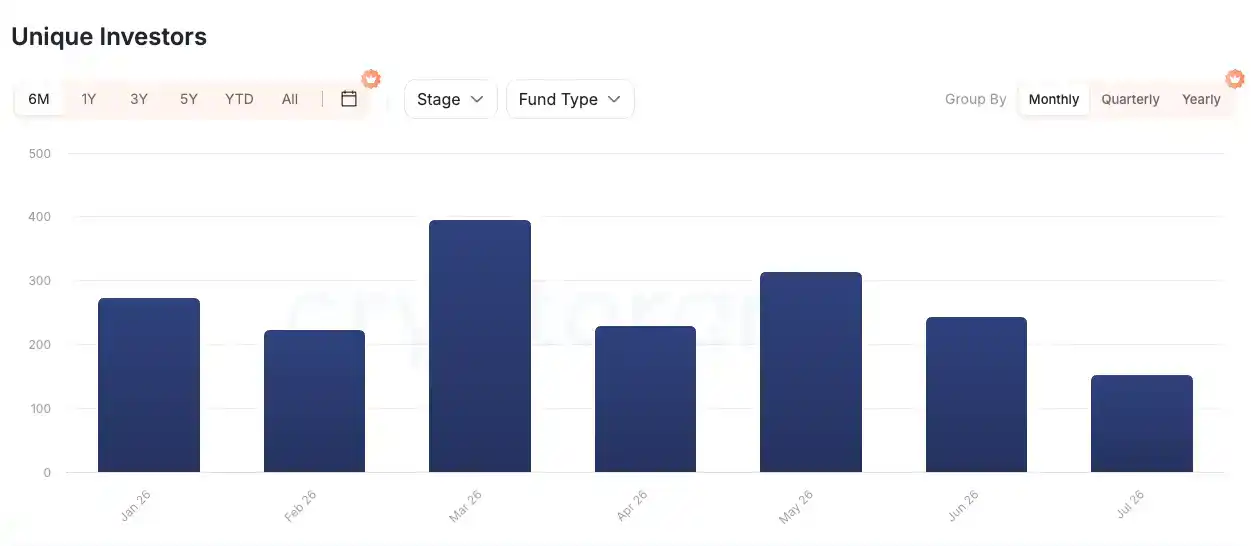
CryptoRank: Monthly Deduplicated Investor Count in 2026

On the other hand, this reduction in crypto venture capital activity is occurring during a phase of expansion in the global venture capital landscape. Global venture capital investment reached $227.4 billion across 8,440 deals in Q2 2026, marking the second-highest quarter on record; the total for the first half of the year reached $560.4 billion, second only to the same period in 2021. Large funding rounds for AI companies like Anthropic, Prometheus, and DeepSeek were the primary drivers.

According to KPMG statistics, by the end of Q2, global VC funds had raised approximately $98.8 billion in the year to date, involving 727 funds. Among these, 19 funds that raised over $1 billion each collectively absorbed $53.2 billion, accounting for more than half of the total. The number of deals remains relatively weak, with large sums primarily flowing to AI and mature companies with proven business models.

Bleeding off this enthusiasm, both capital and deal count in the crypto market have retreated simultaneously. Galaxy Research statistics show that in Q1 2026, crypto and blockchain startups completed 355 funding rounds, raising approximately $4.0 billion, representing quarterly declines of 16% and about 50%, respectively. Only 8 new crypto VC funds completed fundraising in that quarter, raising a total of around $1.1 billion, the lowest since Q3 2020.

Galaxy attributed the fundraising difficulties to multiple factors, including pressure from historical returns due to industry turbulence in 2022-2023, the macro environment, competition for limited partner funds from AI, and the availability of more liquid crypto exposure through spot crypto ETFs and digital asset treasury companies. Global capital remains abundant, but the focus of allocation and the list of favored managers are narrowing.

First 7 Months Funding: $11.778 Billion, May Alone Contributed One-Third

According to CryptoRank's public dashboard as of July 31, crypto projects completed 481 funding rounds in the first 7 months of 2026, with a disclosed total of approximately $11.778 billion.
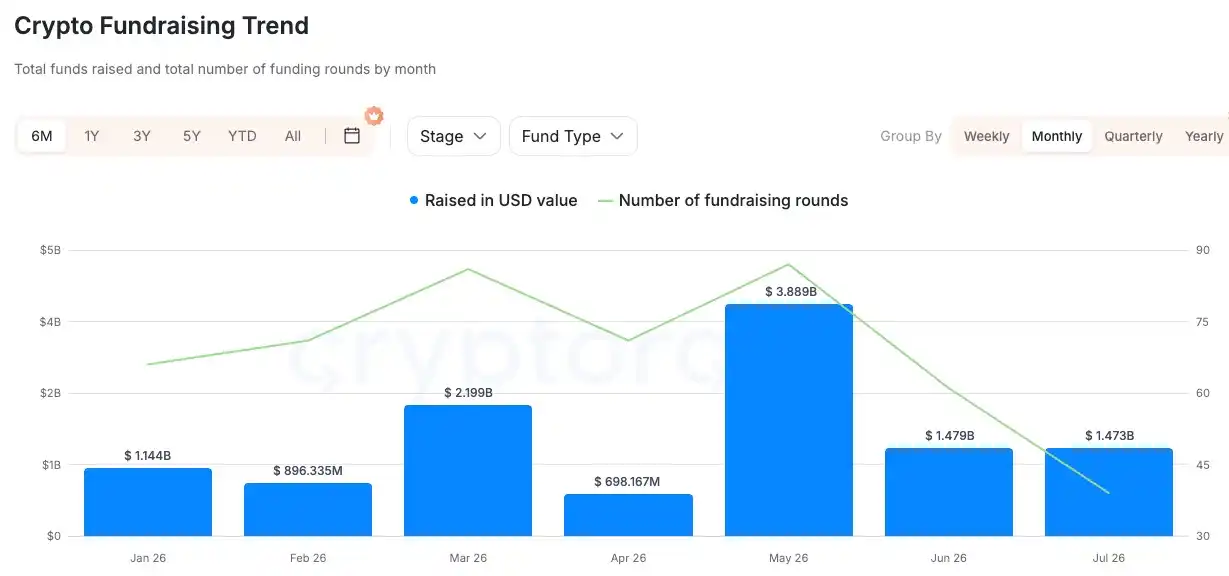
CryptoRank: Monthly Crypto Funding Amount and Number of Rounds in 2026

May, with $3.889 billion across 87 rounds, was the year's high point, accounting for about 33% of the total for the first 7 months. April saw only $698 million across 71 rounds. May's funding amount surged to 5.6 times that of the previous month, while the number of rounds increased by only about 23%. Projects of a similar quantity scale can correspond to vastly different total funding amounts, indicating that a few large deals still dominate the monthly curves.

March and May together absorbed approximately $6.088 billion, accounting for about 52% of the year-to-date total. Funding amounts fell to $1.479 billion in June and $1.473 billion in July, while the number of publicly disclosed rounds dropped from 61 to 39.

Trading Platforms, Prediction Markets, and Payments Absorb 53% of Capital

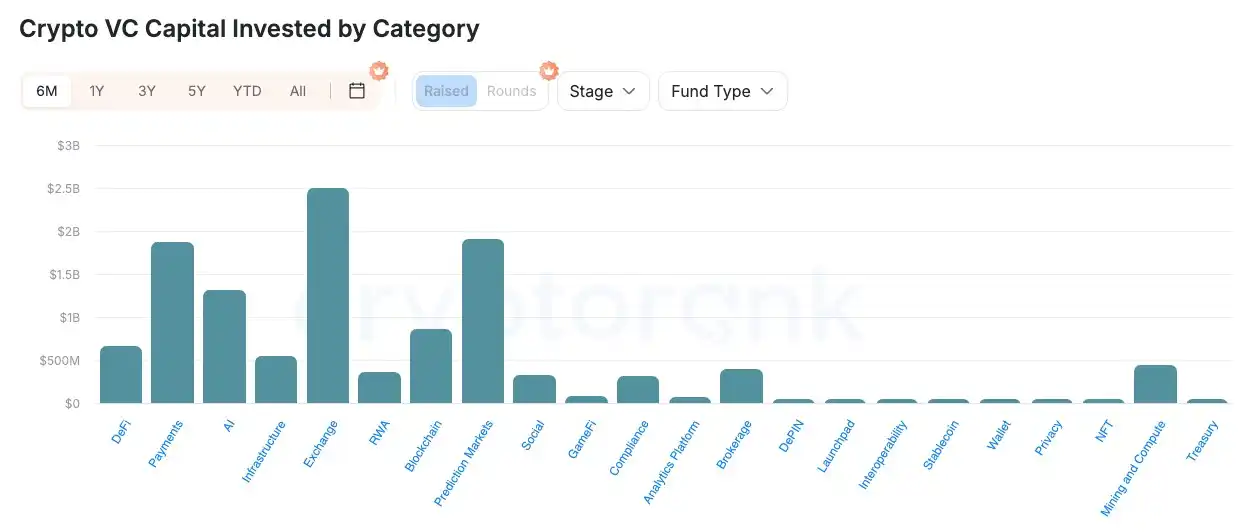
According to CryptoRank's project category classification, Trading Platforms, Prediction Markets, and Payments ranked top three in terms of funding amount for the year to date, raising $2.490 billion, $1.897 billion, and $1.861 billion respectively. Combined, this totals approximately $6.247 billion, representing 53% of the funding for the first 7 months. AI ranked fourth with $1.305 billion.
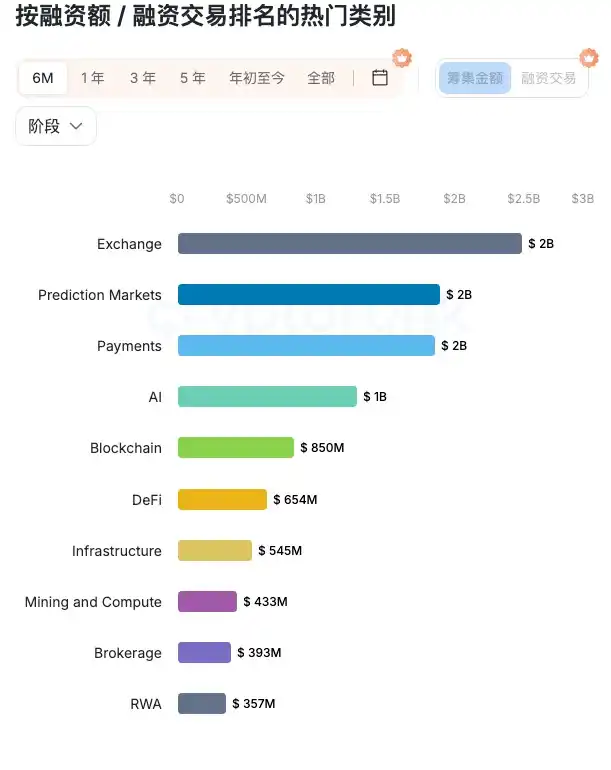
Interestingly, DeFi ranked first with 78 rounds but secured only about $654 million; Payments and AI completed 73 and 65 rounds respectively. High-frequency early-stage funding still exists, but capital is more concentrated in sectors like trading platforms and prediction markets, which can accommodate large later-stage transactions.
The funding stage further amplifies this disparity. CryptoRank recorded only 20 Series C and later rounds, but they absorbed approximately $3.333 billion. The seed stage, including Pre-Seed and extension rounds, comprised 156 rounds with a disclosed amount of about $750 million. Strategic funding rounds totaled 127, raising about $2.718 billion. Rounds are mainly distributed across early-stage and strategic funding, while the peaks in amount are driven by a handful of late-stage projects.
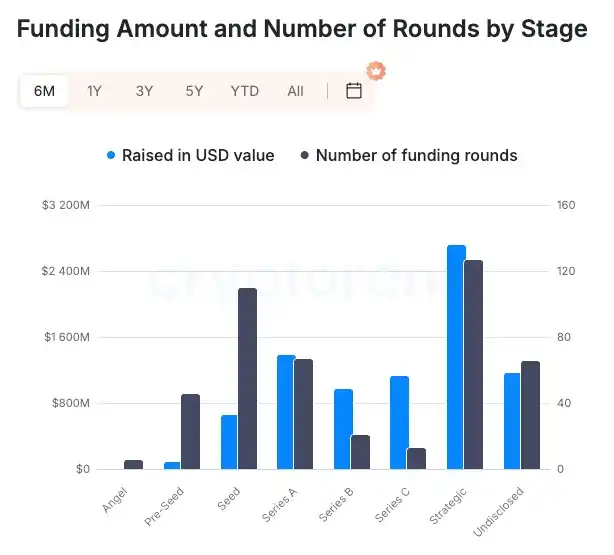
The value of mergers and acquisitions (M&A) in the crypto industry surged from $272 million in Q4 2025 to $7.23 billion in Q2 2026, expanding over 26-fold in six months. This amount is not included in the aforementioned $11.778 billion funding figure but indicates that capital is also flowing through M&A to companies that have already established business operations and assets.

The investor leaderboard also shows a concentration trend. Coinbase Ventures participated in 34 rounds year-to-date, while Animoca Brands, a16z crypto, and Tether participated in 19, 18, and 17 rounds respectively. Repeated investments by a single institution increase the transaction count but do not increase the deduplicated investor metric, explaining the concurrent state where funding activity continues while the total number of active institutions keeps declining.
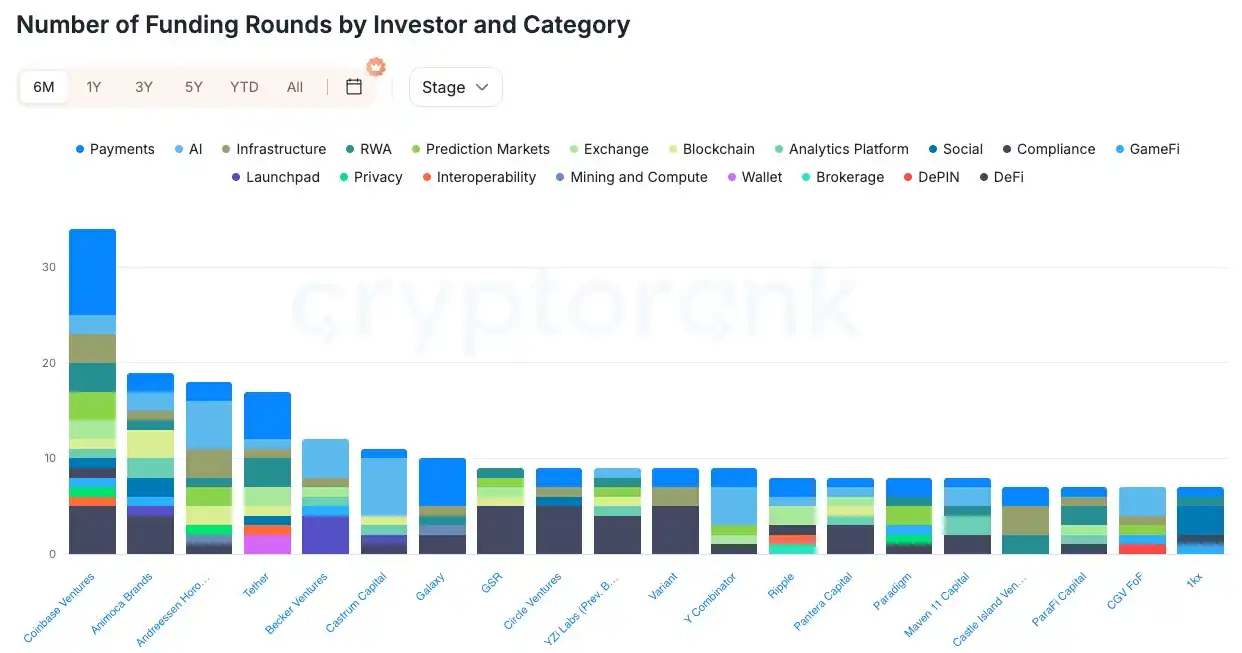
Top Funds Can Still Raise Capital; Long-Tail Institutions Exiting Reduces Project Options

Dragonfly completed its $650 million fourth fund in February, and a16z crypto announced raising a $2.2 billion fifth fund in June. In contrast, Galaxy Research statistics show that in Q1 2026, only 8 new crypto VC funds completed fundraising, raising a total of approximately $1.1 billion, the lowest since Q3 2020. Top-tier managers can still secure substantial capital, but the list of institutions capable of sustainable fundraising is shrinking.

Rob Hadick, a partner at Dragonfly, previously described in an interview with Fortune magazine that the crypto VC industry is experiencing a "mass extinction." The number of active institutions has shrunk by nearly 90% from its peak, diverging from the concurrent expansion of the global venture capital total. This indicates that this contraction is more a shift in capital allocation. The AI sector and secondary market instruments are simultaneously diverting capital that would have otherwise flowed into primary crypto projects, a trend unlikely to reverse in the short term.

However, early-stage projects can still maintain a certain frequency of transactions, albeit with limited individual deal sizes; large sums of capital are concentrated in a few later-stage sectors like trading platforms and prediction markets, as well as in M&A transactions. This means the crypto primary market has not vanished, but risk appetite has clearly converged, favoring projects with proven business models and accumulated assets.

While top funds complete large fundraises, numerous small and medium-sized institutions are no longer participating in new funding rounds. This landscape has practical implications for startup teams: the pool of potential investors is shrinking, negotiation space on terms is narrowing, and project selection criteria are rising. The decline in the number of institutions, capital scale, and transaction frequency may not necessarily be a negative signal, but it does signify rising industry barriers, with stricter requirements on project quality, capital efficiency, and exit paths than before.


Criptos en tendencia

Preguntas relacionadas

QAccording to the article, what was the lowest monthly number of unique venture capital firms participating in crypto funding since November 2020?

AAccording to the article, in July, 153 different venture capital firms participated in crypto funding, which was the lowest monthly level since November 2020.

QWhat are the top three project categories in terms of funding received in the first seven months of 2026 according to CryptoRank's data?

AAccording to CryptoRank's data, the top three project categories for funding in the first seven months of 2026 were Trading Platforms, Prediction Markets, and Payments. They received $2.49 billion, $1.897 billion, and $1.861 billion respectively, accounting for 53% of the total.

QHow does the article explain the concurrent situation of decreasing unique crypto investors while the number of funding deals is still ongoing?

AThe article explains this by pointing out that top-tier firms like Coinbase Ventures, Animoca Brands, a16z crypto, and Tether are repeatedly participating in multiple funding rounds. This increases the deal count but does not increase the unique investor count, as the same firms are counted multiple times in deal statistics but only once in the unique investor metric.

QWhat major factor is identified as diverting capital away from the crypto venture sector, according to the analysis in the article?

AThe article identifies the AI sector as a major factor diverting capital. It states that large-scale funding for AI companies like Anthropic, Prometheus, and DeepSeek, along with the expansion of global venture capital, has created significant competition for limited partner funds, drawing investment away from crypto projects.

QWhat term does Dragonfly partner Rob Hadick use to describe the current state of the crypto venture capital industry, and what key evidence supports this description?

ADragonfly partner Rob Hadick describes the current state as a 'mass extinction' for the crypto venture capital industry. The key evidence supporting this is that the number of active investing institutions has shrunk by nearly 90% from its peak of 1,177 in 2022 to just 153 in July, even while global venture capital as a whole is expanding.

Lecturas Relacionadas

a16z: De la empresa al DAO, DUNA podría convertirse en la próxima forma organizativa

A lo largo de la historia, el principal desafío empresarial ha sido cómo hacer colaborar a extraños con intereses diversos. Las formas organizativas han evolucionado para resolverlo: desde las estructuras familiares y las *commenda* medievales hasta la revolucionaria invención de la corporación con la Compañía Neerlandesa de las Indias Orientales (VOC), que permitió la colaboración a gran escala con responsabilidad limitada. Sin embargo, la corporación tradicional, diseñada para la era industrial, introduce problemas de agencia y burocracia. En la era digital, las Organizaciones Autónomas Descentralizadas (DAO) surgieron como una promesa de coordinación sin autoridad central. No obstante, se enfrentan a un vacío legal: carecen de reconocimiento formal, exponiendo a sus miembros a responsabilidad ilimitada, y su modelo desafía los marcos regulatorios existentes, como la prueba *Howey* de la SEC. La DUNA (Asociación No Incorporada Sin Fines de Lucro Descentralizada) se presenta como una innovación legal crucial. Reconocida ya en algunos estados de EE.UU., proporciona personalidad jurídica y responsabilidad limitada a un grupo descentralizado, permitiéndole celebrar contratos y operar como una entidad única. No resuelve todos los desafíos de gobernanza, pero llena el vacío legal, ofreciendo a las redes nativas de Internet una forma legítima para organizarse sin depender de estructuras jerárquicas forzadas o fundaciones en el extranjero. Así, la DUNA representa el siguiente salto evolutivo, extendiendo las protecciones de la colaboración empresarial moderna al ámbito de la gobernanza descentralizada.

marsbitHace 47 min(s)

a16z: De la empresa al DAO, DUNA podría convertirse en la próxima forma organizativa

marsbitHace 47 min(s)

Informe de mitad de año 2026 sobre RWA en cadena: El valor de mercado de las acciones tokenizadas se duplica en un año, pero el 90% de los derechos son solo una cáscara vacía

Informe intermedio de 2026 sobre RWA en cadena: La capitalización del mercado de acciones tokenizadas se duplica en un año, pero el 90% de los derechos son vacíos. Aunque los datos de valor bloqueado de activos tokenizados en cadena parecen sólidos, existe una contradicción fundamental: los productos con libre circulación a menudo carecen de derechos de propiedad reales, mientras que aquellos con validez legal efectiva carecen de liquidez. Según RWA.xyz, el valor de las acciones tokenizadas distribuidas casi se duplicó de marzo a julio de 2026, alcanzando los 1,890 millones de dólares. Sin embargo, este crecimiento está impulsado principalmente por unos pocos productos y plataformas, mostrando una concentración significativa (Ondo, xStocks y Securitize representan el 85.1%). El mercado se divide entre infraestructuras reguladas en EE.UU., que priorizan la seguridad jurídica, y productos offshore más accesibles. La tokenización de bonos del Tesoro muestra un mejor ajuste al mercado. El informe advierte que las cifras agregadas pueden ser engañosas, ya que combinan eventos económicos distintos (nuevas emisiones, cambios de precios), y subraya la falta de productos que combinen a escala la propiedad canónica, distribución amplia, liquidez institucional y descubrimiento de precios en cadena.

marsbitHace 1 hora(s)

Informe de mitad de año 2026 sobre RWA en cadena: El valor de mercado de las acciones tokenizadas se duplica en un año, pero el 90% de los derechos son solo una cáscara vacía

marsbitHace 1 hora(s)

Bitcoin en agosto: los expertos esperan una prueba del rango, no una rápida reversión

**Bitcóin en agosto: expertos esperan prueba del rango, no una rápida reversión** Los analistas prevén que Bitcoin permanezca bajo presión en agosto. Tras la recuperación de julio, el mercado no parece listo para un crecimiento sostenido, y persiste el riesgo de caer por debajo de $60,000. A finales de julio, la principal criptomoneda cotizaba alrededor de $63,500. Los expertos señalan una combinación macroeconómica difícil: altas tasas de interés en EE. UU., inflación persistente y un dólar fuerte, lo que limita el apetito por activos de riesgo como las criptomonedas. Además, se registró una fuerte salida neta de fondos ETF de Bitcoin en el primer semestre. Agosto históricamente es un mes débil para el sector. Los analistas anticipan que será más un período de prueba de niveles clave que de un repunte decisivo. Rufat Abyasov plantea tres escenarios para el mes: movimiento lateral entre $58,000-$68,000 (50% de probabilidad), caída a $50,000-$55,000 (30%), o subida a $71,000-$75,000 (20%). La zona crítica de soporte se sitúa en $60,000-$61,000. Aunque algunos, como Víctor Pershikov, ven posible un repunte a $70,000, se coincide en que el ciclo correctivo probablemente no terminará antes del último trimestre del año. Los inversores deben monitorear las tasas, la inflación, los flujos de los ETF y el interés general por el riesgo. Se recomienda acumulación gradual a largo vista, pero con cautela ante posibles caídas a corto plazo.

cryptonews.ruHace 3 hora(s)

Bitcoin en agosto: los expertos esperan una prueba del rango, no una rápida reversión

cryptonews.ruHace 3 hora(s)

Billetera de hardware Coldcard hackeada: piratas informáticos retiraron 594 bitcoins en 25 minutos

Las carteras hardware han sido consideradas la forma más segura de almacenar criptomonedas, pero un reciente incidente con los dispositivos Coldcard de Coinkite cuestiona esta idea. El 30 de julio de 2026, atacantes drenaron 594.5 bitcoins (unos $40 millones) de quinientas direcciones en solo veinticinco minutos. La causa fue un error en el código introducido en marzo de 2021 y no detectado durante cinco años. Un error tipográfico en una macro desactivó la función del chip seguro que generaba números aleatorios verdaderos para crear la frase semilla (seed phrase). En su lugar, las claves se generaban usando datos predecibles, como el número de serie del procesor y la hora del sistema, reduciendo drásticamente la entropía y haciéndolas vulnerables a ataques por fuerza bruta offline. Los atacantes no necesitaron acceso físico. Simplemente generaron millones de frases semilla posibles basándose en los parámetros del generador comprometido, las contrastaron con el registro público de la cadena de bloques y firmaron transacciones para robar los fondos. Inicialmente, Coinkite declaró que los modelos nuevos no estaban en riesgo, pero luego reconoció que todos los dispositivos con firmware afectado eran vulnerables. El CEO, Rodolphe Novak (NVK), se disculpó, asumiendo la responsabilidad, pero descartó compensaciones financieras para los usuarios afectados. Los propietarios de dispositivos vulnerables deben actualizar el firmware a una versión segura, generar una NUEVA frase semilla en el dispositivo actualizado y transferir TODOS sus fondos a direcciones derivadas de esta nueva semilla. El uso de una frase de contraseña BIP-39 ayuda, pero no sustituye este proceso. Otros productos de Coinkite (TAPSIGNER, OPENDIME, SATSCARD) no se vieron afectados. El incidente subraya que incluso el hardware especializado requiere auditorías de código independientes y continuas, especialmente en funciones criptográficas críticas.

cryptonews.ruHace 3 hora(s)

Billetera de hardware Coldcard hackeada: piratas informáticos retiraron 594 bitcoins en 25 minutos

cryptonews.ruHace 3 hora(s)

Trading

Spot

Artículos destacados

Cómo comprar F

¡Bienvenido a HTX.com! Hemos hecho que comprar Synfutures (F) sea simple y conveniente. Sigue nuestra guía paso a paso para iniciar tu viaje de criptos.Paso 1: crea tu cuenta HTXUtiliza tu correo electrónico o número de teléfono para registrarte y obtener una cuenta gratuita en HTX. Experimenta un proceso de registro sin complicaciones y desbloquea todas las funciones.Obtener mi cuentaPaso 2: ve a Comprar cripto y elige tu método de pagoTarjeta de crédito/débito: usa tu Visa o Mastercard para comprar Synfutures (F) al instante.Saldo: utiliza fondos del saldo de tu cuenta HTX para tradear sin problemas.Terceros: hemos agregado métodos de pago populares como Google Pay y Apple Pay para mejorar la comodidad.P2P: tradear directamente con otros usuarios en HTX.Over-the-Counter (OTC): ofrecemos servicios personalizados y tipos de cambio competitivos para los traders.Paso 3: guarda tu Synfutures (F)Después de comprar tu Synfutures (F), guárdalo en tu cuenta HTX. Alternativamente, puedes enviarlo a otro lugar mediante transferencia blockchain o utilizarlo para tradear otras criptomonedas.Paso 4: tradear Synfutures (F)Tradear fácilmente con Synfutures (F) en HTX's mercado spot. Simplemente accede a tu cuenta, selecciona tu par de trading, ejecuta tus trades y monitorea en tiempo real. Ofrecemos una experiencia fácil de usar tanto para principiantes como para traders experimentados.

377 Vistas totalesPublicado en 2024.12.21Actualizado en 2026.06.02

Cómo comprar F

Discusiones

Bienvenido a la comunidad de HTX. Aquí puedes mantenerte informado sobre los últimos desarrollos de la plataforma y acceder a análisis profesionales del mercado. A continuación se presentan las opiniones de los usuarios sobre el precio de F (F).

活动图片