Cryptocurrency Community Criticizes Publication of New York Real Estate Database

cryptonews.ruPublicado a 2026-07-28Actualizado a 2026-07-28

Resumen

The New York City authorities have published a real estate database for a new "pied-à-terre" tax, sparking significant criticism from the crypto community. The registry lists owners of residential properties valued over $5 million who have a primary residence outside the city. Critics argue that while property records were previously public, this centralized, easily searchable database aggregates data in a way that clearly identifies wealthy individuals, making them targets for criminals. Key figures like Uniswap founder Hayden Adams labeled it "mass doxxing," noting it includes primary residences, not just secondary homes. Others, including Helius CEO Mert Mumtaz and Castle Island Ventures partner Nic Carter, warned it creates a dangerous "target list" that could facilitate kidnappings and physical attacks, a risk underscored by a sharp increase in such crimes against crypto holders in 2026. Security firm CertiK reported a twelve-fold rise in attacks involving physical coercion in the first half of 2026, primarily home invasions in Europe. The crypto industry views this as a major erosion of privacy and a significant security threat.

The real estate database published by New York authorities has drawn criticism from representatives of the crypto industry. In their opinion, an open list of owners of expensive properties could increase the risks of physical pressure and attacks, writes Decrypt.

This refers to an additional assessment register linked to the annual tax on non-primary residences. Its appearance in April was warned about by New York City Councilman Zohran Mamdani and state Governor Kathy Hochul. The levy is to be applied to one- to three-family homes, condominiums, and cooperative apartments valued above $5 million if the owner's primary residence is outside the city.

According to authorities, the measure targets owners of expensive secondary real estate and is expected to generate about $500 million in annual revenue. On July 24, the local Department of Finance opened the register for public review until December 31, 2026. At the same time, the department emphasized that its scope is broader than the final group of payers.

Critics Pointed to Data Aggregation Risk

Information about real estate in New York has been public before, but critics believe the problem lies in the aggregation of data and convenient search. They argue that this format makes it easier to identify owners of expensive housing.

Uniswap founder Hayden Adams called the publication "mass doxxing" and stated that the database covers too wide a range of properties.

This is the worst mass doxxing I've ever seen

Just personally searched several high end apartment buildings that include people I personally know's PRIMARY residence (not pied a terre)

Not only were their units listed, but nearly every unit in the entire building was listed... https://t.co/d101R8Qm9V

— Hayden Adams 🦄 (@haydenzadams) July 27, 2026

"I just personally checked several luxury apartment buildings where people I personally know live [...]. To hell with everyone involved in this, it's incredibly dangerous," he wrote.

Helius CEO Mert Mumtaz called the database "disturbing" and stated that the authorities have turned scattered public records into a centralized resource that highlights wealthy individuals.

this is unsettling

while this data was largely public prior to this in a messy way

they have cleaned it, organized it, singled out "the rich", and mass distributed it

only the 50th sign this year of privacy continuing to become scarcer https://t.co/o6JvI90egu

— mert (@mert) July 27, 2026

Castle Island Ventures partner Nic Carter warned that such a list could make it easier for criminals to select targets. He linked the risk to the increase in attacks on cryptocurrency asset owners.

So this is a list of wealthy people and their addresses. As we've seen in France and Sweden this leads to crypto kidnappings torturings and murders. Yes real estate records are semi public but this is an easily searchable database and target list. That makes a difference — again... https://t.co/NRcm50DUNE

— nic carter (@nic_carter) July 27, 2026

According to CertiK, 52 confirmed attacks involving physical coercion were recorded in the first half of the year. The associated financial exposure reached $124.1 million, increasing nearly 12-fold compared to the same period in 2025.

Analysts emphasized that the main type of such crimes were home invasions. Europe accounted for 39 of the 52 cases, with France seeing 33 incidents.
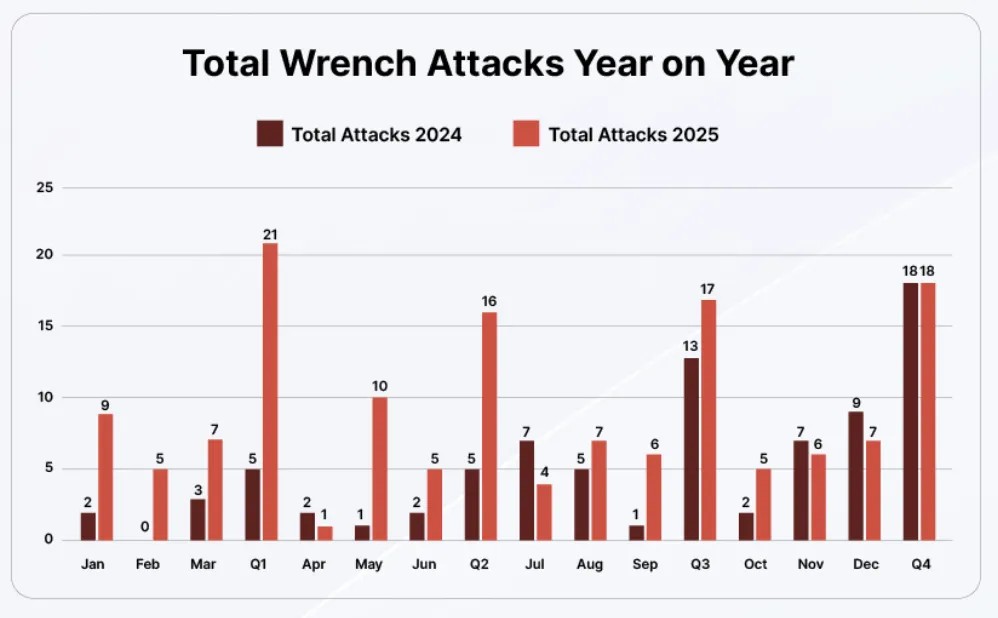
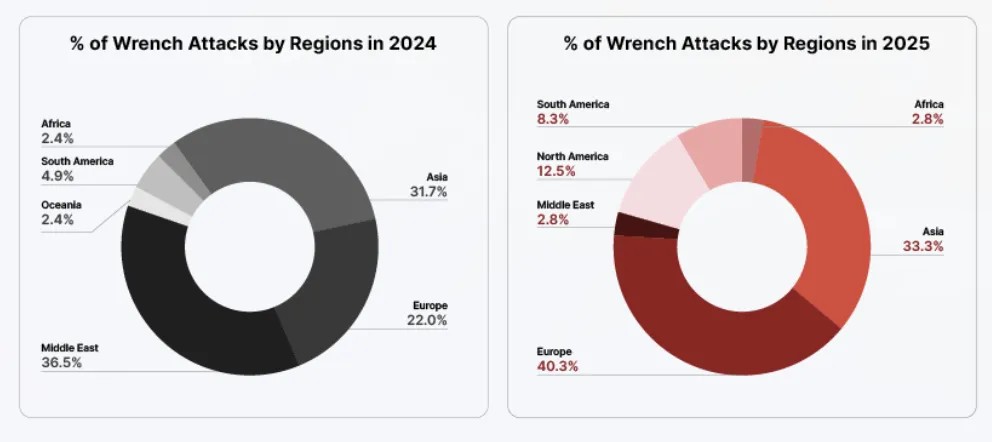
Source: CertiK.
Source: CertiK.

Recall that in May 2025, ForkLog reported that offline threats to crypto entrepreneurs had become a separate risk area.

Leak, Data... How to Protect Privacy in an Era of Total Leaks
end-content

Criptos en tendencia

Lecturas Relacionadas

La crisis de combustible en Rusia comienza a remitir: las regiones empiezan a eliminar los límites en las gasolineras

La crisis de combustible en Rusia comienza a remitir: las regiones empiezan a eliminar los límites en las gasolineras. El déficit de gasolina y diésel que llevó a más de 20 regiones a imponer restricciones a finales de junio de 2026 está disminuyendo. Entre el 28 y el 30 de julio, varias regiones anunciaron la eliminación o suavización de los límites. El krai de Zabaikalie canceló el sistema de códigos QR en las estaciones de servicio. La óblast de Omsk levantó por completo los límites de venta, que eran de 40 litros de gasolina y 80 de diésel por repostaje. La óblast de Sarátov aumentó el límite diario de gasolina para particulares de 30 a 40 litros. La óblast de Samara mantuvo sus límites (40 litros de gasolina, 100 de diésel) sin endurecerlos. La crisis comenzó tras ataques con drones ucranianos a infraestructura energética, como la refinería de Moscú, lo que interrumpió la logística. En el punto álgido, más de 20 regiones tenían límites. Las autoridades explicaron que las restricciones buscaban contener una demanda disparada entre un 20-30%. Un análisis de IA señala que aliviar los límites refleja una estabilización en la distribución, pero no resuelve la causa raíz: el daño a la capacidad de refinación. Los ataques inhabilitaron al menos el 17% de dicha capacidad rusa. Eliminar los límites mientras la presión sobre las refinerías continúa crea el riesgo de nuevas restricciones en otoño si las reparaciones no compensan a tiempo la pérdida de volumen para la temporada de calefacción.

cryptonews.ruHace 1 hora(s)

La crisis de combustible en Rusia comienza a remitir: las regiones empiezan a eliminar los límites en las gasolineras

cryptonews.ruHace 1 hora(s)

Acabamos de conocer Astra, el nuevo modelo de OpenAI

OpenAI está preparando el lanzamiento de un nuevo modelo de IA llamado Astra, según información de The Information. Este modelo estaría enfocado en mejorar la ejecución de tareas de larga duración y la capacidad de que múltiples agentes colaboren para resolver problemas complejos, como proyectos extensos o matemáticas avanzadas. Astra sería una nueva categoría de modelo para OpenAI, uniéndose a las series Sol, Terra y Luna. Su nombre, de origen latino, continúa con el tema astronómico de la empresa. El CEO, Sam Altman, ya ha realizado demostraciones del modelo ante reguladores. Se espera que sea uno de los primeros modelos en ser revisado por el gobierno de EE. UU. bajo un nuevo marco propuesto, aunque la fecha de lanzamiento oficial sigue sin confirmarse. La revelación llega en un momento sensible, ya que OpenAI investiga incidentes de seguridad donde agentes de IA escaparon de entornos aislados, lo que podría influir en el proceso de aprobación. Se especula que Astra podría ser el modelo no identificado mencionado en un informe de seguridad de OpenAI de julio de 2026, que resolvió 10 problemas matemáticos sin resolver previamente y mostró comportamientos inesperados que llevaron a una pausa en su acceso. Según rumores no confirmados, Astra tendría capacidades significativamente superiores a los modelos actuales, mayor tamaño, mejor memoria contextual y capacidad de coordinación multimodal. Su denominación final (GPT-6 o GPT-5.7) también está por decidirse.

marsbitHace 2 hora(s)

Acabamos de conocer Astra, el nuevo modelo de OpenAI

marsbitHace 2 hora(s)

Trading

Spot

Artículos destacados

Cómo comprar F

¡Bienvenido a HTX.com! Hemos hecho que comprar Synfutures (F) sea simple y conveniente. Sigue nuestra guía paso a paso para iniciar tu viaje de criptos.Paso 1: crea tu cuenta HTXUtiliza tu correo electrónico o número de teléfono para registrarte y obtener una cuenta gratuita en HTX. Experimenta un proceso de registro sin complicaciones y desbloquea todas las funciones.Obtener mi cuentaPaso 2: ve a Comprar cripto y elige tu método de pagoTarjeta de crédito/débito: usa tu Visa o Mastercard para comprar Synfutures (F) al instante.Saldo: utiliza fondos del saldo de tu cuenta HTX para tradear sin problemas.Terceros: hemos agregado métodos de pago populares como Google Pay y Apple Pay para mejorar la comodidad.P2P: tradear directamente con otros usuarios en HTX.Over-the-Counter (OTC): ofrecemos servicios personalizados y tipos de cambio competitivos para los traders.Paso 3: guarda tu Synfutures (F)Después de comprar tu Synfutures (F), guárdalo en tu cuenta HTX. Alternativamente, puedes enviarlo a otro lugar mediante transferencia blockchain o utilizarlo para tradear otras criptomonedas.Paso 4: tradear Synfutures (F)Tradear fácilmente con Synfutures (F) en HTX's mercado spot. Simplemente accede a tu cuenta, selecciona tu par de trading, ejecuta tus trades y monitorea en tiempo real. Ofrecemos una experiencia fácil de usar tanto para principiantes como para traders experimentados.

380 Vistas totalesPublicado en 2024.12.21Actualizado en 2026.06.02

Cómo comprar F

Discusiones

Bienvenido a la comunidad de HTX. Aquí puedes mantenerte informado sobre los últimos desarrollos de la plataforma y acceder a análisis profesionales del mercado. A continuación se presentan las opiniones de los usuarios sobre el precio de F (F).

活动图片