Claude Doesn't Submit Code Directly After Writing It: Runs 4 Skills for Self-Check, Fixes Issues, Then Comes Back to You

marsbitPublicado a 2026-07-27Actualizado a 2026-07-27

Resumen

Claude No Longer Submits Code Directly: 4 Self-Check Skills to Run Before Coming Back to You AI already writes code, but the burden of reviewing it still falls on you. To address this, Anthropic has built a "verification loop" into Claude Code. After writing code, Claude now runs four self-check skills before delivering the work: * `/code-review`: Finds potential bugs and provides review feedback. * `/simplify`: Cleans up the diff, removing redundant or over-complex implementations to reduce future maintenance costs. * `/verify`: Performs end-to-end validation, actually running the application to confirm the feature works, not just appears to. * `/design`: Used only for UI changes; cross-references the implementation against the project's DESIGN.md file. This loop extends the AI agent's workflow from "gather context → execute" to "gather context → execute → auto-verify → fix → re-verify." It tackles the new bottleneck in AI-assisted development: the speed of verifying code now outpaces human review. These skills are built on Claude Code's existing verification foundation (like running apps and using linters). Teams can create their own custom verification skills by documenting their repetitive manual checks in plain language as Markdown files. Verification can be triggered at four levels: manually (Standalone), embedded in a task, chained with other skills, or automatically on every PR (On every PR). The shift signifies that competition in AI programming is movin...

AI has taken over the task of writing code. But the job of acceptance still falls on you.

Whether a piece of code is written correctly or not is not AI's responsibility; ultimately, you still have to go through it line by line. This hurdle has stumped many people.

Recently, Anthropic has also integrated AI acceptance into the loop.

They made Claude, after writing code, not immediately hand it over. Instead, it runs four checks itself first:

/code-review to root out bugs, /simplify to clean up redundant implementations, /verify to perform end-to-end verification, and if the UI was touched this time, use /design to cross-check against the visual specifications in DESIGN.md.

Only after running through all four does it count as delivered.

On July 22nd, the Claude Code team publicly shared this internal "verification loop."
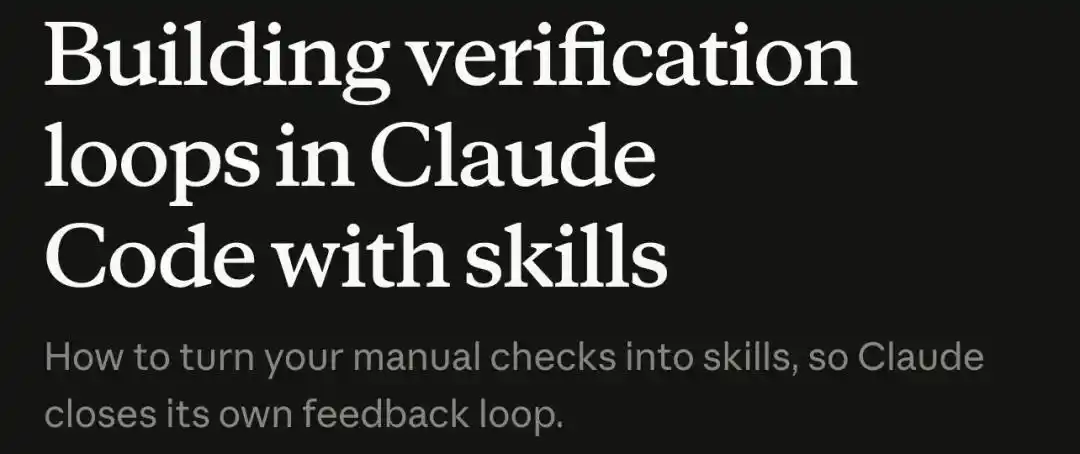
In other words, after Claude writes code, it first finds and fixes errors on its own before coming back to you.

This signifies AI evolving from "being able to write code" to "being able to check the code it wrote."

Agent Work Loop Gains an Extra Verification Step

Anthropic gave this system a name: the verification loop.

The official definition is simple: it's an iterative process where Claude checks and attempts to fix its own work.

What it changes is the agent's work cycle.

Previously, it was "gather context → execute action → manual check." The final step rested on humans: the AI hands over the work, and you have to review it line by line.

Now this line is extended to "gather context → execute action → automatic verification → fix → verify again." Checking and fixing are placed back inside the loop.
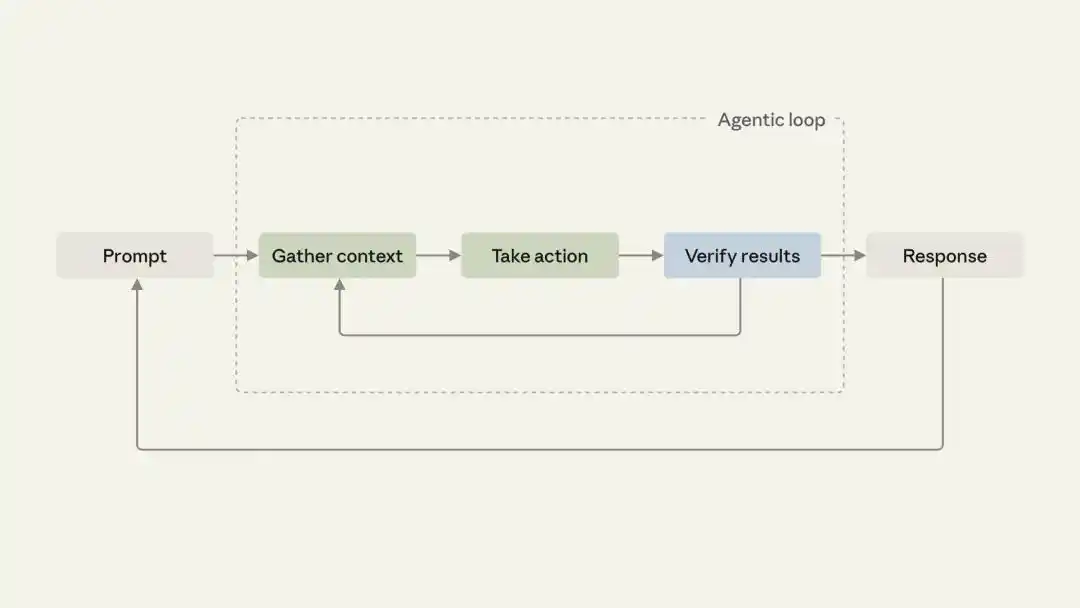
Anthropic's official agent cycle diagram: after a prompt comes in, Claude gathers context, executes actions, verifies results. If verification fails, it loops back; only when it passes does it return.

Some checks Claude already knows how to do. Deterministic signals in the codebase, like type checker, linter, running tests, runtime errors—it can read these and will fix them as it goes.

The real trouble lies with another category: whether the UI changes are correct, whether the user flow is smooth, whether this change has buried unseen pitfalls...

In the past, these could only be caught by humans watching, performing the same checks dozens or hundreds of times.

Anthropic's solution is to write down each of those manual checks you perform every time, package them into Skills, and have Claude execute them automatically for each task.

For decades, all software engineering processes—writing requirements, planning, layer upon layer of reviews, endless meetings—were essentially because: writing code was too slow, and engineers' time was too valuable.

But when AI makes the act of writing code faster and cheaper, this premise disappears.

The Claude Code team's own assessment is: the bottleneck hasn't vanished; it has merely shifted: from "writing code" to verification, code review, security, and other such stages.

Code is generated too quickly. The new problem becomes: are these codes correct, who will maintain them, can people keep up with the pace of reviewing code.

Faced with this new bottleneck, the Claude Code team first experimented on themselves.

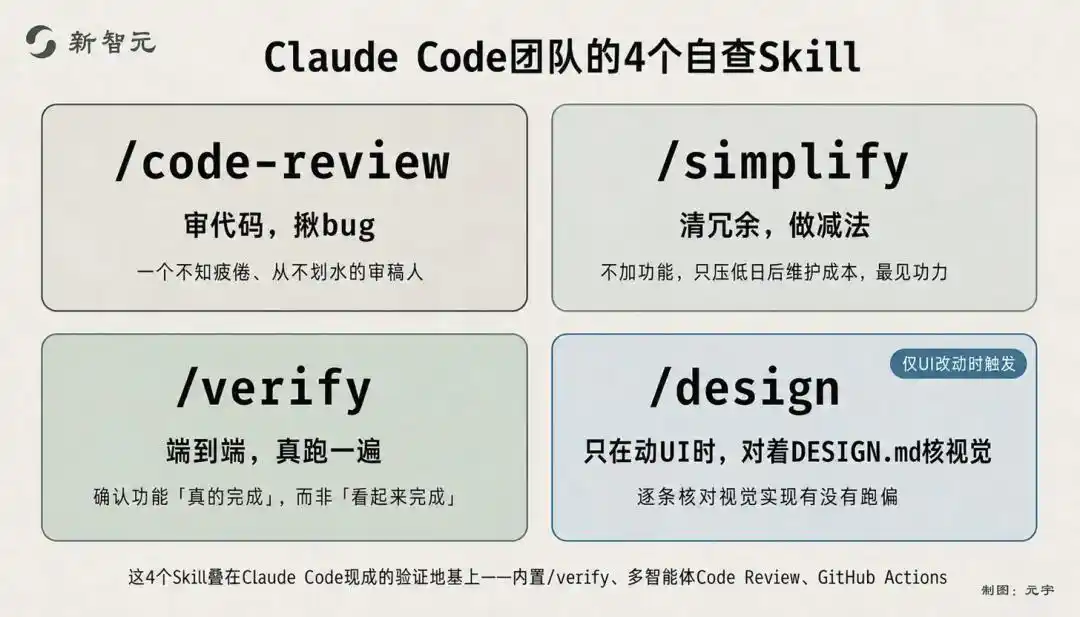
The 4 Self-Check Skills the Claude Code Team Uses Daily

Internally, the Claude Code team uses these four self-check Skills every day.

/code-review, specialized in reviewing code changes, rooting out potential bugs, and providing review comments along the way.

This is like having a tireless reviewer on standby.

/simplify, cleans up the diff for this change, removing convoluted, complex implementations to make the structure simpler.

It doesn't add features for you; instead, it removes redundancy, simplifies implementation, pushing down future maintenance costs.

This point is crucial and requires real skill. Most people write code by adding more; tools that proactively simplify are particularly valuable.

/verify, performs end-to-end verification, actually running things to confirm the feature is truly complete, not just "looks complete."

/design, only comes into play when the UI is touched. It cross-checks against the DESIGN.md in the repository, verifying point by point if your visual implementation has deviated.

These 4 Skills didn't appear out of thin air.

Underlying them, Claude Code has already laid a foundation of existing verification support:

The built-in /verify can run the application to observe changes; you specify the build and test commands in CLAUDE.md, and it follows them. There's also Code Review specifically for multi-agent reviews on PRs, and GitHub Actions that automatically trigger on every commit.

The team's 4 Skills are like adding their own layer of process on top of this general foundation.
How to Write Your Own Verification Skill?

Anthropic's method is also simple:

Write down that manual step you always perform in plain language, as if you were explaining precautions to a new colleague on their first day.

If you're even stuck on how to describe this check step, you can first ask Claude to provide a version of general best practices and then modify it.

Your version will likely differ from the generic approach at a few key points, and those differences are precisely the things most worth documenting.

Checks don't necessarily have to be vague judgments like "feels right or not."

For example: any change that deletes a database field without an accompanying data migration step should be rejected. This is a "local rule" that a generic linter will never catch but is specific to your project.

Any rule you've only been able to enforce by manually watching like a hawk is worth writing into a loop.

What to do after writing it?

Throw it to skill-creator to have it interview you back, or simply drop a Markdown file into .claude/skills/.

The simplest verification Skill is a few lines of instructions plus a body paragraph. Then test it once on a new task to confirm this check step actually runs. If not, fix it.

For Skills you can't modify, like built-in ones or those hosted by plugins, there's a workaround: write a wrapper Skill that first calls the original, then calls your verification. A detour, but it still embeds the check.

Verification Isn't One-Size-Fits-All; It Has 4 Levels

After packaging checks into Skills, the next question is: when should this thing trigger?

Anthropic provides 4 levels of automation, from loose to tight.

Standalone: You remember to manually invoke it.

Embedded: Embedded into a specific task flow, running alongside it.

Chained: Several verification Skills strung into a chain, automatically running one after another.

On every PR: The strictest level, automatically running on every code commit.

The official term for the middle layer transition is "from habit to contract."

What was "I always remember to run /verify after /simplify" as a personal habit becomes "automatically call /verify after /simplify runs" as a fixed contract once chained.

The entire chain completes the development loop on its own, only coming back to you when your approval is needed.

The longer the chain, the higher the reliability, but the official team specifically cautioned: chained verification will genuinely burn through tokens.

So don't immediately set all checks as PR gates that block every commit. The right approach is to first see if it's stable, then gradually add more.

Behind the 4 Skills: AI Programming is Changing Tracks

Behind the 4 Skills, the competition in AI programming is shifting from generation to verification.

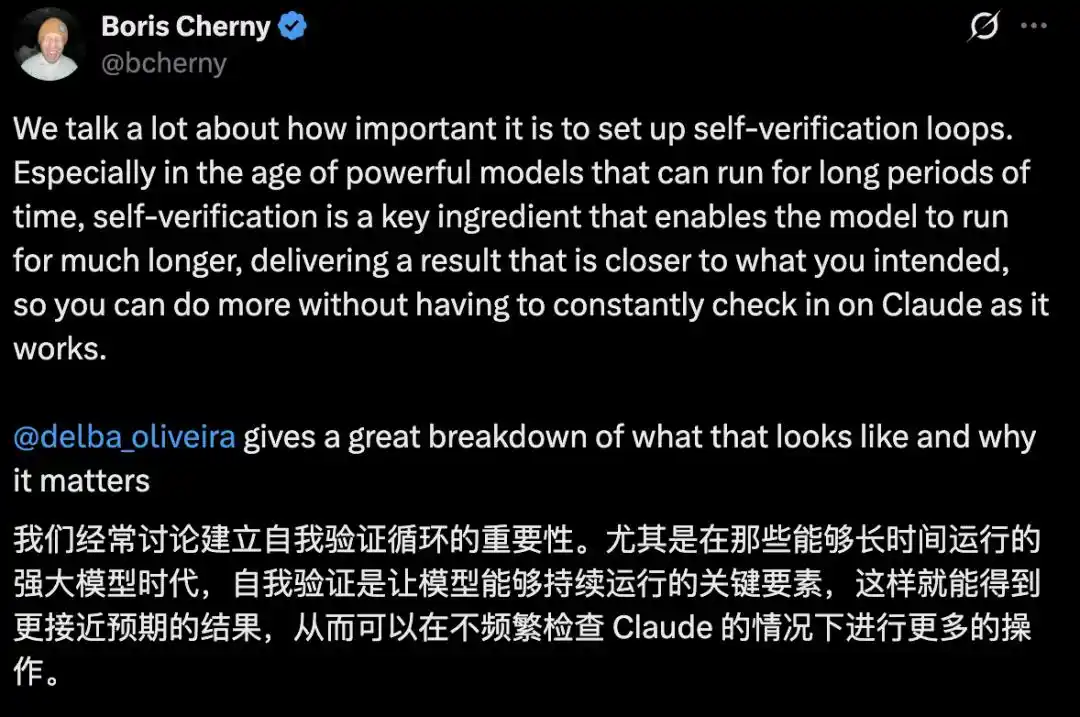
The creator of Claude Code has given the same assessment.

On June 9th of this year, he tweeted: In an era where powerful models can run autonomously for long periods, self-verification is key to letting models run longer and produce results closer to your expectations. You don't have to watch Claude frequently to hand over more work.

Simply put, the more solid the verification, the more confidently an agent can run; the longer it runs, the less hassle for humans.
In the past, we relied on prompts, but they have a ceiling too: they only solve the task at hand; next time you start from scratch.

Let's first correct a common misunderstanding: A Skill is not a piece of Markdown prompt.

It's a capability module containing instructions, file structure, scripts, tool calls, configuration, and an entire workflow. It's about solidifying a team's check steps, design norms, and lessons learned into a package readily available for Claude to reference when needed.

More crucially, Skills are evolving from a feature of Claude Code into an open standard across vendors.

According to industry analysis, GitHub Copilot, Cursor, OpenAI Codex, and Gemini CLI have already adopted the same format.

This means the Skills you solidify for your team won't be locked into one specific tool. They will encapsulate your team's experience, norms, and check processes, turning into reusable capabilities.

This also highlights a stark reality: the same Claude might yield efficiency differences of several times between different teams. This gap isn't due to the model but rather the workflow:

Have you written checks into Skills? Have you set up verification loops? Have you enabled the agent to run its own feedback loop to completion?

Ultimately, an agent's capability is an addition problem: model, plus tools, plus verification mechanisms, plus workflow.

The model aspect is becoming more similar across vendors. What truly creates distance are the latter three items, all of which are in the user's hands.

Of course, what this blog post demonstrates is the process optimization of AI-assisted development, not "AI can already write software independently." It still requires engineers and cannot handle production-grade delivery without humans.

Therefore, it's not about agents coming to take human engineers' jobs, but the direction is already clear.

In the past, we've been teaching AI how to write code. Now we need to start teaching it to verify if what it wrote is correct.

For someone who uses AI to write code every day, the day when "having to manually review everything before leaving work" can finally be entrusted to AI with peace of mind is the day it truly starts carrying the load for you.

References:

https://claude.com/blog/building-verification-loops-in-claude-code-with-skills

https://claude.com/blog/getting-started-with-loops?utm_source=chatgpt.com

This article is from the WeChat public account "New Zhiyuan", author: ASI Revelation

Criptos en tendencia

Preguntas relacionadas

QWhat is the core innovation described in the article regarding Claude's code generation?

AThe core innovation is the introduction of a 'verification loop' where Claude, after writing code, automatically runs it through four specialized Skill checks (code-review, simplify, verify, design) to find and fix errors before delivering the final code to the user.

QWhat are the four primary verification Skills used by the Claude Code team internally?

AThe four primary Skills are: /code-review (to catch potential bugs and provide review comments), /simplify (to clean up and streamline the implementation), /verify (to perform end-to-end functional verification), and /design (to ensure UI changes align with a project's DESIGN.md file).

QWhat is the key difference between a traditional AI coding workflow and the new 'verification loop' workflow?

AThe traditional workflow is: 'collect context -> execute action -> human review'. The new 'verification loop' workflow extends this to: 'collect context -> execute action -> automatic verification -> repair -> re-verify', embedding the review and repair steps back into an automated loop before returning to the user.

QAccording to the article, what is the main 'bottleneck' that has shifted as AI code generation becomes faster?

AThe main bottleneck has shifted from 'writing code' to the verification, code review, and security aspects. The article states that the new problem is ensuring the rapidly generated code is correct, maintainable, and can be reviewed at the required pace.

QHow does the article describe the nature and importance of 'Skills' compared to simple prompts?

AA Skill is described not as a simple prompt, but as a modular capability package. It contains instructions, file structures, scripts, tool calls, configurations, and workflows. It is a way to encapsulate a team's review steps, design standards, and learned lessons into a reusable asset that Claude can access autonomously.

Lecturas Relacionadas

Director ejecutivo de HIVE: Los GPU para IA generan 10 veces más ingresos por hora que las granjas de minería

El CEO de HIVE Digital Technologies, Frank Holmes, ha presentado datos que demuestran que su clúster de 504 GPUs Nvidia B200, utilizado para infraestructura de IA, genera aproximadamente 2.90 dólares por hora por GPU. En contraste, sus operaciones de minería de Bitcoin producen solo unos 0.12 dólares por hora, una diferencia de más de 20 veces en este indicador clave. Esta brecha de rentabilidad fundamenta la estrategia de HIVE: priorizar inversiones en el negocio de IA, de mayores ingresos, mientras mantiene sus significativas operaciones mineras. En el año fiscal 2026, HIVE alcanzó una tasa de hash promedio de 22.2 EH/s y minó 2,885 BTC. Los ingresos totales fueron de 297.8 millones de dólares, con un crecimiento del 158%. Su división de IA/HPC, BUZZ, contribuyó con 19.5 millones. La compañía está construyendo un ambicioso centro de datos de IA de 320 MW en Toronto, que albergará más de 100,000 GPUs y se espera que genere unos 360 millones de dólares en ingresos recurrentes anuales una vez operativo a finales de 2027. HIVE no está sola en esta transición; otras mineras como MARA, Hut 8 y Terawulf también están redirigiendo recursos energéticos hacia contratos de IA/HPC debido a la mayor rentabilidad y a la presión en los márgenes de la minería de Bitcoin. El objetivo inmediato de HIVE es multiplicar por diez sus ingresos anuales por IA/HPC.

cryptonews.ruHace 51 min(s)

Director ejecutivo de HIVE: Los GPU para IA generan 10 veces más ingresos por hora que las granjas de minería

cryptonews.ruHace 51 min(s)

"Cada día sin reglas claras es una pérdida de capital": Grayscale se dirige al Senado por la Ley CLARITY

La empresa Grayscale Investments, la mayor plataforma de inversión en activos digitales del mundo, ha instado públicamente al liderazgo del Senado de EE.UU. a llevar a votación el proyecto de ley CLARITY Act antes del receso parlamentario de agosto. En una carta abierta, el director jurídico de Grayscale, Craig Salm, pidió a los líderes del Senado que actúen, subrayando que la industria cripto estadounidense ha operado durante años sin un marco regulatorio integral, en un entorno de "regulación mediante aplicación coercitiva". El CLARITY Act, resultado de meses de trabajo bipartidista, busca establecer reglas claras para el mercado, definir las jurisdicciones de los reguladores CFTC y SEC, y reforzar la competitividad de EE.UU. Grayscale advierte que cada día de retraso provoca la fuga de talento, innovación y capital hacia jurisdicciones como Singapur o Abu Dabi, que ya cuentan con marcos regulatorios definidos. La aprobación de la ley también permitiría un mayor desarrollo de fondos cotizados (ETF) y otros productos de inversión regulados en criptoactivos. El proyecto ya ha sido aprobado por el Comité Bancario y debatido en audiencias. Grayscale reconoce la agenda cargada del Senado, pero solicita urgentemente una votación previa al receso de agosto para proporcionar la certeza regulatoria que el sector demanda. La petición se produce en medio de un intenso debate político sobre el proyecto. Aunque ha recibido apoyo, también enfrenta críticas de algunos reguladores estatales, como la Fiscal General de Nueva York, que teme que limite la capacidad para combatir fraudes, y de bancos importantes que pieren normas más estrictas para los stablecoins.

cryptonews.ruHace 53 min(s)

"Cada día sin reglas claras es una pérdida de capital": Grayscale se dirige al Senado por la Ley CLARITY

cryptonews.ruHace 53 min(s)

Grayscale cree que la llegada de 3.000 bóvedas on-chain con activos por valor de más de 7.000 millones de dólares será el próximo gran avance en el ámbito de las criptomonedas

Las stablecoins y los activos tokenizados ya han comenzado a transformar el sistema financiero tradicional. Ahora, Grayscale prevé que los "vaults" o almacenes en cadena de bloques serán la próxima innovación criptográfica en alcanzar la corriente principal. Estos vaults agrupan fondos de inversores y los asignan a estrategias generadoras de rentabilidad, administradas por gestores profesionales llamados curadores. Su estructura se asemeja a las Obligaciones de Crédito Colateralizado (CLO) tradicionales, pero con una diferencia clave: utilizan contratos inteligentes en redes como Ethereum, Base y Solana en lugar de intermediarios. Esto ofrece transparencia en tiempo real, puede reducir costos administrativos y aumentar la liquidez. Actualmente, el mercado es pequeño: más de 3,000 vaults mantienen activos por unos $7 mil millones, gestionados por 57 curadores, con un 79% en estrategias de stablecoins. En comparación, el mercado global de CLO ronda los $1.5 billones. El principal obstáculo para el crecimiento es la incertidumbre regulatoria, especialmente en EE.UU., donde la discreción de los curadores podría atraer la atención de los reguladores. A pesar de esto, Grayscale cree que los vaults tienen un potencial significativo para convertirse en productos de inversión principales para activos digitales, siempre que la industria logre combinar la eficiencia de los contratos inteligentes con el cumplimiento de los estándares financieros tradicionales.

cryptonews.ruHace 54 min(s)

Grayscale cree que la llegada de 3.000 bóvedas on-chain con activos por valor de más de 7.000 millones de dólares será el próximo gran avance en el ámbito de las criptomonedas

cryptonews.ruHace 54 min(s)

Trading

Spot

Artículos destacados

Cómo comprar 4

¡Bienvenido a HTX.com! Hemos hecho que comprar 4 (4) sea simple y conveniente. Sigue nuestra guía paso a paso para iniciar tu viaje de criptos.Paso 1: crea tu cuenta HTXUtiliza tu correo electrónico o número de teléfono para registrarte y obtener una cuenta gratuita en HTX. Experimenta un proceso de registro sin complicaciones y desbloquea todas las funciones.Obtener mi cuentaPaso 2: ve a Comprar cripto y elige tu método de pagoTarjeta de crédito/débito: usa tu Visa o Mastercard para comprar 4 (4) al instante.Saldo: utiliza fondos del saldo de tu cuenta HTX para tradear sin problemas.Terceros: hemos agregado métodos de pago populares como Google Pay y Apple Pay para mejorar la comodidad.P2P: tradear directamente con otros usuarios en HTX.Over-the-Counter (OTC): ofrecemos servicios personalizados y tipos de cambio competitivos para los traders.Paso 3: guarda tu 4 (4)Después de comprar tu 4 (4), guárdalo en tu cuenta HTX. Alternativamente, puedes enviarlo a otro lugar mediante transferencia blockchain o utilizarlo para tradear otras criptomonedas.Paso 4: tradear 4 (4)Tradear fácilmente con 4 (4) en HTX's mercado spot. Simplemente accede a tu cuenta, selecciona tu par de trading, ejecuta tus trades y monitorea en tiempo real. Ofrecemos una experiencia fácil de usar tanto para principiantes como para traders experimentados.

703 Vistas totalesPublicado en 2025.10.20Actualizado en 2026.06.02

Cómo comprar 4

Discusiones

Bienvenido a la comunidad de HTX. Aquí puedes mantenerte informado sobre los últimos desarrollos de la plataforma y acceder a análisis profesionales del mercado. A continuación se presentan las opiniones de los usuarios sobre el precio de 4 (4).

活动图片