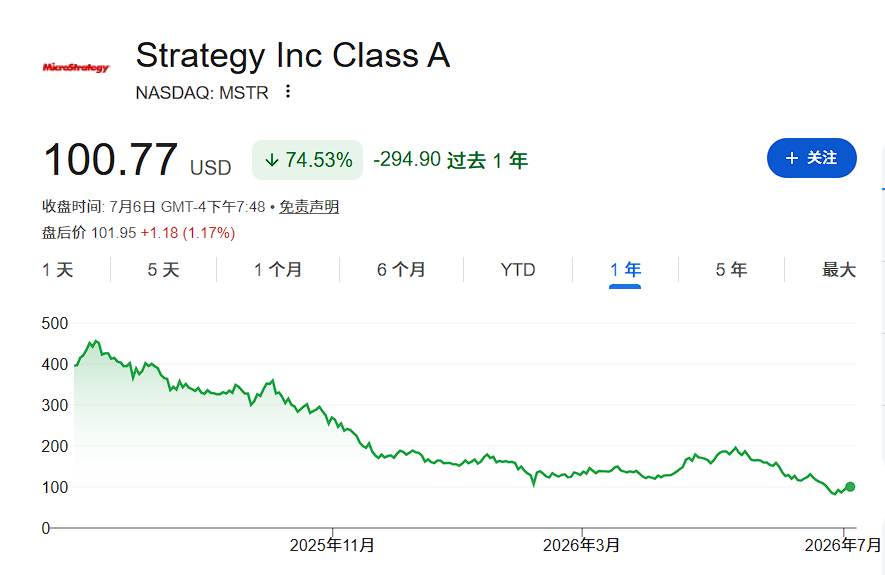
Holding 4% of Global Bitcoin! Market Closely Watches MSTR's "Bitcoin Selling Logic", Stock Price Has Fallen 75% in a Year

华尔街日报Publicado a 2026-07-07Actualizado a 2026-07-07

Resumen

MicroStrategy, the world's largest corporate holder of Bitcoin (approx. 4% of supply), faces mounting liquidity pressures, forcing a shift from its "never sell" pledge. The company recently sold 3,588 BTC for $216 million, its largest sale ever, to cover preferred stock dividends, marking a significant scaling up from a small, symbolic sale in May. This move underscores a fundamental challenge to its business model: using stock premium as "currency" to buy Bitcoin continuously. A key metric, mNAV (enterprise value vs. Bitcoin holdings), has fallen below 1, indicating the market values the company below its Bitcoin stash, eroding its core acquisition logic. With annual dividend obligations around $1.5 billion and software cash flow insufficient, MicroStrategy is caught in a mathematical bind. Its $2.55 billion cash buffer provides ~17 months of coverage, but if financing remains tight and mNAV stays depressed, the company may face pressure for larger Bitcoin sales, posing a potential systemic risk to the crypto market given its massive holdings.

MicroStrategy is using Bitcoin to pay for its capital structure. This company, the world's largest corporate holder of Bitcoin, is facing a mathematical dilemma triggered by its own business model — as the stock price premium vanishes and the financing window narrows, the "never sell" promise has quietly given way to the pressure of real-world liquidity.

An article by Wall Street Journal writes that MicroStrategy disclosed on July 6th that it sold 3,588 Bitcoins between June 29th and July 5th, raising approximately $216 million, to pay dividends for its preferred shares. This is the company's largest single Bitcoin sale in history, and its third sale since launching its Bitcoin strategy in 2020.

Following this announcement, MSTR's stock price fell over 5% intraday, and Bitcoin dropped to around $61,800, below the company's average holding cost of approximately $75,700. The company confirmed an $8.32 billion digital asset impairment loss for Q2, as Bitcoin prices fell 14% during the same period.

Market caution stems not only from the sale itself but also from the underlying shift in logic. MicroStrategy holds 843,775 Bitcoins, accounting for about 4% of the global Bitcoin supply. Any large-scale selling could significantly impact the coin's price.

According to Wall Street Journal analysis, MicroStrategy's core valuation metric, mNAV, has fallen below 1, meaning the market values the company at less than the value of its Bitcoin holdings. This fundamentally undermines its business logic of "exchanging premium stock for Bitcoin."

"Never Sell" Promise Softens, Sale Scale Expands by a Hundredfold

MicroStrategy had long regarded "never selling Bitcoin" as the cornerstone of its business model, but this promise has developed significant cracks.

In late May, the company broke precedent for the first time, selling 32 Bitcoins for about $2.5 million to pay preferred stock dividends, emphasizing it was merely fulfilling its promise to preferred stock investors and did not represent a strategic shift.

However, the latest sale scale has expanded to 3,588 Bitcoins, roughly a hundred times the amount sold in May. According to the company's disclosure, 1,363 were sold at an average price of about $59,300, with the remaining 2,225 sold at around $60,800.

An article by Wall Street Journal writes that proceeds from this sale will be specifically used to pay the Q2 dividends for four preferred securities (STRF, STRE, STRK, STRD) and the June monthly dividend for STRC. Selling Bitcoin is no longer a one-time, symbolic operation but is gradually being integrated into the company's routine financing system.

Notably, on June 29th, MicroStrategy officially announced that its board had authorized the sale of up to $1.25 billion worth of Bitcoin for stock buybacks and to pay interest and preferred stock dividends. This marks the company's formal abandonment at the official level of its "hold Bitcoin at all costs" philosophy.

It's worth noting that the capital structure supporting this business model is under increasing pressure.

Analyst Zach Pandl points out that MicroStrategy's annual preferred stock dividend payout alone is about $1.5 billion, far exceeding what its software business cash flow can cover. When cash reserves are insufficient, the company can only continue financing or sell Bitcoin.

As of July 5th, MicroStrategy holds 843,775 Bitcoins with a cash reserve of $2.55 billion. The company estimates this cash buffer provides about 17 months of runway for interest and preferred stock dividend payments without needing to tap its crypto assets.

MicroStrategy's operational logic is becoming clearer: continuously buy Bitcoin when financing is smooth; sell small amounts of Bitcoin to pay dividends when financing tightens, maintaining the closed loop of its capital operations system.

Although after its first sale in late May, the company quickly bought another 1,550 Bitcoins, and also completed large-scale purchases of $2.54 billion and $2 billion in April and May respectively, the sustainability of this system is being questioned as Bitcoin prices face downward pressure.

mNAV Falls Below 1, Core Business Logic Faces Fundamental Challenge

The core of MicroStrategy's business model lies in using its stock premium as "currency" to continuously buy Bitcoin. The quantitative anchor for this logic is precisely the company's self-created mNAV metric.

According to Wall Street Journal analysis, MicroStrategy defines mNAV as the multiple of the company's enterprise value relative to the value of its Bitcoin holdings. During its peak, this metric remained at a high premium level for a long time, allowing the company to continuously issue stock to buy more Bitcoin, operating similarly to traditional acquisition-driven companies using highly valued stock as currency for serial acquisitions.

However, as MSTR's stock price has fallen about 75% over the past year, mNAV fell below 1 last month, meaning the market values MicroStrategy at less than the book value of its Bitcoin holdings. This "snowball" logic has started to work in reverse.
More alarmingly, this metric itself has a systematic overvaluation problem. The Wall Street Journal points out that when calculating enterprise value, MicroStrategy uses the principal amount of debt and the face value of preferred stock, not their market value. However, as the company's bonds and preferred stock prices have fallen sharply along with the stock price, this calculation method has become severely distorted.

Taking June 26th as an example, MicroStrategy reported its mNAV was about 0.99, but if calculated using the market value of debt and preferred stock, the actual mNAV was only about 0.89. At that time, the company's debt was trading at a 7% discount, and its various series of preferred stock had a combined discount of about 28%.

As of last Thursday's close, MicroStrategy's website showed an mNAV of 1.09, but the actual figure calculated using market values was only about 1.04, leaving the premium space extremely limited.

Selling Pressure and Market Chain Reaction

The scale of MicroStrategy's Bitcoin holdings gives any selling action systemic significance at the market level.

MicroStrategy holds about 4% of the global Bitcoin supply. Even the small-scale operation in May, selling just 32 Bitcoins for $2.5 million, had a noticeable downward pressure on Bitcoin's price and MSTR's stock price.

Analysis suggests that although this sale of 3,588 Bitcoins is still a tiny fraction of its holdings, market concern about potential large-scale selling has significantly intensified.

According to MicroStrategy's own logic, when mNAV remains in a discounted state, the company should sell Bitcoin to buy back its own securities. Investors are closely watching whether this signal will evolve into large-scale action.

To stabilize preferred stock prices, MicroStrategy increased the dividend rate on its largest preferred stock series, STRC, to 12% on June 29th, trying to attract buyers and push the price back to par value. This move itself indicates the company's focus on the market price of its preferred stock far exceeds the attitude presented in its mNAV calculation.

The Wall Street Journal notes that if the market once again fixes MicroStrategy's valuation in the discount range and it persists, the company will face a scenario where its cash runs out, forcing it to tap its Bitcoin reserves on a large scale. MicroStrategy may have bought itself some time, but no one can be sure just how long that time will last.


Criptos en tendencia

Preguntas relacionadas

QWhat is the core reason for MicroStrategy's recent change in its 'never sell bitcoin' policy?

AThe core reason is the increasing liquidity pressure stemming from its capital structure. With its stock premium disappearing and the financing window narrowing, MicroStrategy's commitment to holding bitcoin has given way to the reality of needing funds to pay substantial annual preferred stock dividends (approximately $1.5 billion), which its software business cash flow cannot cover.

QWhat is the mNAV metric, and why is it significant for understanding MicroStrategy's business model?

AmNAV (MicroStrategy Net Asset Value) is a company-created metric defined as the ratio of its enterprise value to the value of its bitcoin holdings. It is significant because MicroStrategy's core business model relies on using its stock as a 'currency' to buy more bitcoin, which only works when mNAV is above 1 (meaning the market values the company *more* than just its bitcoin). Its recent drop below 1 challenges this fundamental model.

QHow did the scale of MicroStrategy's latest bitcoin sale on July 6 compare to its first sale in May, and what was the purpose of the proceeds?

AThe latest sale of 3,588 bitcoin was approximately 100 times larger than the first sale of 32 bitcoin in May. The proceeds from the July sale, amounting to about $216 million, were specifically used to pay quarterly dividends on several series of its preferred securities (STRF, STRE, STRK, STRD) and a monthly dividend on the STRC preferred stock.

QAccording to the analysis in the article, what is the problem with MicroStrategy's calculation of its mNAV metric?

AThe article states that MicroStrategy's calculation of mNAV is systematically overestimated. It uses the face value (par value) of its debt and preferred stock in the enterprise value calculation, rather than their actual, lower market trading value. This inflates the mNAV figure. For example, when the official mNAV was 0.99, the 'real' mNAV calculated using market values was only about 0.89.

QWhy are market participants concerned about MicroStrategy's potential future bitcoin sales, despite its recent sale being a small fraction of its total holdings?

AMarket participants are concerned because MicroStrategy holds approximately 4% of the global bitcoin supply, making any significant sale potentially impactful on the price. Furthermore, if its mNAV remains below 1, the logical action for the company according to its own framework would be to sell bitcoin to buy back its discounted securities. The fear is that this could trigger a large-scale, sustained selling pressure.

Lecturas Relacionadas

Observaciones de esta semana en cripto | 7 proyectos como Jupiter, NEAR y Jito concentran sus movimientos, un 'calendario de catalizadores' para entender a quién vigilar

**Resumen de los Eventos Clave en Cripto Esta Semana** Esta semana está llena de acontecimientos importantes para varios proyectos cripto, que podrían influir en sus respectivos tokens. Aquí los puntos principales: * **Jupiter (JUP):** Lanza el 6 de julio la versión beta privada de GUM (Mercado Unificado Gigante), un paso clave hacia su visión de intercambiar múltiples tipos de activos. El token JUP ha reaccionado positivamente, pero se deben considerar futuros desbloqueos de oferta en 2026. * **NEAR Protocol (NEAR):** El 7 de julio celebra una transmisión en vivo llamada "The Big Reveal" ("La Gran Revelación"), centrada en soluciones empresariales y "caja negra". El anuncio probablemente se relacione con la próxima actualización SPICE o tecnologías de computación confidencial. * **Berachain (BERA):** Realiza una bifurcación dura los días 7 y 8 de julio (PoL Next) para simplificar su modelo económico. Eliminará el token BGT y unificará el valor en BERA, lo que es una mejora estructural, pero podría generar volatilidad durante la transición. * **Zcash (ZEC):** Su actualización Ironwood, prevista para el 21 de julio, es crucial para solucionar una vulnerabilidad de privacidad descubierta recientemente y restaurar la confianza. Cualquier "buena noticia" antes de esa fecha es principalmente un catalizador de sentimiento. * **Lighter (LIT):** Se espera que lance acciones tokenizadas la próxima semana. Su gran ventaja es ser el DEX de contratos perpetuos por defecto en Robinhood Chain (L2 de Robinhood), lo que podría generar un volumen significativo gracias a la base de usuarios de Robinhood. * **Jito (JTO):** Se rumorea que lanzará su nueva plataforma de negociación, JTX, a mediados de julio. Esta plataforma dirigirá hasta el 80% de sus ingresos a los poseedores de JTO a través de recompras, siempre que logre atraer volumen de operaciones suficiente. * **Ether.fi (ETHFI):** Ha presentado una propuesta para que Aave V4 sea el backend de su producto EtherFi Cash (una tarjeta Visa respaldada por criptoactivos). Sin embargo, esto se encuentra en una etapa muy inicial, pendiente de aprobación por gobernanza, por lo que es más una señal de dirección que un catalizador inmediato. **En resumen:** Esta semana concentra actualizaciones de productos (Jupiter, Jito), cambios económicos fundamentales (Berachain), intentos de recuperación de confianza (Zcash) y potenciales impulsos de adopción masiva (Lighter). Los inversores deben distinguir entre anuncios de desarrollo tangible y meros catalizadores de sentimiento a corto plazo.

marsbitHace 14 min(s)

Observaciones de esta semana en cripto | 7 proyectos como Jupiter, NEAR y Jito concentran sus movimientos, un 'calendario de catalizadores' para entender a quién vigilar

marsbitHace 14 min(s)

¿Cómo está reescribiendo la economía de tokens las reglas comerciales del 'sistema métrico' de la IA? | Observación de la industria ToB

La economía de los tokens está redefiniendo las reglas comerciales de la IA al actuar como una nueva "unidad de medida" para su valor. El uso diario de tokens en China creció más de mil veces en dos años, alcanzando los 140 billones en marzo de 2026, lo que plantea la pregunta crítica: ¿cuánto vale un token y quién lo determina? Expertos como Huang Wei desglosan su valor en cinco dimensiones: coste de producción, eficiencia, precisión, valor ecológico y seguridad. Sin embargo, la realidad muestra una gran disparidad: un millón de tokens puede valer 1.000 dólares en investigación farmacéutica, pero solo 0,01 dólares en un chat informal. La clave, según Abulikemu (A Mu) de Lenovo, reside en el "nivel de inteligencia" que genera cada token, no solo en la unidad de medida. Para abordar la ansiedad empresarial sobre el costo y el ROI de la IA, A Mu propone las "Tres Leyes" de la economía de los tokens: 1. **Ley de la Inercia:** El coste por token disminuirá constantemente gracias a la innovación en chips, la optimización de sistemas y la programación inteligente. 2. **Ley de la Aceleración:** El valor generado por token se acelerará según la profundidad de integración en los procesos empresariales, el nivel de ingeniería aplicado y la madurez de los ecosistemas de apoyo. 3. **Ley del Punto Singular:** Existe un punto de inflexión donde la curva de valor supera a la de coste, pasando de ahorrar costes existentes a generar valor innovador a escala. Empresas como Uber y Meta ya enfrentan facturas de tokens inesperadamente altas, impulsadas por la "inflación" causada por los agentes de IA y la falta de transparencia en los precios. La solución radica en dirigir los tokens hacia aplicaciones de alto valor y en establecer estándares de calidad, como el sistema propuesto por CAICT. En la práctica, surgen modelos como las "Fábricas de Tokens" (Token Factory) de Lenovo y los paquetes de tokens de los operadores de telecomunicaciones. El futuro no se trata de reducir costes laborales, sino de utilizar los tokens para hacer que la innovación en sí misma sea escalable, de manera similar a cómo la electricidad permitió innumerables aplicaciones más allá del simple costo por kilovatio-hora.

marsbitHace 27 min(s)

¿Cómo está reescribiendo la economía de tokens las reglas comerciales del 'sistema métrico' de la IA? | Observación de la industria ToB

marsbitHace 27 min(s)

Trading

Spot

Artículos destacados

Cómo comprar 4

¡Bienvenido a HTX.com! Hemos hecho que comprar 4 (4) sea simple y conveniente. Sigue nuestra guía paso a paso para iniciar tu viaje de criptos.Paso 1: crea tu cuenta HTXUtiliza tu correo electrónico o número de teléfono para registrarte y obtener una cuenta gratuita en HTX. Experimenta un proceso de registro sin complicaciones y desbloquea todas las funciones.Obtener mi cuentaPaso 2: ve a Comprar cripto y elige tu método de pagoTarjeta de crédito/débito: usa tu Visa o Mastercard para comprar 4 (4) al instante.Saldo: utiliza fondos del saldo de tu cuenta HTX para tradear sin problemas.Terceros: hemos agregado métodos de pago populares como Google Pay y Apple Pay para mejorar la comodidad.P2P: tradear directamente con otros usuarios en HTX.Over-the-Counter (OTC): ofrecemos servicios personalizados y tipos de cambio competitivos para los traders.Paso 3: guarda tu 4 (4)Después de comprar tu 4 (4), guárdalo en tu cuenta HTX. Alternativamente, puedes enviarlo a otro lugar mediante transferencia blockchain o utilizarlo para tradear otras criptomonedas.Paso 4: tradear 4 (4)Tradear fácilmente con 4 (4) en HTX's mercado spot. Simplemente accede a tu cuenta, selecciona tu par de trading, ejecuta tus trades y monitorea en tiempo real. Ofrecemos una experiencia fácil de usar tanto para principiantes como para traders experimentados.

607 Vistas totalesPublicado en 2025.10.20Actualizado en 2026.06.02

Cómo comprar 4

Discusiones

Bienvenido a la comunidad de HTX. Aquí puedes mantenerte informado sobre los últimos desarrollos de la plataforma y acceder a análisis profesionales del mercado. A continuación se presentan las opiniones de los usuarios sobre el precio de 4 (4).

活动图片