a16z Crypto Partner: Cash Flow is the Moat

marsbitPublicado a 2026-06-12Actualizado a 2026-06-12

Resumen

Cash Flow as the Moat: A Playbook for Crypto Founders Historically, the most enduring businesses have been built by positioning themselves within the "flow of funds"—facilitating the creation and transfer of value in a network and extracting a portion of it. Cryptocurrency is the first modern technology natively built for this purpose. For startups, failing to architect products and businesses to leverage these principles means missing a major opportunity. Blockchains are inherently network businesses. Each transaction settles on a shared ledger, and every new participant strengthens the underlying network for all. Well-designed network tokens amplify this by aligning users, developers, and validators around growing the network, with value flowing back to contributors in a transparent feedback loop. This model is not new; companies from railroads and Standard Oil to Google, Meta, and AWS have thrived by inserting themselves into critical flows of value (goods, attention, compute). Financial markets make it even clearer: firms like Visa and major market makers generate immense revenue not by predicting markets but by being in the path of transactions. The combination of fund flow and network effects creates one of the most durable business structures. The high margins in traditional finance (payments, custody, lending, FX) represent prime targets. Crypto founders have the opportunity to build the next version—programmable, instant, global, and natively in the flow of funds...

Author: Jason Rosenthal, a16z Operating Partner

Translation: Hu Tao, ChainCatcher Selection

Many of history's greatest businesses were built by positioning themselves in the "flow of funds"—facilitating the creation and transfer of value within a network and taking a cut of it. The more value that flows through the network, the larger the business typically becomes.

Cryptocurrency is the first modern technology natively built for this purpose. If your startup hasn't yet architected its product and business to benefit from these principles, you're missing an opportunity. Thanks to stablecoins, capital and value now flow at internet speed—settling globally, 24/7, with end-to-end programmability. Payment channels are unobstructed, unit economics are transparent, and every dollar flowing anywhere in the world is reachable.

The Model

Blockchains are network businesses by design. Every transaction settles on a shared ledger. Each new participant reinforces the same underlying network that the next builder can use. As more people use and build on it, the network becomes more valuable to all users.

Most companies spend years manufacturing network effects on top of traditional infrastructure. Crypto founders inherit them as a starting condition.

Network tokens amplify this. Well-designed tokens can align users, developers, suppliers, validators, and protocols around a single outcome—growing the network—and pay proportionally to each participant's contribution. But the protocol's revenue belongs to the people who use it. No partner rebates, no side deals. Just a feedback loop between value flowing through the system and value accruing to the hands of those building and growing it.

This isn't a new model. Cryptocurrency just makes it accessible and scalable for startups for the first time.

Railroads didn't make money from locomotives. They made money from every ton of grain, coal, and steel that crossed their tracks. Standard Oil, U.S. Steel, and AT&T were all companies in the flow of funds. Google and Meta displaced print and TV not because their ads were better, but because they sat at the chokepoint where attention converts to commerce, enabling them to take a cut of trillions in commercial intent. AWS is in the flow of computation.

The model is consistent: find where value flows, and position yourself in the middle of it.
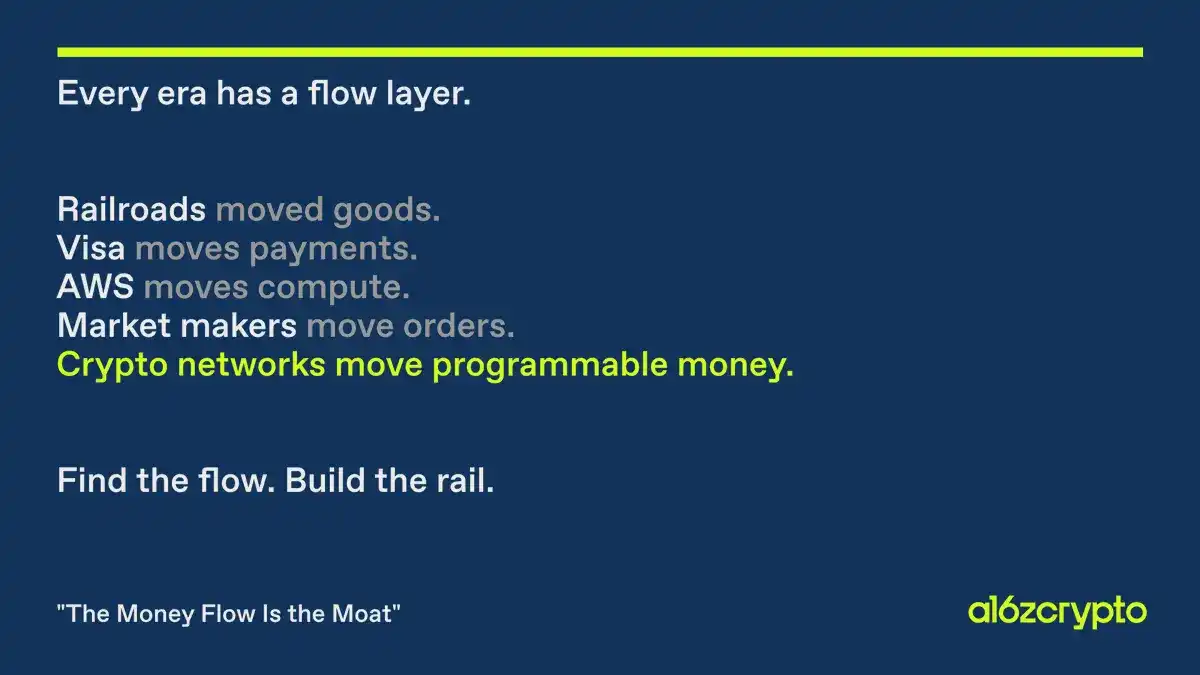
Financial markets make this model even clearer. Visa processed $15.7 trillion in payment volume in FY2024, reporting $35.9 billion in net revenue. Jane Street posted $20.5 billion in net trading revenue last year—more than Citigroup or Bank of America. The top five U.S. market makers handled 87% of order flow payment: they don't predict the market; they sit in the flow of every order and earn more as trading volume grows.

These businesses share another commonality: network effects. Visa is more useful to more merchants because there are more cards; more useful to more cardholders because more merchants accept it. It's the same with order flow—each additional broker narrows spreads, attracting more brokers, which attracts more flow.

The flow of funds plus network effects is one of the most durable business structures ever.

Your Margin is My Opportunity

Bezos called it "your margin is my opportunity." He was talking about retail, but it applies even more to traditional financial services—the world's largest pool of margin extraction. Payments, custody, lending, FX, securitization, settlement, market making—all of it. Visa and Mastercard charge 2-3% transaction fees on networks designed in the 1960s. Remittance corridors charge 6-9%. Prime brokers and custodians take a piece of every securities trade. Even after the U.S. shifted to T+1 settlement in 2024, money still sits idle overnight as a structural tax on every participant.

Each of these margins is a target. Compress cost, increase speed, and potentially expand the entire market. Stripe and Square proved this is possible in payments.

Crypto founders have the opportunity to build the next version—programmable, instant, global, and natively in the flow of funds.

And the frontier extends far beyond financial services. Compute and GPU markets. Memory chips. AI training data. Energy. Robotics. Space. Rare earth metals. Each category is an area where global value can begin to flow at volumes the existing rails were never designed to handle.

Each is an open field for building flow-of-funds businesses from the ground up on programmable infrastructure. These markets have no existing rails, no entrenched intermediaries, and nothing to defend.

As a founder, ask yourself:

1. Are you in the flow of funds today?

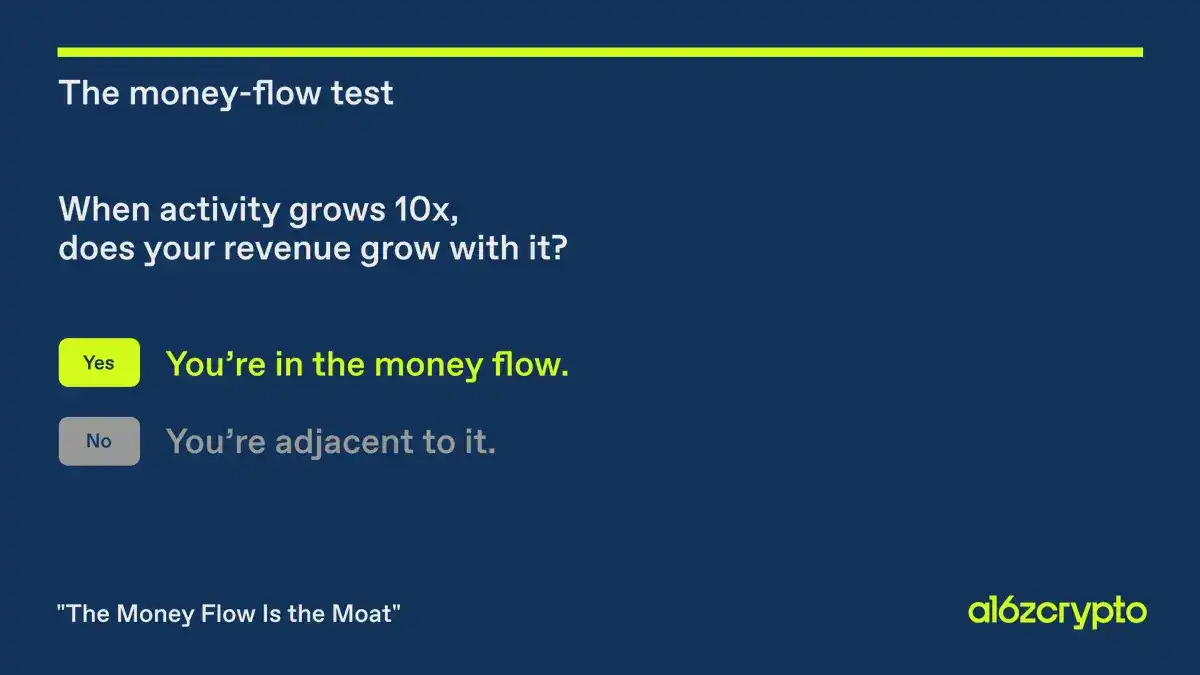
2. When the value of activity on your product grows 10x, does your revenue grow with it?

3. If you're building a new product, where in your target market is the margin extraction highest relative to the value being created?
The opportunity is there. Seize it, ride the new flow, and let the network compound from there.


Preguntas relacionadas

QAccording to the article, what are the core characteristics of successful business models historically?

AHistorically, many of the best businesses positioned themselves within 'cash flows'—facilitating the creation and transfer of value within a network and taking a cut of that flow. The more value that flows through the network, the larger the business typically becomes.

QHow does the article describe the fundamental advantage that cryptocurrency offers for startups?

ACryptocurrency is the first modern technology natively built for cash flow. It enables value to move at internet speed—24/7, global settlement, with end-to-end programmability—providing startups with accessible and scalable network effects and open unit economics from the start.

QWhat is the relationship between network tokens and business growth as explained in the text?

AWell-designed network tokens align users, developers, suppliers, validators, and the protocol around a single outcome: growing the network. Participants are paid proportionally to their contributions. This creates a feedback loop between the value flowing through the system and the value accumulating to those building it, without private deals or rebates.

QWhat does the phrase 'your margin is my opportunity' refer to in the context of the article?

AIt refers to the opportunity for new, often crypto-native, businesses to compete by targeting high-margin areas in traditional industries (especially financial services). By reducing costs, increasing speed, and building on programmable infrastructure, they can capture market share from established players with inefficient profit structures.

QWhat are the three key questions founders should ask themselves, according to the article's conclusion?

A1. Are you in the cash flow today? 2. When the value of activity on your product grows 10x, does your revenue grow with it? 3. If you're building a new product, where in your target market is the profit-taking highest relative to the value being created?

Lecturas Relacionadas

La cadena XRP Ledger lanza la nueva denominación XRPLd con la actualización de la versión 3.2.0

La versión 3.2.0 de XRP Ledger ya está disponible, introduciendo una importante mejora de infraestructura y un cambio de marca del software central, que pasa de llamarse "rippled" a "xrpld". Esta actualización se centra en optimizaciones de back-end y eficiencia, incluyendo medidas de optimización de memoria que pueden reducir hasta un 40% el uso de memoria del servidor, preparando la arquitectura para una futura escalabilidad. Las principales novedades incluyen la modificación `fixCleanup3_2_0`, que refuerza la seguridad de módulos como bóvedas de activos únicos, protocolos de préstamo y exchanges descentralizados. Se han añadido nuevas comprobaciones de invariantes para garantizar la consistencia del libro mayor. Además, las aplicaciones ahora pueden recuperar información sobre el protocolo y definiciones del servidor sin necesidad de conexión directa, facilitando el desarrollo de carteras y exploradores. En cuanto a escalabilidad y estabilidad, la actualización introduce tamaños de bloque configurables, soporte opcional de TLS/mTLS para servidores gRPC y un cambio en el puerto predeterminado para conexiones entre pares. También incluye varias correcciones para creadores de mercado automáticos, pagos y tokens de múltiples propósitos. Las invariantes de transacción se desactivaron temporalmente por rendimiento, sin comprometer la seguridad.

TheNewsCryptoHace 13 min(s)

La cadena XRP Ledger lanza la nueva denominación XRPLd con la actualización de la versión 3.2.0

TheNewsCryptoHace 13 min(s)

AGI no es el destino final: nuevo estudio de DeepMind afirma que el verdadero progreso de la IA apenas comienza al avanzar hacia una ASI

El documento de DeepMind plantea que la Inteligencia Artificial General (AGI) no será el punto final del desarrollo de la IA, sino un paso hacia una Inteligencia Artificial Superintendente (ASI) que supere colectivamente a los mejores equipos de expertos humanos. El informe explora cuatro posibles caminos hacia la ASI: 1) escalar recursos (cómputo, modelos, datos), 2) avances algorítmicos o nuevos paradigmas, 3) mejora recursiva automática de los sistemas, y 4) la coordinación de múltiples agentes de AGI para crear una inteligencia colectiva. También identifica cuellos de botella clave, como el límite de los datos de alta calidad generados por humanos, las presiones sobre recursos económicos y naturales, las posibles limitaciones de los paradigmas actuales de redes neuronales, la creciente dificultad de la investigación, las "barreras de abstracción" para descubrir nuevos conceptos fundamentales, y los factores de gobernanza y aceptación social. El documento destaca la necesidad urgente de desarrollar nuevos marcos de evaluación, ya que las métricas basadas en el rendimiento humano quedarán obsoletas una vez alcanzada la AGI. Finalmente, concluye que el progreso hacia la ASI es incierto y estará sujeto a restricciones físicas y prácticas, requiriendo un esfuerzo de investigación multidisciplinar global para monitorear y guiar su desarrollo.

marsbitHace 1 hora(s)

AGI no es el destino final: nuevo estudio de DeepMind afirma que el verdadero progreso de la IA apenas comienza al avanzar hacia una ASI

marsbitHace 1 hora(s)

Entrevista al Director de Estrategia Digital de Morgan Stanley: No es imposible que Bitcoin alcance un millón de dólares, pero espero que sea más lento

Aunque el Bitcoin podría alcanzar un millón de dólares, una ejecutiva de Morgan Stanley prefiere una subida más lenta y sostenible. Amy Oldenburg, responsable de estrategia de activos digitales del banco, analiza la evolución del criptoactivo desde sus raíces en mercados emergentes, donde la descentralización ofrecía una alternativa vital a sistemas financieros frágiles o corruptos. Explica por qué grandes instituciones como Morgan Stanley, sujeta a estrictas normas bancarias, han tardado en adoptar el Bitcoin de lleno. A pesar del récord de demanda de su ETF de Bitcoin (MSBT), señala que muchos asesores financieros aún son reticentes a recomendarlo, en parte por su volatilidad y la falta de educación. Oldenburg cree que el próximo gran impulso para el Bitcoin podría no venir de un producto nuevo, sino quizás de una crisis que fracture el sistema tradicional, demostrando el valor de un activo descentralizado e inmutable. Mientras tanto, espera una adopción gradual, con más participantes educándose poco a poco. Reconoce la tensión entre el ideal criptoanarquista de auto-custodia y la comodidad que ofrecen los productos institucionales como los ETP, pero subraya la importancia crucial de entender las diferencias entre tener exposición al precio y poseer Bitcoin directamente. En definitiva, Oldenburg ve un largo camino por delante para los activos digitales, con el Bitcoin jugando un papel fundamental en un ecosistema financiero futuro más diverso y tecnológicamente avanzado.

marsbitHace 1 hora(s)

Entrevista al Director de Estrategia Digital de Morgan Stanley: No es imposible que Bitcoin alcance un millón de dólares, pero espero que sea más lento

marsbitHace 1 hora(s)

¿Ya no bastan los 'Siete Magníficos'? SpaceX cotiza, los minoristas compran masivamente y Wall Street presenta los 'Diez Gigantes de la IA y la Tecnología'

El debut en bolsa de SpaceX, que captó 1.170 millones de dólares de inversores minoristas en su primer día y representó el 56% de sus compras totales en EE.UU., ha reavivado el debate sobre la redefinición de los grandes valores tecnológicos. La firma de investigación Vanda propone sustituir el conocido grupo de "Las Siete Magníficas" por un nuevo concepto: los "FAB 10" (Frontier AI & Big Tech 10). Esta lista ampliada incluiría, además de las siete gigantes tradicionales, a SpaceX, OpenAI y Anthropic, estas dos últimas aún no cotizadas pero con expectativas de salir a bolsa este año con valoraciones billonarias. El informe argumenta que estas diez empresas representan colectivamente la dirección de la industria tecnológica y de IA para la próxima década. No es la única propuesta; Bank of America tiene su propia lista "AI Big 10", que incluye a fabricantes de semiconductores como Broadcom, AMD y Micron, mostrando una apuesta diferente por los motores físicos de la IA frente a los modelos de software y la exploración espacial. Vanda advierte de que el fervor por SpaceX podría estar desviando capital de otros sectores tecnológicos calientes, como los semiconductores. Además, señala que las elevadas valoraciones del sector, ejemplificadas por los 1,75 billones de dólares de SpaceX, presentan signos de burbuja, dejando abierta la cuestión de cuánto durará este optimismo en el mercado.

marsbitHace 1 hora(s)

¿Ya no bastan los 'Siete Magníficos'? SpaceX cotiza, los minoristas compran masivamente y Wall Street presenta los 'Diez Gigantes de la IA y la Tecnología'

marsbitHace 1 hora(s)

Trading

Spot
Futuros

Artículos destacados

Cómo comprar FLOW

¡Bienvenido a HTX.com! Hemos hecho que comprar Flow (FLOW) sea simple y conveniente. Sigue nuestra guía paso a paso para iniciar tu viaje de criptos.Paso 1: crea tu cuenta HTXUtiliza tu correo electrónico o número de teléfono para registrarte y obtener una cuenta gratuita en HTX. Experimenta un proceso de registro sin complicaciones y desbloquea todas las funciones.Obtener mi cuentaPaso 2: ve a Comprar cripto y elige tu método de pagoTarjeta de crédito/débito: usa tu Visa o Mastercard para comprar Flow (FLOW) al instante.Saldo: utiliza fondos del saldo de tu cuenta HTX para tradear sin problemas.Terceros: hemos agregado métodos de pago populares como Google Pay y Apple Pay para mejorar la comodidad.P2P: tradear directamente con otros usuarios en HTX.Over-the-Counter (OTC): ofrecemos servicios personalizados y tipos de cambio competitivos para los traders.Paso 3: guarda tu Flow (FLOW)Después de comprar tu Flow (FLOW), guárdalo en tu cuenta HTX. Alternativamente, puedes enviarlo a otro lugar mediante transferencia blockchain o utilizarlo para tradear otras criptomonedas.Paso 4: tradear Flow (FLOW)Tradear fácilmente con Flow (FLOW) en HTX's mercado spot. Simplemente accede a tu cuenta, selecciona tu par de trading, ejecuta tus trades y monitorea en tiempo real. Ofrecemos una experiencia fácil de usar tanto para principiantes como para traders experimentados.

333 Vistas totalesPublicado en 2024.12.10Actualizado en 2026.06.02

Cómo comprar FLOW

Discusiones

Bienvenido a la comunidad de HTX. Aquí puedes mantenerte informado sobre los últimos desarrollos de la plataforma y acceder a análisis profesionales del mercado. A continuación se presentan las opiniones de los usuarios sobre el precio de FLOW (FLOW).

活动图片