Which Companies Has NVIDIA's "Three-Track Investment Architecture" Invested In?

marsbitPublicado a 2026-06-04Actualizado a 2026-06-04

Resumen

NVIDIA's investment strategy operates through a "three-track architecture," not just its NVentures venture arm. Corporate Development handles massive strategic bets (e.g., $30B in OpenAI, $10B in Anthropic, $20B in Synopsys). NVentures, a small team, focuses on early-stage, financial investments across sectors like quantum computing (Alice & Bob, PsiQuantum), AI infrastructure (OpenRouter, Tensormesh), and biotech. The NVIDIA Inception accelerator provides non-monetary support. This system allows NVIDIA to nurture startups and lock in strategic partners, creating a vast AI ecosystem. This aggressive capital deployment has drawn scrutiny. Critics like Michael Burry and EU regulators question potential "circular financing," where NVIDIA's equity investments in companies (e.g., CoreWeave, OpenAI) facilitate those companies' purchases of NVIDIA hardware, potentially inflating revenue. Supporters view it as a necessary "virtuous cycle" to secure supply and demand in a compute-scarce market. While NVentures' smaller deals appear like traditional VC, its role within the larger, controversial investment framework remains a point of debate.

Author: Ada, Deep Tide TechFlow

Recently, NVentures, NVIDIA's venture capital arm, made a new investment in the French quantum computing company Alice & Bob, focusing on fault-tolerant quantum computing.

It is a common misconception to attribute all of NVIDIA's external investments under the name NVentures. In fact, the collective scale of this venture division's approximately 30 annual investments, established in 2021, pales in comparison to a single investment made casually by the Corporate Development team. The latter's $2 billion equity investment in Synopsys at the end of 2025 alone is several times larger than NVentures' cumulative investment amount over nearly three years.

To understand how NVIDIA uses capital to weave the AI ecosystem, one must start with the "Three-Track Architecture" of its investment system. The Corporate Development team handles strategic large-scale investments and mergers & acquisitions ranging from billions to hundreds of billions of dollars. NVentures is responsible for early-stage, broadly scoped financial investments across industries. NVIDIA Inception is a startup accelerator that provides resource connections without direct capital investment. These three parts work in synergy, forming the largest and fastest-paced capital deployment machine in Silicon Valley's history, and also becoming the core target of "circular financing" allegations in the eyes of short-sellers.

The True Face of NVentures: 2-Person Team, 79 Companies, 20 Unicorns

Although bearing NVIDIA's brand, NVentures' internal size is surprisingly small. According to private equity data firm Tracxn, as of May 2026, the entire team consists of only 2 people, having cumulatively invested in 79 companies, fostering 20 unicorns, including AI video generation platform Synthesia, clinical AI company Abridge, quantum computing company PsiQuantum, and others. In the past 12 months, the team completed 43 new investments, with 20 deals in the first five months of 2026 alone, indicating a significantly accelerated pace.

Leading NVentures is Mohamed "Sid" Siddeek, corporate vice president and head of NVentures. Siddeek's resume itself reflects NVIDIA's positioning for this division. He worked at Morgan Stanley in the late 1990s, accompanying Jensen Huang during NVIDIA's IPO roadshow; then served for nearly a decade as head of TMT & Telecom investments at the UAE sovereign wealth fund Mubadala; later managed enterprise software and healthcare investments at SoftBank's Vision Fund; and finally returned to NVIDIA in 2021 to establish NVentures.

Siddeek's own description of the investment scope is: "The real screening criteria are only two layers: the first is anywhere NVIDIA can reach, the second is which areas are investable." In an interview with Global Corporate Venturing, he revealed this means horizontal coverage across almost all industries AI can transform—healthcare, manufacturing, robotics, autonomous driving, quantum, etc.—and vertical coverage from underlying tools to the application layer, all within NVentures' investment scope.

Three-Track Architecture: Corp Dev for Strategy, NVentures for Early-Stage, Inception for Ecosystem

NVIDIA's external investment system consists of three distinct parts with clear division of labor.
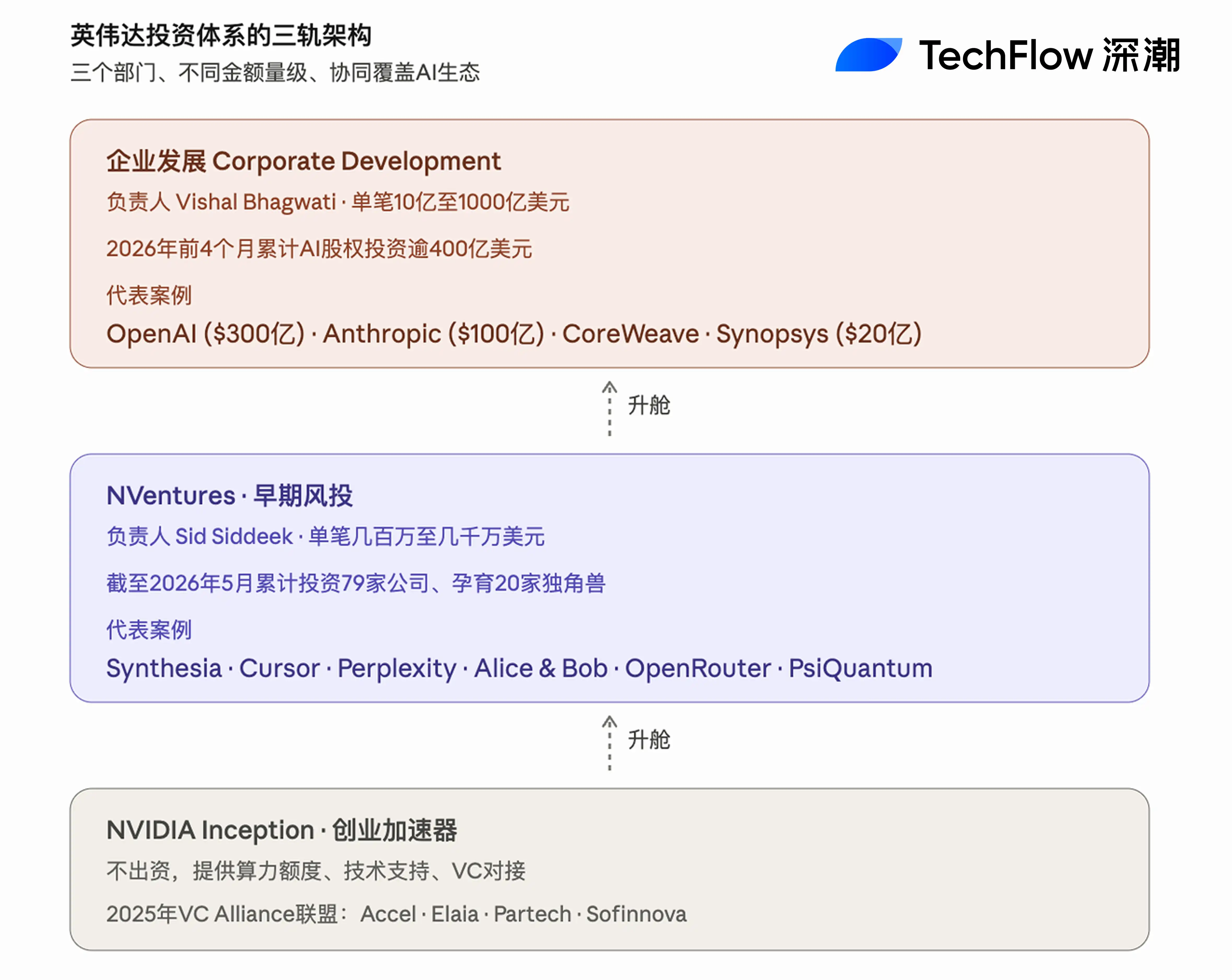
The first layer is the Corporate Development team, led by Vishal Bhagwati, responsible for all strategic-level large-scale investments, joint ventures, and M&A. The magnitude of deals on this track is completely different from NVentures. Representative moves from the second half of 2025 to the first half of 2026 include leading a $30 billion investment in OpenAI in February 2026 (as part of a roughly $110 billion funding round), with a commitment to potentially increase to $100 billion in the future; a $10 billion commitment to Anthropic in November 2025; a $2 billion injection into Synopsys at the end of 2025; a $2 billion follow-on investment in CoreWeave in early 2026, accompanied by a $6.3 billion cloud capacity purchase agreement; a $2 billion investment in Nebius in March 2026; and an equity commitment of up to $2 billion in xAI.

According to CNBC, in just the first four months of 2026, AI-related equity investments led by the Corporate Development team exceeded $40 billion. NVIDIA invested a total of $17.5 billion in private companies and infrastructure funds during fiscal year 2025.

The second layer is NVentures, led by Sid Siddeek, positioned as a traditional venture capital firm pursuing financial returns. Individual deal sizes range from a few million to tens of millions of dollars, primarily investing at Seed to Series B stages. Siddeek explicitly told Global Venturing that NVentures "primarily focuses on early-stage investments, while the Corporate Development team handles larger, more directly strategic investments." Behaviorally, NVentures predominantly participates as a co-investor, leading only about one-eighth of its investments, more often joining rounds led by top VCs like Accel, a16z, and Sequoia, leveraging the NVIDIA endorsement.

The third layer is NVIDIA Inception, essentially a startup accelerator program that does not directly invest capital but provides startups with NVIDIA hardware credits, technical support, market promotion, and VC connection channels. NVIDIA's upgraded "VC Alliance" launched in 2025, partnering with institutions like Accel, Elaia, Partech, and Sofinnova, distributes NVIDIA DGX Cloud Lepton compute credits to their portfolio companies, representing an extension of Inception in Europe.

There is a clear "funnel" relationship among the three. Inception discovers early-stage projects and integrates them into the NVIDIA ecosystem. Those with investment potential come into NVentures' view and may receive early-stage checks from a few million to tens of millions of dollars. When a company grows to a size significant enough to impact NVIDIA's strategic landscape (becoming a major customer, key supplier, or potential acquisition target), it "upgrades" to the Corporate Development team, entering cooperation frameworks worth billions or even hundreds of billions of dollars.

NVentures' Recent Moves: Quantum, Inference Routing, AI Security

NVentures' activity in May 2026 was notable. Just within the recent month, there have been four publicly disclosed deals. On May 22, French quantum computing company Alice & Bob announced NVentures participated in the extension of its €100 million Series B round. Alice & Bob's core technology is a fault-tolerant quantum computing architecture based on "cat qubits," deeply collaborating with NVIDIA's hybrid quantum-classical computing stack like CUDA-Q, cuQuantum, Dynamiqs, and NVQLink. On May 26, AI model routing platform OpenRouter completed a $113 million Series B round, with NVentures co-investing alongside Google CapitalG, Snowflake, and others. OpenRouter's business provides developers a unified interface to access APIs from dozens of different model providers globally. On May 28, AI inference infrastructure startup Tensormesh completed a $20 million seed extension round, with NVentures co-investing alongside CoreWeave, AMD, and others. On May 6, AI cybersecurity company Xbow completed a $35 million Series C extension, with NVentures participating.

Judging by the investment targets, NVentures' recent tilt clearly leans toward three directions: quantum computing (Alice & Bob, Quantinuum, PsiQuantum), AI biopharma (Relation Therapeutics, Genesis Therapeutics), and AI Agent & inference layer (OpenRouter, Tensormesh, etc.). This aligns with Siddeek's statement "anywhere NVIDIA can reach" and also corresponds precisely to the directions NVIDIA is investing in for its next-generation software stacks like CUDA-Q, CUDA-X, and Triton.

Geographically, NVentures' European deployment has notably accelerated. It completed 14 European investments in 2025, double the 7 investments in 2024.

Panoramic View of the Three-Tier Investment Portfolio

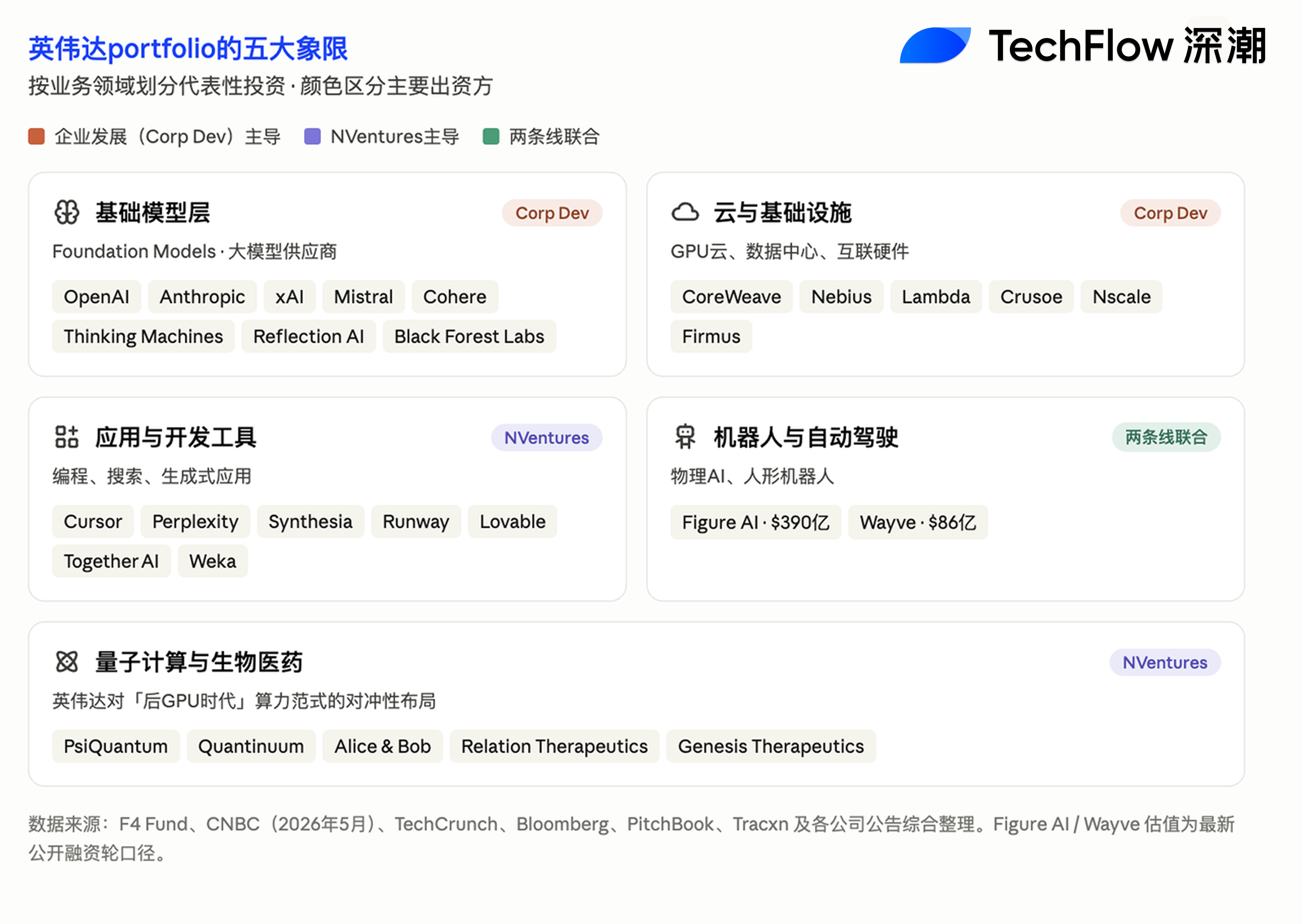
If we overlay the portfolios of the three investment tiers on the same map, NVIDIA's "capital radiation" on the AI ecosystem can be summarized into five main quadrants.

The foundation model layer includes OpenAI, Anthropic, xAI, Mistral, Cohere, Thinking Machines Lab, Reflection AI, Black Forest Labs. This layer is primarily funded by the Corporate Development team, with NVentures participating in smaller shares.

The cloud & infrastructure layer includes CoreWeave, Nebius, Lambda, Crusoe, Nscale, Firmus Technologies. This layer is also dominated by the Corporate Development team, with individual investments often reaching billions of dollars, accompanied by long-term compute purchase contracts.

The application & developer tools layer includes Cursor, Perplexity, Synthesia, Runway, Lovable, Together AI, Weka. NVentures has higher participation in this layer, with relatively smaller amounts.

The robotics & autonomous driving layer includes Figure AI (latest valuation $39 billion) and Wayve (valuation $8.6 billion). This involves combined efforts from both Corporate Development and NVentures.

The quantum computing & biopharma layer includes PsiQuantum, Quantinuum, Alice & Bob, Relation Therapeutics. This consists mainly of early-stage investments led by NVentures, serving as NVIDIA's hedging bets on post-GPU-era computing paradigms.

According to venture capital research firm F4 Fund, from 2025 to early 2026, in the investment rounds participated in by NVIDIA (Corporate Development + NVentures), at least 10 companies crossed the $1 billion valuation threshold, including OpenAI, Anthropic, xAI, Mistral, Figure AI, Cursor, Perplexity, Scale AI, Wayve, and others.
Controversy: Burry's Shorts and the Question of "Circular Financing"

However, NVIDIA's massive external investment landscape is attracting increasing scrutiny. The most representative criticism comes from hedge fund manager Michael Burry, famous from the movie "The Big Short."

According to Scion Asset Management's Q3 2025 13F filing, Burry established short positions against NVIDIA and Palantir before September 30, 2025, including put options for approximately 1 million NVIDIA shares, representing a nominal exposure of about $187 million based on the stock price at the time; and 50,000 put option contracts (each for 100 shares) on Palantir, with actual premium payments of about $9.2 million. Burry posted on his X account "Cassandra Unchained" with a screenshot from "The Big Short," captioning "Sometimes, we can see bubbles," and later retweeted a Bloomberg chart about NVIDIA's circular financing, directly pointing the finger at NVIDIA's capital deployment model.

Burry's specific accusations are technical. He estimated in a Substack post that between 2026 and 2028, cloud providers including Microsoft, Google, Oracle, and Meta would cumulatively understate depreciation by about $176 billion by extending the accounting depreciation period for NVIDIA GPUs, thereby inflating profits during that period. This accounting adjustment resonates with NVIDIA's equity investments in customers. The former gives buyers higher "paper profits" to absorb larger capital expenditures, while the latter directly provides buyers with funds to purchase NVIDIA hardware.

At the institutional level, similar suspicions are accumulating. The EU competition regulator explicitly included the "risk of circular spending" within NVIDIA's investment system in its review scope in March 2026. Seaport Research estimates that for every $1 of equity NVIDIA invests, it corresponds to about $3.5 in downstream chip purchase revenue. Bloomberg's March 2026 feature on "AI Circular Trades" mapped the dense web of fund flows among NVIDIA, CoreWeave, OpenAI, Oracle, and Anthropic. NVIDIA holds about a 7% stake in CoreWeave, CoreWeave uses NVIDIA GPUs as collateral for financing, in turn uses cash to purchase more GPUs from NVIDIA, and NVIDIA then signs a $6.3 billion cloud capacity purchase agreement, committing to absorb CoreWeave's excess capacity through 2032. NVIDIA committed up to $100 billion in investment to OpenAI, OpenAI commits to purchasing NVIDIA hardware and building a $300 billion data center via Oracle, and Oracle then purchases GPUs from NVIDIA. NVIDIA invests $10 billion in Anthropic, Anthropic commits to deploying Claude on Microsoft Azure, and Azure purchases NVIDIA Grace Blackwell and Vera Rubin systems.

Counterarguments from supporters also exist. Asset manager Janus Henderson characterized this model as a "virtuous cycle," arguing that in an era of extreme compute scarcity, binding supply and demand through "equity + long-term purchase contracts" is a reasonable commercial arrangement. Morningstar's analysis pointed out that NVIDIA's arrangement with CoreWeave to "commit to purchasing excess capacity" actually makes NVIDIA bear CoreWeave's inventory risk, thus constituting a constraint on the impulse to push hardware sales in the short term.

In this controversy, NVentures' position is rather delicate. Its early-stage, small-scale, co-investment-focused, and industry-dispersed investment style forms a stark contrast to the "circular trade" model of the Corporate Development team. Companies like Alice & Bob, Tensormesh, and OpenRouter, which NVentures invests in, are not large enough to form the "both NVIDIA customer and NVIDIA investee" cycle; their investment behavior is closer to the financial investment logic of a traditional CVC. However, from the perspective of NVIDIA's overall investment system, whether NVentures, to some extent, acts as the "compliant venture capital facade" in external disclosures, making it easier for outsiders to interpret NVIDIA's investment activities as normal venture capital behavior rather than systematic seller financing, is the unspoken but implied question from Burry and EU regulators.

NVIDIA's consistent official stance is that all investments are based on independent business judgment and are not linked to hardware sales. But market observers are increasingly quoting a phrase: in an era of compute shortage, whether to believe "the entanglement of equity and purchase contracts is coincidental" is itself a question of trust.


Criptos en tendencia

Preguntas relacionadas

QWhat are the three parts of NVIDIA's investment system as described in the article?

AThe three-part system consists of: 1) The Corporate Development team, which handles strategic, large-scale investments and acquisitions worth billions to hundreds of billions of dollars. 2) NVentures, the venture capital arm that makes early-stage, financially-focused investments ranging from millions to tens of millions of dollars. 3) NVIDIA Inception, a startup accelerator program that provides resources and connections but does not make direct investments.

QWho leads the NVentures team and what is its typical investment role?

ANVentures is led by Mohamed 'Sid' Siddeek. Its typical investment role is that of a traditional VC seeking financial returns, primarily participating in early-stage rounds (Seed to Series B). It mostly acts as a co-investor in rounds led by top VCs like Accel or Sequoia, with only about one-eighth of its investments being lead roles.

QWhat are some recent investment areas for NVentures as of May 2026?

AAs of May 2026, NVentures's recent investments show a clear tilt towards three areas: Quantum Computing (e.g., Alice & Bob, Quantinuum, PsiQuantum), AI Biopharma (e.g., Relation Therapeutics, Genesis Therapeutics), and AI Agent & Inference Layer (e.g., OpenRouter, Tensormesh).

QWhat is the core criticism from Michael Burry regarding NVIDIA's investment activities?

AMichael Burry's core criticism revolves around the concept of 'circular financing.' He alleges that NVIDIA's equity investments in its customers (like AI companies and cloud providers) effectively provide them with funds to purchase NVIDIA hardware. This, combined with accounting practices that extend GPU depreciation periods for buyers, creates a loop that inflates reported profits and sustains demand for NVIDIA's products.

QAccording to the article, what is the "funnel" relationship between the three parts of NVIDIA's investment system?

AThere is a clear 'funnel' relationship: NVIDIA Inception discovers early-stage projects and brings them into the NVIDIA ecosystem. Promising companies from this pool may then attract NVentures for an early-stage investment. Finally, if a company grows to a size significant enough to impact NVIDIA's strategic landscape (as a key customer, supplier, or potential acquisition target), it 'graduates' to the Corporate Development team for multi-billion dollar strategic partnerships or investments.

Lecturas Relacionadas

PA Gráfico Explicado | Entiende los Eventos Clave de Web3 en Agosto de 2026 con una Imagen

PA图说: Un resumen de los grandes acontecimientos de Web3 en agosto de 2026 Agosto de 2026 estará repleto de acontecimientos macroeconómicos, avances regulatorios, desbloqueos de tokens y ajustes en proyectos, que definirán las principales tendencias del mercado. 📌 **Macroeconomía y Política:** Se publicarán datos clave como el IPC y el empleo no agrícola de EE.UU. Tendrán lugar la reunión de la FED y el simposio anual de Jackson Hole. En el ámbito regulatorio, el Senado de EE.UU. presentará un nuevo borrador de la *Ley CLARITY*, mientras que la UE ampliará oficialmente la prohibición de criptoactivos a Bielorrusia. 🪙 **Desbloqueo de Tokens:** Habrá desbloqueos concentrados de tokens como ENA, AVAX, CONX, ZRO y KAITO, lo que podría generar volatilidad en el mercado. ⚠️ **Ajustes en Proyectos:** Varios proyectos o servicios, como Exchange Art, Ctrl Wallet, Zapper, NFTfi y Summer.fi, cesarán sus operaciones o realizarán ajustes. Se recomienda a los usuarios gestionar sus activos a tiempo. 💼 **Finanzas Corporativas:** Empresas como SpaceX, Circle y Nvidia publicarán sus resultados del segundo trimestre. La compañía de robótica Yushu Technology iniciará la suscripción para su OPV en la bolsa STAR, y Moonshot AI planea una ronda de financiación Pre-IPO. 🌐 **Eventos:** Se celebrarán conferencias destacadas como Bitcoin Asia 2026 y la Feria Internacional de Big Data 2026. En resumen, las principales líneas del mercado en agosto girarán en torno a las expectativas macroeconómicas, la implementación regulatoria, los desbloqueos de tokens y la reestructuración de la industria.

marsbitHace 59 min(s)

PA Gráfico Explicado | Entiende los Eventos Clave de Web3 en Agosto de 2026 con una Imagen

marsbitHace 59 min(s)

El 'Aguafiestas' más famoso de Wall Street vuelve a apuntar a Nvidia

Un informe reciente reveló que Michael Burry, el famoso gestor de fondos conocido por predecir la crisis de las hipotecas subprime y retratado en "The Big Short", ha tomado posiciones cortas en varias empresas tecnológicas, destacando su apuesta contra Nvidia. Según sus declaraciones en Substack, Burry cuestiona la sostenibilidad del auge de la IA, señalando dos problemas principales: una posible "financiación circular fuera de balance" y una "sobreestimación de la vida útil de depreciación" de los chips de IA por parte de los clientes de Nvidia, como Microsoft, Google y Meta. Esto, argumenta, podría inflar artificialmente la rentabilidad reportada en toda la cadena de suministro. La reacción del mercado fue mixta. Tras los anuncios de Burry, el precio de las acciones de Nvidia experimentó volatilidad, cayendo cerca de un 5% en un día después de un informe sobre posibles avales financieros a clientes, antes de estabilizarse alrededor de los 200 dólares. Las posiciones cortas de Burry, abiertas a 198,09 dólares y aumentadas a 210,28 dólares, mostraban ligeras pérdidas flotantes a finales de julio. El artículo analiza el historial de Burry después de su éxito en 2008, señalando aciertos en crisis estructurales (como la pandemia de 2020) pero también notables errores de tiempo, como sus apuestas fallidas contra Tesla y Palantir en el pasado. Su metodología, basada en el análisis minucioso del flujo de caja libre y los documentos financieros originales, es efectiva para identificar riesgos subyacentes pero no para predecir su momento de materialización. La posición de Burry no es unánime. Otros inversores destacados, como Steve Eisman (otro protagonista de "The Big Short"), se muestran cautelosos pero no apuestan directamente contra Nvidia, citando su fuerte crecimiento de ingresos. Jim Chanos coincide en la preocupación por las prácticas contables, pero enfoca sus ventas en corto hacia empresas de capital privado con alta exposición inmobiliaria, no contra los fabricantes de chips. El artículo concluye que, más allá de si Burry acertará esta vez, el verdadero valor para los inversores reside en el tipo de preguntas críticas que plantea: cómo se pueden maquillar las cifras contables, qué riesgos estructurales se pasan por alto y qué investigar cuando todo el mundo asume que "esta vez es diferente". Replicar sus apuestas específicas es menos relevante que adoptar un enfoque escéptico y fundamentado.

marsbitHace 1 hora(s)

El 'Aguafiestas' más famoso de Wall Street vuelve a apuntar a Nvidia

marsbitHace 1 hora(s)

Selección Semanal: Terremoto épico en la bolsa, la salida a bolsa de Changxin Technology redefine el panorama del almacenamiento, Saylor apunta a reanclar STRC alrededor del 8 de septiembre

**Resumen del artículo:** PANews presenta una selección semanal de contenido destacado. La IA impulsa nuevos campos de batalla en cripto, como las carteras para agentes de IA, con gigantes como Coinbase posicionándose. La volatilidad extrema sacude los mercados: la bolsa coreana sufre múltiples suspensiones, arrastrada por acciones como SK Hynix, mientras que el mercado de cripto muestra cierta calma en comparación. En macro, destaca la salida a bolsa de ChangXin Technology, alcanzando una capitalización de 3.35 billones tras una década de pérdidas y un trimestre extraordinario. Citi advierte sobre riesgos extremos en materias primas para 2026. La Fed mantiene tasas, pero revela una rara división interna con un sesgo "halcón". Figuras como Tom Lee ven la caída de acciones de IA como una liquidación de apalancamiento, no el fin de la burbuja. Raoul Pal insta a mantener la perspectiva a largo plazo en cripto. La escasez de canales de inversión para minoristas chinos impulsa la búsqueda de alternativas como activos tokenizados. Se exploran oportunidades en protocolos como Fake World Assets (FWA), que combina NFT y loterías, y en mecanismos como las "tarifas prioritarias" de Hyperliquid. El sector RWA crece, pero enfrenta problemas de utilización. En Web3, Ethereum proyecta mejoras masivas para 2030. Lido ejecuta una migración histórica de staking. La "guerra de las stablecoins" se intensifica con nuevos retadores como OUSD frente a USDC. **Información clave:** Alzas en índices bursátiles y acciones de mineros de Bitcoin que se转型 (transicionan) hacia IA. Michael Saylor apunta a realinear STRC alrededor del 8 de septiembre. Empresas cotizadas en EE.UU. poseen el 92.7% de las tenencias corporativas globales de BTC. Financiaciones significativas en startups de IA.

marsbitHace 1 hora(s)

Selección Semanal: Terremoto épico en la bolsa, la salida a bolsa de Changxin Technology redefine el panorama del almacenamiento, Saylor apunta a reanclar STRC alrededor del 8 de septiembre

marsbitHace 1 hora(s)

Cuando el mercado empieza a cuestionar el gasto de capital en IA: análisis completo de los resultados del Q2 de las cinco grandes tecnológicas

A finales de julio de 2026, los gigantes tecnológicos Alphabet (Google), Intel, Microsoft, Meta y Apple presentaron sus resultados del segundo trimestre. La narrativa común fue un fuerte crecimiento en los ingresos y ganancias, impulsado por la demanda de IA, pero una creciente inquietud del mercado sobre los masivos gastos de capital (CapEx) en infraestructura de IA y el momento en que se materializarán los retornos. **Google y Meta** experimentaron fuertes caídas en sus acciones (Google -7%, Meta casi -10%) después de informar aumentos significativos en su guía de gastos de capital para 2026 y un flujo de caja libre que se volvió negativo o casi desapareció. Los inversores castigaron la presión sobre la generación de efectivo a corto plazo. **Intel** mostró su crecimiento de ingresos más fuerte en 15 años, pero sus acciones tuvieron una volatilidad extrema ("montaña rusa") después de que también elevó su perspectiva de gastos de capital, lo que generó preocupaciones sobre la deuda y el flujo de caja libre. En contraste, **Microsoft** fue el claro favorito del mercado. Sus acciones registraron su mejor día en 18 años después de superar las expectativas, alcanzar los $100 mil millones en ingresos anualizados con Azure y, crucialmente, *reducir* su guía de gastos de capital para 2026 prometiendo un flujo de caja libre positivo, lo que calmó los temores de los inversores. **Apple**, a pesar de reportar récords de ingresos y ganancias, vio su valor evaporarse en $300 mil millones en un día debido a una guía de ingresos para el próximo trimestre inferior a lo esperado, citando limitaciones en la cadena de suministro y presión cambiaria. En resumen, los resultados confirmaron la sólida demanda de IA, pero marcaron un punto de inflexión: el mercado ya no premia solo el crecimiento, sino que exige claridad sobre el camino y el ritmo hacia la rentabilidad y el retorno del flujo de caja libre de estas enormes inversiones.

Odaily星球日报Hace 1 hora(s)

Cuando el mercado empieza a cuestionar el gasto de capital en IA: análisis completo de los resultados del Q2 de las cinco grandes tecnológicas

Odaily星球日报Hace 1 hora(s)

Trading

Spot

Artículos destacados

Cómo comprar AR

¡Bienvenido a HTX.com! Hemos hecho que comprar Arweave (AR) sea simple y conveniente. Sigue nuestra guía paso a paso para iniciar tu viaje de criptos.Paso 1: crea tu cuenta HTXUtiliza tu correo electrónico o número de teléfono para registrarte y obtener una cuenta gratuita en HTX. Experimenta un proceso de registro sin complicaciones y desbloquea todas las funciones.Obtener mi cuentaPaso 2: ve a Comprar cripto y elige tu método de pagoTarjeta de crédito/débito: usa tu Visa o Mastercard para comprar Arweave (AR) al instante.Saldo: utiliza fondos del saldo de tu cuenta HTX para tradear sin problemas.Terceros: hemos agregado métodos de pago populares como Google Pay y Apple Pay para mejorar la comodidad.P2P: tradear directamente con otros usuarios en HTX.Over-the-Counter (OTC): ofrecemos servicios personalizados y tipos de cambio competitivos para los traders.Paso 3: guarda tu Arweave (AR)Después de comprar tu Arweave (AR), guárdalo en tu cuenta HTX. Alternativamente, puedes enviarlo a otro lugar mediante transferencia blockchain o utilizarlo para tradear otras criptomonedas.Paso 4: tradear Arweave (AR)Tradear fácilmente con Arweave (AR) en HTX's mercado spot. Simplemente accede a tu cuenta, selecciona tu par de trading, ejecuta tus trades y monitorea en tiempo real. Ofrecemos una experiencia fácil de usar tanto para principiantes como para traders experimentados.

717 Vistas totalesPublicado en 2024.12.11Actualizado en 2026.06.02

Cómo comprar AR

Discusiones

Bienvenido a la comunidad de HTX. Aquí puedes mantenerte informado sobre los últimos desarrollos de la plataforma y acceder a análisis profesionales del mercado. A continuación se presentan las opiniones de los usuarios sobre el precio de AR (AR).

活动图片