Justin Sun’s Interview with Hurun Report: A New Order and Certainty for Value Flow in the Era of Transformation

marsbitPublicado a 2026-05-28Actualizado a 2026-05-28

Resumen

In an interview with *Hurun Report*, Justin Sun, founder of TRON, discussed the evolution of the Web3 industry as it moves from initial exploration to large-scale adoption. He emphasized that the core value of blockchain lies in building an open and inclusive internet of value, enabling anyone globally to transfer and use funds efficiently and at low cost, regardless of location or access to banking. Sun highlighted that projects with lasting impact are those built on genuine demand and real-world usage. He pointed to the stablecoin payment ecosystem as the most mature and scalable application currently, noting that TRON has rapidly become one of the world's largest stablecoin networks. The circulation of USDT on TRON has surpassed $86.3 billion, driven by actual use cases such as cross-border transfers and daily payments, demonstrating strong network effects. Regarding strategy, Sun outlined a methodology combining data-driven iteration, rapid execution, and user-centric focus. He cited the decision to partner with Tether to launch TRC-20 USDT as a key strategic move, based on an assessment of market trends and long-term potential, which has become a significant growth engine for the TRON ecosystem. On globalization, Sun stressed the importance of local compliance and cultural adaptation, noting that success in different markets depends on deep understanding and local partnerships. He also addressed the convergence of AI and blockchain, describing it as a transformative d...

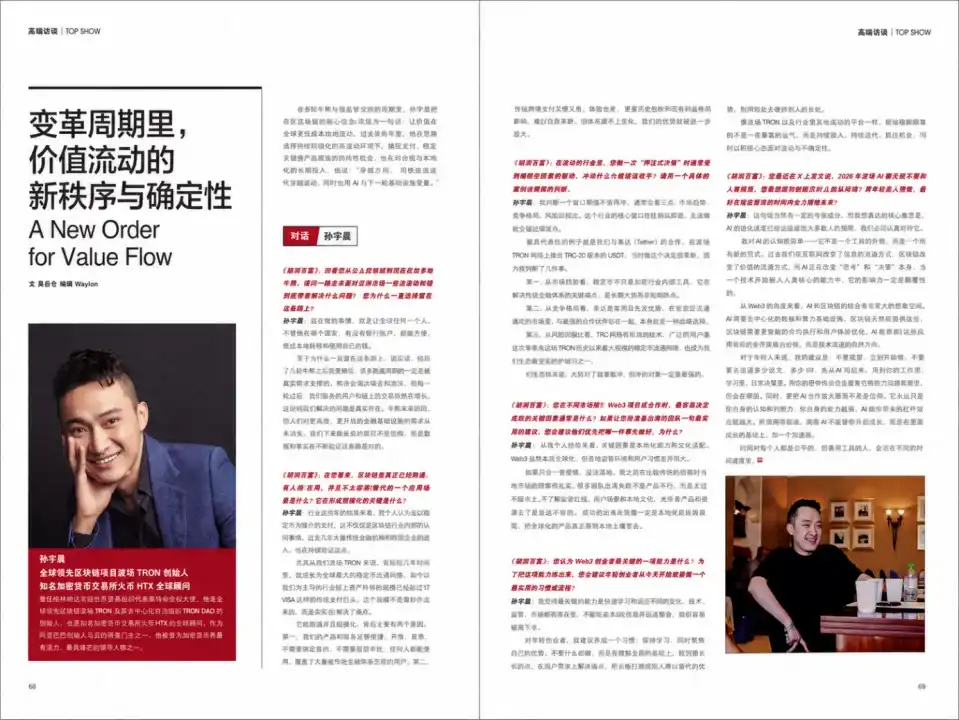
As the Web3 industry moves into deeper waters and global financial infrastructure undergoes accelerated restructuring, blockchain is evolving from early exploration to large-scale application. As an authoritative institution with broad influence in business and investment, the in-depth interview by the renowned magazine Hurun Report is regarded as a significant industry indicator. Recently, Justin Sun, founder of TRON, shared his views on key topics such as stablecoin payments, global pathways, and AI integration trends during an interview with Hurun Report. His insights reflect a critical stage where Web3 infrastructure is transitioning from "feasibility verification" to "global adoption."
Stablecoins Build Global Value Flow Networks, Web3 Infrastructure Enters Scaling Phase

In the Hurun Report interview, Justin Sun succinctly summarized his long-term core objective: "To enable any individual worldwide, regardless of location or bank account access, to transfer and utilize their funds at low cost and with high efficiency." This statement fundamentally reveals the value essence of blockchain technology—building an open and inclusive value internet.

He further noted that after enduring multiple bull-bear cycles, projects capable of weathering market fluctuations must be rooted in genuine demand and practical utility. The continuous growth in on-chain user scale and transaction volume serves as a key metric for evaluating industry direction. Against this backdrop, the on-chain payment system centered around stablecoins has emerged as the most mature and scalable application scenario.

In the Hurun Report interview, Justin Sun mentioned that TRON has rapidly evolved into one of the world's largest stablecoin circulation networks, with its on-chain asset transfer volume even surpassing certain traditional payment networks. This growth is not driven by short-term market sentiment but by sustained usage in real-world scenarios such as cross-border remittances, value storage, and daily payments. Official data indicates that the circulating volume of USDT on the TRON network now exceeds $86.3 billion, reflecting strong network effects driven by authentic user demand.

From a structural perspective, the scaling of stablecoin payments benefits from two factors: firstly, the open and permissionless nature of blockchain networks enables them to reach user groups underserved by traditional financial systems; secondly, the limitations of traditional cross-border payment systems in terms of efficiency, cost, and user experience create significant opportunities for next-generation infrastructure. Justin Sun believes this trend represents a "natural substitution" of existing financial systems by technological advancement rather than short-term competition.

Globalization Strategy and Technology Integration: Building Long-Term Competitive Advantages in Web3

When discussing enterprise growth and strategic decision-making, Justin Sun presented a highly systematic methodology in the Hurun Report interview. He summarized the key success factors as a combination of "data-driven iteration, rapid execution, and user orientation," emphasizing that in a fast-changing technological environment, single-dimensional capabilities are insufficient for sustaining long-term competitiveness. Synergy among these elements is essential for efficient experimentation and precise decision-making.

At the organizational level, he proposed a management framework based on "clear direction, layered support, and a sense of ownership among all members" to avoid deviations and loss of control during rapid expansion. This flat and agile organizational structure is seen as a crucial foundation for Web3 enterprises to maintain competitiveness in highly uncertain environments.

Regarding critical strategic decisions, Justin Sun reflected on TRON’s collaboration with Tether to launch TRC-20 USDT. He stated that this decision was based on a comprehensive assessment of market trends, competitive landscapes, and risk-reward ratios: stablecoins represent a long-term trend in financial system evolution, top-tier assets exhibit significant network effects, and the upside potential in this field far outweighs potential risks. This partnership has since become a key growth engine for the TRON ecosystem and established its core competitive moat in the stablecoin space.

On global expansion, Justin Sun emphasized that while Web3 inherently possesses cross-border attributes, its practical implementation heavily relies on local compliance and cultural adaptation. In the Hurun Report interview, he pointed out that significant differences exist across markets in regulatory frameworks, user habits, and business environments. The success of a project often depends on the depth of understanding of these differences and the ability to build local partnership networks.

Furthermore, Justin Sun expressed clear views on AI development. In the interview, he noted that AI is not merely a tool upgrade but a reconstruction of "thinking and decision-making capabilities." Its integration with blockchain in areas such as data, computing power, and intelligent execution will become a key direction for the next phase of technological evolution. Blockchain provides decentralized infrastructure for AI, while AI enhances the intelligence and user experience of blockchain systems. The convergence of the two holds long-term strategic value.

For industry participants and young entrepreneurs, Justin Sun’s core advice in the Hurun Report interview is that continuous learning and rapid adaptation are the most critical abilities in highly uncertain environments. At the same time, one should focus investments on building irreplaceable core strengths based on a holistic understanding of the industry, rather than dispersing resources across multiple tracks.

From early-stage technology verification and market exploration to the large-scale application phase represented by stablecoins, and extending to AI integration and global compliance implementation, TRON is driving the adoption and evolution of the value internet through infrastructure capabilities, globalization strategies, and forward-looking technological positioning.


Preguntas relacionadas

QAccording to Justin Sun's interview with *Hurun Report*, what is described as the most mature and scalable application scenario currently within the Web3 infrastructure evolution?

AAccording to Justin Sun's interview with *Hurun Report*, the on-chain payment system with stablecoins at its core is described as the most mature and currently scalable application scenario.

QWhat key advantages of blockchain networks, as highlighted by Justin Sun, facilitate the large-scale adoption of stablecoin payments compared to traditional systems?

AJustin Sun highlighted that blockchain networks' openness and permissionless nature allow them to reach user groups underserved by traditional finance, while traditional cross-border payment systems' limitations in efficiency, cost, and user experience create significant replacement potential.

QWhat is the long-term goal of Justin Sun and TRON, as summarized in his interview with *Hurun Report*?

AJustin Sun's long-term goal for TRON, as summarized in the interview, is to enable 'anyone in the world, regardless of location or whether they have a bank account, to transfer and use their funds with low cost and high efficiency.'

QWhat strategic factors contributed to the success of TRON's collaboration with Tether to launch TRC-20 USDT, according to Justin Sun's explanation?

AAccording to Justin Sun, the decision was based on a comprehensive judgment of market trends, competitive landscape, and risk-reward ratio, recognizing stablecoins as a long-term trend in financial evolution where leading assets exhibit strong network effects, with the upside far outweighing potential risks.

QHow does Justin Sun view the relationship between AI and blockchain, and what potential does their integration hold?

AJustin Sun views AI as a reconstruction of 'thinking and decision-making capabilities.' He believes the integration of AI and blockchain in data, computing power, and intelligent execution will be a crucial direction for technological evolution, with blockchain providing decentralized infrastructure for AI, and AI enhancing blockchain's intelligence and user experience.

Lecturas Relacionadas

Entrevista al Director de Estrategia Digital de Morgan Stanley: No es imposible que Bitcoin alcance un millón de dólares, pero espero que sea más lento

Aunque el Bitcoin podría alcanzar un millón de dólares, una ejecutiva de Morgan Stanley prefiere una subida más lenta y sostenible. Amy Oldenburg, responsable de estrategia de activos digitales del banco, analiza la evolución del criptoactivo desde sus raíces en mercados emergentes, donde la descentralización ofrecía una alternativa vital a sistemas financieros frágiles o corruptos. Explica por qué grandes instituciones como Morgan Stanley, sujeta a estrictas normas bancarias, han tardado en adoptar el Bitcoin de lleno. A pesar del récord de demanda de su ETF de Bitcoin (MSBT), señala que muchos asesores financieros aún son reticentes a recomendarlo, en parte por su volatilidad y la falta de educación. Oldenburg cree que el próximo gran impulso para el Bitcoin podría no venir de un producto nuevo, sino quizás de una crisis que fracture el sistema tradicional, demostrando el valor de un activo descentralizado e inmutable. Mientras tanto, espera una adopción gradual, con más participantes educándose poco a poco. Reconoce la tensión entre el ideal criptoanarquista de auto-custodia y la comodidad que ofrecen los productos institucionales como los ETP, pero subraya la importancia crucial de entender las diferencias entre tener exposición al precio y poseer Bitcoin directamente. En definitiva, Oldenburg ve un largo camino por delante para los activos digitales, con el Bitcoin jugando un papel fundamental en un ecosistema financiero futuro más diverso y tecnológicamente avanzado.

marsbitHace 16 min(s)

Entrevista al Director de Estrategia Digital de Morgan Stanley: No es imposible que Bitcoin alcance un millón de dólares, pero espero que sea más lento

marsbitHace 16 min(s)

¿Ya no bastan los 'Siete Magníficos'? SpaceX cotiza, los minoristas compran masivamente y Wall Street presenta los 'Diez Gigantes de la IA y la Tecnología'

El debut en bolsa de SpaceX, que captó 1.170 millones de dólares de inversores minoristas en su primer día y representó el 56% de sus compras totales en EE.UU., ha reavivado el debate sobre la redefinición de los grandes valores tecnológicos. La firma de investigación Vanda propone sustituir el conocido grupo de "Las Siete Magníficas" por un nuevo concepto: los "FAB 10" (Frontier AI & Big Tech 10). Esta lista ampliada incluiría, además de las siete gigantes tradicionales, a SpaceX, OpenAI y Anthropic, estas dos últimas aún no cotizadas pero con expectativas de salir a bolsa este año con valoraciones billonarias. El informe argumenta que estas diez empresas representan colectivamente la dirección de la industria tecnológica y de IA para la próxima década. No es la única propuesta; Bank of America tiene su propia lista "AI Big 10", que incluye a fabricantes de semiconductores como Broadcom, AMD y Micron, mostrando una apuesta diferente por los motores físicos de la IA frente a los modelos de software y la exploración espacial. Vanda advierte de que el fervor por SpaceX podría estar desviando capital de otros sectores tecnológicos calientes, como los semiconductores. Además, señala que las elevadas valoraciones del sector, ejemplificadas por los 1,75 billones de dólares de SpaceX, presentan signos de burbuja, dejando abierta la cuestión de cuánto durará este optimismo en el mercado.

marsbitHace 23 min(s)

¿Ya no bastan los 'Siete Magníficos'? SpaceX cotiza, los minoristas compran masivamente y Wall Street presenta los 'Diez Gigantes de la IA y la Tecnología'

marsbitHace 23 min(s)

Las transacciones de fusiones y adquisiciones en el mercado de criptomonedas están inusualmente activas

El mercado de criptomonedas está experimentando una actividad inusualmente alta en fusiones y adquisiciones (M&A), alcanzando aproximadamente el 42% del total de transacciones de mercado primario este mes, su nivel más alto histórico. Esta tendencia no refleja un ciclo de expansión, sino más bien la contracción del mercado de financiación, que ha pasado de unas 100 rondas mensuales a unas 50, haciendo que las adquisiciones se conviertan en la forma más estable de transacción. Empresas líderes como Coinbase, Kraken, Ripple y MoonPay están aprovechando esta situación para adquirir equipos, licencias y tecnología a costes más bajos y con mayor poder de negociación. Las adquisiciones se centran en cuatro áreas principales: infraestructura de negociación (ej. Coinbase adquiriendo Deribit), pagos y stablecoins (ej. Ripple y MoonPay expandiéndose), licencias de cumplimiento normativo, y emisión/distribución de activos (ej. adquisiciones relacionadas con RWA y tokenización). Este cambio está reescribiendo la lógica de salida del mercado primario, ofreciendo a los proyectos una vía de rentabilidad alternativa al mero lanzamiento de tokens, basada en el valor real de sus productos y capacidades estratégicas. Sin embargo, también señala una creciente centralización del sector, donde unos pocos grandes actores consolidan su control sobre licencias, liquidez e infraestructura clave, elevando las barreras de entrada para nuevos emprendedores y alejándose del ideal inicial de apertura y descentralización.

链捕手Hace 33 min(s)

Las transacciones de fusiones y adquisiciones en el mercado de criptomonedas están inusualmente activas

链捕手Hace 33 min(s)

Panorama del Ecosistema de Privacidad de Solana: La Pila Completa de Privacidad desde la Computación hasta la IA

Solana, en su fase temprana de desarrollo de privacidad, presenta desafíos en aspectos como la verificación formal y la inmutabilidad. Sin embargo, su arquitectura única facilita la escalabilidad y la composibilidad de protocolos privados, sin depender de rollups persistentes gracias a los "based rollups". Helius Privacy está desarrollando una capa de privacidad UTXO basada en ZK para Solana, ofreciendo zonas tanto públicas como privadas con diferentes compensaciones. Dos proveedores principales, Arcium (usando MPC) y Magic Block (usando TEE), lideran el campo del cómputo privado. Arcium, con su red de ejecución MXE, maneja datos arbitrarios y ha procesado millones de transacciones. Magic Block emplea rollups efímeros privados (PER) para confidencialidad y escalabilidad. Ambos permiten casos de uso como libros de órdenes privados y fondos oscuros. Para transferencias y saldos privados, proyectos como Umbra (con cuentas de token encriptadas), Privacy Cash (usando pools de mezcla tipo Tornado) y Hush (inspirado en Zcash con utilidad DeFi) ofrecen privacidad en montos, saldos y asociaciones, además de funciones de cumplimiento. Para eliminar el rastro en cadena en actividades como trading, Encifherio enruta transacciones a través de Jupiter manteniendo los detalles encriptados en TEE, mientras que Vanish Trade usa enrutamiento de liquidez enmascarada. Darklake ofrece infraestructura de liquidez nativa ZK, como su zk-AMM de "deslizamiento a ciegas" para prevenir ataques front-running. En mercados de predicción privados, Melee Markets utiliza la infraestructura MPC de Arcium para encriptar libros de órdenes, protegiendo las estrategias de los participantes. Finalmente, en el ámbito de la IA privada, Loyal utiliza rollups temporales de Magic Block y cómputo encriptado de Arcium para crear protocolos de IA en cadena que protegen datos de usuario como conversaciones y preferencias, otorgando a los usuarios propiedad y control sobre su información.

Foresight NewsHace 41 min(s)

Panorama del Ecosistema de Privacidad de Solana: La Pila Completa de Privacidad desde la Computación hasta la IA

Foresight NewsHace 41 min(s)

Trading

Spot
Futuros

Artículos destacados

Cómo comprar FLOW

¡Bienvenido a HTX.com! Hemos hecho que comprar Flow (FLOW) sea simple y conveniente. Sigue nuestra guía paso a paso para iniciar tu viaje de criptos.Paso 1: crea tu cuenta HTXUtiliza tu correo electrónico o número de teléfono para registrarte y obtener una cuenta gratuita en HTX. Experimenta un proceso de registro sin complicaciones y desbloquea todas las funciones.Obtener mi cuentaPaso 2: ve a Comprar cripto y elige tu método de pagoTarjeta de crédito/débito: usa tu Visa o Mastercard para comprar Flow (FLOW) al instante.Saldo: utiliza fondos del saldo de tu cuenta HTX para tradear sin problemas.Terceros: hemos agregado métodos de pago populares como Google Pay y Apple Pay para mejorar la comodidad.P2P: tradear directamente con otros usuarios en HTX.Over-the-Counter (OTC): ofrecemos servicios personalizados y tipos de cambio competitivos para los traders.Paso 3: guarda tu Flow (FLOW)Después de comprar tu Flow (FLOW), guárdalo en tu cuenta HTX. Alternativamente, puedes enviarlo a otro lugar mediante transferencia blockchain o utilizarlo para tradear otras criptomonedas.Paso 4: tradear Flow (FLOW)Tradear fácilmente con Flow (FLOW) en HTX's mercado spot. Simplemente accede a tu cuenta, selecciona tu par de trading, ejecuta tus trades y monitorea en tiempo real. Ofrecemos una experiencia fácil de usar tanto para principiantes como para traders experimentados.

333 Vistas totalesPublicado en 2024.12.10Actualizado en 2026.06.02

Cómo comprar FLOW

Discusiones

Bienvenido a la comunidad de HTX. Aquí puedes mantenerte informado sobre los últimos desarrollos de la plataforma y acceder a análisis profesionales del mercado. A continuación se presentan las opiniones de los usuarios sobre el precio de FLOW (FLOW).

活动图片