121 Billion Shiba Inu Coins From Exchanges, Where Are They Headed With Prices Down?

bitcoinistPublicado a 2025-11-17Actualizado a 2025-11-18

Resumen

Fresh on-chain data reveal that 121 billion Shiba Inu (SHIB) coins were moved from crypto exchanges in 24 hours, extending...

Trusted Editorial content, reviewed by leading industry experts and seasoned editors. Ad Disclosure

Fresh on-chain data reveal that 121 billion Shiba Inu (SHIB) coins were moved from crypto exchanges in 24 hours, extending a series of large withdrawals recorded throughout this month. The movement occurs at a time when the SHIB price is struggling, which may indicate that holders are either preparing for long-term storage or anticipating a major shift in the market. 

Where 121 Billion SHIB Are Headed As Prices Fall

CryptoQuant has revealed that approximately 121,256,104,299 SHIB exited crypto exchanges on November 15. This latest transfer continues a pattern that has defined the entire month. Earlier, on November 14, over 234.7 billion tokens were withdrawn from exchanges, marking one of the largest single-day outflows in recent months. Four days later, another 84.7 billion was left, followed by an additional 195.9 billion on November 11. Altogether, these transfers account for well over 600 billion SHIB being moved into cold storage in just over two weeks. 

This movement could be an indication of shifting sentiment among SHIB holders who may be positioning for long-term custody as market volatility rises and prices decline. November’s transfers reflect a clear accumulation pattern despite the downturn in SHIB’s price, suggesting that investors are buying the dip. 
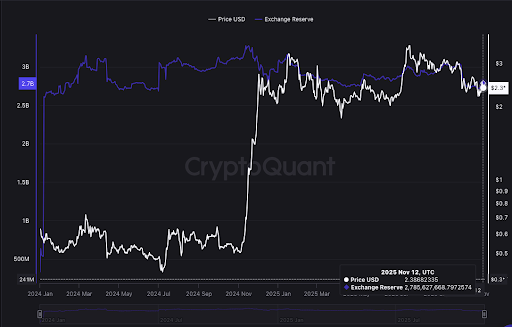
Shiba Inu
Source: Chart from CryptoQuant

While exchanges have seen billions of tokens exit recently, the last two days saw a reversal in flow direction. CryptoQuant data shows that 59.8 billion SHIB returned to exchanges on November 16, followed by another 36.7 billion at the time of writing. This brings the total inflow to over 96.5 billion, partially offsetting the 121 billion tokens removed on November 15. Such inflows typically indicate profit-taking or short-term repositioning, creating uncertainty about whether holders plan to re-enter the market or respond to further price volatility

Shiba Inu Records Year-Long Price Drop

The broader trend of shrinking exchange reserves coincides with a significant decline in SHIB’s valuation. CoinMarketCap reports that Shiba Inu is down more than 63% this year, reflecting a persistent bearish pressure. Over the past week alone, the meme coin has declined by approximately 10% and remains in negative territory, trading at around $0.000009. Notably, this downward momentum has continued to weigh on market sentiment.

Crypto analyst Jack noted that, amidst the decline in exchange reserves and rising burn rates, buyers are stepping in at every price dip to accumulate SHIB tokens. He says these developments are creating the perfect recipe for a supply shock, which could set the stage for a potential recovery.

Jack emphasized that Shiba Inu is still holding a key demand zone, with momentum indicators like the Relative Strength Index (RSI) starting to show strength. If these conditions persist and momentum kicks in, he believes that SHIB may finally break out of its current range. He points to $0.000010, $0.000011, and $0.000013 as the next resistance levels and bullish targets. 

Shiba Inu
SHIB trading at $0.0000090 on the 1D chart | Source: SHIBUSDT on Tradingview.com
Featured image from Peakpx, chart from Tradingview.com
Editorial Process for bitcoinist is centered on delivering thoroughly researched, accurate, and unbiased content. We uphold strict sourcing standards, and each page undergoes diligent review by our team of top technology experts and seasoned editors. This process ensures the integrity, relevance, and value of our content for our readers.

Scott Matherson is a leading crypto writer at Bitcoinist, who possesses a sharp analytical mind and a deep understanding of the digital currency landscape. Scott has earned a reputation for delivering thought-provoking and well-researched articles that resonate with both newcomers and seasoned crypto enthusiasts. Outside of his writing, Scott is passionate about promoting crypto literacy and often works to educate the public on the potential of blockchain.

Lecturas Relacionadas

Upbit se apresura: una contraofensiva apresurada para recuperar su participación en el mercado de stablecoins

Upbit lanzó una campaña promocional del 26 de julio al 9 de agosto, eliminando la comisión del 0.05% para transacciones con stablecoins en su mercado de won coreano, al tiempo que listaba rápidamente nuevas stablecoins como RLUSD y USDG. Estas medidas buscan recuperar participación en un mercado que ha cambiado drásticamente. Mientras Upbit dominaba con el 53.5% a inicios de 2025, para junio de 2026 su cuota había caído al 30.1%, superado por Coinone (34.8%) y Bithumb (31.1%). Este cambio se debe principalmente a la política de comisión cero permanente de Coinone para USDC, iniciada en octubre de 2025, que atrajo a usuarios sensibles a los costes. La demanda de stablecoins en Corea está fuertemente vinculada a la salida de capitales hacia intercambios y DeFi en el extranjero, mostrando una salida neta constante. La promoción de Upbit generó un aumento inicial del 162% en el volumen diario, impulsado casi en su totalidad por USDT. Sin embargo, el volumen ya mostraba signos de desaceleración en la segunda semana, y se espera que gran parte de las ganancias sean temporales una vez finalice la oferta, a menos que Upbit adopte una política de comisión cero permanente. El movimiento estratégico parece responder a un panorama regulatorio en evolución, con una futura ley coreana que regularía las stablecoins locales, y a la integración de Dunamu (matriz de Upbit) en Naver Financial, que planea un ecosistema de pagos con stablecoins. Aunque las regulaciones actuales podrían impedir que Upbit liste una eventual stablecoin de won emitida por Naver, fortalecer su posición como hub de distribución para stablecoins globales, especialmente las denominadas en dólares, se vuelve crucial de cara al futuro.

marsbitHace 6 hora(s)

Upbit se apresura: una contraofensiva apresurada para recuperar su participación en el mercado de stablecoins

marsbitHace 6 hora(s)

El Nasdaq operará 23 horas al día, ¿a quién le está quitando negocio?

La Bolsa de Nasdaq planea implementar un horario de negociación de 23 horas diarias a partir de diciembre de 2026, cubriendo el horario diurno de Asia (21:00-04:00 EST). El objetivo principal no es extender el tiempo para inversores estadounidenses, sino capturar el flujo de órdenes de Asia. Los datos muestran que en el horario nocturno actual la actividad se concentra en unos pocos ETF (como los del S&P 500) y megacap tecnológicas, utilizados principalmente para gestión de riesgo. Con esta medida, Nasdaq busca recuperar órdenes que actualmente se ejecutan en plataformas alternativas nocturnas (ATS) o sistemas internos de corredores, reforzando así la transparencia y su posición en el descubrimiento de precios. A largo plazo, pretende consolidar a EE.UU. como el centro de formación de precios globales, incluso para activos de otros países negociados a través de ETF estadounidenses. La expansión conlleva costos significativos para intermediarios y creadores de mercado, que probablemente se trasladen a los inversores mediante spreads más amplios. Además, la liquidez reducida en horario nocturno puede generar precios menos eficientes. Mientras Nasdaq compite por órdenes globales ampliando su horario, otras bolsas como la de Hong Kong enfrentan desafíos distintos, como la integración con el mercado continental, y su ventaja competitiva reside más en ofrecer acceso único a activos chinos que en extender el tiempo de negociación.

marsbitHace 6 hora(s)

El Nasdaq operará 23 horas al día, ¿a quién le está quitando negocio?

marsbitHace 6 hora(s)

Trading

Spot
活动图片