Cardano Founder Slams ‘Clickbait’ Reports He Blamed ADA Users

bitcoinistPublicado a 2025-11-05Actualizado a 2025-11-05

Resumen

Charles Hoskinson issued a rebuttal on November 3, rejecting circulating headlines that claimed he blamed Cardano’s users for the network’s...

Trusted Editorial content, reviewed by leading industry experts and seasoned editors. Ad Disclosure

Charles Hoskinson issued a rebuttal on November 3, rejecting circulating headlines that claimed he blamed Cardano’s users for the network’s decentralized finance shortfall. In a brief video, the Cardano founder said media outlets misrepresented his prior comments about participation patterns across the ecosystem, stressing that his point was a structural “mismatch” between who stakes and governs versus who takes part in DeFi—not blame.

“I never once blamed anyone from the Cardano ecosystem for the DeFi [woes],” Hoskinson said, naming The Crypto Basic as an example of outlets whose framing he called fundamentally inaccurate. “I’m sorry crypto media that you guys are […] and you just want clickbait headlines. You guys have to cut this the […] out.” He added that there is “not a single person in the Cardano ecosystem who I am blaming for our DeFi situation right now.”

Cardano’s DeFi Gap Is A Participation Mismatch

Hoskinson’s core claim is numerical and directional rather than accusatory. He argued there is a demonstrable divergence between Cardano’s high participation in staking and governance and its lower participation in DeFi protocols, which depresses total value locked. “I pointed out in a video that there is a mismatch between the people who participate in staking and governance and the people who participate in DeFi. And if there was proportionality there… our TVL would be at least five to 10 billion,” he said. He characterized the recent headlines as “materially wrong and factually wrong” because they attributed intent—“blaming users”—that he explicitly disavowed.

The founder anchored his point in a specific user count comparison. Some third-party measurements, he said, “are asserting that Cardano has only 10,000 to 50,000 actual users when there’s 1.3 million who are using staking.” For Hoskinson, that delta underscores that Cardano “has a large population, a large wallet base, and a lot of users as evidenced by the enormous level of participation in both governance and staking,” even if those participants are not currently “deploying to the other side of the aisle, to the TVL side, to the DeFi side.”

He repeatedly emphasized that diagnosing the participation gap is an ecosystem responsibility, not a morality play. “I’m not blaming them for not participating,” he said. “Never once said it’s their fault and they’re bad people and they’ve done something wrong.” Instead, he called for a frank community conversation about the drivers behind users’ choices. “It could be slippage. It could be fees. It could be user experience. It could be yields. It could be safety concerns. It could be education. There could be 150,000 different reasons for that. But we as an ecosystem have to have that discussion.”

The remedy, in his view, is a coordinated governance agenda rather than a media narrative. He urged Cardano stakeholders to treat the participation gap as a 2026 workstream and to fund targeted initiatives through delegated authority. “We as an ecosystem have to ask why that mismatch exists and how can we correct that mismatch… as a 2026 governance agenda, and get some delegated authority funding and effort to correct that,” he said. If the proportionality problem were addressed, Hoskinson argued, “that alone can get our TVL up 5 billion to 10 billion,” potentially placing Cardano “in the top ranks of TVL, the top five to top 10.”

The dispute originated, he said, when media took a narrow, data-driven observation about where Cardano users allocate capital and translated it into a blame narrative. “People say something very specific, very targeted, and then it gets misinterpreted, and then everybody judges you based upon the headlines,” he said. “I’m not going to allow the crypto media to go ahead and put words in my mouth.” He reiterated the same point multiple times for emphasis: “I did not blame the Cardano ecosystem. I did not blame the Cardano users for anything. I was very careful, guarded, and specific in the things that I said.”

Hoskinson coupled the clarification with a broader critique of crypto media practices. “If you continue to broadcast, you’re lying to people,” he said, adding, “I expect that from the crypto media because they are scum. They do lie. Everything’s sensational. Everything’s clickbait.” He framed his intervention as a corrective to prevent a headline cycle from hardening into accepted fact: “The record has been corrected.”

Beyond media criticism, the practical substance of his message focused on mobilizing existing users rather than conjuring new ones. “We have the users. We have the capital,” he said. “For some reason, those users with their capital are not participating in DeFi.” While he acknowledged having personal “suspicions” and hearing “frustrations” from ecosystem participants, he stopped short of diagnosing root causes, instead calling for an open, data-first process to “systematically chip away” at barriers that deter stakers and governance participants from crossing into DeFi activity.

Across the video, Hoskinson’s throughline never deviated: the issue is proportional participation by an already large user base. “There is a mismatch between the people participating in staking and governance—of which it’s seven figures over a million people—and the people participating in DeFi,” he said. “We have to get to the bottom of that mismatch as an ecosystem… But I’m not blaming the Cardano users for that mismatch. I’m not saying it’s their fault. I’m not saying that they did something wrong.”

At press time, ADA traded at $0.538.
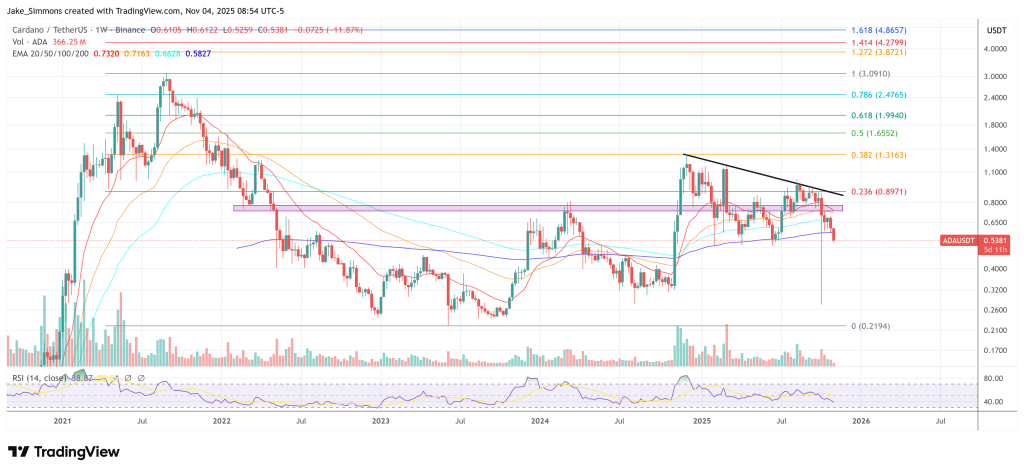
Cardano price
ADA drops below the EMA200, 1-week chart | Source: ADAUSDT on TradingView.com
Featured image created with DALL.E, chart from TradingView.com
Editorial Process for bitcoinist is centered on delivering thoroughly researched, accurate, and unbiased content. We uphold strict sourcing standards, and each page undergoes diligent review by our team of top technology experts and seasoned editors. This process ensures the integrity, relevance, and value of our content for our readers.

Jake Simmons has been a Bitcoin enthusiast since 2016. Ever since he heard about Bitcoin, he has been studying the topic every day and trying to share his knowledge with others. His goal is to contribute to Bitcoin's financial revolution, which will replace the fiat money system. Besides BTC and crypto, Jake studied Business Informatics at a university. After graduation in 2017, he has been working in the blockchain and crypto sector. You can follow Jake on Twitter at @realJakeSimmons.

Criptos en tendencia

Lecturas Relacionadas

Tras siete meses admitiendo el fracaso, Farcaster busca nuevamente quien se haga cargo

Farcaster, el protocolo de redes sociales descentralizado, busca nuevamente un equipo operativo tras solo siete meses bajo la gestión de Neynar. Rishav Mukherji, cofundador de Neynar, anunció el proceso de transición, admitiendo que no se alcanzaron los objetivos establecidos a principios de año. Aunque Neynar logró reducir costos de infraestructura en un 80%, la aplicación principal sigue siendo costosa de operar y el crecimiento del mercado es lento, una combinación que requiere una estructura organizativa y financiera diferente. Farcaster, creado por exejecutivos de Coinbase, permite a los usuarios mantener su identidad y conexiones a través de diferentes aplicaciones. Su principal cliente se asemeja a X (antes Twitter). La plataforma fue traspasada de su desarrollador original, Merkle Manufactory, a Neynar en enero, después de recaudar aproximadamente 180 millones de dólares en cinco años. El problema central sigue siendo el crecimiento en el lado del consumidor, con solo entre 200.000 y 300.000 usuarios mensuales, una cifra considerada insuficiente para la sostenibilidad. La salida de Neynar no detiene el protocolo subyacente, que sigue funcionando, pero deja en incógnita el futuro de la aplicación para usuarios, la cartera digital, la plataforma de tokens Clanker y los servicios para desarrolladores. No está claro si se transferirán como un paquete o por separado. Este es el segundo traspaso de un proyecto de redes sociales Web3 en poco tiempo, tras el de Lens a Mask Network, destacando el desafío común de operar y hacer crecer productos de consumo en este espacio. Mientras se definen los detalles, Neynar mantendrá los servicios en funcionamiento.

marsbitHace 14 min(s)

Tras siete meses admitiendo el fracaso, Farcaster busca nuevamente quien se haga cargo

marsbitHace 14 min(s)

Las acciones de Compound se disparan tras anunciar la transición al mercado institucional por 52 millones de dólares

Las acciones del protocolo de préstamo descentralizado Compound ($COMP) aumentaron más de un 10% tras anunciar una importante reorientación estratégica hacia el mercado institucional. La DAO de Compound aprobó un presupuesto récord de 52 millones de dólares, destinando una parte significativa a desarrollar Compound V4 y forjar alianzas institucionales. Este giro marca un alejamiento del enfoque en usuarios minoristas, reflejando una tendencia más amplia en DeFi. El cambio llega en un momento en que el Valor Total Bloqueado (TVL) de Compound es de unos 1.200 millones de dólares, muy por debajo de su máximo histórico de 12.000 millones. La nueva dirección, compuesta por veteranos de finanzas tradicionales como exejecutivos de Coinbase y Near Foundation, busca adaptar el protocolo a los requisitos de las instituciones financieras. Más de 10 socios ya han confirmado su participación en la nueva versión V4, que introduce un modelo de "hub-and-spoke" para una mejor gestión de riesgos. Aunque algunos expertos señalan el desafío de cumplir con los estrictos estándares institucionales, la movida de Compound se alinea con la creciente tokenización de activos reales y la entrada de capital institucional a la criptoeconomía, un mercado que Standard Chartered proyecta podría alcanzar los 2,7 billones de dólares para 2030.

cryptonews.ruHace 34 min(s)

Las acciones de Compound se disparan tras anunciar la transición al mercado institucional por 52 millones de dólares

cryptonews.ruHace 34 min(s)

Trading

Spot

Artículos destacados

Cómo comprar ADA

¡Bienvenido a HTX.com! Hemos hecho que comprar Cardano (ADA) sea simple y conveniente. Sigue nuestra guía paso a paso para iniciar tu viaje de criptos.Paso 1: crea tu cuenta HTXUtiliza tu correo electrónico o número de teléfono para registrarte y obtener una cuenta gratuita en HTX. Experimenta un proceso de registro sin complicaciones y desbloquea todas las funciones.Obtener mi cuentaPaso 2: ve a Comprar cripto y elige tu método de pagoTarjeta de crédito/débito: usa tu Visa o Mastercard para comprar Cardano (ADA) al instante.Saldo: utiliza fondos del saldo de tu cuenta HTX para tradear sin problemas.Terceros: hemos agregado métodos de pago populares como Google Pay y Apple Pay para mejorar la comodidad.P2P: tradear directamente con otros usuarios en HTX.Over-the-Counter (OTC): ofrecemos servicios personalizados y tipos de cambio competitivos para los traders.Paso 3: guarda tu Cardano (ADA)Después de comprar tu Cardano (ADA), guárdalo en tu cuenta HTX. Alternativamente, puedes enviarlo a otro lugar mediante transferencia blockchain o utilizarlo para tradear otras criptomonedas.Paso 4: tradear Cardano (ADA)Tradear fácilmente con Cardano (ADA) en HTX's mercado spot. Simplemente accede a tu cuenta, selecciona tu par de trading, ejecuta tus trades y monitorea en tiempo real. Ofrecemos una experiencia fácil de usar tanto para principiantes como para traders experimentados.

2.1k Vistas totalesPublicado en 2024.12.10Actualizado en 2026.06.02

Cómo comprar ADA

Discusiones

Bienvenido a la comunidad de HTX. Aquí puedes mantenerte informado sobre los últimos desarrollos de la plataforma y acceder a análisis profesionales del mercado. A continuación se presentan las opiniones de los usuarios sobre el precio de ADA (ADA).

活动图片