Ethereum Will Impose Gas Limit In Fusaka Upgrade

bitcoinistPublicado a 2025-10-23Actualizado a 2025-10-23

Resumen

The Ethereum Foundation has confirmed that the upcoming Fusaka hard fork will introduce a protocol-level ceiling on how much gas...

Trusted Editorial content, reviewed by leading industry experts and seasoned editors. Ad Disclosure

The Ethereum Foundation has confirmed that the upcoming Fusaka hard fork will introduce a protocol-level ceiling on how much gas a single transaction may consume, formally codified as EIP-7825. The cap is set at 2²⁴ gas—16,777,216 units—marking the first time Ethereum enforces a per-transaction limit distinct from the block gas limit. The change is already active on Holesky and Sepolia and will go live on mainnet when Fusaka activates.

In a post published October 21, Toni Wahrstätter framed the rationale in direct terms: “Starting with the upcoming Fusaka hard fork, EIP-7825 introduces a per-transaction gas limit cap of 2²⁴ (≈ 16.78 million gas).” The Foundation’s note emphasizes that while the cap bounds individual transactions, it does not alter the block gas limit; instead, it is designed to mitigate denial-of-service vectors where a single oversized call monopolizes an entire block and to improve block packing predictability as the network prepares for parallel execution.

EIP-7825 draws a clean line between transaction-level complexity and system-level throughput. Previously, exceptionally large calls could approach the full block gas target (around 45 million at times), creating timing and scheduling pathologies for builders and validators.

The new ceiling obliges workloads that would exceed 16.78 million gas to be broken into smaller, sequenced calls. The Foundation’s guidance is careful to note that “for most users, nothing changes,” since the statistical distribution of real-world transactions already sits well below the threshold; the risk surface primarily concerns batch-heavy contracts, deployment scripts, and specialized routers.

What This Means For Ethereum And Users

From a roadmap perspective, the cap is explicitly positioned as groundwork for parallel execution. The blog post connects the change to anticipated efforts such as EIP-7928 in the “Glamsterdam” era, where predictable, bounded transactions are a prerequisite for meaningful concurrency in the execution layer. By ensuring that at least several independent transactions can be packed per block—even under pathological mempool conditions—the cap reduces worst-case contention and simplifies scheduler design for builders experimenting with parallelizable execution paths.

The specification itself is spare and mechanical. EIP-7825’s abstract states the intent “to 16,777,216 (2^24) gas” per transaction, improving resilience against certain DoS vectors and making transaction processing more predictable as block limits rise. That simplicity has been part of its appeal in core-dev channels: a small, well-scoped constraint that preserves forward compatibility with more ambitious scaling work.

Debate on how to encode and communicate the ceiling has been active for months, including discussions over naming and parameterization on Ethereum Magicians and during AllCoreDevs calls. One thread summarized the core guarantee being targeted by several contributors: aligning block targets to multiples of 2²⁴ so builders can always include at least n transactions if the mempool has n eligible ones—an argument for predictability rather than raw throughput.

Operationally, the Foundation says all major clients—Geth, Erigon, Reth, Nethermind, and Besu—have implemented the change in Fusaka-ready releases, reducing cross-client divergence risk at activation. The post also stresses that eth_call semantics are unaffected and that pre-signed transactions whose gas limits exceed 2²⁴ will need to be re-signed below the cap. The upgrade path for developers is straightforward: test against Holesky or Sepolia, re-tool batch operations that flirt with the limit, and adjust gas-estimation logic and alerts so they fail fast when constructions exceed the new ceiling.

The policy context is worth parsing. Ethereum’s history has favored minimal, general-purpose constraints, deferring complexity to higher layers. EIP-7825 fits that pattern: it does not opine on what contracts should do, only that they respect an upper bound that protects liveness and prepares the execution layer for a multi-threaded future.

It also sidesteps fee-market alterations and leaves blob-space economics and block targets to other EIPs and forks. As the Foundation put it, the cap “establishes a safer and more predictable foundation for higher throughput in future forks,” a line that sums up the trade-off succinctly.

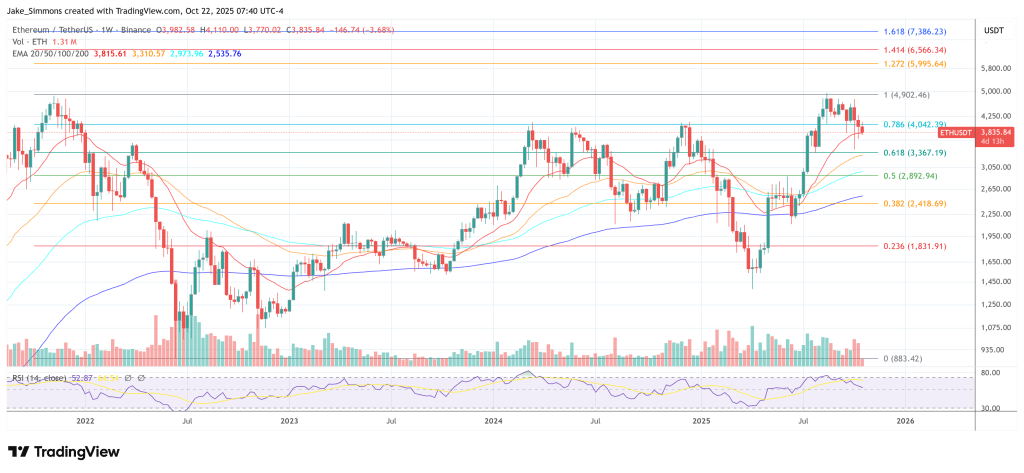
At press time, ETH traded at $3,835.
Ethereum price
ETH holds above the EMA20, 1-week chart | Source: ETHUSDT on TradingView.com
Featured image created with DALL.E, chart from TradingView.com
Editorial Process for bitcoinist is centered on delivering thoroughly researched, accurate, and unbiased content. We uphold strict sourcing standards, and each page undergoes diligent review by our team of top technology experts and seasoned editors. This process ensures the integrity, relevance, and value of our content for our readers.

Jake Simmons has been a Bitcoin enthusiast since 2016. Ever since he heard about Bitcoin, he has been studying the topic every day and trying to share his knowledge with others. His goal is to contribute to Bitcoin's financial revolution, which will replace the fiat money system. Besides BTC and crypto, Jake studied Business Informatics at a university. After graduation in 2017, he has been working in the blockchain and crypto sector. You can follow Jake on Twitter at @realJakeSimmons.

Lecturas Relacionadas

Confirmado, GPT-5.5 sorprendido «desatontándose», la documentación oficial de OpenAI lo reconoce

**Resumen:** Un artículo revela que OpenAI estaría sustituyendo silenciosamente los modelos GPT-5.5 de alta capacidad por versiones inferiores (como mini o instantáneas) en sus servicios ChatGPT y Codex, una vez que los usuarios agotan ciertos límites de uso o bajo alta carga del servidor. Esta degradación, que no se refleja en la interfaz de usuario, ha sido confirmada por documentación oficial de OpenAI y evidenciada por usuarios mediante comandos de trazado. Los usuarios de planes Plus y Pro han reportado una caída abrupta en la calidad de las respuestas, tiempos de procesamiento más largos y un incumplimiento de las instrucciones, a pesar de que la interfaz sigue mostrando etiquetas como "Extended Thinking" o "GPT-5.5". La documentación de OpenAI indica que, tras 160 mensajes cada 3 horas, el sistema cambia automáticamente a un modelo mini sin notificar al usuario. Casos similares de "silent downgrade" se registraron en versiones anteriores como GPT-5.3 y GPT-5.4. Aunque OpenAI ha marcado estos incidentes como "resueltos" en su página de estado, las quejas de los usuarios persisten. El artículo sugiere que estas prácticas podrían ser una medida para reducir costos de cómputo. La polémica surge mientras OpenAI ya estaría probando internamente el próximo modelo, GPT-5.6, lo que destaca la tensión entre el rápido lanzamiento de nuevas versiones y la estabilidad de la experiencia del usuario con los modelos actuales.

marsbitHace 37 min(s)

Confirmado, GPT-5.5 sorprendido «desatontándose», la documentación oficial de OpenAI lo reconoce

marsbitHace 37 min(s)

La inclusión de la empresa DAT en el índice Russell tampoco puede salvar a Ethereum

La firma FTSE Russell ha incluido varias acciones relacionadas con criptomonedas, como BitMine y Galaxy Digital, en la lista preliminar del índice Russell 3000 para 2026. Esto significa que miles de millones en fondos pasivos deberán invertir en estas compañías, lo que probablemente impulse sus precios de acciones. Sin embargo, este flujo de capital no necesariamente beneficia a las criptomonedas subyacentes, como Ethereum (ETH). David Hoffman, cofundador de Bankless, ha vendido todas sus tenencias de ETH, argumentando que, aunque la red de Ethereum es exitosa, su token nativo no captura la mayor parte del valor generado, ya que este se queda en las aplicaciones y capas secundarias (L2). A pesar de que empresas como BitMine han adquirido millones de ETH, su precio ha caído cerca de un 60% desde su máximo histórico, mostrando la desconexión entre el desempeño de las acciones de las compañías de criptoactivos (DAT) y el valor de los tokens mismos. La inclusión en el índice Russell es un paso importante hacia la integración financiera tradicional, pero no resuelve el desafío fundamental de valoración para criptomonedas como Ethereum o Solana. La narrativa de "ETH como dinero" está cediendo ante la visión de "ETH como infraestructura pública", lo que requiere nuevas ideas para sostener y aumentar el valor de estos activos digitales a largo plazo.

marsbitHace 38 min(s)

La inclusión de la empresa DAT en el índice Russell tampoco puede salvar a Ethereum

marsbitHace 38 min(s)

Trading

Spot
Futuros

Artículos destacados

Cómo comprar GAS

¡Bienvenido a HTX.com! Hemos hecho que comprar GAS (GAS) sea simple y conveniente. Sigue nuestra guía paso a paso para iniciar tu viaje de criptos.Paso 1: crea tu cuenta HTXUtiliza tu correo electrónico o número de teléfono para registrarte y obtener una cuenta gratuita en HTX. Experimenta un proceso de registro sin complicaciones y desbloquea todas las funciones.Obtener mi cuentaPaso 2: ve a Comprar cripto y elige tu método de pagoTarjeta de crédito/débito: usa tu Visa o Mastercard para comprar GAS (GAS) al instante.Saldo: utiliza fondos del saldo de tu cuenta HTX para tradear sin problemas.Terceros: hemos agregado métodos de pago populares como Google Pay y Apple Pay para mejorar la comodidad.P2P: tradear directamente con otros usuarios en HTX.Over-the-Counter (OTC): ofrecemos servicios personalizados y tipos de cambio competitivos para los traders.Paso 3: guarda tu GAS (GAS)Después de comprar tu GAS (GAS), guárdalo en tu cuenta HTX. Alternativamente, puedes enviarlo a otro lugar mediante transferencia blockchain o utilizarlo para tradear otras criptomonedas.Paso 4: tradear GAS (GAS)Tradear fácilmente con GAS (GAS) en HTX's mercado spot. Simplemente accede a tu cuenta, selecciona tu par de trading, ejecuta tus trades y monitorea en tiempo real. Ofrecemos una experiencia fácil de usar tanto para principiantes como para traders experimentados.

279 Vistas totalesPublicado en 2024.12.12Actualizado en 2025.03.21

Cómo comprar GAS

Discusiones

Bienvenido a la comunidad de HTX. Aquí puedes mantenerte informado sobre los últimos desarrollos de la plataforma y acceder a análisis profesionales del mercado. A continuación se presentan las opiniones de los usuarios sobre el precio de GAS (GAS).

活动图片