Ethereum Gas Fees Falls To Record Low, Price Consolidates Around $1,000

newsbtcPublicado a 2022-07-05Actualizado a 2022-07-05

Resumen

After reaching a level last seen in November 2020, the average Ethereum gas fee is now below $1. Ethereum Gas Fees Falls The Ethereum network experienced transaction fees as low...

After reaching a level last seen in November 2020, the average Ethereum gas fee is now below $1.

Ethereum Gas Fees Falls

The Ethereum network experienced transaction fees as low as 69 cents on Saturday, which has not happened in the previous 19 months. The following day, gas prices reached $1.57 or 0.0015 ETH, which is equivalent to December 2020’s numbers. Transaction costs on the network today ranged from 20 cents to merely 20 cents, with 20 cents being the highest.

Gas prices in the Ethereum ecosystem ranged from $0.01 to $0.10 from July 2016 to May 2017. Users are now assessed a substantial cost; in May 2021, average transaction fees reached $69 per transaction. The highest gas price ever observed was $196.683 in May 2022.

Notably, the Ethereum blockchain has struggled to become widely used, much to the chagrin of users, due to the high cost of gas or network fees, payments necessary to complete a transaction on a blockchain. NFT holders are seen profiting from the decline as the numbers dwindle.
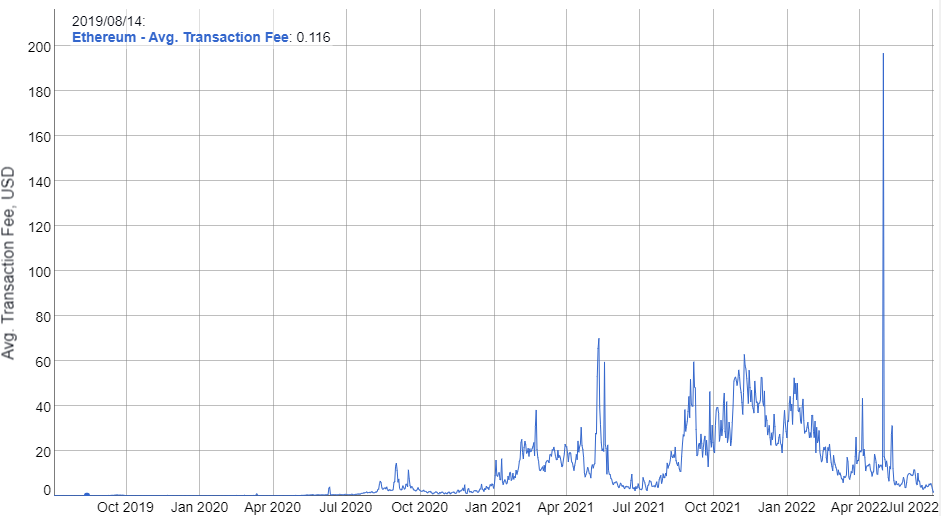
Source: Bitinfo charts

DappRadar reports that 50,466 people have traded their assets in OpenSea, up 10.14 percent from the previous day. At the time of writing, the largest NFT market’s trading volume increased by 34.18 percent to $15.92 million.

All of the top 20 collections, led by Ethereum Name Service, DopeApeClub, God Hates NFTees, Bored Ape Yacht Club (BAYC), and Mutant Ape Yacht Club (MAYC), were transacted within Ethereum, according to data from DappRadar.

Price Slumps Further

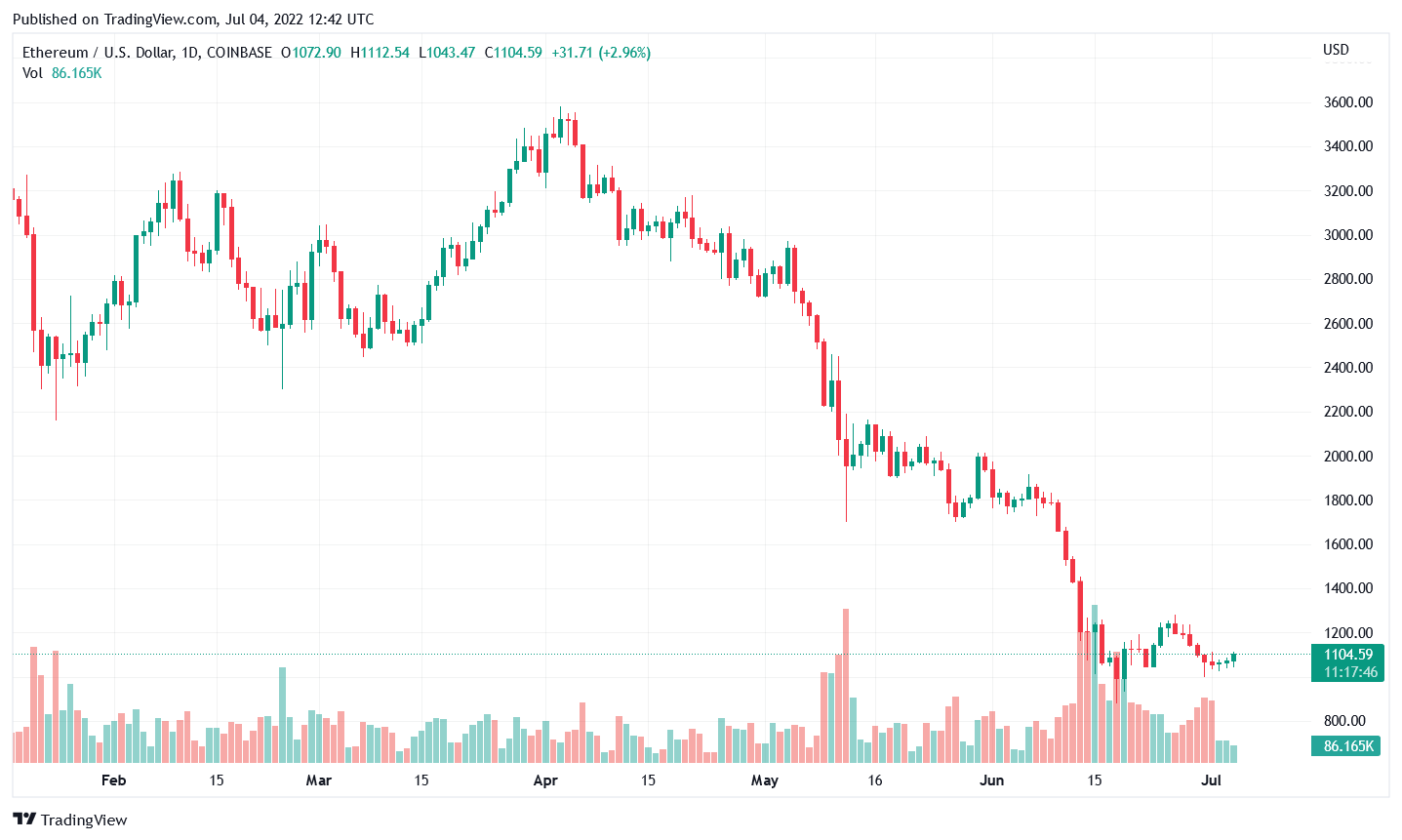
The analysis of the price of ethereum is bearish due to consolidation near $1,050 and rejection of further recovery. As a result, ETH/USD is prepared to decline even further and surpass the $1,000 local support. After that is finished, the prior swing low at $900 should be challenged the following week.

The decline approached the $1040–$1000 area that serves as a close support and was accompanied by a sharp increase in demand pressure. The numerous smaller price rejection candles at this point represent attempts by sellers to break through this support that were unsuccessful.

Therefore, the renewed positive momentum could encourage buyers to again attack the overhead barrier of $1260, providing ETH holders with a chance for a recovery.
Ethereum

ETH/USD consolidates above $1k. Source: TradingView

At the start of the week, a significant new swing bottom was established in the price movement of ethereum. After falling by more than 21%, the price of ETH/USD hit a new low at $1,000.

From then, a swift upward reaction continued to the $1,115 level, where Friday’s rejection of further recovery was observed. Following sideways consolidation, lower local highs and lows were set.

Since then, the $1,050 level has functioned as the main trading range, with this morning’s denial of further gains. As a result, ETH/USD is prepared to drop even more and try to surpass the current low of $1,000.

If the traders continue to be persuaded by the sellers to break through the bottom support, the next decline could drive the price of ETH down by 12.56% to $880.


Lecturas Relacionadas

Desglose de Estrategias de Trading de Bitcoin: Predicciones de Celebridades y Modelos Clásicos Fallan, Solo Quedan Estos Cuatro Indicadores

Resumen de la estrategia de trading de Bitcoin: Tras analizar todos los métodos de predicción desde 2017 hasta 2025, se descartaron pronósticos de celebridades, modelos clásicos como Stock-to-Flow e indicadores de sentimiento aislados (ej. Fear & Greed), por ser inexactos o estar desactualizados. El sistema final se basa en solo cuatro indicadores confiables: 1. **MVRV Z-Score**: Identifica fondos (zona verde) con precisión histórica, aunque perdió eficacia para techos tras los ETF. 2. **SOPR (28-day MA)**: Señala capitulación de holders (valor <1.0), crucial para fondos. 3. **Flujos netos de ETF**: Refleja la demanda institucional post-2024, invisible en datos on-chain. 4. **Liquidez macro (Fed y M2)**: Define la dirección general del mercado. La estrategia actúa solo con **resonancia de 3+ señales**: - **Fondo**: MVRV en verde + SOPR <1.0 + miedo extremo (Fear & Greed <20). - **Techo**: Sobrecalentamiento on-chain + flujos de ETF negativos. - La liquidez establece el contexto macro. Actualmente (15/04/2026), hay triple señal de fondo: Fear & Greed en 12 (pánico extremo), MVRV en zona verde y SOPR <1.0. Históricamente, esto precedió ganancias >100% en 12 meses (2018, 2020, 2022). La única señal en contra son los flujos de ETF, aún débiles. Conclusión: El marco evita predicciones subjetivas, focusing en datos objetivos y resonancia de señales para decisiones de alta probabilidad.

marsbitHace 2 hora(s)

Desglose de Estrategias de Trading de Bitcoin: Predicciones de Celebridades y Modelos Clásicos Fallan, Solo Quedan Estos Cuatro Indicadores

marsbitHace 2 hora(s)

El fundador de Netflix fue al lugar que más teme

El cofundador de Netflix, Reed Hastings, anuncia su salida total de la empresa tras casi 30 años, justo cuando la compañía reporta su mejor desempeño financiero: ingresos de $12.25 mil millones en Q1 2026 (+16%) y ganancias netas de $5.28 mil millones (+83%). Aunque Netflix afirma que su decisión no implica desacuerdos, Hastings ya se había unido en 2025 a la junta directiva de Anthropic, empresa de IA, y ha expresado abiertamente que la inteligencia artificial es la mayor amenaza para Netflix. Hastings, quien estudió IA en Stanford hace 40 años, inicialmente veía la IA como una herramienta creativa, pero su postura cambió radicalmente. En 2025 donó $50 millones para investigar el impacto de la IA en la sociedad y advirtió: "Lucharemos por la supervivencia y prosperidad humana". Su preocupación central es que la IA generative, como el modelo Seedance 2.0 de ByteDance, pueda reducir drásticamente el costo y la barrera de entrada para la creación de contenido, haciendo que contenido gratuito en plataformas como YouTube sea tan atractivo que desafíe el modelo de suscripción de Netflix. Aunque Netflix está adoptando IA para optimizar producciones (como la reciente compra de InterPositive por $600 millones), Hastings parece estar "protegiéndose": mantiene sus acciones de Netflix mientras se integra en el epicentro de la tecnología que podría disruptirla. Su salida coincide con el momento cumbre de Netflix, pero también con la aceleración imparable de la IA generative. El veredicto final sobre si su temor era profético o excesivo, dependerá de cuándo la IA logre producir contenido que realmente captive al público masivo.

marsbitHace 2 hora(s)

El fundador de Netflix fue al lugar que más teme

marsbitHace 2 hora(s)

Trading

Spot
Futuros
活动图片