Stablecoins have gone from niche payment rails to the backbone of crypto activity in 2025. Their market cap hit $204B by the end of 2024, up 64% year-over-year.
This boom was fueled by the Trump administration’s decision to drop a federal CBDC and back stablecoins as its private-sector ‘digital dollar,’ led by ‘Crypto Czar’ David Sacks.
And the impact is clear in how we use wallets. Visa Onchain data shows $37.5T in stablecoin transactions over the last year, with more than half tied to small-value, real-world transfers.
Wallets are no longer just storage – they’re becoming execution hubs with tools like D’CENT turning self-custody into active decision-making.
Stablecoins Surge to $266B in 2025
Stablecoins have cemented their position as crypto’s most dominant sector. Their market cap has surged to $266.59B, up sharply from $202B at the end of 2024 – a pace of growth that dwarfs the broader crypto market.
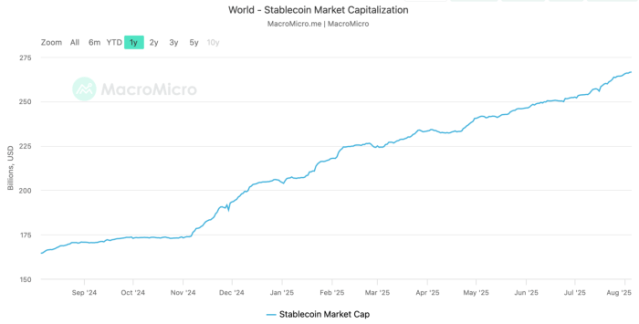
This surge is powered by a mix of policy and utility: the Trump administration’s decision to halt a federal CBDC with the Anti-CBDC Surveillance State Act, in favor of a market-driven stablecoin approach.
‘Crypto Czar’ David Sacks, who steered the strategy, has injected new momentum in stablecoins.
Monthly on-chain stablecoin volume set a new record last month, surpassing $1.5T for the first time, driven by real-world use cases like payments, remittances, and on-chain trading.
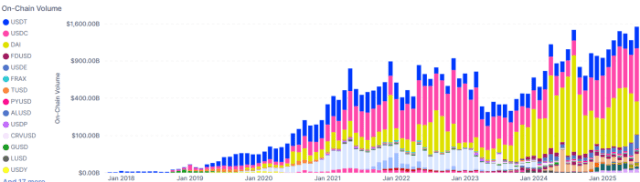
Far from being a speculative side market, stablecoins are now the backbone of crypto’s day-to-day economy. And they’re only gaining speed.
Wallets Shift From Storage to Action
The rise of stablecoins isn’t just swelling transaction volumes – it’s transforming how crypto wallets are used. Once little more than digital vaults, wallets are now active interfaces for everyday crypto activity.
More than 100M+ wallets now hold stablecoins, and around 22M+ monthly users are engaging directly with on-chain actions like swapping, bridging, and staking.
Visa Onchain data backs this up.
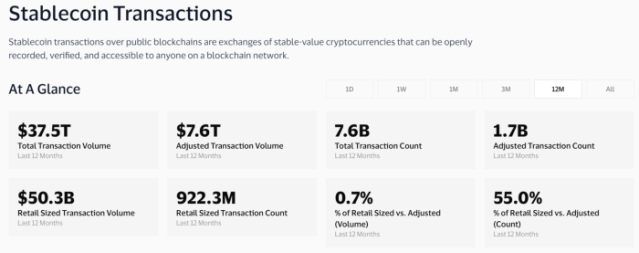
Out of $37.5T in stablecoin transactions last year, 55% were small-value transfers (retail-sized), showing wallets are becoming tools for real, day-to-day usage.
This evolution is changing what users expect from secure crypto wallets.
Security is no longer enough. Execution and usability now matter most. And this is exactly where D’CENT is stepping in, redefining what a hardware wallet can do.
D’CENT – From Storage Device to Decision Engine
Most hardware wallets still treat security as the endgame. D’CENT flips that model on its head, turning the wallet into a platform where every decision starts.
Instead of just holding assets, D’CENT’s interface guides users through real on-chain actions (from swaps to staking), complete with step-by-step prompts and even rewards for repeated engagement.
Its redesigned portfolio screen doesn’t just show balances. It delivers real-time valuations, allocation breakdowns, and trend signals, helping you see how your assets are performing at a glance.
Add to that on-chain insights that track transaction flow across multiple networks, plus instant alerts when tokens hit key ‘Trend 7’ zones, and you get a hardware wallet built for active investors, not passive holders.

D’CENT pairs this functionality with unmatched security. As the world’s first biometrically secured hardware wallet, it combines cold storage with fingerprint authentication, ensuring only you can access your assets.
Supporting 84 mainnets and over 4.6K cryptocurrencies, D’CENT integrates seamlessly with leading networks like Bitcoin, Ethereum, Polygon, and XRPL while offering in-wallet staking for select assets.
Its companion mobile app, dApp browser, and real-time market data from CoinMarketCap and CoinGecko make portfolio management simple.
Whether you’re switching from a Ledger or buying your first hardware wallet, D’CENT delivers convenience, security, and control – all in one device.
Why Stablecoins Demand Smarter Wallets, Not Just Safer Ones
Stablecoins have grown into crypto’s most reliable workhorse, moving more than $1.5T on-chain in a single month and fueling an entirely new standard for wallets. This isn’t just about where you store digital assets anymore. It’s about how easily you can access them.
That’s why wallets like D’CENT stand out. Pairing biometric security with real-time actionable insights, it reflects where self-custody is headed: from passive storage to active control.
In a market moving this fast, the best wallet is the one that moves with it. D’Cent is bridging the divide, merging the intelligence of mobile wallets with the security of a cold wallet.
As always, please do your own research (DYOR). This is not financial advice. Research your options and only use tools you know you can trust with your assets.

Related Posts