Cardano Founder Hails ‘Most Advanced Stablecoin Ever Built’

bitcoinistPublicado a 2025-08-01Actualizado a 2025-08-01

Resumen

Cardano founder Charles Hoskinson has intensified the ecosystem’s push into regulated, privacy-preserving digital dollars, declaring on July 31 that “Moneta’s...

Trusted Editorial content, reviewed by leading industry experts and seasoned editors. Ad Disclosure

Cardano founder Charles Hoskinson has intensified the ecosystem’s push into regulated, privacy-preserving digital dollars, declaring on July 31 that “Moneta’s USDM is becoming the most advanced stablecoin ever built.” The remark, posted on X, came in the wake of a multi-day workshop in Buenos Aires that he said was “making progress on the first Private Stablecoin.”

Hoskinson’s endorsement dovetailed with a dense technical thread from Cardano developer Andrew Westberg that sketched how a privacy-enabled dollar could satisfy enterprise and legal requirements without turning public ledgers into open books. “The stablecoin is a small but important piece of the discussion in Argentina. That being said, the complexity is 10x to 20x that of USDM,” he wrote.

Why Cardano’s USDM Is A Next-Gen Stablecoin

Westberg walked the community through a role-based access model that would let a payroll recipient see only their own payment, an accountant see amounts without personal details, a CFO view the whole, and a court-ordered investigator gain full transparency during discovery. “Really cool tech, but it is a cambrian explosion of complexity to build out something where blockchain can truly eclipse and replace tradfi systems for the first time,” Westberg said.

Those comments follow months of public positioning by Input Output Global’s partner-chain Midnight, a zero-knowledge (“rational privacy”) network designed to let developers program selective disclosure and meet regulatory obligations while shielding counterparties and amounts. Midnight describes its approach as “programmable data protection” for enterprise-grade applications, with smart contracts written in a TypeScript-based language called Compact.

What Hoskinson hailed and what Westberg described are two closely related tracks. On Cardano’s base layer, Moneta Digital LLC issues USDM as a fiat-backed, regulated stablecoin. Moneta identifies itself as a US Money Services Business regulated at the federal level by FinCEN and relevant state authorities, and says reserves are held in bank deposits and money market funds managed by Fidelity and Western Asset Management.

Moneta also opened retail minting with a $1,000 minimum, a stated $0 minting fee, and availability in 19 US states, reflecting the incremental nature of state licensing. As of press time, DeFiLlama shows roughly $12 million USDM in circulation on Cardano.

In parallel, a privacy-preserving instrument is being built for Midnight. An X account branded “ShieldUSD” describes itself as a “fiat-backed privacy stablecoin on @MidnightNtwrk … issued by Moneta Digital LLC @USDMOfficial [and] built by @W3iSoftware,” the development studio where Westberg serves as CTO. While branding and final product details remain in flux, the direction is clear: a fiat-backed dollar with granular permissions that lives natively on a privacy chain and interoperates with public ledgers.

The core design debate—sparked by Westberg’s thread and community replies—turns on whether such complexity is overkill relative to today’s public stablecoins or the prerequisite for real-world finance to migrate on-chain. One respondent argued that USDC would be a “better fit” and that use cases for privacy coins without “government level integrations” are limited. Westberg countered bluntly: “Usdc is not capable of any of the above requirements. Everything it does is public.” He pointed to use cases beyond enterprise payroll—such as paying a public utility where the payer’s identity remains private while the public dataset is anonymized, or compliant remittances that disclose to a verifier only that the receiver is not in a sanctioned country.

Crucially, the privacy layer appears scoped to Midnight. Westberg and subsequent coverage have noted that once assets move off Midnight to public chains, users “lose the privacy,” even if the instrument remains interoperable with other stablecoins for liquidity or settlement. That trade-off—private by default where needed, public when bridged—tracks with Midnight’s own “selective disclosure” model and may reassure regulators that investigatory access can be granted “with a court order,” as Westberg’s payroll example emphasized.

Hoskinson’s choice of Buenos Aires as a backdrop is not incidental. Argentina has been a recurring stage for Cardano’s governance and adoption rhetoric, and for Hoskinson’s advocacy of “private money” that mimics the transactional privacy of cash while remaining auditable under law. The Buenos Aires workshop, framed by him as a milestone on the path to a “first Private Stablecoin,” underscores a push to marry compliance and confidentiality in a jurisdiction where inflation and dollarization have made stablecoins part of everyday economic life.

For Moneta and Cardano, the near-term milestones are prosaic but vital: expanding licensed jurisdictions, growing USDM’s fiat reserves and on-chain supply, integrating with Cardano DeFi venues, and, if the Midnight instrument launches as envisioned, proving that programmable privacy can slot into familiar workflows—payroll, bill payment, remittances—without recreating shadow banking on a blockchain. The longer-term test is market acceptance. USDM’s circulating supply—still modest relative to incumbents—will need to scale, and the privacy variant will need to demonstrate that role-based visibility and regulator-friendly access controls can survive contact with real compliance departments.

For now, the public signal from Cardano’s founder is unequivocal. “Moneta’s USDM is becoming the most advanced stablecoin ever built,” he wrote. The rest of the ecosystem—developers, enterprises, regulators, and users—will determine whether the architecture emerging on Midnight and Cardano can earn that superlative in production rather than in principle.

At press time, Cardano (ADA) traded at $0.72.
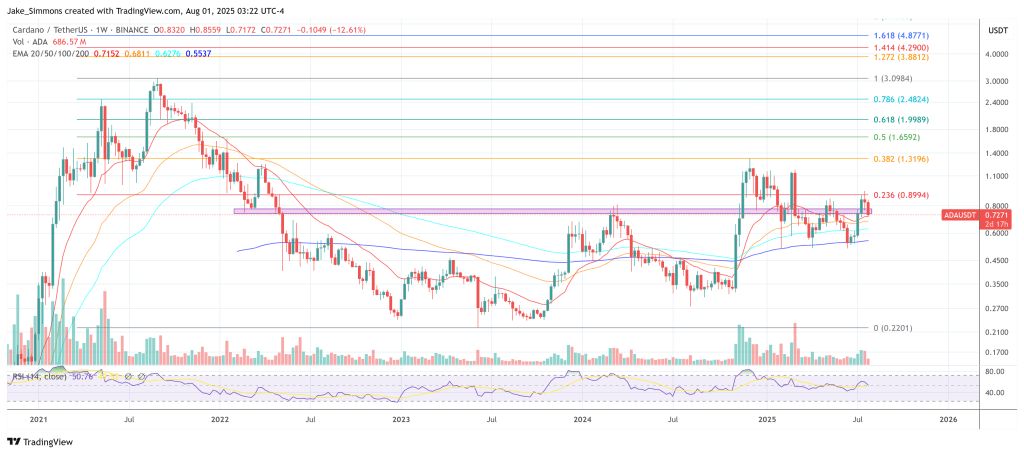
Cardano price
Cardano dips below key support, 1-week chart | Source: ADAUSDT on TradingView.com
Featured image created with DALL.E, chart from TradingView.com
Editorial Process for bitcoinist is centered on delivering thoroughly researched, accurate, and unbiased content. We uphold strict sourcing standards, and each page undergoes diligent review by our team of top technology experts and seasoned editors. This process ensures the integrity, relevance, and value of our content for our readers.

Jake Simmons has been a Bitcoin enthusiast since 2016. Ever since he heard about Bitcoin, he has been studying the topic every day and trying to share his knowledge with others. His goal is to contribute to Bitcoin's financial revolution, which will replace the fiat money system. Besides BTC and crypto, Jake studied Business Informatics at a university. After graduation in 2017, he has been working in the blockchain and crypto sector. You can follow Jake on Twitter at @realJakeSimmons.

Criptos en tendencia

Lecturas Relacionadas

Las stablecoins son los 'realistas' del mundo cripto: Open USD hace que el viejo sistema monetario entre en juego personalmente

El artículo analiza el lanzamiento de Open USD, una nueva stablecoin respaldada por un consorcio de más de 140 instituciones tradicionales (Visa, Mastercard, Google, BlackRock, etc.). El autor, Hu Yilin, argumenta que las stablecoins como Open USD no representan una revolución monetaria real, sino una "reforma leal" al sistema actual. Aunque aprovechan la eficiencia de blockchain, refuerzan el papel central del dólar y la Reserva Federal, en lugar de desafiarlo. Compara este enfoque con el sistema de Tycho Brahe en astronomía, que adoptó nuevas técnicas pero mantuvo la Tierra en el centro. La llegada de Open USD, impulsada por actores tradicionales, cuestiona el papel de los proyectos nativos de criptomonedas. Si su objetivo es solo mejorar la eficiencia del sistema existente, se arriesgan a ser absorbidos por él. El autor sostiene que la verdadera revolución criptográfica, encarnada por Bitcoin, requiere desafiar la idea de que se necesita un banco central como núcleo del orden monetario. Para los proyectos que aspiran a un cambio fundamental, depender solo de las tarifas de transacción (como "vender combustible") es insuficiente; deben mantener un núcleo "disruptivo", ya sea la soberanía monetaria, la descentralización o la resistencia a la censura. En resumen, las stablecoins pueden ser un puente útil, pero no el destino final de la revolución criptográfica.

marsbitHace 22 min(s)

Las stablecoins son los 'realistas' del mundo cripto: Open USD hace que el viejo sistema monetario entre en juego personalmente

marsbitHace 22 min(s)

Standard Chartered se hace cargo del acceso a USDC, Circle cede control a cambio de escala

El 2 de julio, Standard Chartered y Circle anunciaron una asociación que permitirá a clientes institucionales crear o canjear USDC directamente a través de las cuentas bancarias de Standard Chartered, sin necesidad de una cuenta separada en Circle. Este servicio se lanzará inicialmente en el Centro Financiero Internacional de Dubái (DIFC). Como primer Banco de Importancia Sistémica Global (G-SIB) en ofrecer este acceso "integrado" a USDC, Standard Chartered actúa como un puente de confianza para grandes capitales institucionales, como fondos de pensiones o soberanos, que anteriormente podían verse disuadidos por barreras de cumplimiento normativo. Para Circle, este acuerdo representa un intercambio estratégico: cede cierta relación directa con el cliente a cambio de acceder a la amplia red de distribución institucional del banco, con el objetivo de impulsar la escala y circulación de USDC, base de su modelo de negocio. Este movimiento señala un cambio significativo en la narrativa de las stablecoins. En lugar de eludir el sistema financiero tradicional, se integran en él, con un banco global proporcionando la infraestructura de acceso y cumplimiento. La elección de DIFC como punto de lanzamiento refleja una estrategia para probar el modelo en un entorno regulatorio favorable antes de posibles expansiones. El acuerdo redefine las relaciones en el sector, trasladando la cuestión central de la legitimidad a la de quién controlará la relación con el cliente y la tarificación en esta nueva configuración.

marsbitHace 3 hora(s)

Standard Chartered se hace cargo del acceso a USDC, Circle cede control a cambio de escala

marsbitHace 3 hora(s)

Trading

Spot

Artículos destacados

Cómo comprar ADA

¡Bienvenido a HTX.com! Hemos hecho que comprar Cardano (ADA) sea simple y conveniente. Sigue nuestra guía paso a paso para iniciar tu viaje de criptos.Paso 1: crea tu cuenta HTXUtiliza tu correo electrónico o número de teléfono para registrarte y obtener una cuenta gratuita en HTX. Experimenta un proceso de registro sin complicaciones y desbloquea todas las funciones.Obtener mi cuentaPaso 2: ve a Comprar cripto y elige tu método de pagoTarjeta de crédito/débito: usa tu Visa o Mastercard para comprar Cardano (ADA) al instante.Saldo: utiliza fondos del saldo de tu cuenta HTX para tradear sin problemas.Terceros: hemos agregado métodos de pago populares como Google Pay y Apple Pay para mejorar la comodidad.P2P: tradear directamente con otros usuarios en HTX.Over-the-Counter (OTC): ofrecemos servicios personalizados y tipos de cambio competitivos para los traders.Paso 3: guarda tu Cardano (ADA)Después de comprar tu Cardano (ADA), guárdalo en tu cuenta HTX. Alternativamente, puedes enviarlo a otro lugar mediante transferencia blockchain o utilizarlo para tradear otras criptomonedas.Paso 4: tradear Cardano (ADA)Tradear fácilmente con Cardano (ADA) en HTX's mercado spot. Simplemente accede a tu cuenta, selecciona tu par de trading, ejecuta tus trades y monitorea en tiempo real. Ofrecemos una experiencia fácil de usar tanto para principiantes como para traders experimentados.

1.9k Vistas totalesPublicado en 2024.12.10Actualizado en 2026.06.02

Cómo comprar ADA

Discusiones

Bienvenido a la comunidad de HTX. Aquí puedes mantenerte informado sobre los últimos desarrollos de la plataforma y acceder a análisis profesionales del mercado. A continuación se presentan las opiniones de los usuarios sobre el precio de ADA (ADA).

活动图片