Battle For Freedom: Tornado Cash Founder Seeks $1.5M In Donations Ahead Of Trial

bitcoinistPublicado a 2025-07-15Actualizado a 2025-07-15

Resumen

Tornado Cash co-founder Roman Storm has called the crypto community and privacy advocates to help him raise an additional $1...

Trusted Editorial content, reviewed by leading industry experts and seasoned editors. Ad Disclosure

Tornado Cash co-founder Roman Storm has called the crypto community and privacy advocates to help him raise an additional $1 million in the coming weeks to continue his legal defense and the battle for privacy tools.

Tornado Cash Founder Faces Fundraising Shortfall

The co-founder of crypto mixer Tornado Cash, Roman Storm, has updated his fundraising target and is pushing to raise over $1 million to continue funding his legal battle. Over the weekend, Storm revealed that his team is facing a “critical shortfall” ahead of the start of his July trial.

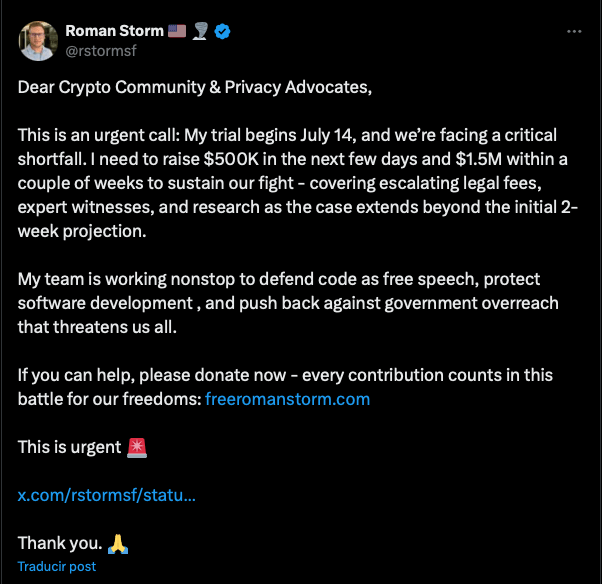
The Tornado Cash co-founder explained that he needs to raise $500,000 in the next few days and $1.5 million within a couple of weeks to cover escalating legal fees, expert witnesses, and research.
tornado cash

Tornado Cash co-founder calls for the community's help. Source: Roman Storm on X

He detailed that his planned 2-week trial, scheduled to begin on July 14, is now expected to last 3-4 weeks due to “complex legal arguments and unforeseen witnesses and evidence.” As a result, expenses for expert testimonies, thorough research, and his legal team have significantly increased.

My team is working nonstop to defend code as free speech, protect software development, and push back against government overreach that threatens us all. If you can help, please donate now – every contribution counts in this battle for our freedoms.

For context, the US Department of the Treasury’s Office of Foreign Assets Control (OFAC) sanctioned Tornado Cash in August 2022 for “failing to impose effective controls” to prevent malicious actors from laundering funds through the protocol, including $455 million by North Korea’s Lazarus Group.

Storm and the crypto mixer’s developer, Alexey Pertsev, were detained after the sanctions. Pertsev was sentenced to 5 years in the Netherlands after being found guilty of money laundering by the s-Hertogenbosch Court of Appeal in May 2024, and is currently working on his appeal.

Meanwhile, Storm was detained in Washington in August 2023 and faces three charges, including conspiracy to commit money laundering, conspiracy to commit sanctions violations, and conspiracy to operate an unlicensed money-transmitting business.

Storm pleaded not guilty to all charges and was freed on a $2 million bond. However, if convicted, he could face up to 45 years in prison. His trial, initially scheduled for December 2024, has been delayed twice.

Crypto Community Aids Storm’s Legal Defense

On Monday, Julian Zawistowski of the Golem Foundation shared that they had donated 50 ETH, worth around $150,000, stating that they’ve “always walked the walk when it comes to important causes. (…) Time for others in our industry to step up too.”

Meanwhile, developer and contributor to Meta Cartel DAO Bill Warren affirmed that the organization had donated all the funds in its treasury to support Storm’s case. Warren also urged privacy and decentralization advocates to contribute to the Tornado Cash co-founder’s legal defense.

Earlier this year, crypto investment firm Paradigm donated over one million dollars to aid the Tornado Cash co-founder’s legal battle. The firm’s co-founder, Matt Huang, revealed that Paradigm was giving $1.25 million to help fund Storm’s legal defense.

Notably, the DeFi Education Fund sent a letter signed by multiple industry leaders to AI and Crypto Czar David Sacks, urging the White House to end the Department of Justice’s war on open-source developers.

The April letter affirmed that trying to hold software developers criminally liable for how third parties use their code will set a terrible precedent and “freeze” technological innovation in the US, which would oppose Trump’s promise to make America “the crypto capital of the planet.”

It also highlighted that the Southern District of New York (SDNY) is continuing its prosecution of Storm with charges related to money transmitting and other liabilities that could punish the Tornado Cash co-founder for the conduct of unrelated bad actors.

As of this writing, Storm has raised $2.12 million, 61% of the $3.5 million goal for his legal defense fund.
tornado Cash, Ethereum, eth, ethusdt

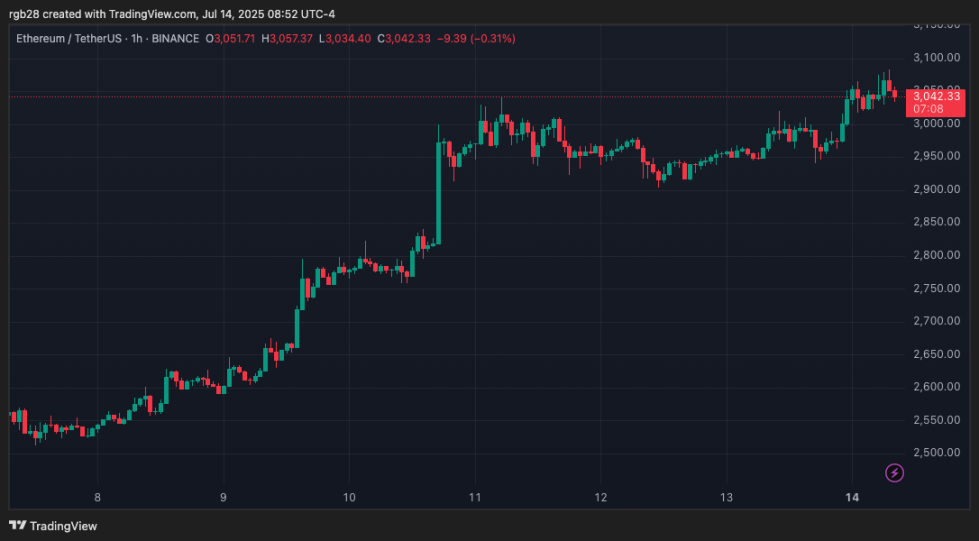
Ethereum (ETH) trades at $3,042 in the one-week chart. Source: ETHUSDT on TradingView
Featured Image from Unsplash.com, Chart from TradingView.com
Editorial Process for bitcoinist is centered on delivering thoroughly researched, accurate, and unbiased content. We uphold strict sourcing standards, and each page undergoes diligent review by our team of top technology experts and seasoned editors. This process ensures the integrity, relevance, and value of our content for our readers.

Rubmar is a crypto enthusiast who likes learning and improving constantly. She enjoys reporting on the latest news and developments in the crypto industry. Rubmar also enjoys scrapbooking, crafting, simulation games, and watching football.

Lecturas Relacionadas

La 'mayor evolución' de Bitcoin está más allá del protocolo: Michael Saylor

En una reciente aparición en X, Michael Saylor de MicroStrategy destacó la evolución más significativa de Bitcoin en la próxima década. Sostiene que este cambio no provendrá de modificaciones frecuentes en su protocolo, sino del fuerte crecimiento del ecosistema financiero que lo rodea. Para Saylor, la resistencia de Bitcoin al cambio es una fortaleza clave. Afirma que, si bien los eventos de "halving" seguirán reduciendo la oferta, el principal motor de su precio y trayectoria serán los flujos de capital institucional. El futuro crecimiento dependerá de la adopción por parte de ETFs de spot, tesorerías corporativas, fondos soberanos, bancos y otras grandes instituciones, más que de inversores minoristas. Sin embargo, Saylor advierte sobre riesgos como la proliferación de "Bitcoin en papel" (reclamaciones excedentes a las reservas reales), la centralización de custodios, una mayor supervisión gubernamental y la sostenibilidad de las tarifas de transacción. A pesar de estos desafíos, se mantiene optimista, proyectando que para 2036 Bitcoin estará más extendido, institucionalizado, integrado financieramente y defendido. Sus declaraciones llegan mientras crecen las críticas a la estrategia de acumulación de Bitcoin de MicroStrategy, que para mediados de 2026 poseía más del 4% de la oferta circulante, continuando sus compras incluso en máximos históricos y durante correcciones del mercado.

ambcryptoHace 7 min(s)

La 'mayor evolución' de Bitcoin está más allá del protocolo: Michael Saylor

ambcryptoHace 7 min(s)

¿Hay alguien todavía comprando en el mercado cripto? Desglose de 3 mentalidades comunes de espera y observación en la actualidad

El artículo analiza la actitud predominante en el mercado de las criptomonedas, identificando tres creencias clave entre los inversores actuales. Muchos, incluso los entusiastas, están reduciendo sus posiciones o adoptando un enfoque pasivo ("comprar y olvidar"), manteniendo solo activos principales como BTC. Su principal preocupación es el alto coste de oportunidad: ¿por qué invertir en cripto cuando acciones relacionadas con la IA ofrecen un crecimiento aparentemente constante? Las tres mentalidades comunes son: 1. **Satisfacción con las posiciones actuales:** Se mantiene la fe a largo plazo en los activos digitales, pero faltan catalizadores a corto plazo. La inversión marginal se dirige a otros sectores. 2. **Esperando precios más bajos:** Esto refleja tanto un intento de *timing* del mercado (esperando caídas) como dudas sobre el potencial alcista inmediato. Un cambio podría venir de un evento catalizador (como adopción institucional), del paso del supuesto ciclo de 4 años sin un colapso mayor, o de un rebote por miedo a perderse una recuperación (FOMO). 3. **Alto coste de oportunidad de la asignación:** En un entorno donde la IA domina, es difícil justificar desviar capital marginal hacia activos que no muestren un crecimiento hiperacelerado. Un posible cambio dependería de que el "tren de la productividad de la IA" se ralentizara. En conclusión, el sentimiento general sugiere una fase de espera y cautela. El artículo especula que el mercado podría estar más cerca de un fondo que de un techo, pero subraya que la clave es entender la psicología y las creencias que se expresan a través de los precios de los activos.

marsbitHace 37 min(s)

¿Hay alguien todavía comprando en el mercado cripto? Desglose de 3 mentalidades comunes de espera y observación en la actualidad

marsbitHace 37 min(s)

Trading

Spot
活动图片