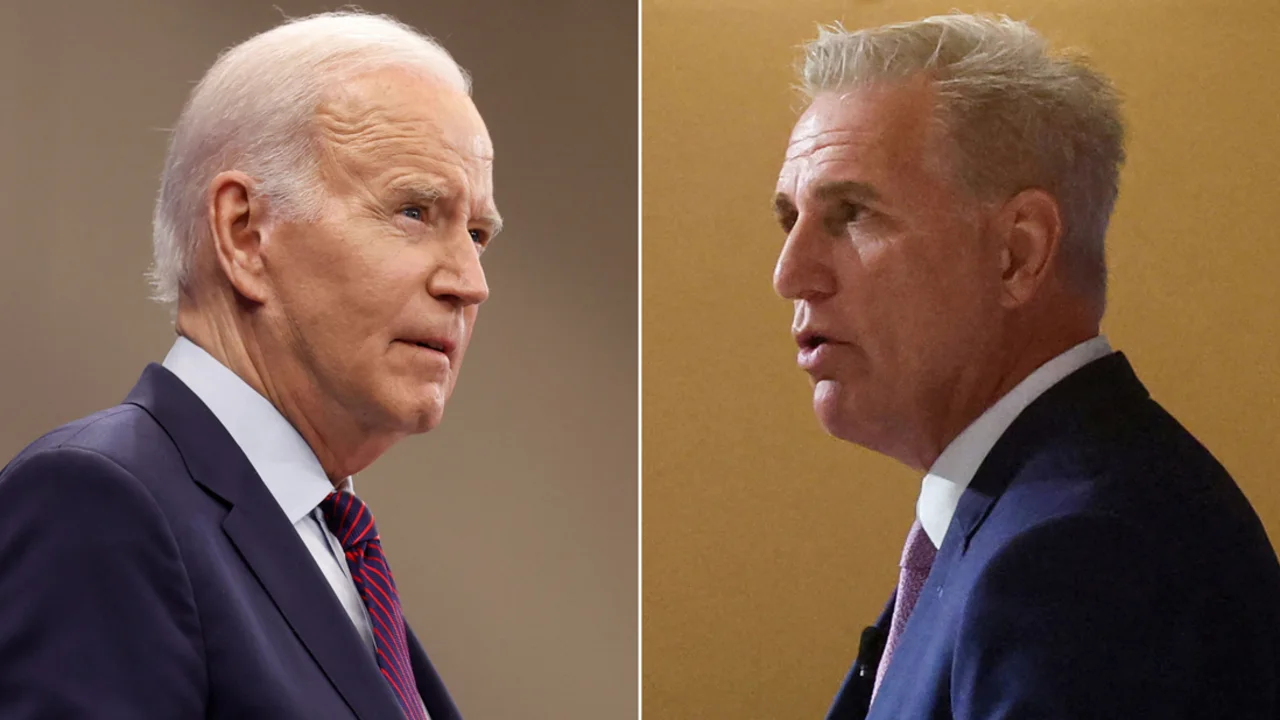
WASHINGTON—House Speaker Kevin McCarthy and President Biden failed to reach a deal to raise the debt ceiling following a high-stakes meeting at the White House but planned to press ahead with talks, as the U.S. nears a deadline to prevent a first-ever default.
Heading into the meeting, the president said that he was optimistic they could make progress. After the sit-down concluded, Biden termed it a productive meeting and “we reiterated once again that default is off the table and the only way to move forward is in good faith toward a bipartisan agreement.”
McCarthy told reporters that the tone of the roughly 90-minute meeting was “better than any other time we’ve had discussions.” He too said the meeting was productive and offered both leaders an opportunity to dig into the details of their positions.
McCarthy told reporters that the meeting was “productive,” adding, “I think the tone tonight was better than any other time we’ve had discussions.” He said the meeting offered both leaders an opportunity to dig into the details of their positions.
“I believe we can get it done,” he said, adding that negotiators would continue their discussions and he expects to talk to Biden every day.
Central to the talks is setting a top line spending level for the next year and deciding how long to lift the debt ceiling until having to raise it again. The two sides are aiming to reach a deal by June 1, when the Treasury Department estimates the U.S. could run out of money to pay all of its bills, leading to default. Treasury Secretary Janet Yellen repeated that estimate Monday.
Ahead of the meeting, Biden and McCarthy’s negotiating teams huddled on Capitol Hill. The two sides remained at odds on the central issue of spending, but are nearing agreement on secondary matters such as clawing back unused coronavirus-response funding, according to people familiar with the matter.
McCarthy said a deal must be reached this week to have time for the legislation to pass Congress. He added that he would consider canceling a planned House recess next week if there was no deal. “We’re going to stay and do our jobs,” McCarthy said.
Once a deal is reached, it will likely take at least several days for the agreement to wind its way through Congress. McCarthy said he planned to give House lawmakers 72 hours to read the bill, a rule that was put in place at the beginning of this Congress. House lawmakers will likely want to introduce amendments to any agreement as well.
Monday’s meeting comes after several stops and starts in the negotiations and increased tension among White House officials and House Republicans.
Rep. Byron Donalds (R., Fla.) said that in a closed-door briefing with some Republicans, Mr. McCarthy indicated that the talks were dragging on and lawmakers may need to cancel part of a 10-day recess planned to start this weekend.
“We were talking a lot about how to manage the clock and what that was going to look like,” Donalds said.
On Sunday, Biden said House Republicans have taken extreme positions and he called the GOP’s current proposal unacceptable. White House officials have accused Republicans of being unreasonable in the negotiations and pushing partisan proposals that have little chance of winning approval by both chambers of Congress. Meanwhile, Republicans have criticized Biden for waiting until May to engage in the negotiations, and they say the White House isn’t doing enough to cut spending.
Republicans have called for spending cuts as a condition for any debt-ceiling increase and they passed a bill in April to do so, saying that was their starting point on negotiations. They also want to cap spending in future years. Democrats for months declined to negotiate, saying the debt ceiling should be raised with no strings attached, but began engaging seriously in talks earlier this month as the deadline approached.
Biden has said he would like to work to narrow the deficit with some tax increases to wealthy Americans, but McCarthy said tax increases are off the table.
GOP lawmakers also want to attach changes to permitting rules that would speed the process of building energy projects and to tighten work requirements for some government benefit programs, proposals that the White House has signaled some openness to.
McCarthy has said spending in the coming fiscal year must be lower than it was last year. The White House has proposed keeping nondefense and defense discretionary spending flat from fiscal 2023 to fiscal 2024, and a 1% increase in fiscal 2025, according to people familiar with the matter.
Democrats want the debt ceiling increased until after the 2024 election, while Republicans’ original bill pushed the next debt-ceiling deadline to March 2024.
If Congress doesn’t act to raise the debt limit soon and the government is unable to borrow to help pay all of its bills, it might have to suspend certain pension payments, withhold or cut the pay of soldiers and federal workers, or delay interest payments, which would constitute a default.
Given the uncertainty of negotiations, lawmakers are examining emergency solutions that could avoid a default. Nearly all House Democrats have signed a discharge petition, a long-shot parliamentary maneuver that requires 218 signatures to force a vote on debt-ceiling legislation.
Republicans control the House, 222-213, so for their petition to succeed, Democrats would need at least five GOP lawmakers to sign on. Because of timing rules around the maneuver, the petition would also not be ready to implement until after the June 1 deadline.
Progressives in the Senate and House are pushing Biden to use the 14th Amendment of the Constitution to unilaterally act without Congress, a never-before-used process that Republicans have derided, which would almost certainly be challenged in court.
The 14th Amendment states that federal debt authorized by law “shall not be questioned.” Biden has said he was considering invoking the amendment as a way to keep paying the nation’s bills but that it remained a long shot.
Lawmakers could also pursue a short-term increase of the debt ceiling to give negotiators more time to reach a deal. But McCarthy and others in Washington have expressed resistance to that approach.