Bitcoin Forecast: The Market Is Reach Neutral Market Sentiment

Crypto BriefingPublicado a 2023-05-16Actualizado a 2023-05-16

Resumen

Bitcoin price is struggling with an uptrend as the new week begins, paralleling the time when the market is active in a key zone. After closing the weekly candle below $27,000, the BTC/USD pair is attempting to consolidate support to gain momentum.

Bitcoin price is struggling with an uptrend as the new week begins, paralleling the time when the market is active in a key zone. After closing the weekly candle below $27,000, the BTC/USD pair is attempting to consolidate support to gain momentum.

Last week, BTC plummeted below $26,000 – its lowest level in the past two months. This leaves traders fearful of an impending major bearish breakdown. Although this has not materialized yet, many people are still very worried, especially when looking at BTC on a chart with a shorter and longer time frame.

What is the likely next price move? It's been a relatively calm week with not many special events going on, but the upcoming difficulty adjustment will most likely take it back to all-time highs (ATH) and similar events could potentially be. could take place to further drive BTC up. Here are some factors affecting BTC next week.

After a weekly close at around $26,930, Bitcoin price edged higher, reaching $27,550 overnight. While encouraging, the closing price still marks Bitcoin's lowest level since mid-March. Prominent trader and analyst Rekt Capital noticed this and warned that $27,600 is now moving towards support. .

“First, BTC failed to regain $28,800 on the weekly chart (orange). And then BTC closed below $27,600, failing to hold the support (black). This turns $27,600 into resistance and will likely push BTC further down to the lows of $20,000.”
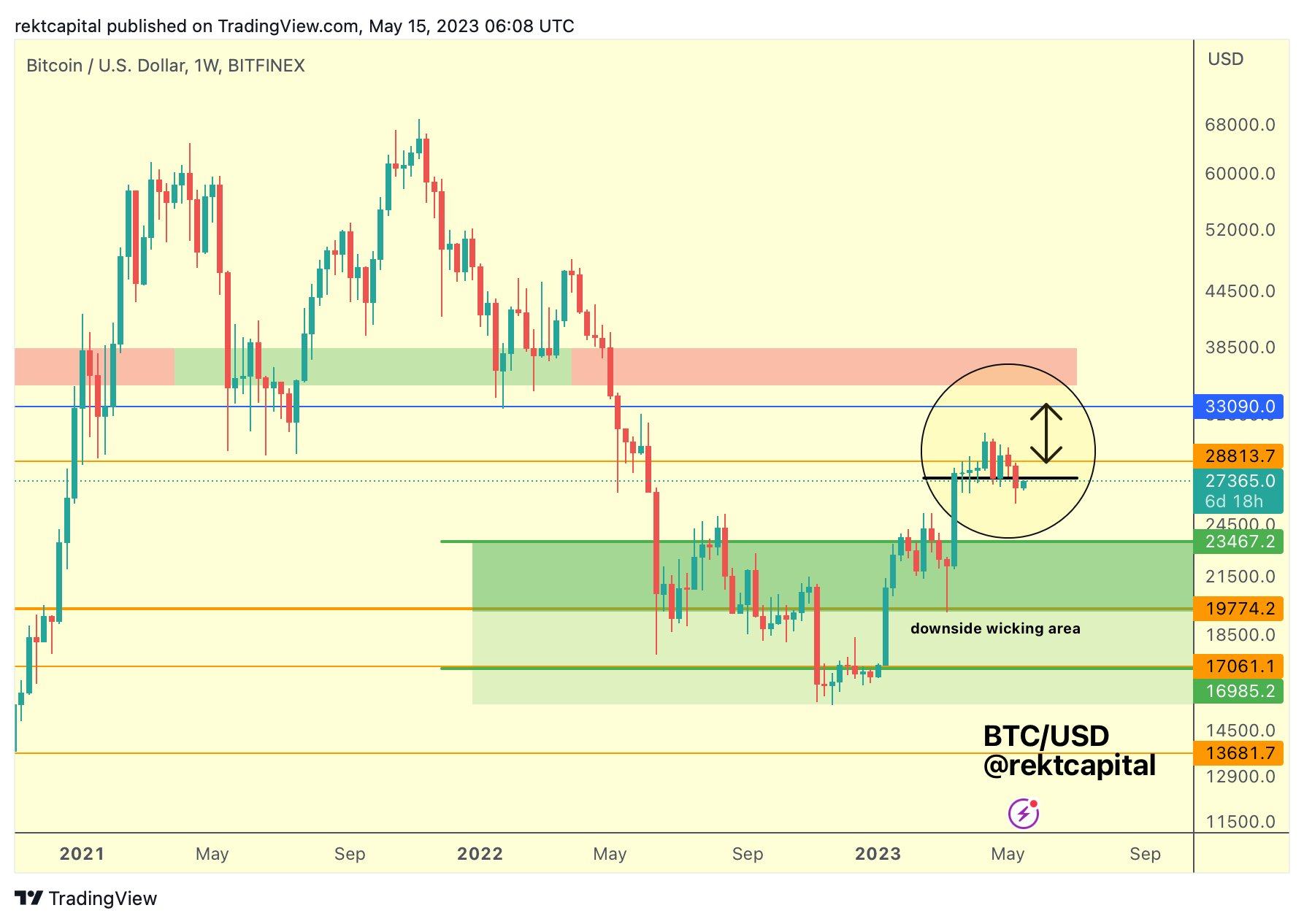
BTC/USD 1-week chart | Source: Rekt Capital/ Twitter

That view reinforces warnings that have emerged since late last week about the possibility of a BTC price drop. However, Rekt Capital remains bullish on Bitcoin in general. He looked beyond the current correction and towards its potential target.

“Bitcoin broke the Downtrend. Now all look New Uptrend. Whether it needs to be rechecked or not is the question. But history shows that the medium to long term outlook looks optimistic,” he added .

On the weekly time frames, the 200-week moving average (WMA) remains at $26,200 and has been retested for the first time.
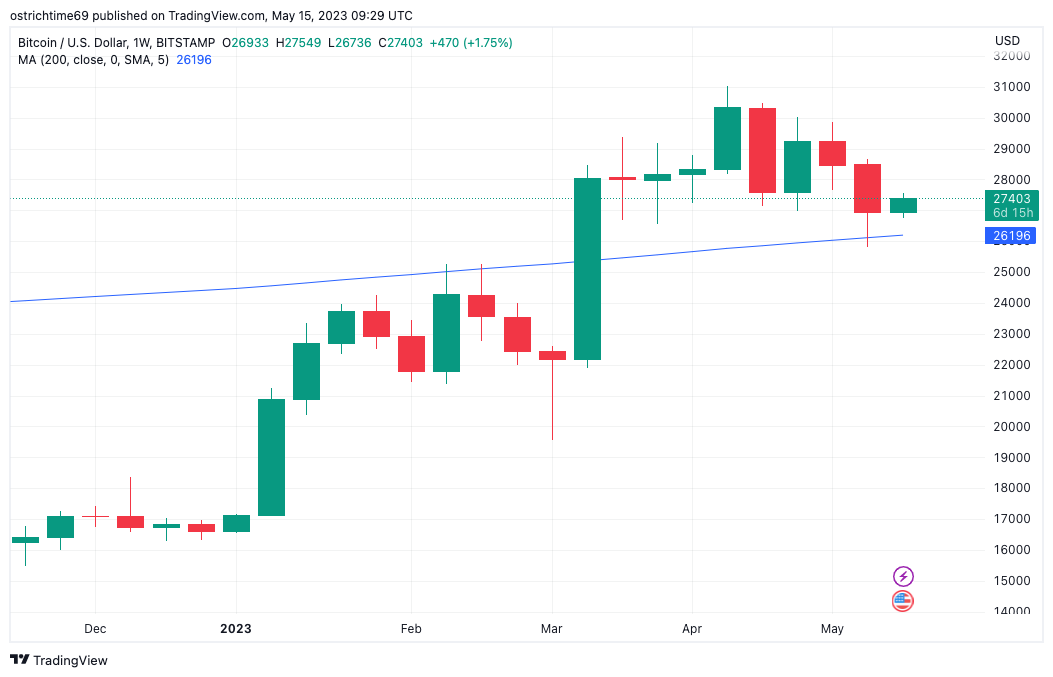
BTC/USD 1-week candlestick chart with MA-200 | Source: TradingView

Rekt Capital described the retest as “successful” but also reiterated the need to reclaim $27,600.

House Michaël van de Poppe thinks the BTC/USD pair is “ready to resume an uptrend.”

“Hold the key at $27,000 and we should be ready for a potential top,” he said, adding that Litecoin is also a notable name for upcoming events.

The LTC/USD pair is up more than 8% in the 24 hours to press time, hitting its highest level since May 6.
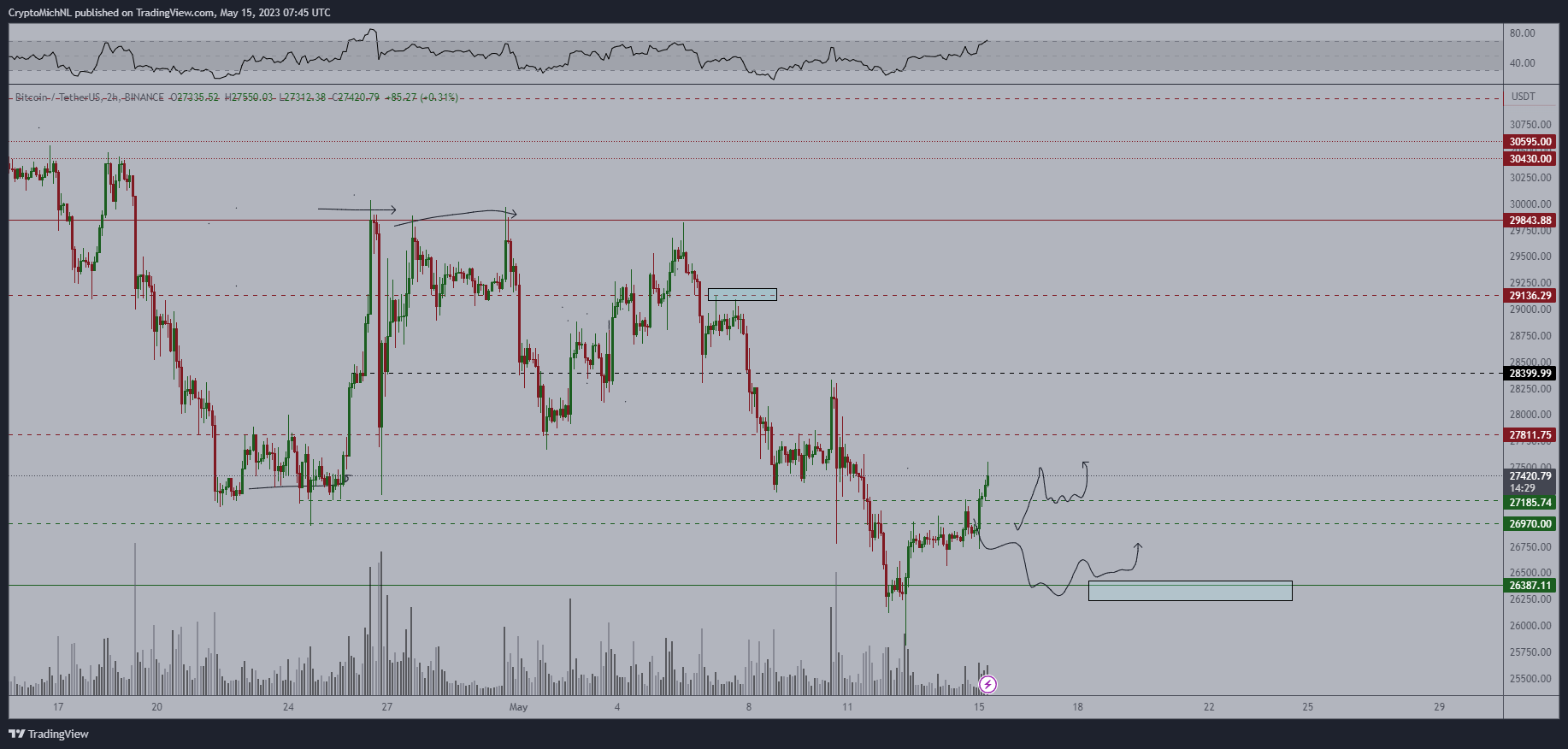
BTC/USD chart with caption | Source: Michael van de Poppe/Twitter

Accordingly, one of the traders who prefers the long-term trend, Mustache, thinks that the current price move is a time for Bitcoin and Altcoin to "take a breather".

“My opinion remains unchanged. Need to blow off steam before things get really crazy. To the bears: I will say this once and never say it again. Remember, you cannot compare a monthly chart with a daily chart.”
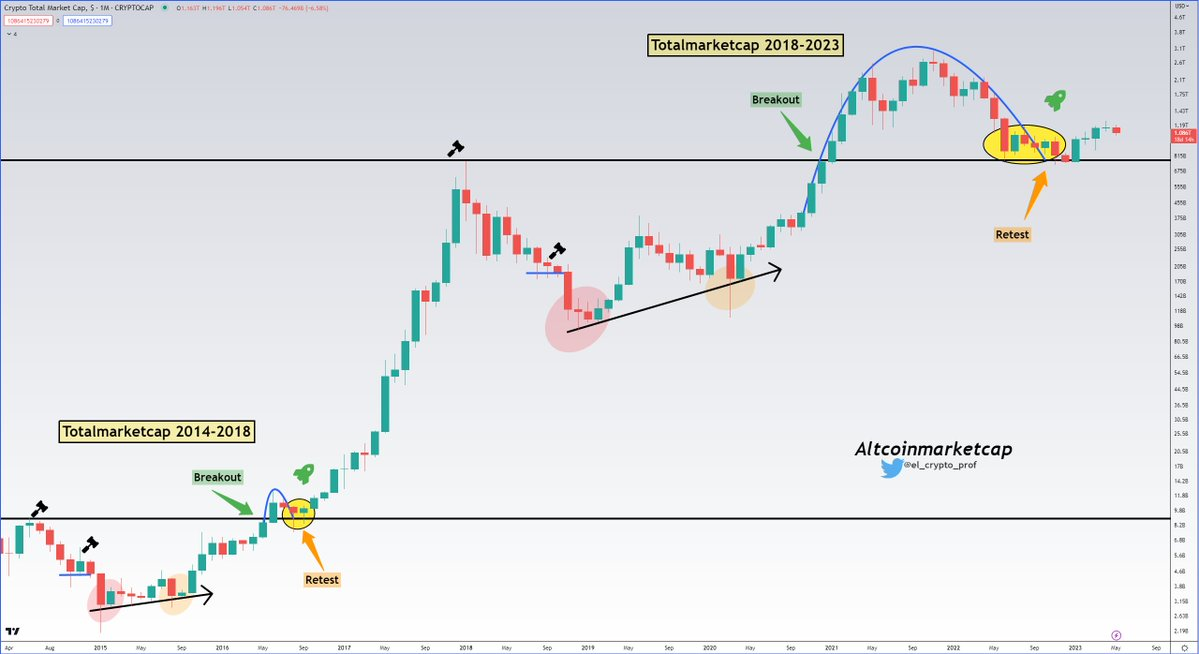
Cryptocurrency market cap chart | Source: Mustache/Twitter

Trader and analyst Trader Tardigrade, aka Alan, has made a similar bullish forecast based on Bitcoin's weekly relative strength index (RSI). For him, even the weekly close is cause for optimism.

Those looking for political events to trigger the price of BTC will likely be quite disappointed this week, as events in the United States have stabilized. After some macro data last week, the event that will unfold in the coming days is simply a speech by Jerome Powell, chair of the US Federal Reserve, on May 19.

As The Kobeissi Letter highlights, a total of 14 Fed officials will be available for comment in the coming days, with plenty of potential conflict. Kobeissi added that there is a high chance that volatility is starting to return to the market again.

Meanwhile, another point worth noting is the strength of the US dollar. In a market update on May 12, trading firm QCP Capital considered the US Dollar Index (DXY)'s return to a downtrend as the key event needed for risk assets to get the lights on. green.

“We see dollar strength as the main reason BTC is capped. This leads to market reflexes that are often blamed on known bearish factors such as the upcoming massive supply from the US government and Mt. Gox,” they declared.

DXY experienced a recovering week through May 14, after bouncing up at 101, near its lowest level since April of last year.
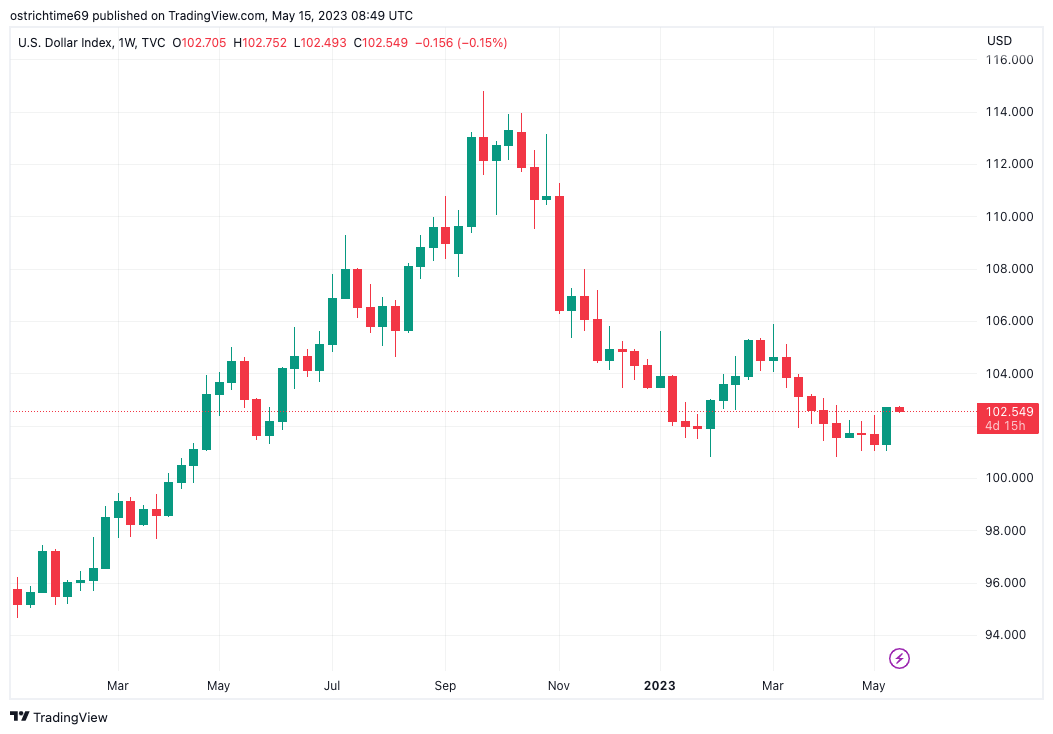
1-week US Dollar Index Chart | Source: TradingView

Bitcoin network difficulty has once again hit a new all-time high. After the previous correction that produced a slight retracement, the difficulty should increase by around 2% this week, according to estimates from BTC.
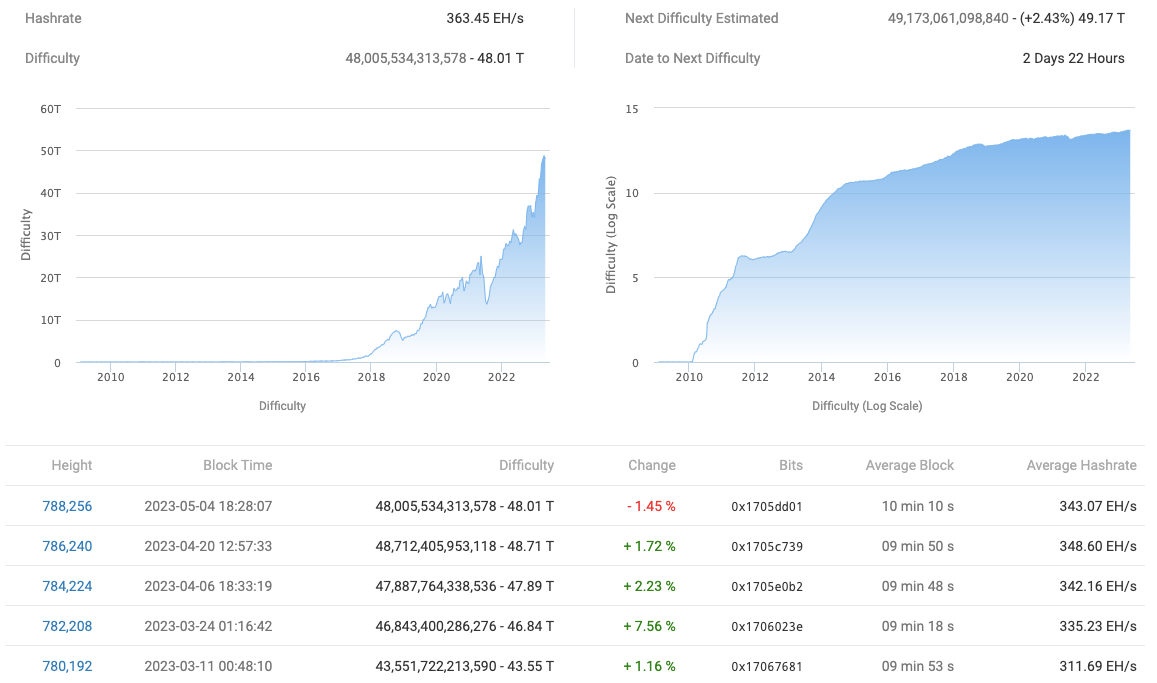
Bitcoin Network Fundamentals Overview (screenshot) | Source: BTC

This difficulty continues the upward trend, with competition for block subsidies among miners in “just up” mode. This trend has not been affected by recent short-term fluctuations in the fee market, so miner revenue has increased significantly.

Also, the hash rate will depend on the mining source. This also shows that mining-specific processing power is at an all-time high or close to an all-time high.
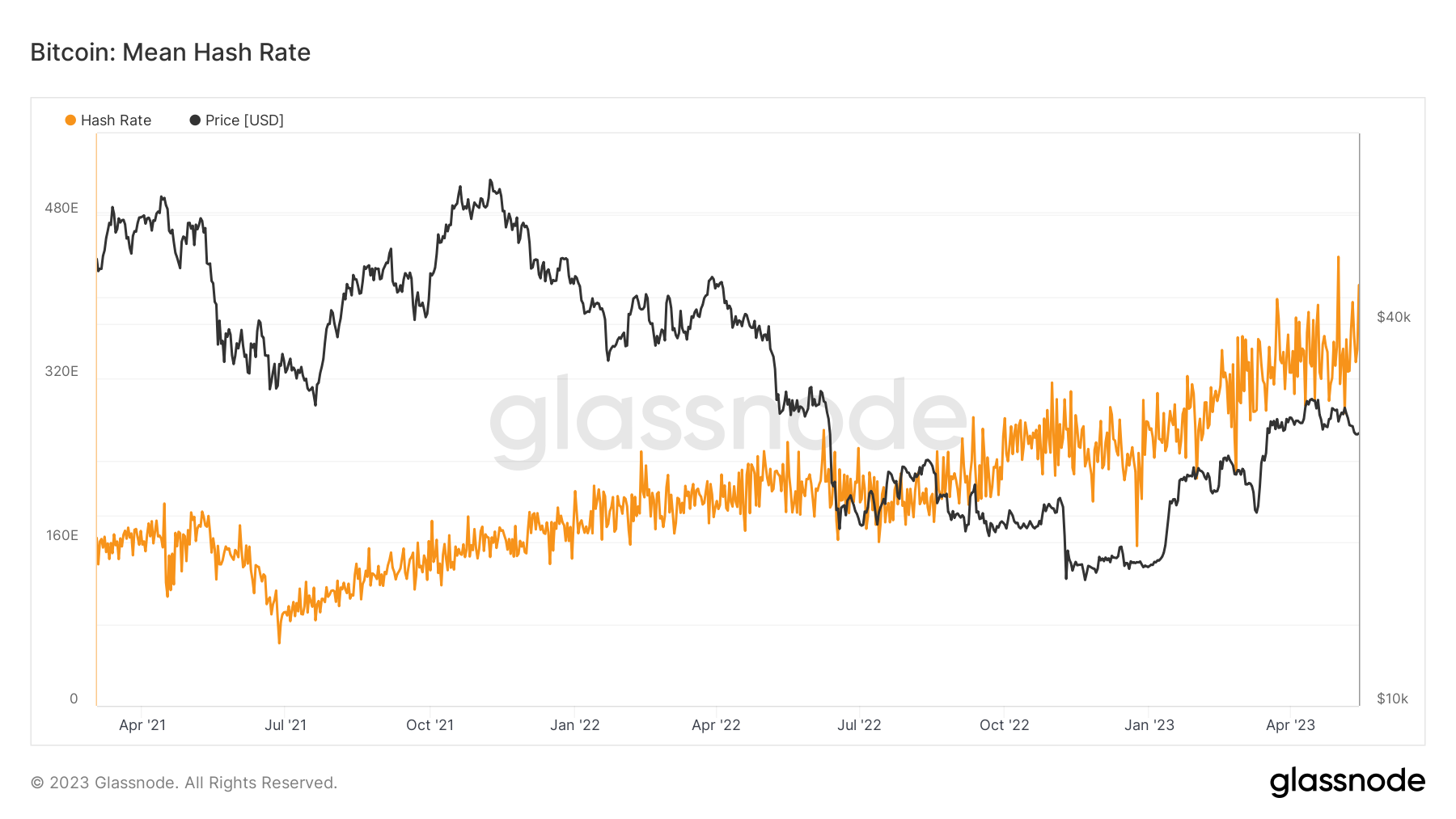
Bitcoin hash rate chart | Source: Glassnode

After hitting the highest level since November 2021, the Crypto Fear and Greed Index shows irrational euphoria, which has been hit hard by the recent price drop. As of May 15, the Fear & Greed index measures at 50/100, exactly in between its extremes and characteristic of “neutral” market sentiment.
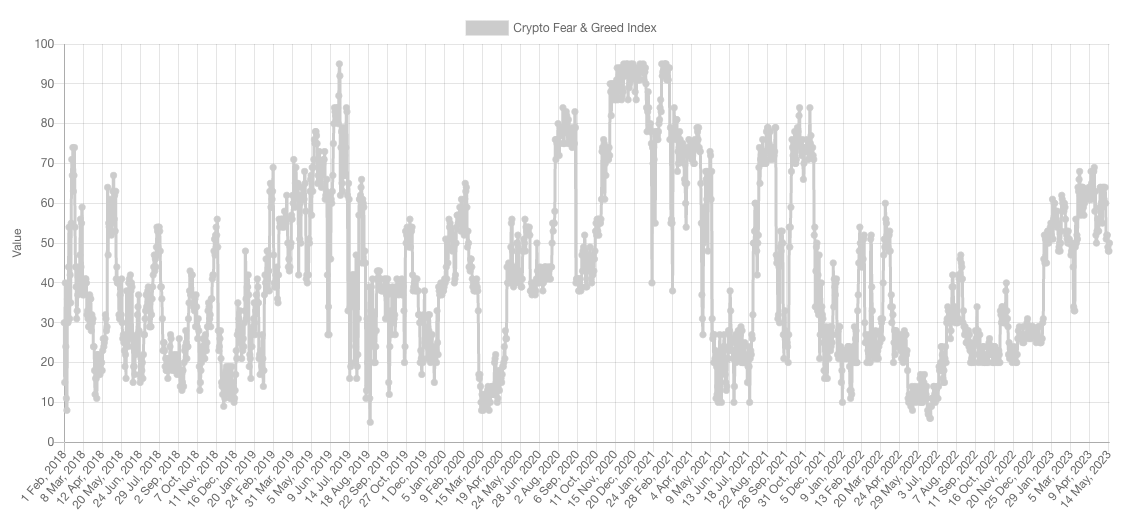
Cryptocurrency Fear and Greed Index (screenshot) | Source: alternative.me

Research firm Santiment also emphasized that the recent hype surrounding the memecoin has also dissipated and interest has returned to Stablecoin.

“With Bitcoin at $27,4000 and Ethereum at $1,825, traders seem annoyed with the fact that the market has stagnated. Stablecoin are seeing a huge increase in interest on social media, which is often a sign that they are not interested in the market for tokens like HEX & PEPE, which has plummeted.”


Lecturas Relacionadas

Standard Chartered vuelve a entonar una fantasía desbocada de 50 veces, pintando un pastel para AAVE que apunta a los 3.500 dólares

El banco británico Standard Chartered ha lanzado una predicción audaz: el token AAVE, del protocolo de préstamos descentralizados Aave, podría aumentar 50 veces su valor para 2030, alcanzando los 3.500 dólares. Esta proyección optimista se basa en dos tendencias clave previstas por el banco: el valor total bloqueado (TVL) en DeFi crecería 37 veces hasta unos 2,7 billones de dólares, y la penetración de activos del mundo real (RWA) en DeFi aumentaría del 3,5% al 30%. Según su modelo, el crecimiento de los depósitos impulsaría los ingresos por comisiones y, en última instancia, la capitalización del token. La nota destaca la sólida posición de Aave en el mercado. Un informe de Grayscale señala que Aave es un activo impulsado por flujos de efectivo y está infravalorado, generando 142 millones de dólares en ingresos en 2025. Además, el protocolo captura más del 80% de las ganancias netas del sector de préstamos DeFi, a pesar de representar solo la mitad de su TVL, mostrando una rentabilidad dominante. Sin embargo, el artículo también señala debilidades estructurales. El modelo de préstamo "peer-to-pool" de Aave conlleva una significativa pérdida de eficiencia del capital, estimada en unos 52 millones de dólares anuales en sus principales mercados, debido a la necesidad de mantener liquidez inactiva como reserva. Este problema, junto con vulnerabilidades expuestas en incidentes como el hackeo de KelpDAO, representa un desafío. Competidores como Morpho, que ofrecen modelos más eficientes, están ganando terreno. En resumen, Aave se encuentra en una encrucijada entre la ambiciosa visión de crecimiento pintada por actores tradicionales y la necesidad de abordar sus limitaciones operativas para escalar de manera sostenible hacia una adopción masiva de activos en cadena.

链捕手Hace 55 min(s)

Standard Chartered vuelve a entonar una fantasía desbocada de 50 veces, pintando un pastel para AAVE que apunta a los 3.500 dólares

链捕手Hace 55 min(s)

Inversión en Mareas: Seguimos siendo optimistas respecto a la cadena de suministro de IA, pero las razones han cambiado

Inversiones Mareas: Sigue siendo optimista sobre la cadena industrial de IA, pero las razones han cambiado. A mediados de 2026, las principales empresas tecnológicas como Alphabet, Amazon, Meta, Microsoft y Oracle continúan aumentando agresivamente sus inversiones de capital (CAPEX), con cifras proyectadas entre 600 y 2000 mil millones de dólares para 2026. La fase actual de inversión, a diferencia de ciclos tecnológicos anteriores, se centra en infraestructura física a largo plazo (electricidad, redes, transformadores, refrigeración) donde los cuellos de botella son complejos y los plazos de ejecución son lentos. Aunque el mercado muestra preocupación ante el crecimiento del CAPEX por encima de los ingresos y posibles similitudes con la burbuja puntocom del año 2000, el análisis argumenta diferencias clave: la oferta de infraestructura crítica no puede expandirse rápidamente, lo que dificulta una sobrecapacidad masiva. El optimismo actual se basa en que las inversiones continúan, los pedidos a proveedores de infraestructura se mantienen fuertes y aún no hay señales de reducción en las proyecciones de gasto o cancelación de pedidos. Los riesgos de rentabilidad (ROI) existen, pero los datos actuales no justifican un cambio de postura. Por lo tanto, el ciclo de inversión en IA no ha terminado; ha entrado en una nueva fase más compleja y extensa.

marsbitHace 2 hora(s)

Inversión en Mareas: Seguimos siendo optimistas respecto a la cadena de suministro de IA, pero las razones han cambiado

marsbitHace 2 hora(s)

Inversiones Mareales: Seguimos siendo optimistas sobre la cadena industrial de IA, pero la razón ha cambiado

En "Inversiones Mareal", mantenemos una visión positiva de la cadena industrial de la IA, pero los motivos han cambiado. En 2026, el mercado ha pasado de preguntarse si la IA es viable a cuestionar cuánto tiempo puede sostenerse esta intensa inversión. Los gigantes tecnológicos como Alphabet, Amazon, Meta, Microsoft y Oracle han elevado drásticamente sus guías de gasto de capital (Capex) para 2026, lo que demuestra un compromiso continuo. Esta ronda de inversión es más compleja y difícil de detener que los ciclos anteriores de hardware. Los cuellos de botella se han trasladado de los chips a componentes físicos como la energía eléctrica, los transformadores y la refrigeración, cuyas cadenas de suministro tienen plazos de entrega muy largos. Datos de empresas como Eaton muestran un crecimiento explosivo en pedidos para centros de datos. El mercado tiene dos preocupaciones clave: que el Capex supere el crecimiento de los ingresos, poniendo en riesgo el ROI, y los paralelismos con la burbuja puntocom del año 2000. Sin embargo, a diferencia de aquella burbuja impulsada por un exceso de oferta fácil (como la fibra óptica), la infraestructura de IA actual enfrenta limitaciones de oferta reales y prolongadas. La electricidad no se puede "pre-instalar" como la fibra. Por lo tanto, aunque las recientes rondas de financiación masiva de las grandes tecnológicas puedan causar nerviosismo, no señalan el final del ciclo. Más bien, indican que la obra de la IA ha entrado en un nuevo acto, uno marcado por la superación de obstáculos de infraestructura a largo plazo. El ciclo de inversión sigue en marcha.

链捕手Hace 2 hora(s)

Inversiones Mareales: Seguimos siendo optimistas sobre la cadena industrial de IA, pero la razón ha cambiado

链捕手Hace 2 hora(s)

Grayscale: Estos 15 protocolos de criptomonedas generadores de ingresos están gravemente infravalorados

**Resumen: Un análisis de Grayscale sobre protocolos DeFi infravalorados** Grayscale Research identifica 15 protocolos criptográficos con ingresos sustanciales que, según su análisis, cotizan con múltiplos de valoración notablemente bajos. Muchos presentan un múltiplo de ingresos (capitalización de mercado/ingresos anuales) de un solo dígito, e incluso cercano a 1x, como Pump.fun (1x), PancakeSwap (1x) y Meteora (1x). Otros como Aave (9x), Jupiter (6x) y Lido (3x) también se consideran baratos según métricas fundamentales. El informe argumenta que la posible aprobación de la "CLARITY Act" (con una probabilidad del 67% según Polymarket), una ley estadounidense que clarificaría el marco regulatorio para los activos digitales, podría actuar como catalizador. Al reducir la incertidumbre para las instituciones, se esperaría un aumento de la actividad y los ingresos en estos protocolos, predominantemente financieros (DEXs, préstamos, staking). Grayscale aplica, de manera destacada, modelos de valoración tradicionales como el descuento de flujos de caja (DCF) a protocolos como Aave, fijando un precio objetivo de ~175 dólares. No obstante, se advierte que: 1) la aprobación de la ley no está garantizada, y 2) Grayscale, como gestor de activos cripto con productos relacionados (ej. ETF de Hyperliquid), tiene un interés comercial inherente en esta tesis de inversión. La conclusión subraya la anomalía de valoración, pero deja al inversor la valoración final del riesgo.

marsbitHace 2 hora(s)

Grayscale: Estos 15 protocolos de criptomonedas generadores de ingresos están gravemente infravalorados

marsbitHace 2 hora(s)

Trading

Spot
Futuros
活动图片