[Featured Research]Why I Think Selling My #BLUR Airdrop Was a Mistake

MirrorPublicado a 2023-02-21Actualizado a 2023-02-21

Resumen

The key is product experience. Majority of their portcos prioritise this, Blur is no exception.

Over the weekend, I've been renewing my personal thesis for $BLUR, why I think selling my airdrop was a mistake, and why Blur Bidding is a game-changer for the NFT space.
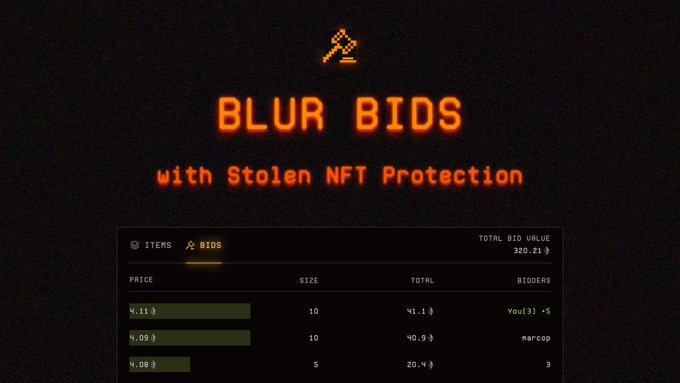
What is the most important aspect wrt product experience on NFT marketplaces? Ease of buying/selling NFTs.

ADVANTAGE OF BLUR

The majority of trading volume in the current state of the NFT market is from whales, and they want one thing: To be able to buy cheaper and sell quickly in SIZE

Compared to the DeFi space, the trading experience for NFTs is subpar. Before blur_io came along, the user experience was terrible and was not optimized for the professional, mass trading market.

NFT trading needs to (at least) attain the usability of fungible tokens in DeFi

Here comes the second (and likely the hardest) pain point: Liquidity.

While attempts have been made to solve this, including (but not limited to) NFT fragmentation, asset tokenization, and incentivization (via trading volume/listing rewards), liquidity is still extremely thin.

If I was looking to sell off 20 Doodles NFT today, it would've been impossible, likely taking days to weeks to unload fully, not to mention a downward spiraling floor price + me needing to actively re-adjust the floor price.

So what did @blur_io do? Introducing the Bid Points system.

Blur's bid mining model is essentially a liquidity pool transaction where users provide ETH (not WETH!) liquidity to a liquidity pool, a parallel comparison would be Uniswap's AMM innovation for the DeFi space.

On the other hand, opensea, LooksRare , and the_x2y2 models are pending order transactions, which makes them illiquid/inaccurate.

Blur's bidding system then incentivizes users who want the airdrop to provide liquidity and bear the risk of NFT prices once the bid is accepted.

In essence, what blur_io did right was find the right PMF (Pro NFT traders) and design a platform that focuses on the best-in-class product experience.

Users get deeper liquidity on Blur than OpenSea, allowing whales to buy/sell large amounts of NFTs frictionlessly.

GREAT AIRDROP

With $BLUR's release, the project imo is one of the most successful projects in transferring the power of protocol value distribution to the community.

The initial circulating supply of 360M tokens (12%) of supply) were distributed to the community, but what about the rest?
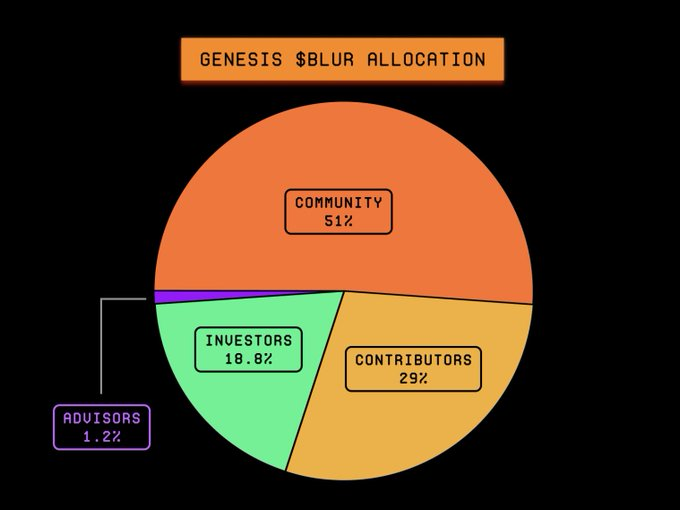
Majority of the airdrop in the first round has already been claimed, and over billions in $BLUR trading volume. Users who wanted to sell the airdrop would have already sold by now and the tokens are transferred to stronger hands.

The first year selling pressure is likely to be high, as circulating supply will increase by nearly 3x to 1 billion by the end of this year. Even so, the majority of the tokens are owned by the community. Investor/Team allocations are also subjected to a 4+ year vesting period

In my view, $BLUR is a proxy of the NFT market and a pure-play bet on the space since Blur benefits when NFT collections rise as a whole.

Assuming Blur becomes the market leader in the future, the current implied FDV of $2-3B is likely justified, given OS valuation of $13B

GREAT NEWS AHEAD

The largest exchange binance has yet to even list $BLUR, and once Blur's clear volume dominance is sustained and gains further traction, it will be inevitable.

Further, if that traction continues to gain steam, additional funding will come pouring in too.

ADVANTAGE COMPARE TO OTHER PLAYERS

Even if OS wanted to compete, they would have to reduce costs to traders and royalties (and they already did), but to really compete with Blur on liquidity, they likely have to switch to a similar model to Blur. (although that offers zero differentiation from Blur lol)

Further, building out a new product might potentially introduce bugs, which could completely destroy OS.

Wen $OS? Imo, highly unlikely, given the regulatory landscape and their desire to IPO. It also doesn't make sense from the business/investor POV; why would they give away their profits?

Also, PacmanBlur and the Blur team understand the NFT market deeply, perhaps better than OpenSea themselves. LooksRare and X2Y2 were focused on incentivizing trading volume instead of the most important thing: Liquidity.

The models used by Looksrare and X2Y2 incentivize wash trading, essentially fake volume that does nothing to improve the product experience. In other words, ponzinomics designed to attract retail who wants a dividend payout. Nothing wrong with that, btw. To each his own.

When the airdrop/token incentives end, how does Blur plan to sustain its liquidity depth? Good question, but this has been reiterated many times in multiple podcasts with @PacmanBlur, and the team is well aware of this and will be optimizing for growth long term.

Being a 2-sided marketplace, as long as user experience is top-notch and prioritized by the team, users will remain sticky to the platform. So product experience = #1

A case in point is OpenSea. Even without a token, users kept using it, of course, until Blur came along.

The Blur team is currently not making $$ themselves since marketplace fees are currently still 0%. And as everyone knows, they are @paradigm backed, but what does that even imply?

The key is product experience. Majority of their portcos prioritise this, Blur is no exception.

Lecturas Relacionadas

El Bitcoin vuelve a caer por debajo de los 60.000 dólares; tras 20 meses, lo que encontramos es un nuevo mínimo

Bitcóin vuelve a caer por debajo de los 60.000 dólares, marcando un mínimo en casi 20 meses. El precio tocó un mínimo intradía de 59.023 dólares, su nivel más bajo desde octubre de 2024, antes de recuperarse ligeramente a alrededor de 60.600 dólares. Esta es la tercera vez este año que el BTC pierde el soporte psicológico clave de 60.000 dólares. Dos factores clave impulsan la caída. En primer lugar, los ETF spot de Bitcoin en EE.UU. registran una salida neta récord, con 59.400 millones de dólares retirados en 30 días, presionando constantemente el precio. En segundo lugar, las expectativas de subidas de tipos por parte de la Fed, debido a datos económicos persistentemente fuertes, están reduciendo el apetito por activos de riesgo como el bitcóin. Los analistas tienen perspectivas diversas. 21Shares mantiene su objetivo de 100.000 dólares para fin de año, argumentando que las grandes tenencias de los ETF proporcionarán soporte. Arthur Hayes es más pesimista, pronosticando un posible fondo en 40.000 dólares en seis meses si la Fed mantiene una postura restrictiva. CryptoQuant señala que, históricamente, los mercados bajistas tocan fondo cuando el precio cae por debajo del coste promedio de los inversores, situado actualmente en unos 53.000 dólares. El mercado espera ansioso los próximos datos de inflación de EE.UU. y las señales de política de la Fed. Si estos no son favorables, la presión bajista podría continuar. La capacidad del bitcóin para mantener el nivel de 60.000 dólares será crucial para determinar el próximo movimiento del mercado.

Odaily星球日报Hace 1 min(s)

El Bitcoin vuelve a caer por debajo de los 60.000 dólares; tras 20 meses, lo que encontramos es un nuevo mínimo

Odaily星球日报Hace 1 min(s)

Bitcoin vuelve a caer por debajo de los 60.000 dólares; tras 20 meses, lo que esperamos es un nuevo mínimo

El precio de Bitcoin ha caído nuevamente por debajo del nivel clave de 60.000 dólares, tocando un mínimo de 59,023 USD, su nivel más bajo en casi 20 meses desde octubre de 2024. En el momento de redactar el resumen, cotiza alrededor de 60,600 dólares. La caída actual se atribuye a dos factores principales. En primer lugar, los ETF de Bitcoin en EE.UU. atraviesan su período de salidas netas más largo desde su lanzamiento, con cerca de 59.4 mil millones de dólares retirados en 30 días, ejerciendo una presión de venta constante. En segundo lugar, las expectativas de una posible subida de tipos por parte de la Reserva Federal, ante datos económicos persistentemente fuertes, están reduciendo la liquidez y la apetencia por activos de riesgo como Bitcoin. Analistas presentan perspectivas divergentes: 21Shares mantiene una visión alcista a largo plazo, con un objetivo de 100,000 dólares para fin de año, argumentando que las salidas de ETF son un impacto emocional temporal. Por el contrario, Arthur Hayes anticipa un posible fondo en 40,000 dólares en los próximos seis meses debido a un entorno macroeconómico restrictivo. CryptoQuant señala que el precio de costo promedio de los inversores ronda los 53,000 dólares, y que históricamente los mercados bajistas tocan fondo tras caer por debajo de ese nivel, sugiriendo que la tendencia bajista podría prolongarse. El mercado estará atento a los próximos datos de inflación y señales de la Fed para determinar si Bitcoin puede sostener el soporte de los 60,000 dólares o si la presión bajista persistirá.

marsbitHace 22 min(s)

Bitcoin vuelve a caer por debajo de los 60.000 dólares; tras 20 meses, lo que esperamos es un nuevo mínimo

marsbitHace 22 min(s)

El S&P cae tres días consecutivos, el dólar alcanza un máximo de 13 meses, el oro cae por debajo de 4000, el petróleo por debajo de 70 y el bitcoin por debajo de 60000, Micron y Qualcomm impulsan un fuerte rebote en las acciones de chips

Los mercados globales experimentaron una jornada volátil, con el dólar alcanzando máximos de 13 meses y presionando a los activos denominados en la divisa estadounidense. El oro cayó por debajo de los 4.000 dólares y el bitcoin tocó los 60.000 dólares. El petróleo WTI cayó por debajo de 70 dólares, eliminando la prima de riesgo geopolítico de la guerra en Irán, gracias a una mejora más rápida de lo esperado en los flujos de crudo del Golfo Pérsico. Los rendimientos de los bonos del Tesoro a 10 años cayeron significativamente. En bolsa, el S&P 500 cerró plano por tercer día consecutivo, con el sector tecnológico como lastre principal. Los chips de IA y las "Siete Magníficas" se debilitaron, mientras que sectores como el consumo discrecional e industrial avanzaron. Sin embargo, tras el cierre, las acciones de Micron Technology se dispararon más de un 16% tras publicar resultados trimestrales y perspectivas que superaron ampliamente las expectativas, impulsadas por la escasez de chips de memoria para IA. Este optimismo contagió a otras acciones del sector semiconductores, como Qualcomm, que también subió notablemente, sugiriendo un posible alivio a la presión reciente en el sector tecnológico. El índice del dólar alcanzó nuevos máximos, respaldado por comentarios de las autoridades estadounidenses sobre la fortaleza de la economía y un posible reforzamiento del papel global de la divisa. La atención se centra ahora en los datos de inflación PCE de EE.UU. y en su impacto en las expectativas de política de la Reserva Federal.

华尔街日报Hace 1 hora(s)

El S&P cae tres días consecutivos, el dólar alcanza un máximo de 13 meses, el oro cae por debajo de 4000, el petróleo por debajo de 70 y el bitcoin por debajo de 60000, Micron y Qualcomm impulsan un fuerte rebote en las acciones de chips

华尔街日报Hace 1 hora(s)

Trading

Spot
Futuros
活动图片