Is There Still Hope?: Experts Cite Percentages for the Likelihood That the Clarity Act Will Lead to the Adoption of Favorable Cryptocurrency Legislation

cryptonews.ruPublished on 2026-08-15Last updated on 2026-08-15

Abstract

Analytical firm Galaxy Research has lowered its probability assessment of the CLARITY Act passing by 2026 to 10%. The bipartisan cryptocurrency market structure bill faces significant hurdles, including a lack of consensus on ethics rules for public officials in the sector, lobbying pressure from traditional banks, and demands to restrict developer protections in the bill. With the Senate's September session shortened due to the election campaign, there is limited time for passage. In response to the legislative stall, U.S. regulators like the SEC and CFTC are expected to accelerate administrative rulemaking for the crypto market. The SEC may soon finalize long-considered rules such as the "Reg Crypto" for crypto asset offerings and the "Innovation Exemption" for trading tokenized securities on decentralized finance protocols. However, Galaxy notes these agency rules can be reversed by a future administration and do not offer the same long-term legal certainty as a Congressional law. Even if the CLARITY Act fails, the SEC is anticipated to publish regulatory texts in the coming weeks or months.

Analytical firm Galaxy Research has lowered its estimate of the probability of the CLARITY Act, aimed at regulating the structure of the cryptocurrency market in the United States, being passed by 2026 to 10 percent.

A report published by Galaxy Research states that there were earlier expectations that the bill, advancing with bipartisan support in the Senate Banking Committee, could be passed by the Senate before the August recess, but political disagreements and industry lobbying have slowed this process.

According to the research firm, one of the main obstacles to passing the bill has been the lack of consensus regarding ethical standards for the activities of public officials in the cryptocurrency sector. Additionally, it is reported that pressure from local banks, in particular, has weakened support among some Republican senators.

It was noted that demands for additional restrictions on provisions of the Blockchain Regulation Act, which includes protections for cryptocurrency developers, have also complicated negotiations.

Analytical firm Galaxy Research reported that Senate Majority Leader John Thune was unable to secure the necessary 60 votes to pass the bill with cloture and therefore did not bring it to a vote before the August recess. The bill is planned to be presented to the Senate after work resumes in September.

However, according to Galaxy, the Senate session, which begins on September 14th, will conclude in early October due to the election campaign, leaving extremely tight deadlines for passing the bill.

In its assessment, the company stated: "CLARITY is now paying less attention to policy content and more to political balance."

Thus, Galaxy Research has lowered the probability of the CLARITY Act being passed in 2026 to 10 percent.

SEC and CFTC May Accelerate Regulatory Procedures.

The difficulties faced by the Clarity Act in Congress are prompting US regulators to accelerate their efforts to create new rules for the cryptocurrency market through administrative means.

According to Galaxy Research data, the US Securities and Exchange Commission (SEC) is preparing to enact two important regulatory exemptions that have been under consideration for some time.

Reg Crypto aims to create a new regulatory mechanism for the initial public offering of crypto-assets. The Innovation Exemption, on the other hand, aims to create a regulatory framework that would allow trading of tokenized securities on the secondary market within decentralized finance protocols.

However, Galaxy noted that the SEC has backed away from both rules several times under pressure from the traditional financial sector.

In the company's view, the SEC's recent resumption of considering these rules may indicate that the agency believes the CLARITY Act's chances of being passed by Congress have significantly decreased.

Galaxy Research also stated that Reg Crypto regulation is closely related to Section 1 of the CLARITY Act, and that Innovation Exemption regulation directly intersects with Section 10505 of this bill.

Galaxy Research analysts noted that regulatory exemptions, clarifications, and new rules that may be enacted by the Securities and Exchange Commission (SEC) and the Commodity Futures Trading Commission (CFTC) could temporarily fill the legislative gap in Congress.

However, the company noted that such regulatory measures do not provide the same long-term legal protection as a law passed by Congress.

It was emphasized that another administration coming to power in the future could alter or completely repeal these rules.

Thus, in Galaxy's opinion, while regulatory measures may provide greater clarity in the short term regarding the issuance, trading, and market oversight of crypto-assets, they cannot replace a long-term market structure law that would be passed by Congress.

On the other hand, Galaxy Research stated that even if the CLARITY Act is not passed, the SEC expects to publish the text of the Crypto Regulation, the Innovation Exemption, or both in the coming weeks or months.

*This is not investment advice.

Trending Cryptos

Related Questions

QAccording to the article, what has Galaxy Research reduced the probability of the CLARITY Act passing by 2026 to, and why?

AGalaxy Research has reduced the probability of the CLARITY Act passing by 2026 to 10 percent. This is due to political disagreements, industry lobbying, a lack of consensus on ethical standards for officials in the crypto sector, and weakened Republican support due to pressure from local banks.

QWhat are the two major regulatory carve-outs the SEC is reportedly preparing, as mentioned in the article?

AThe two major regulatory carve-outs the SEC is reportedly preparing are the 'Reg Crypto' carve-out, which aims to create a new regulatory pathway for crypto asset primary offerings, and the 'Innovation Exemption,' which seeks to establish a framework for trading tokenized securities on secondary markets via decentralized finance protocols.

QWhy is the Congressional timeline for passing the CLARITY Act considered extremely tight?

AThe timeline is extremely tight because the Senate session starting September 14th will conclude in early October due to the election campaign season, leaving very little time for the bill to be debated and passed before the session ends.

QWhat is a key limitation of regulatory actions by the SEC and CFTC compared to a law passed by Congress, according to Galaxy Research?

AA key limitation is that regulatory actions do not provide the same long-term legal certainty as a Congressional law. A future administration could modify or completely rescind such regulations, whereas a law is more permanent and secure.

QHow does the article connect the potential failure of the CLARITY Act to the SEC's recent actions on its proposed carve-outs?

AThe article suggests that the SEC's recent revival of its proposed 'Reg Crypto' and 'Innovation Exemption' carve-outs may indicate that the agency believes the CLARITY Act's chances of passing in Congress have diminished significantly, prompting regulators to accelerate their own rulemaking efforts to fill the legislative gap.

Related Reads

Bitcoin Is Ready for "Parabolic Growth". Is Altseason Upon Us?

Amid a general market uptrend, experts are discussing the potential start of an 'altcoin season', where major cryptocurrencies could outpace Bitcoin's growth. This follows Bitcoin surpassing $81,000, predictions of a new bull market, and a capital shift from AI stocks toward Bitcoin and gold. Since August 17th, the crypto market has risen over 22%, primarily driven by Bitcoin (BTC) and Ethereum (ETH), which gained 25% and 30% respectively, reaching highs last seen in May. Analysts suggest the Bitcoin bear cycle has ended, anticipating a historically strong rally, with renewed institutional demand for cryptocurrency ETFs. BitMEX founder Arthur Hayes, in a recent interview, declared the start of a new bull market, predicting Bitcoin could quickly reach "hundreds of thousands" of dollars. Market observers interpret this as an expectation for 'parabolic growth.' Signs of a bull market revival include Bitcoin ETFs re-entering the top 10 most-traded ETFs, displacing some AI-focused funds. Analysts at CryptoQuant note capital is flowing from Bitcoin into riskier altcoins, with their bull market indicators showing the most optimistic signals since October 2025. However, the reality is more nuanced. The current surge is a rebound from yearly lows; Bitcoin's price is still down nearly 40% from its October peak. The Altcoin Season Index has dropped to 39 from 67 in early August, and Bitcoin's dominance remains around 60%, indicating investor focus is still on Bitcoin rather than altcoins. Experts predict the market is entering a phase where project fundamentals and real revenue, rather than speculation, will increasingly determine asset value.

cryptonews.ru2m ago

Bitcoin Is Ready for "Parabolic Growth". Is Altseason Upon Us?

cryptonews.ru2m ago

$120 Million Vanishes Overnight! Crypto's 'Steadiest Giant' Stumbles in South America

Summary: Tether's $120 million Bitcoin mining venture in Uruguay, initiated in May 2023, was abruptly shut down in July 2025 when the national power utility UTE cut off electricity. The project, developed in partnership with local firm Microfin in Florida province, was touted as a model for leveraging the country's nearly 98% renewable energy grid. The collapse stemmed from a fundamental contract dispute over electricity supply. Tether interpreted the agreed power volume as a "minimum guaranteed supply," expecting to request more as the mining operation expanded. UTE, however, viewed it as a "strict maximum cap." This disagreement led to frequent power curtailments for the 24/7 mining facility, causing significant revenue loss from lost computing power. Following the 2025 election of left-wing President Yamandú Orsi and a management change at UTE, negotiations broke down. Microfin stopped paying electricity bills in May 2025, formally notified UTE of contract termination in June, and did not attend a final meeting where UTE presented a revised contract. By the July 25 power cut, Microfin's debt approached $5 million. The operation ceased, laying off 30 of its 38 local staff, with all outstanding debts settled by December 2025. The failure highlights key risks for heavy-asset overseas investments: Uruguay's green energy proved not to be cheap energy, especially after the 2024 Bitcoin halving squeezed industry profits. Furthermore, political changes can swiftly alter utility company policies, undermining the long-term regulatory stability critical for such projects. While financially absorbable for Tether, the incident underscores that operational success depends on unambiguous contracts and genuine cost advantages, not just technological scale.

marsbit27m ago

$120 Million Vanishes Overnight! Crypto's 'Steadiest Giant' Stumbles in South America

marsbit27m ago

Is Bitcoin Price Lagging? Record Global M2 Money Supply Could Be a Springboard for BTC's Rise

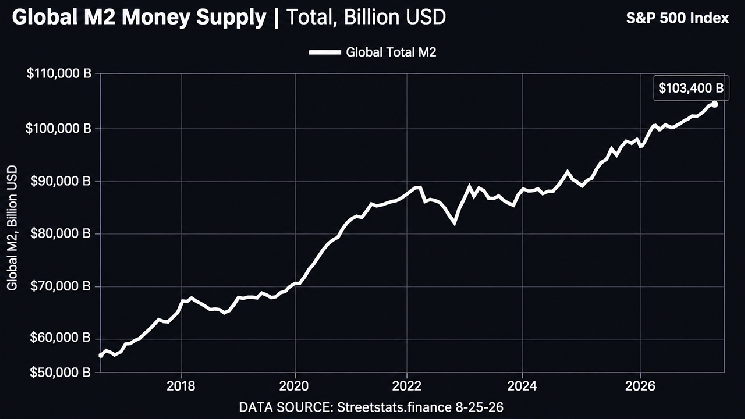
Bitcoin Price Lagging? Record Global Money Supply M2 Could Springboard BTC Growth The global money supply (M2) is expanding rapidly, similar to global debt. The US M2, representing all money circulating in its economy, has reached a record $23.16 trillion. Combined with figures from major economies like the Eurozone, China, and Japan, the global M2 is approximately $103 trillion. Some estimates, however, place it closer to $195 trillion. This surge in liquidity is significant because excess capital often seeks higher returns in assets like precious metals, stocks, and cryptocurrencies. Bitcoin's recent price surge above $81,000 has brought the global M2 metric back into focus. Following a sharp rise in early August after a US Treasury bond buyback announcement, BTC still trades about 37% below its October 2025 all-time high exceeding $126,000. This gap presents a potential "catch-up" trade thesis. Bitcoin's fixed supply of 21 million contrasts with governments' ability to print fiat currency, making scarce assets like BTC attractive if monetary expansion continues. Historically, Bitcoin's bull cycles in 2017-2018 and 2020-2021 coincided with M2 expansion and increased liquidity. Over the past year, the correlation seemed broken as M2 grew while Bitcoin's price fell sharply from its peak. Observers believe fresh dollars may have remained locked in cash-favorable investments. Some, like Ash Crypto, now suggest a long-awaited alignment between Bitcoin and M2 may be starting, especially as a weakening US Dollar Index this month has seen assets like gold and Bitcoin surge. A softer dollar pressures cash havens and prompts holders to act. While record M2 doesn't guarantee higher Bitcoin prices, a sustained influx of liquidity, a weak dollar, and capital flowing into alternative assets could trigger a catch-up rally sooner than expected. However, changes in these conditions could lead to the opposite outcome.

cryptonews.ru52m ago

Is Bitcoin Price Lagging? Record Global M2 Money Supply Could Be a Springboard for BTC's Rise

cryptonews.ru52m ago

Trading

Spot

Hot Articles

How to Buy T

Welcome to HTX.com! We've made purchasing Threshold Network Token (T) simple and convenient. Follow our step-by-step guide to embark on your crypto journey.Step 1: Create Your HTX AccountUse your email or phone number to sign up for a free account on HTX. Experience a hassle-free registration journey and unlock all features.Get My AccountStep 2: Go to Buy Crypto and Choose Your Payment MethodCredit/Debit Card: Use your Visa or Mastercard to buy Threshold Network Token (T) instantly.Balance: Use funds from your HTX account balance to trade seamlessly.Third Parties: We've added popular payment methods such as Google Pay and Apple Pay to enhance convenience.P2P: Trade directly with other users on HTX.Over-the-Counter (OTC): We offer tailor-made services and competitive exchange rates for traders.Step 3: Store Your Threshold Network Token (T)After purchasing your Threshold Network Token (T), store it in your HTX account. Alternatively, you can send it elsewhere via blockchain transfer or use it to trade other cryptocurrencies.Step 4: Trade Threshold Network Token (T)Easily trade Threshold Network Token (T) on HTX's spot market. Simply access your account, select your trading pair, execute your trades, and monitor in real-time. We offer a user-friendly experience for both beginners and seasoned traders.

13.1k Total ViewsPublished 2024.03.29Updated 2026.06.02

How to Buy T

Discussions

Welcome to the HTX Community. Here, you can stay informed about the latest platform developments and gain access to professional market insights. Users' opinions on the price of T (T) are presented below.

活动图片