‘Let’s finish the job’ – Senator Cynthia Lummis pushes CLARITY Act despite delay

ambcryptoPublished on 2026-07-06Last updated on 2026-07-06

Abstract

The CLARITY Act, a key cryptocurrency market structure bill, missed its July 4 signing deadline. With Congress shifting focus to campaigning, the new target is August 7 before the summer recess. Senator Cynthia Lummis urged action, calling the act "this generation’s contribution" to American innovation. Proponents argue the bill would eliminate regulatory ambiguity, spur new products, and attract capital. Market sentiment remains cautiously optimistic, though prediction markets show approval odds dropping to 48%. Support comes from entities like the National Organization of Black Law Enforcement Executives, while the Major County Sheriffs of America shifted to a neutral stance. However, political hurdles remain, notably from former President Donald Trump's stance on prioritizing other legislation. The bill's fate is uncertain as lawmakers work to reconcile differences between committee versions ahead of the tight legislative window.

The much-anticipated July 4 deadline for signing the CLARITY Act into law was missed yet again. The lawmakers once more failed to meet a deadline for advancing the much-awaited cryptocurrency market structure bill.

This is concerning because Congress will soon turn its attention to campaigning, leaving fewer legislative days to pass the bill before the 2026 U.S. midterm elections.

Senator Lummis presses on approval

However, Senate staff are still trying to reconcile differences between the versions created by the Agriculture and Banking Committees. Despite the delay, those closely watching the negotiations remain optimistic.

For instance, Senator Cynthia Lummis said,

Two hundred and fifty years of American innovation, American freedom, and American grit. The Clarity Act is this generation’s contribution to that legacy. Let’s finish the job!

Approval odds are concerning

That being said, the new deadline to advance the bill is the 7th of August, the Senate’s last scheduled session before the summer recess.

Advocates think that if it is passed, long-standing regulatory ambiguity could be eliminated, which would encourage cryptocurrency companies to introduce new goods and draw in new capital. But at the time of writing, the odds dropped to 48%, raising fresh concerns.
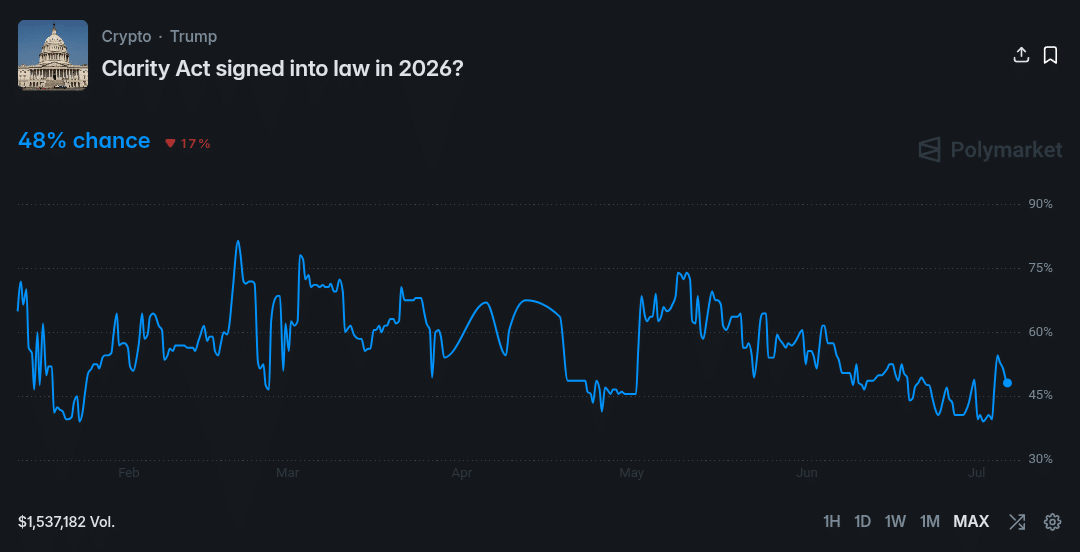
Source: Polymarket

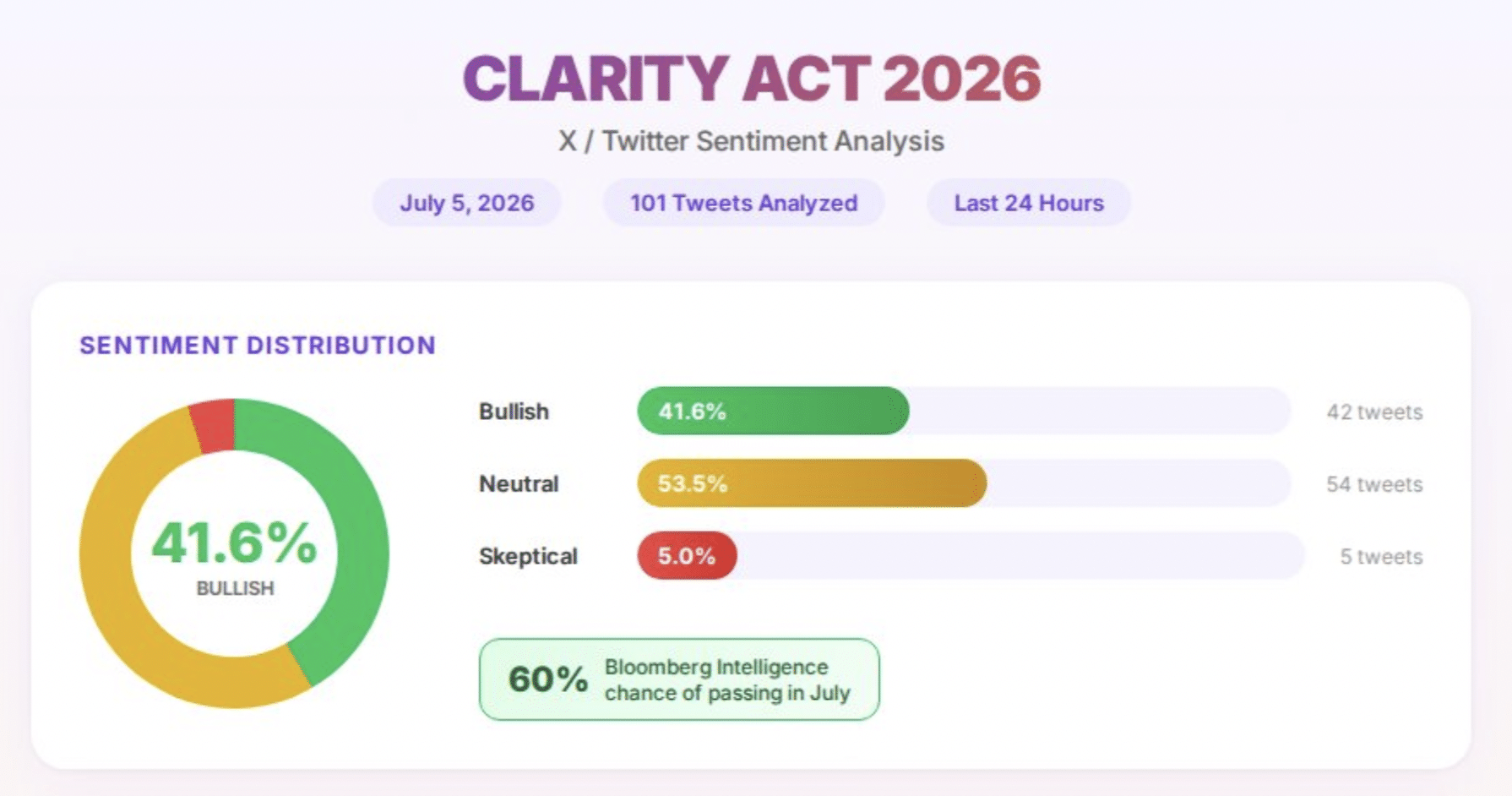
Still, with 41.6% of participants expressing a bullish outlook over the last 24 hours, market sentiment regarding the CLARITY Act is still cautiously optimistic.
Source: X

Benefits of approval

In fact, an analyst emphasized that many cryptocurrency projects are awaiting legislative approval for the CLARITY Act. For instance, Abstract is awaiting this change before introducing Project Quantum. It’s also anticipated that the CLARITY Act will further pave the way for capital formation, allowing businesses to raise $50 million annually.

Additionally, many big organizations are also supporting the bill. For example, the National Organization of Black Law Enforcement Executives (NOBLE) was the first significant law enforcement group to support the bill.

Meanwhile, recently, after deliberating over the clause, the Major County Sheriffs of America (MCSA) recently told the Senate in a letter that it had changed its stance on the bill to “neutral.”

Red flags remain

However, the legislation is still facing political obstacles, as U.S. President Donald Trump recently said that he would “not sign other bills” until Republicans in Congress passed the SAVE America Act.

Hence, the bill hangs in balance, as Trump reiterated,

Today’s Housing News Conference and Signing is hereby cancelled until such time as we pass the desperately needed SAVE AMERICA ACT, which I consider to be a National Emergency.


Final Summary

  • Senator Cynthia Lummis is pressing to pass the CLARITY Act for America’s innovation and freedom.
  • The volatility in approval odds is further adding uncertainty for the bill’s approval in 2026.

Trending Cryptos

Related Questions

QWhat is the main deadline mentioned for the CLARITY Act to advance, and why is this deadline concerning?

AThe new deadline for the CLARITY Act to advance is August 7th, which is the Senate's last scheduled session before the summer recess. This is concerning because Congress will soon turn its attention to campaigning, leaving fewer legislative days to pass the bill before the 2026 U.S. midterm elections.

QWhat is Senator Cynthia Lummis's argument for passing the CLARITY Act, according to the article?

ASenator Cynthia Lummis argues that the CLARITY Act represents this generation's contribution to America's legacy of innovation, freedom, and grit, which has spanned 250 years. She urges lawmakers to 'finish the job' and pass the bill.

QWhat are some of the potential benefits if the CLARITY Act is passed, as mentioned in the article?

APotential benefits of the CLARITY Act include eliminating long-standing regulatory ambiguity for cryptocurrencies, encouraging companies to introduce new products, attracting new capital, paving the way for businesses to raise $50 million annually, and providing a clear legislative framework for projects like Abstract's Project Quantum to launch.

QWhat recent development has added a political obstacle to the passage of the CLARITY Act?

AA recent political obstacle is that U.S. President Donald Trump stated he would 'not sign other bills' until Congress passes the SAVE America Act, which he considers a national emergency. This creates uncertainty for the CLARITY Act's approval.

QWhat is the current market sentiment and approval odds for the CLARITY Act based on the information provided?

AMarket sentiment regarding the CLARITY Act is described as cautiously optimistic, with 41.6% of participants expressing a bullish outlook over the last 24 hours. However, the approval odds for the bill have dropped to 48%, raising fresh concerns.

Related Reads

MSTR Discloses Sale of 3,588 Bitcoins, Stock Price Drops Over 5% at One Point During Trading

MicroStrategy, the world's largest corporate holder of Bitcoin, has significantly shifted its business model. Between June 29 and July 5, the company sold 3,588 bitcoins for approximately $216 million to fund quarterly dividends for its preferred stock. This marks its largest-ever Bitcoin sale and signals a strategic pivot: Bitcoin is transitioning from a "buy-and-hold" reserve asset to a liquidity management tool for the company. This move follows a recent authorization allowing Bitcoin sales when equity fundraising is less attractive. The announcement contributed to a more than 5% intraday drop in MicroStrategy's stock price, while Bitcoin fell to around $61,800—below the company's average holding cost of roughly $75,700. The sale represents a major departure from MicroStrategy's long-standing "never sell" commitment, which saw its first minor breach in May with a $2.5 million sale. The latest, hundred-times-larger transaction underscores growing financial pressures. Analysts note the company faces about $1.5 billion in annual preferred dividend obligations, far exceeding cash flow from its software business. As of July 5, MicroStrategy holds 843,775 bitcoins. Its current operational logic involves buying Bitcoin during favorable financing conditions and selling portions to cover dividends when needed, creating a flexible capital management cycle amidst a challenging market environment.

华尔街日报3h ago

MSTR Discloses Sale of 3,588 Bitcoins, Stock Price Drops Over 5% at One Point During Trading

华尔街日报3h ago

Q-Day Countdown: Will Quantum Computing End Cryptocurrencies?

Quantum Computing's Threat to Cryptocurrency: A Countdown to Q-Day Quantum computing, specifically Shor's algorithm, poses a fundamental threat to the public-key cryptography (e.g., ECDSA, RSA) that secures blockchain networks like Bitcoin and Ethereum. This critical juncture, known as Q-Day, is estimated to occur potentially within the next 5-15 years. The core vulnerability stems from the public and immutable nature of blockchains. Assets in addresses where the public key is already exposed on-chain (e.g., spent outputs) are at direct risk, as a sufficiently powerful quantum computer could derive the private key. This threatens the very trust model of cryptocurrencies. The response lies in Post-Quantum Cryptography (PQC)—algorithms like lattice-based ML-DSA and hash-based SLH-DSA, which are resistant to quantum attacks. NIST has standardized key PQC algorithms (FIPS 203, 204, 205), providing a migration path. However, the primary challenge is not technical but socio-economic and involves complex governance: * **Bitcoin's** path is constrained by its conservative ethos. Migrating requires a soft-fork to new address types, facing hurdles like significantly larger signature sizes and, most critically, the divisive governance question of how to handle at-risk legacy UTXOs without violating core principles. * **Ethereum** is pursuing a "cryptographic agility" strategy, with a multi-layered roadmap. It leverages account abstraction for user accounts and is developing compressed hash-based signatures (e.g., leanXMSS) for its consensus layer, aiming for a full-stack upgrade over time. In conclusion, quantum computing does not spell an instant end for cryptocurrency but initiates a critical countdown. The industry has a limited "engineering comfort window" to orchestrate a coordinated, ecosystem-wide migration to PQC. The ultimate bottlenecks are the immense coordination efforts and governance decisions required for this foundational transition.

marsbit4h ago

Q-Day Countdown: Will Quantum Computing End Cryptocurrencies?

marsbit4h ago

Trump, the President Who Knows Best How to 'Trade Stocks'

Former US President Donald Trump reported a record-breaking $2.2 billion in personal income for 2025, the highest annual income ever disclosed by a sitting president. This figure, from a 927-page government ethics filing, represented a 3.5-fold increase from his $600 million income in 2024 and boosted his net worth to $6.5 billion. The primary drivers were cryptocurrency (64% of income, approximately $1.4 billion) and real estate (26%, approximately $575 million). His crypto earnings stemmed largely from the launch of his personal meme coin, $TRUMP, generating over $600 million in licensing fees, and substantial profits from the WLFI token and its parent company. Despite a sluggish property market, his Mar-a-Lago resort and associated golf clubs saw revenue surges of 50% and 27%, respectively, attributed to their use as venues for presidential events. Trump's financial disclosure also revealed an unprecedented level of stock market activity, with over 22,000 trades executed in 2025, averaging 87 trades per market day. Media analyses noted several instances where significant trading coincided with major policy announcements, such as proposed tariffs, raising questions about potential conflicts of interest. While the White House stated these trades were handled by a family-managed trust fund and not Trump directly, critics highlighted this as a departure from the blind trusts traditionally used by presidents post-Watergate. The report has intensified debate over the commercialization of the presidency. Supporters view it as a success story of a businessman-president, while critics argue it demonstrates an unprecedented conversion of public influence into private wealth, with policy decisions potentially linked to personal financial gains. The controversy centers on whether Trump's earnings represent innovative entrepreneurship or a fundamental conflict of interest, sparking renewed calls for stricter ethics reforms in US governance.

marsbit4h ago

Trump, the President Who Knows Best How to 'Trade Stocks'

marsbit4h ago

Countdown to Q-Day: Will Quantum Computing End Cryptocurrencies?

The article explores the existential threat quantum computing poses to cryptocurrencies and the urgent need for "post-quantum" migration. It outlines that quantum computers, through Shor's algorithm, could break the elliptic-curve cryptography (ECC) underlying blockchain security, potentially allowing private keys to be derived from public keys. The core challenge is not a lack of post-quantum cryptography (PQC) standards—like NIST's ML-KEM and ML-DSA—but the immense complexity of upgrading entire ecosystems before "Q-Day" (when quantum computers become capable of such attacks, estimated around 2035-2045). Key points include: * **Bitcoin's** risk is concentrated in legacy UTXOs with exposed public keys (e.g., early P2PK outputs). Migration faces massive hurdles: PQC signatures are much larger, increasing transaction size and cost, and the governance dilemma of handling un-migrated assets threatens its "code is law" ethos. * **Ethereum's** strategy focuses on "cryptographic agility," using Account Abstraction for user accounts and developing compressed hash-based signatures (like leanXMSS with SNARK aggregation) for consensus. Its migration is a complex, full-stack overhaul of execution, consensus, and data layers. * The "security debt" is enormous. The comfortable engineering window for a coordinated, ecosystem-wide upgrade is only 5-8 years. High-value infrastructure (exchanges, bridges) may face pressure before mainnet protocols. In conclusion, quantum computing is not an instant "doomsday" event but a forcing function for systemic change. Bitcoin's ultimate test is social consensus and property rights governance, while Ethereum's is technical complexity. Failure to migrate in time could lead to a fundamental re-pricing of crypto assets.

链捕手4h ago

Countdown to Q-Day: Will Quantum Computing End Cryptocurrencies?

链捕手4h ago

Trading

Spot

Hot Articles

How to Buy 4

Welcome to HTX.com! We've made purchasing 4 (4) simple and convenient. Follow our step-by-step guide to embark on your crypto journey.Step 1: Create Your HTX AccountUse your email or phone number to sign up for a free account on HTX. Experience a hassle-free registration journey and unlock all features.Get My AccountStep 2: Go to Buy Crypto and Choose Your Payment MethodCredit/Debit Card: Use your Visa or Mastercard to buy 4 (4) instantly.Balance: Use funds from your HTX account balance to trade seamlessly.Third Parties: We've added popular payment methods such as Google Pay and Apple Pay to enhance convenience.P2P: Trade directly with other users on HTX.Over-the-Counter (OTC): We offer tailor-made services and competitive exchange rates for traders.Step 3: Store Your 4 (4)After purchasing your 4 (4), store it in your HTX account. Alternatively, you can send it elsewhere via blockchain transfer or use it to trade other cryptocurrencies.Step 4: Trade 4 (4)Easily trade 4 (4) on HTX's spot market. Simply access your account, select your trading pair, execute your trades, and monitor in real-time. We offer a user-friendly experience for both beginners and seasoned traders.

4.5k Total ViewsPublished 2025.10.20Updated 2026.06.02

How to Buy 4

Discussions

Welcome to the HTX Community. Here, you can stay informed about the latest platform developments and gain access to professional market insights. Users' opinions on the price of 4 (4) are presented below.

活动图片