Doubao and Qwen Will Discontinue Agent Functionality on July 15

marsbitPublished on 2026-07-05Last updated on 2026-07-05

Abstract

On July 4th, Doubao and Tongyi Qianwen announced the impending shutdown of their user-created "AI Agent" features. Doubao confirmed its agent feature will be taken offline on July 15, directing users to ByteDance's CatBox app for similar needs. On the same day, Tongyi Qianwen notified users, specifying that personalized interactive agents and user-built agent functions will cease on July 10, with all agent features and services completely deactivated by July 15. After this date, access to agent configurations and historical chat records will be lost. This adjustment impacts core user scenarios like role-playing, personal assistants, and vertical tool agents. The shutdown date coincides with the official implementation of China's "Interim Measures for the Administration of Artificial Intelligence Human-like Interactive Services" on July 15. The new regulations impose strict rules on "human-like emotional interaction services," requiring platforms to implement measures like anti-addiction systems, minor verification, and content moderation. This move is widely seen as a proactive step by the platforms to align with regulatory timelines and mitigate compliance risks. Additionally, commercial challenges are a key driver. Analysis suggests that casual, human-like chat agents generate high-frequency, low-value interactions, leading to high computational costs with poor monetization. As the AI application market shifts from user growth to proving value, sustaining such "high-cost...

On July 4, Doubao and Tongyi Qwen announced the upcoming discontinuation of their agent functionality.

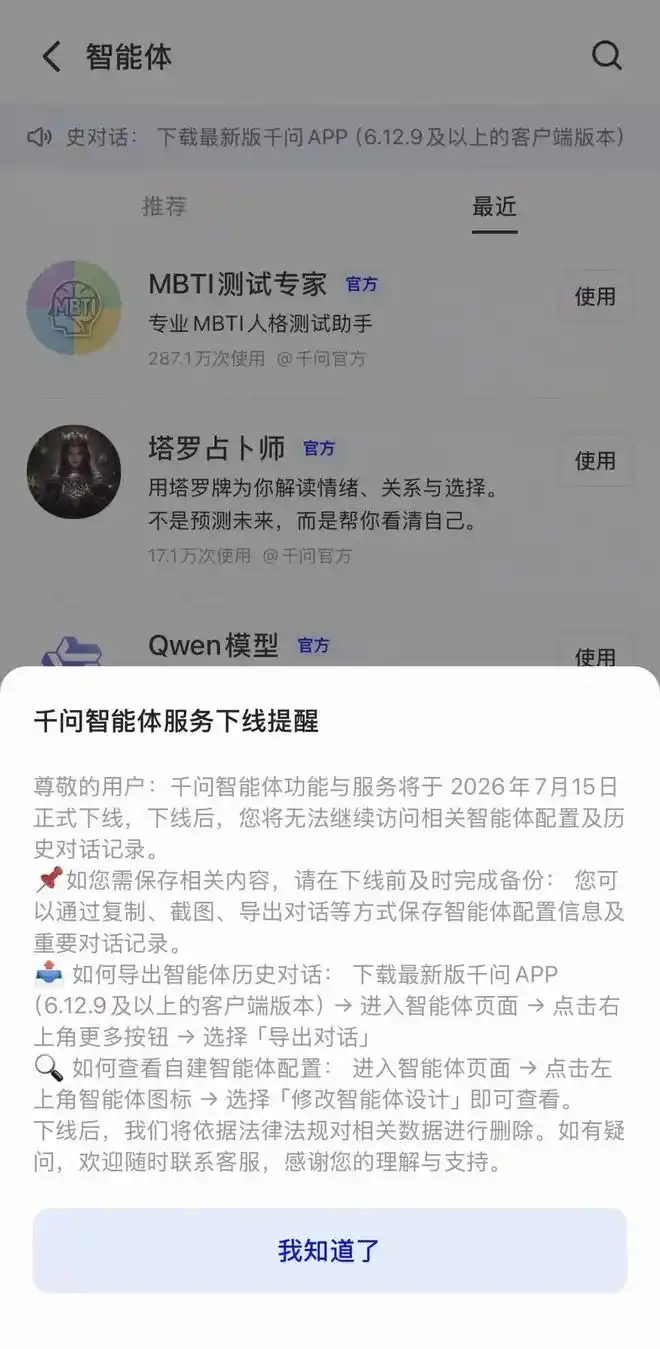
Doubao issued the "Notice on Discontinuation of Doubao Agent Functionality," confirming that the agent functionality will be discontinued on July 15, and will redirect users to ByteDance's Mao Xiang App to meet related needs.
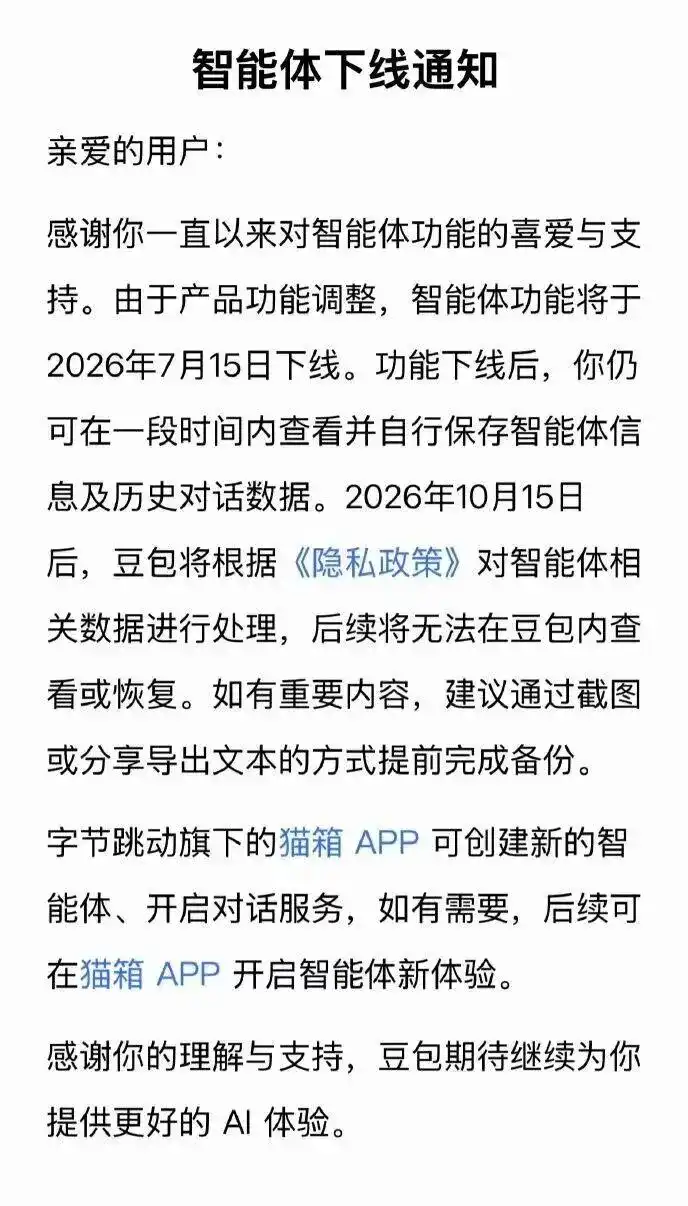
On the same day, Tongyi Qwen pushed a discontinuation reminder to users, stating that personified interaction agents and user-created agent functionality will be discontinued on July 10, and that after the complete discontinuation of Qwen agent functionality and services on July 15, users will no longer be able to access related agent configurations and historical conversation records.
This adjustment affects the most core personalized usage scenarios for C-end users of AI platforms — including role-playing, exclusive assistants, and vertical tool-type agents.

For Doubao and Qwen, user-created agents were previously a key means to gather C-end users and accumulate UGC content. The comprehensive discontinuation of this functionality signifies a directional shift in the platforms' traffic strategies.

New Regulations Force Action, Discontinuation Date Not a Coincidence

The discontinuation date chosen by Doubao and Qwen, July 15, coincides with the official implementation date of the "Interim Measures for the Administration of AI Personified Interaction Services."

These measures strictly regulate "personified emotional interaction services," requiring platforms to implement mechanisms to prevent addiction, verify the identities of minors, conduct content reviews, and fulfill other primary responsibilities.

Regulatory rectification actions have already begun. On June 26, the Cyberspace Administration of Shanghai Municipal Committee announced the results of the first phase of the "Clear and Bright: Rectifying Irregularities in AI Applications" special campaign, having removed over 14,000 non-compliant agents. Among them, agents from Xuanyu (MiniMax) involving functions like "one-click undressing" and soccer betting/gambling were key targets of the crackdown.

Currently, the Cyberspace Administration of Shanghai Municipal Committee has completed regulatory briefings for nearly a hundred key platforms, urging enterprises to fulfill their compliance obligations.

Against this backdrop, Doubao and Qwen proactively aligning with the regulatory timeline, choosing to complete the functionality discontinuation on the day the new regulations take effect, is widely interpreted by the industry as a proactive move to mitigate compliance risks in advance and fulfill platform responsibilities.

User Transition Arrangements and Data Processing Timeline

Both platforms have provided a transition window for existing users to save their data.

For Doubao, after the functionality is discontinued, users will still be able to view and manually save their agent information and historical conversation data for a period of time; after October 15, Doubao will process the relevant data according to its privacy policy, at which point the data will no longer be viewable or recoverable.

Doubao recommends users back up their data in advance by taking screenshots or exporting text, and migrate agent creation and conversation functionality to the Mao Xiang App.

Tongyi Qwen similarly advises users to save important content before the discontinuation by copying, taking screenshots, or exporting conversations. After discontinuation, access to related agent configuration information and historical conversation records will no longer be possible.

As leading platforms successively scale back their C-end agent layouts, the competitive logic of the AI application market is undergoing a fundamental shift.

Compliance capabilities and sustainable business models will replace user scale and feature richness as the core dimensions of platform competition in the next phase.

High Consumption, Low Efficiency, Business Logic Also Unsustainable

In addition to regulatory pressure, difficulties in commercial monetization are also an intrinsic motive driving this adjustment.

Analysis suggests that personified chit-chat and niche role-playing agents typically generate scattered, high-frequency, lightweight conversation calls, resulting in high computing power consumption and low per-unit commercial value, representing a typical "high consumption, low efficiency" business model.

In the phase where AI applications are shifting from "land grabbing" to "value verification," while such UGC agents may bring short-term traffic and user engagement metrics, they are difficult to convert into direct commercial revenue. Their economic rationale for continued existence is being questioned.

Tongyi Qwen's pivot to the B-end has already shown signs. On June 3, Qwen officially announced the comprehensive opening of Agent and Skill access permissions to third-party enterprises and developers across all industries. Leading brands like Luckin Coffee, KFC, Mixue Ice Cream & Tea, and China Eastern Airlines have already initiated service testing.

This strategic shift indicates that platforms are concentrating resources from low-value C-end UGC ecosystems towards high-value B-end enterprise service scenarios.


Trending Cryptos

Related Questions

QAccording to the article, on what date are Doubao and Tongyi Qianwen scheduled to take their 'Intelligent Agent' functions offline?

ABoth platforms have scheduled the full shutdown of their Intelligent Agent functions for July 15.

QWhat is the main regulatory reason mentioned for the shutdown of the Intelligent Agent functions?

AThe shutdown coincides with the formal implementation on July 15 of the 'Interim Measures for the Management of Artificial Intelligence Anthropomorphic Interaction Services', which strictly regulates services involving simulated human emotional interaction.

QWhat alternative platform does Doubao recommend for users who wish to continue using Intelligent Agent features?

ADoubao is directing users to migrate their Intelligent Agent creation and conversation functions to the ByteDance-owned app, Cat Box (猫箱 App).

QBeyond regulatory pressure, what internal business challenge contributed to the decision to shut down these C-end Intelligent Agent functions?

AThe article cites commercialization difficulties, describing these UGC agents (especially for casual chat and niche roles) as 'high-consumption, low-efficiency'—they require significant computing power but generate little direct revenue, making them economically unsustainable.

QHow is Tongyi Qianwen's strategic focus shifting according to the article?

ATongyi Qianwen is shifting its resources from low-value C-end UGC ecosystems towards high-value B-end enterprise service scenarios, having opened its Agent and Skill access to third-party businesses and developers.

Related Reads

MSTR Discloses Sale of 3,588 Bitcoins, Stock Price Drops Over 5% at One Point During Trading

MicroStrategy, the world's largest corporate holder of Bitcoin, has significantly shifted its business model. Between June 29 and July 5, the company sold 3,588 bitcoins for approximately $216 million to fund quarterly dividends for its preferred stock. This marks its largest-ever Bitcoin sale and signals a strategic pivot: Bitcoin is transitioning from a "buy-and-hold" reserve asset to a liquidity management tool for the company. This move follows a recent authorization allowing Bitcoin sales when equity fundraising is less attractive. The announcement contributed to a more than 5% intraday drop in MicroStrategy's stock price, while Bitcoin fell to around $61,800—below the company's average holding cost of roughly $75,700. The sale represents a major departure from MicroStrategy's long-standing "never sell" commitment, which saw its first minor breach in May with a $2.5 million sale. The latest, hundred-times-larger transaction underscores growing financial pressures. Analysts note the company faces about $1.5 billion in annual preferred dividend obligations, far exceeding cash flow from its software business. As of July 5, MicroStrategy holds 843,775 bitcoins. Its current operational logic involves buying Bitcoin during favorable financing conditions and selling portions to cover dividends when needed, creating a flexible capital management cycle amidst a challenging market environment.

华尔街日报3h ago

MSTR Discloses Sale of 3,588 Bitcoins, Stock Price Drops Over 5% at One Point During Trading

华尔街日报3h ago

Q-Day Countdown: Will Quantum Computing End Cryptocurrencies?

Quantum Computing's Threat to Cryptocurrency: A Countdown to Q-Day Quantum computing, specifically Shor's algorithm, poses a fundamental threat to the public-key cryptography (e.g., ECDSA, RSA) that secures blockchain networks like Bitcoin and Ethereum. This critical juncture, known as Q-Day, is estimated to occur potentially within the next 5-15 years. The core vulnerability stems from the public and immutable nature of blockchains. Assets in addresses where the public key is already exposed on-chain (e.g., spent outputs) are at direct risk, as a sufficiently powerful quantum computer could derive the private key. This threatens the very trust model of cryptocurrencies. The response lies in Post-Quantum Cryptography (PQC)—algorithms like lattice-based ML-DSA and hash-based SLH-DSA, which are resistant to quantum attacks. NIST has standardized key PQC algorithms (FIPS 203, 204, 205), providing a migration path. However, the primary challenge is not technical but socio-economic and involves complex governance: * **Bitcoin's** path is constrained by its conservative ethos. Migrating requires a soft-fork to new address types, facing hurdles like significantly larger signature sizes and, most critically, the divisive governance question of how to handle at-risk legacy UTXOs without violating core principles. * **Ethereum** is pursuing a "cryptographic agility" strategy, with a multi-layered roadmap. It leverages account abstraction for user accounts and is developing compressed hash-based signatures (e.g., leanXMSS) for its consensus layer, aiming for a full-stack upgrade over time. In conclusion, quantum computing does not spell an instant end for cryptocurrency but initiates a critical countdown. The industry has a limited "engineering comfort window" to orchestrate a coordinated, ecosystem-wide migration to PQC. The ultimate bottlenecks are the immense coordination efforts and governance decisions required for this foundational transition.

marsbit4h ago

Q-Day Countdown: Will Quantum Computing End Cryptocurrencies?

marsbit4h ago

Trump, the President Who Knows Best How to 'Trade Stocks'

Former US President Donald Trump reported a record-breaking $2.2 billion in personal income for 2025, the highest annual income ever disclosed by a sitting president. This figure, from a 927-page government ethics filing, represented a 3.5-fold increase from his $600 million income in 2024 and boosted his net worth to $6.5 billion. The primary drivers were cryptocurrency (64% of income, approximately $1.4 billion) and real estate (26%, approximately $575 million). His crypto earnings stemmed largely from the launch of his personal meme coin, $TRUMP, generating over $600 million in licensing fees, and substantial profits from the WLFI token and its parent company. Despite a sluggish property market, his Mar-a-Lago resort and associated golf clubs saw revenue surges of 50% and 27%, respectively, attributed to their use as venues for presidential events. Trump's financial disclosure also revealed an unprecedented level of stock market activity, with over 22,000 trades executed in 2025, averaging 87 trades per market day. Media analyses noted several instances where significant trading coincided with major policy announcements, such as proposed tariffs, raising questions about potential conflicts of interest. While the White House stated these trades were handled by a family-managed trust fund and not Trump directly, critics highlighted this as a departure from the blind trusts traditionally used by presidents post-Watergate. The report has intensified debate over the commercialization of the presidency. Supporters view it as a success story of a businessman-president, while critics argue it demonstrates an unprecedented conversion of public influence into private wealth, with policy decisions potentially linked to personal financial gains. The controversy centers on whether Trump's earnings represent innovative entrepreneurship or a fundamental conflict of interest, sparking renewed calls for stricter ethics reforms in US governance.

marsbit4h ago

Trump, the President Who Knows Best How to 'Trade Stocks'

marsbit4h ago

Countdown to Q-Day: Will Quantum Computing End Cryptocurrencies?

The article explores the existential threat quantum computing poses to cryptocurrencies and the urgent need for "post-quantum" migration. It outlines that quantum computers, through Shor's algorithm, could break the elliptic-curve cryptography (ECC) underlying blockchain security, potentially allowing private keys to be derived from public keys. The core challenge is not a lack of post-quantum cryptography (PQC) standards—like NIST's ML-KEM and ML-DSA—but the immense complexity of upgrading entire ecosystems before "Q-Day" (when quantum computers become capable of such attacks, estimated around 2035-2045). Key points include: * **Bitcoin's** risk is concentrated in legacy UTXOs with exposed public keys (e.g., early P2PK outputs). Migration faces massive hurdles: PQC signatures are much larger, increasing transaction size and cost, and the governance dilemma of handling un-migrated assets threatens its "code is law" ethos. * **Ethereum's** strategy focuses on "cryptographic agility," using Account Abstraction for user accounts and developing compressed hash-based signatures (like leanXMSS with SNARK aggregation) for consensus. Its migration is a complex, full-stack overhaul of execution, consensus, and data layers. * The "security debt" is enormous. The comfortable engineering window for a coordinated, ecosystem-wide upgrade is only 5-8 years. High-value infrastructure (exchanges, bridges) may face pressure before mainnet protocols. In conclusion, quantum computing is not an instant "doomsday" event but a forcing function for systemic change. Bitcoin's ultimate test is social consensus and property rights governance, while Ethereum's is technical complexity. Failure to migrate in time could lead to a fundamental re-pricing of crypto assets.

链捕手4h ago

Countdown to Q-Day: Will Quantum Computing End Cryptocurrencies?

链捕手4h ago

Trading

Spot

Hot Articles

How to Buy 4

Welcome to HTX.com! We've made purchasing 4 (4) simple and convenient. Follow our step-by-step guide to embark on your crypto journey.Step 1: Create Your HTX AccountUse your email or phone number to sign up for a free account on HTX. Experience a hassle-free registration journey and unlock all features.Get My AccountStep 2: Go to Buy Crypto and Choose Your Payment MethodCredit/Debit Card: Use your Visa or Mastercard to buy 4 (4) instantly.Balance: Use funds from your HTX account balance to trade seamlessly.Third Parties: We've added popular payment methods such as Google Pay and Apple Pay to enhance convenience.P2P: Trade directly with other users on HTX.Over-the-Counter (OTC): We offer tailor-made services and competitive exchange rates for traders.Step 3: Store Your 4 (4)After purchasing your 4 (4), store it in your HTX account. Alternatively, you can send it elsewhere via blockchain transfer or use it to trade other cryptocurrencies.Step 4: Trade 4 (4)Easily trade 4 (4) on HTX's spot market. Simply access your account, select your trading pair, execute your trades, and monitor in real-time. We offer a user-friendly experience for both beginners and seasoned traders.

4.5k Total ViewsPublished 2025.10.20Updated 2026.06.02

How to Buy 4

Discussions

Welcome to the HTX Community. Here, you can stay informed about the latest platform developments and gain access to professional market insights. Users' opinions on the price of 4 (4) are presented below.

活动图片