Ripple’s Fed Master Account Bid Gains Momentum After Trump Order

bitcoinistPublished on 2026-05-21Last updated on 2026-05-21

Abstract

President Donald Trump has signed an executive order directing financial regulators and the Federal Reserve to review expanding fintech and crypto firms' access to core payment infrastructure. This order significantly advances the industry's push for direct Fed connectivity, a central issue for Ripple. The company has been seeking a Federal Reserve master account as part of its strategy for its RLUSD stablecoin, which would allow it to hold reserves directly with the central bank and access its payment rails. The order, titled "Integrating Financial Technology Innovation into Regulatory Frameworks," mandates a Fed review within 120 days on allowing access for entities like uninsured depository institutions and non-bank financial companies, including those in digital assets. This creates a formal policy timeline for resolving whether crypto payment firms must rely on traditional bank intermediaries. Ripple's application for a national bank charter and a master account is part of this broader landscape. The issue gained precedent when Kraken Financial received a limited-purpose master account, while Custodia Bank's application was denied after a legal battle. The Fed has also proposed a more restricted "payment account" option. Trump's order does not guarantee approval for Ripple but forces a high-level examination of the regulatory barriers, bringing the company's long-running effort to the forefront of Washington's financial policy agenda.

President Donald Trump has signed an executive order pushing US financial regulators and requesting action from the Federal Reserve to review whether fintech and crypto-linked firms should get broader access to core payment infrastructure. For Ripple, which has been seeking a Fed master account tied to its RLUSD stablecoin strategy, the order moves a long-running industry fight closer to the center of Washington’s financial policy agenda.

The May 19 order, titled “Integrating Financial Technology Innovation into Regulatory Frameworks,” frames the issue as one of competition and modernization. “The Federal Government must update regulations to allow integration of digital assets and innovative technology into traditional financial services and payment systems. The Federal Government must also remove overly burdensome and fragmented regulations and supervisory practices that form barriers to entry and primarily benefit incumbent financial services firms,” the order says.

The most important section for crypto firms is the part on Federal Reserve services. The order asks the Fed to evaluate the legal, regulatory and policy framework for access to Reserve Bank payment accounts and payment services by uninsured depository institutions and non-bank financial companies, including those engaged in digital assets. The Fed is requested to submit findings and recommendations within 120 days, including whether existing law allows expanded access and whether regional Reserve Banks can act independently when granting or denying applications.

What This Means For Ripple

For Ripple, the timing is notable. In July 2025, CEO Brad Garlinghouse said the company had applied for a US national bank charter, while also seeking a Fed master account that would let it access Federal Reserve payment infrastructure and hold RLUSD reserves directly with the central bank. Ripple’s charter application was confirmed by the Office of the Comptroller of the Currency, while the master account bid was positioned as part of the company’s broader stablecoin and payments strategy.

Ripple’s application is not occurring in isolation. Kraken Financial, the exchange’s Wyoming-chartered banking arm, announced in March that it had received a Federal Reserve master account, becoming the first digital asset bank in the US to gain direct access to the Fed’s payment infrastructure. Kraken said the approval followed more than five years of regulatory engagement and would allow direct connectivity to Fedwire without relying on intermediary banks.

That approval has become the template and warning sign for the rest of the sector. Kraken’s account is limited-purpose and initially granted for one year, giving it access to Fedwire and limited overnight balances, but not interest on reserves, emergency Fed lending, FedNow or ACH. Other firms seeking similar access include Ripple, Anchorage Digital and Wise.

Notably, the issue has already been tested in court. Custodia Bank, another Wyoming crypto-focused institution, applied for a master account in October 2020, sued the Fed in 2022 over delays, and saw its application denied in January 2023. In 2025 and 2026, appeals court decisions reinforced the view that Reserve Banks retain discretion to reject master account requests, a legal backdrop Trump’s order now explicitly asks the Fed to examine.

Ripple has also shown interest in a more limited route. In November, Ripple chief legal officer Stu Alderoty said the Fed’s “skinny” account concept was attractive despite restrictions, because it could still improve RLUSD reserve redeemability without granting the full benefits of a traditional master account.

The Fed had already opened that door before Trump’s order. In December, it requested public input on a special-purpose “payment account” for eligible institutions focused on payments innovation. The prototype would be distinct from a master account, would not pay interest, would not provide Fed credit, and would be subject to balance caps.

Ripple’s stablecoin push gives the master account question added weight. The company said in December that the OCC had conditionally approved Ripple National Trust Bank, a federally supervised trust bank that would manage RLUSD reserves under both NYDFS and OCC oversight.

Overall, Trump’s order does not grant Ripple a master account. It does, however, force the policy question into a formal timeline: whether firms building crypto payment and stablecoin infrastructure should remain dependent on bank intermediaries, or gain direct, risk-limited access to the sovereign rails beneath dollar settlement.

At press time, XRP traded at $1.3647.
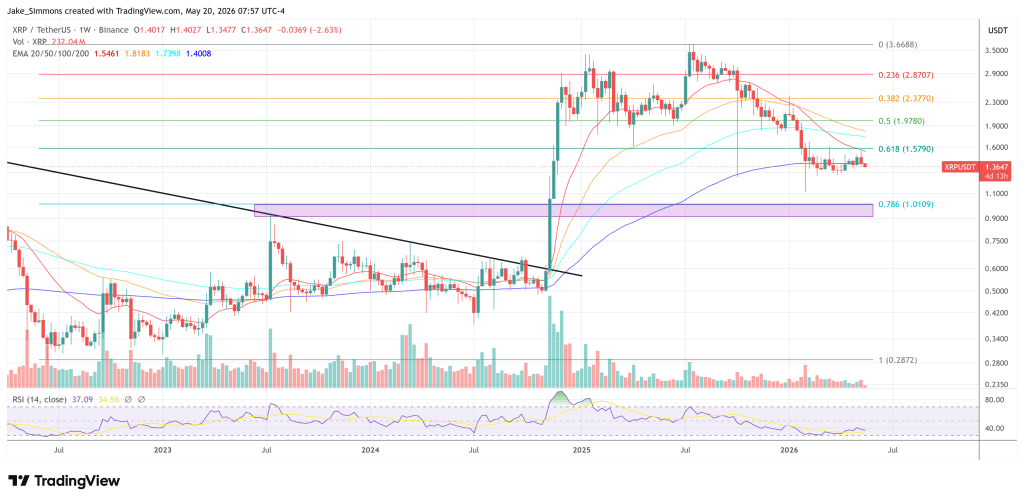
XRP bulls must break the 0.618 Fib, 1-week chart | Source: XRPUSDT on TradingView.com

Related Questions

QWhat specific action did President Trump's executive order request from the Federal Reserve regarding fintech and crypto firms?

AThe executive order requested the Federal Reserve to evaluate the legal, regulatory, and policy framework for access to Reserve Bank payment accounts and services by uninsured depository institutions and non-bank financial companies, including those engaged in digital assets. The Fed must submit its findings and recommendations within 120 days.

QWhy is the timing of Trump's executive order particularly notable for Ripple?

AThe timing is notable because Ripple, as part of its broader stablecoin and payments strategy, had applied for a US national bank charter and a Fed master account in July 2025. The order directly pushes the policy question of access to Fed infrastructure into a formal review timeline, which is central to Ripple's plans for its RLUSD stablecoin.

QWhich crypto company has already received a Federal Reserve master account, and what are its limitations?

AKraken Financial, the Wyoming-chartered banking arm of the Kraken exchange, received a Federal Reserve master account. It is a limited-purpose account granted initially for one year, providing access to Fedwire and limited overnight balances, but not interest on reserves, emergency Fed lending, FedNow, or ACH services.

QWhat is the 'skinny' account concept mentioned in relation to Ripple, and why was it considered attractive?

AThe 'skinny' account concept, or the Fed's proposed special-purpose 'payment account,' is a more limited access option. Ripple found it attractive because, despite restrictions like no interest and balance caps, it could still improve the redeemability of RLUSD reserves without granting the full benefits of a traditional master account.

QWhat was the outcome of Custodia Bank's legal battle with the Federal Reserve over a master account, and why is it relevant now?

ACustodia Bank applied for a master account in 2020, sued the Fed over delays in 2022, and had its application denied in 2023. Subsequent court decisions reinforced that Reserve Banks retain discretion to reject such requests. This legal backdrop is relevant because Trump's order explicitly asks the Fed to examine the issue of access and discretion.

Related Reads

Pricing OpenAI Pre-IPO: A New, Life-or-Death Business on Hyperliquid Lasting Half a Year

Pricing OpenAI Pre-IPO: Hyperliquid's High-Stakes, Six-Month Business Venture The article analyzes the nascent market for pre-IPO perpetual contracts on the Hyperliquid blockchain, exemplified by two contrasting teams: Trade.xyz and Ventuals. Trade.xyz, an anonymous team, successfully built the largest pre-market on Hyperliquid. Its strategy focused on near-term events, like the SpaceX IPO. By listing a SpaceX contract with a known launch date and price, the market had a tangible "anchor" (the eventual Nasdaq opening price) to converge upon, which kept speculation in check. This approach fueled significant growth. In stark contrast, Ventuals, backed by Paradigm, failed despite holding coveted contracts for OpenAI and Anthropic. Its critical flaw was its pricing mechanism for these companies, which have no imminent IPO. Ventuals' oracle price was half-derived from infrequent private market transactions and half from its own contract's moving average. This created a self-reinforcing loop where buying pressure artificially inflated the price, disconnecting it from real supply and demand. The market became illiquid and structurally skewed. Ventuals shut down nine months after launch, reportedly through an acquisition. Its final settlement prices—OpenAI at ~$1,341 and Anthropic at ~$1,618—were thus partially products of its flawed model. Ironically, some company employees and late-stage VCs reportedly used these prices for valuation reference, highlighting the desperate demand for price discovery in opaque private markets. The failure of Ventuals exposes the core challenge of this business: price for illiquid, non-public assets requires a robust, self-correcting market, which is absent without a definitive public listing event. Nevertheless, demand is driving major players like Coinbase and traditional finance (e.g., Citi) to enter the space, aiming to provide 24/7 trading for coveted private company shares. The venture's ultimate viability, however, hinges on solving the fundamental pricing problem Ventuals could not.

marsbit3m ago

Pricing OpenAI Pre-IPO: A New, Life-or-Death Business on Hyperliquid Lasting Half a Year

marsbit3m ago

M&A Deals in the Crypto Market Are Unusually Active

Title: M&A Activity in Crypto Market Becomes Unusually Active A rare signal is emerging in the crypto primary market: mergers and acquisitions (M&A) are nearing half of all financing deals. According to RootData, this month, M&A cases in the crypto industry reached 10, while financing rounds numbered only 14, meaning M&A accounts for approximately 42% of primary market transactions—the highest level in history. This does not signal a sudden industry boom. Instead, the rapid rise in M&A share primarily reflects the continued downturn in the financing market. Since November 2024, monthly crypto M&A deals have remained between 10-20, while financing deals have plummeted from around 100 to about 50, possibly hitting a new low this month. For project teams, this means the traditional path of relying on narratives, token expectations, and ecosystem subsidies to maintain valuations is narrowing. For leading companies, it presents a rare window to acquire teams, licenses, technology, liquidity, and market access at lower prices, with less competition and stronger bargaining power. Key active buyers include Coinbase, Kraken, Ripple, MoonPay, Polymarket, Kaiko, Sol Strategies, GSR, Keyrock, Jupiter, Paxos, and Ondo Finance. Their M&A logic is consistent: acquiring key capabilities at lower costs during the industry downturn. This is driven by more attractive valuations, reduced time and trial-and-error costs, the acquisition of licenses and compliance resources, and the integration of industry upstream and downstream segments. Current M&A focuses are concentrated in four areas: trading infrastructure (e.g., Coinbase acquiring Deribit, Kraken acquiring NinjaTrader), payments and stablecoins (e.g., MoonPay, Ripple expanding payment networks), compliance licenses, and asset issuance/distribution (e.g., acquisitions related to RWA and token issuance platforms like Coinbase's purchases of Liquifi and Echo). The rise in M&A is altering the primary market's exit logic. It provides an alternative path to the token-dependent model, encouraging teams to build tangible products, revenue, and strategic value that can be integrated. This could inject confidence into the market, showing that asset buyers and exit possibilities still exist, albeit with a stricter focus on real utility. However, this trend also indicates the crypto industry is becoming more centralized. As asset issuance, trading, market-making, custody, payments, and data gradually consolidate in the hands of a few major players, the industry's initial emphasis on openness and anti-monopoly is being reshaped by commercial realities. Coupled with rising compliance barriers, this signals the end of the low-barrier era for crypto entrepreneurship.

链捕手36m ago

M&A Deals in the Crypto Market Are Unusually Active

链捕手36m ago

M&A Deals Are Exceptionally Active in the Crypto Market

Mergers and acquisitions (M&A) activity in the cryptocurrency primary market has reached a historic high, accounting for approximately 42% of total deals in the current month, nearly matching the number of financing rounds. This shift does not signal a new boom cycle but rather reflects a severe contraction in the venture capital funding environment. As financing dwindles, established industry giants—including major exchanges, payment firms, and infrastructure providers—are seizing the opportunity to acquire strategic assets at lower valuations. Key drivers behind the surge in M&A include depressed project valuations, the need to quickly acquire talent and technology to capture short market windows, the pursuit of crucial regulatory licenses, and the strategic expansion into adjacent business verticals such as derivatives, payments, stablecoins, and real-world asset (RWA) issuance. Major acquisitions, like Coinbase's purchase of Deribit and Kraken's acquisition of NinjaTrader, exemplify the push to expand into high-margin areas like derivatives and multi-asset trading. This trend is reshaping the industry's exit landscape, offering an alternative to token-based exits and incentivizing startups to build tangible products and revenue streams with inherent strategic value for acquisition. However, it also points toward increasing centralization, as critical functions—trading, custody, payments, compliance—become concentrated within a few large, well-capitalized platforms, potentially raising barriers to entry for new ventures.

marsbit37m ago

M&A Deals Are Exceptionally Active in the Crypto Market

marsbit37m ago

Trading

Spot
Futures

Hot Articles

Discussions

Welcome to the HTX Community. Here, you can stay informed about the latest platform developments and gain access to professional market insights. Users' opinions on the price of S (S) are presented below.

活动图片