Are the "Magnificent Seven" No Longer Enough? SpaceX IPO Attracts Retail Frenzy, Wall Street Serves Up the "AI Tech Ten"

marsbitPublished on 2026-06-16Last updated on 2026-06-16

Abstract

The article discusses a potential shift in Wall Street's categorization of major tech stocks, driven by SpaceX's highly successful IPO. On its first day of trading, SpaceX attracted $117 million in net purchases from retail investors, accounting for 56% of all U.S. retail stock buys that day. This surge has prompted research firm Vanda to propose a new group called the "FAB 10" (Frontier AI & Big Tech 10). This concept suggests replacing the long-standing "Magnificent Seven" with ten companies believed to define the next decade of AI and technology. The proposed FAB 10 would include the original seven giants plus SpaceX and the yet-to-be-public AI firms OpenAI and Anthropic, both anticipated to go public later this year with valuations potentially reaching trillions. This contrasts with another proposed grouping, Bank of America's "AI Big 10," which adds semiconductor companies like Broadcom, AMD, and Micron to the core seven, focusing more on hardware. The divergence highlights different bets on the future drivers of tech growth. Analysts note that the massive influx of retail money into new listings like SpaceX might divert capital from other hot sectors, such as chip stocks, and warn that high valuations across the tech sector may indicate bubble risks.

Author: Claude, TechFlow Deep Tide

Deep Tide TechFlow Introduction:SpaceX's debut on Friday attracted $117 million in net retail purchases, accounting for 56% of the total U.S. retail stock buying that day. Based on this, research firm Vanda proposed the new "FAB 10" concept, advocating for replacing the long-standing "Magnificent Seven" with a frontier AI and tech top ten, including SpaceX, OpenAI, and Anthropic. The latter two are not yet public, but are expected to list later this year with valuations potentially exceeding a trillion dollars each.
SpaceX's market debut is rewriting the way Wall Street labels tech stocks.

According to a report released by Vanda Research last Sunday, cited by Cailian Press, the frenzy among retail investors for SpaceX's IPO last Friday was a huge success, sparking discussions in the market about redefining the entire tech industry. Prior to this, this fundraising round of approximately $75 billion was already the largest IPO on record. SpaceX priced its shares at $135 each, giving it a valuation of about $1.75 trillion, placing it among the world's ten most valuable publicly listed companies.

On SpaceX's Debut, Retail Buying Constituted 56% of the Day's Entire Market

Vanda's data quantifies this frenzy. The report stated that SpaceX attracted $117 million in net retail purchases on its first trading day, accounting for 56% of the total retail stock buying across the entire U.S. market that day.

This figure only reflects secondary market buying on the first day and does not include funds from retail investors who participated in the IPO allocation through brokers. Separate data indicates that retail investors ultimately received about 20% of the allocation in this $75 billion offering, above average; hedge funds got 10%, while long-term institutional investors took 70%.

The concentrated bets by retail investors are further channeling capital towards a handful of mega-cap tech companies. Vanda believes these companies are not only dominating stock market performance but are also driving the entire wave of tech investment.

Vanda: Replace the "Magnificent Seven" with the "FAB 10"

It is based on this judgment that Vanda proposed a new classification framework.

"If markets were dominated by the 'Magnificent Seven' over the past few years, then last Friday might be the clearest signal yet that investors are starting to focus on what we call the 'FAB 10'," Vanda wrote in the report. FAB 10 is short for Frontier AI & Big Tech 10, referring to the ten frontier AI and big tech giants.

According to Vanda's definition, the FAB 10 adds SpaceX, OpenAI, and Anthropic to the original seven giants. The latter two are not yet public, but the market expects them to enter the capital market later this year, with valuations potentially reaching hundreds of billions or even trillions of dollars.

Vanda's reasoning is straightforward: these companies collectively represent the direction of the AI and tech industry for the next decade.

The Same Concept, But Bank of America's Version is Different

Vanda is not the only player packaging mega-cap tech stocks into a new index.
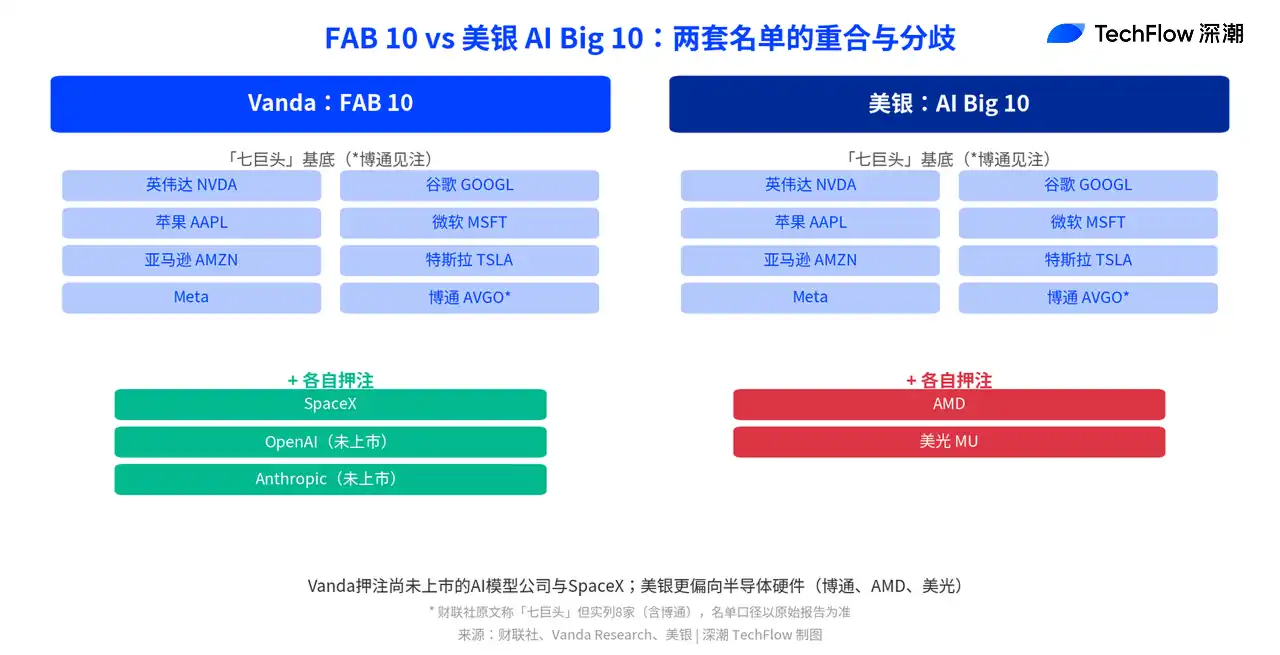
Bank of America's chief strategist, Michael Hartnett, previously proposed an "AI Big 10" portfolio in his "Guide to the Investment Universe." The difference from the FAB 10 lies in the stock selection: BofA's version is the Magnificent Seven plus Broadcom, AMD, and Micron, leaning more towards semiconductor hardware, while Vanda is betting on unlisted AI model companies and SpaceX.

The divergence between the two lists is essentially a different bet on "who defines the next ten years." One side favors the chipmakers, the other favors the model builders and rocket launchers.

Retail Floods into SpaceX, Chip Stocks May Suffer Capital Drain

The other side of the new concept is the redistribution of capital.

Vanda researchers noted that the fervor for SpaceX may be drawing funds away from other hot sectors, especially previously soaring chip stocks, which may be losing favor with retail investors. In other words, even within the FAB 10, favor might not be evenly spread; the capital-attracting effect of new entrants could come at the cost of pullbacks for older members.

However, analysts also caution that valuations across the tech sector are already showing signs of froth. SpaceX's IPO at a $1.75 trillion valuation itself is built on optimistic expectations for AI infrastructure. How long this optimism can last remains for the market to answer.


Related Questions

QWhat is the concept of 'FAB 10' proposed by Vanda Research, and which companies does it include?

AThe concept of 'FAB 10' (Frontier AI & Big Tech 10), proposed by Vanda Research, is a new classification framework aiming to replace the long-standing 'Magnificent Seven.' It includes the original seven tech giants (like Apple, Microsoft, etc.) and adds SpaceX, OpenAI, and Anthropic. These ten companies are seen as representing the direction of the AI and tech industry for the next decade.

QHow did retail investors contribute to SpaceX's IPO debut, and what was their market share?

AAccording to Vanda Research, on SpaceX's first day of trading, retail investors made a net purchase of $117 million, which accounted for 56% of all retail stock buying in the U.S. market that day. In the overall $75 billion IPO, retail investors ultimately received about 20% of the allocated shares, which is higher than the average allocation.

QWhat is the difference between Vanda's 'FAB 10' and Bank of America's 'AI Big 10' list?

AThe key difference lies in the selected companies. Vanda's 'FAB 10' includes the Magnificent Seven plus SpaceX, OpenAI, and Anthropic, focusing on AI models and space tech. Bank of America's 'AI Big 10' includes the Magnificent Seven plus Broadcom, AMD, and Micron, with a stronger emphasis on semiconductor hardware companies.

QWhat potential market impact does Vanda suggest the rise of 'FAB 10' might have?

AVanda suggests that the influx of capital into new members like SpaceX could draw funds away from other hot sectors. Specifically, semiconductor stocks, which previously experienced significant gains, might lose favor with retail investors. This indicates a potential redistribution of capital within the tech sector, where new entrants' success might come at the expense of older members' performance.

QWhat was SpaceX's valuation at its IPO, and what caution do analysts express regarding this?

ASpaceX went public with a valuation of approximately $1.75 trillion at a share price of $135, making it one of the top ten most valuable publicly traded companies globally. Analysts caution that this valuation, built on optimistic expectations for AI infrastructure, shows signs of a bubble in the overall tech sector, and its sustainability remains to be tested by the market.

Related Reads

Has the Crypto Market Bottomed? Here's What Institutions Think

The crypto market is in a period of significant debate, with leading institutions offering differing views on whether a bottom has been reached. Three prominent firms have published detailed analyses: * **Galaxy Digital** argues Bitcoin has **not yet bottomed**. Their analysis of 13 historical indicators across six dimensions (valuation, profit-taking, miner pressure, etc.) shows only four are fully met. They project a potential bottom range between $30k and $54k. * **NYDIG** states a bottom is **possible but not likely**. While metrics are close to historic bear market extremes, they note the absence of a classic panic-selling event. They also suggest increased institutional adoption may have structurally altered the market cycle, potentially leading to a shallower downturn. * **Standard Chartered Bank** asserts the **bottom has already occurred** at around $59k. They cite two key factors: potential US-Iran diplomatic progress and the anticipated SpaceX IPO, which they believe absorbed capital and caused ETF selling pressure that is now subsiding. They forecast a year-end price target of $100k. Despite the surface-level disagreement, the reports share critical common ground more valuable for long-term investors: 1. All three believe the market bottom will form **within this year**. 2. All agree the current price is **closer to the bottom than to previous highs**. 3. All maintain a **bullish long-term outlook** for Bitcoin and a new cycle. The core takeaway is that while the exact bottom price ($40k, $50k, or $60k) is debated, the consensus is that a bottom is imminent. For long-term holders, the primary focus should not be pinpointing the absolute low, but on the future potential for prices to reach $100k, $200k, or higher. The fundamental thesis for Bitcoin—sovereign debt accumulation, inflation, declining trust in centralized institutions, global digitization, and improved accessibility—remains intact and is arguably strengthening. The overall landscape is viewed as more favorable than in previous crypto winters.

marsbit8m ago

Has the Crypto Market Bottomed? Here's What Institutions Think

marsbit8m ago

The 'Chip' Challenge and Breakthroughs in China's Optical Industry Chain

China's Photonics Industry: Bottlenecks and Breakthroughs In the global AI race, computing chips dominate the narrative, but the underlying bottleneck increasingly defining the scale of AI clusters is light—or more specifically, optical connectivity. Optical modules, which translate electrical signals to light and vice versa, are crucial for connecting thousands of GPUs in AI data centers, preventing data congestion and ensuring efficient model training. High-speed modules (800G, 1.6T) are now standard, with performance hinging on advanced DSP (Digital Signal Processor) chips. This is where a critical dependency lies. Two US giants—Marvell and Broadcom—collectively dominate over 90% of the high-end DSP chip market. Chinese optical module leaders like Zhongji Innolight and Eoptolink rely on these chips to manufacture modules for overseas AI customers, primarily in North America. While this creates a supply chain vulnerability, complete decoupling is difficult. Marvell derives over half its revenue from Greater China, and the US firms depend on Chinese partners for chip packaging and optical components. The risk from laser chips (e.g., from Lumentum), another key component, is considered more manageable due to multiple global suppliers and faster progress in domestic alternatives from companies like YOFC and Accelink. To mitigate risks, China's industry is pursuing a multi-pronged strategy: diversifying supply chains and locking in long-term orders; fostering a domestic market ecosystem to adopt homegrown DSPs from firms like Huawei HiSilicon and CETC; accelerating R&D in high-speed DSPs and advanced packaging; and investing in next-gen technologies like silicon photonics and Co-Packaged Optics (CPO) to reduce reliance on discrete DSPs. The ultimate solution lies not in short-term博弈 but in persistent advancement of domestic high-end chip R&D and manufacturing. While challenges remain in performance, certification, and ecosystem building, China's vast domestic market and manufacturing base provide a crucial buffer, buying time for the industry to achieve greater technological independence.

marsbit22m ago

The 'Chip' Challenge and Breakthroughs in China's Optical Industry Chain

marsbit22m ago

Behind SpaceX's $2 Trillion Market Cap: Why Does Musk Always Have the Next Move Planned?

On June 12th, SpaceX debuted on the Nasdaq, reaching a valuation that briefly touched $2 trillion. This marked the culmination of a 24-year journey from its founding in 2002, driven by Elon Musk's frustration at the high cost of buying rockets. The company's path was defined by early failures, with its first three Falcon 1 launches ending in explosions before a successful 2008 flight opened the era of commercial spaceflight. Key to its model was a fixed-price NASA contract, incentivizing cost reduction. SpaceX mastered rocket reusability, first achieving a Falcon 9 landing in 2015, which drastically cut launch costs. This enabled its profitable Starlink satellite internet constellation, envisioned years before reusability was proven, to create an internal market for frequent launches. Similarly, the next-generation Starship rocket was in development long before its first flight, with its business case evolving from Mars colonization to supporting the emerging concept of in-orbit data centers for AI—a story now central to its valuation. The company's recent IPO, a reversal of its long-standing "no IPO" stance, is funding this ambitious "space-based compute" vision. While major tech players like Google, Blue Origin, and others are investing heavily, significant technical and cost hurdles remain. Ultimately, SpaceX's history is one of creating its own demand: first with Starlink and now with space-based AI compute, betting that its next rocket will enable its next giant market.

marsbit25m ago

Behind SpaceX's $2 Trillion Market Cap: Why Does Musk Always Have the Next Move Planned?

marsbit25m ago

When Crypto Meets the World Cup: CoinW and Modrić's Art of "Navigating Cycles"

When Encryption Meets the World Cup: CoinW and Modrić's "Transcending Cycles" Philosophy In the context of the 2026 FIFA World Cup and its massive global audience, the crypto exchange CoinW announced football legend Luka Modrić as its global brand ambassador. This move is framed not merely as a marketing tactic, but as a strategic experiment in user profile migration. It targets mature, financially stable football fans—particularly in Europe, Southeast Asia, and Latin America—who traditionally have low crypto awareness but value trusted, time-tested authority figures like Modrić. The article draws parallels between Modrić's enduring, disciplined career—marked by consistency and success at the highest level over two decades—and CoinW's own development path. Founded in 2017 during a volatile industry period, CoinW focused on building robust infrastructure and risk management. It weathered the 2022 industry crisis without major security incidents, subsequently earning recognition like "Europe's Most Trusted Exchange" and growing to over 20 million registered users. This "long-termism" is translated into user-centric products. CoinW Academy lowers the initial knowledge barrier. Its integrated ecosystem (CoinW, GemW, DeriW, PropW) and the recent launch of a TradFi section—offering perpetual contracts on traditional assets like stocks, gold, and oil—aim to create a unified platform for diverse assets. For the World Cup, CoinW launched the "We Are The Game" campaign, collaborating with Alchemy Pay to offer zero-fee deposits and local payment options, aiming to transform spectators into participants and lower entry barriers. Ultimately, CoinW's sports partnerships and product strategy are presented as a concerted effort to build trust and accessibility for the "silent majority" still outside crypto—shifting the industry narrative toward inclusivity and long-term value.

Foresight News31m ago

When Crypto Meets the World Cup: CoinW and Modrić's Art of "Navigating Cycles"

Foresight News31m ago

Trading

Spot
Futures

Hot Articles

Discussions

Welcome to the HTX Community. Here, you can stay informed about the latest platform developments and gain access to professional market insights. Users' opinions on the price of S (S) are presented below.

活动图片














