CFTC sues Illinois in case that could decide how prediction markets scale in the U.S.

ambcryptoPublished on 2026-04-02Last updated on 2026-04-02

Abstract

The Commodity Futures Trading Commission (CFTC) has sued the State of Illinois, escalating a legal battle that could determine the regulatory future of prediction markets in the U.S. The lawsuit, filed on April 2, challenges Illinois' cease-and-desist orders against platforms like Kalshi and Polymarket, which the state considers unlicensed sports betting. The CFTC argues these event contracts are swaps under federal jurisdiction, preempting state regulation under the Commodity Exchange Act and the Supremacy Clause. This case tests whether prediction markets will develop as a unified financial system under federal oversight or face a fragmented, state-by-state regulatory landscape that could hinder their growth and nationwide access. The outcome may define if these platforms become core financial infrastructure or remain constrained like state-regulated gambling.

The Commodity Futures Trading Commission and the U.S. government have filed a lawsuit against the State of Illinois.

The move escalates a legal dispute that could determine whether prediction markets develop as a unified financial system or remain subject to state-level restrictions.

The complaint, filed on 2 April, challenges actions by Illinois regulators who issued cease-and-desist orders against platforms including Kalshi, Crypto.com, Robinhood, and Polymarket, arguing that the offerings constitute unlicensed sports wagering.

Illinois crackdown triggers federal response

Illinois authorities have treated event-based contracts as gambling products, requiring operators to obtain state licenses. The move forms part of a broader push by several states to assert oversight over prediction markets.

However, federal regulators argue that these contracts fall squarely within the scope of derivatives markets.

Federal regulators claim exclusive authority

In the filing, the CFTC asserts that event contracts qualify as swaps under the Commodity Exchange Act, placing them under federal jurisdiction.

The agency argues that Congress granted it exclusive authority over such instruments, preempting state-level regulation.

The lawsuit also invokes the Supremacy Clause. It states that Illinois’ actions interfere with a federally regulated market and risk undermining uniform access nationwide.

Federal stance builds on earlier push for control

The move follows earlier signals from the CFTC indicating its intent to defend its authority over prediction markets.

In February, the agency filed an amicus brief in a separate case, arguing that such contracts fall under federal commodities law rather than state gambling statutes.

At the time, CFTC Chair Mike Selig warned of an “onslaught of state-led litigation”. He said the commission would defend its jurisdiction in court.

The latest filing against Illinois marks an escalation from legal support to direct enforcement action. It reinforces the agency’s position that prediction markets are a long-standing part of U.S. derivatives oversight.

A test of market structure, not just classification

While much of the debate has focused on whether prediction markets resemble gambling or financial products, the case carries broader implications for how these platforms operate at scale.

If state regulators are allowed to impose their own rules, prediction markets could face a fragmented environment where access varies by jurisdiction.

That could limit participation, complicate compliance, and constrain growth for platforms operating nationally.

Conversely, a federal victory would reinforce a single regulatory framework. It would allow event-based contracts to function more like traditional derivatives markets with nationwide access.

Industry caught between growth and regulation

The dispute comes as prediction markets continue to expand, drawing attention from both regulators and institutional participants.

Recent data shows trading volumes across platforms have surged, reflecting growing demand for contracts tied to real-world events. That growth has also increased scrutiny, with regulators focusing on issues ranging from market integrity to classification.

The outcome of this case may ultimately determine whether prediction markets evolve into a core component of financial infrastructure or remain subject to the same constraints as state-regulated betting markets.


Final Summary

  • The CFTC’s lawsuit against Illinois could shape whether prediction markets operate under a unified federal framework or face fragmented state-level rules.
  • The outcome may determine how quickly these platforms scale as financial infrastructure in the U.S.


Trending Cryptos

Related Questions

QWhat is the main legal dispute between the CFTC and the State of Illinois about?

AThe dispute is over whether prediction market contracts constitute unlicensed sports wagering under state law or if they are derivatives (swaps) that fall under exclusive federal jurisdiction of the CFTC.

QWhich specific companies did Illinois regulators issue cease-and-desist orders against?

AIllinois regulators issued orders against platforms including Kalshi, Crypto.com, Robinhood, and Polymarket.

QWhat is the CFTC's main legal basis for claiming exclusive authority over prediction markets?

AThe CFTC asserts that event contracts qualify as swaps under the Commodity Exchange Act, placing them under federal jurisdiction, and it invokes the Supremacy Clause, arguing that state-level regulation interferes with a federally regulated market.

QWhat broader implication does this case have for the operation of prediction markets in the U.S.?

AThe case will determine if prediction markets operate under a single, unified federal regulatory framework with nationwide access or face a fragmented environment with varying state-level rules that could limit participation and constrain growth.

QHow did the CFTC's action in this case represent an escalation from its previous stance?

AThe CFTC escalated from filing a supporting amicus brief in a separate case in February to taking direct enforcement action by filing this lawsuit against the state of Illinois in April.

Related Reads

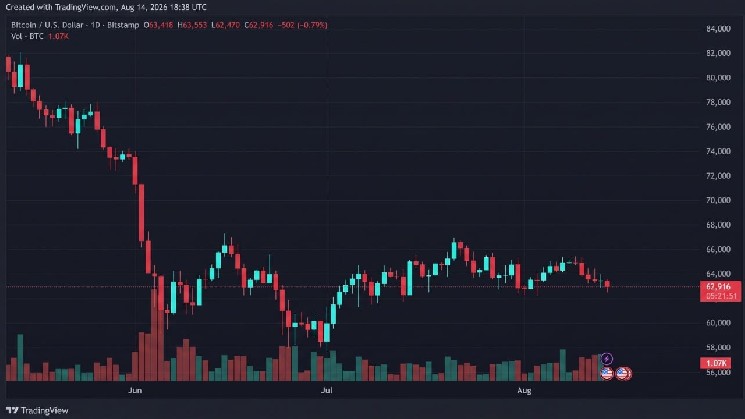
Bitcoin Price Drops to $62,470 as Sellers Retest $63,000 Support Level

Bitcoin's price fell below $63,000 for a second consecutive day on Friday, hitting an intraday low of $62,470. The cryptocurrency later recovered to trade just above $63,000, leaving it nearly flat for the past 24 hours and for August overall, with a weekly loss of 2.6%. The volatility triggered significant liquidations, with $26 million of leveraged long Bitcoin positions liquidated over 24 hours. Market sentiment was further dampened by data showing over $131 million in outflows from spot Bitcoin ETFs for a second straight day, signaling a potential pullback by institutional investors. Adding to the negative pressure, index provider MSCI has proposed new criteria for "non-operating companies" in its global indexes, which could lead to the exclusion of firms holding significant digital assets like Bitcoin on their balance sheets. Companies such as Strategy and Metaplanet could be affected, potentially forcing index-tracking funds to sell their shares. Strategy publicly criticized the proposal, arguing digital assets are legitimate assets and index providers should not dictate what companies can own. Public consultations on MSCI's proposal end September 30, with a final decision expected by October 16. If approved, exclusions could begin in November, potentially triggering sustained institutional selling and damaging a key bridge for Bitcoin adoption in the corporate sector.

cryptonews.ru5h ago

Bitcoin Price Drops to $62,470 as Sellers Retest $63,000 Support Level

cryptonews.ru5h ago

Trading

Spot

Hot Articles

How to Buy LA

Welcome to HTX.com! We've made purchasing Lagrange (LA) simple and convenient. Follow our step-by-step guide to embark on your crypto journey.Step 1: Create Your HTX AccountUse your email or phone number to sign up for a free account on HTX. Experience a hassle-free registration journey and unlock all features.Get My AccountStep 2: Go to Buy Crypto and Choose Your Payment MethodCredit/Debit Card: Use your Visa or Mastercard to buy Lagrange (LA) instantly.Balance: Use funds from your HTX account balance to trade seamlessly.Third Parties: We've added popular payment methods such as Google Pay and Apple Pay to enhance convenience.P2P: Trade directly with other users on HTX.Over-the-Counter (OTC): We offer tailor-made services and competitive exchange rates for traders.Step 3: Store Your Lagrange (LA)After purchasing your Lagrange (LA), store it in your HTX account. Alternatively, you can send it elsewhere via blockchain transfer or use it to trade other cryptocurrencies.Step 4: Trade Lagrange (LA)Easily trade Lagrange (LA) on HTX's spot market. Simply access your account, select your trading pair, execute your trades, and monitor in real-time. We offer a user-friendly experience for both beginners and seasoned traders.

6.8k Total ViewsPublished 2025.06.04Updated 2026.06.02

How to Buy LA

Discussions

Welcome to the HTX Community. Here, you can stay informed about the latest platform developments and gain access to professional market insights. Users' opinions on the price of LA (LA) are presented below.

活动图片