Jito surges on 1000% volume spike – Will volatility stall JTO’s rally?

ambcryptoОпубликовано 2026-03-24Обновлено 2026-03-24

Введение

Jito (JTO) surged 15.96% to $0.3314 with a 1000% spike in trading volume, indicating strong spot demand and renewed market interest. The price exited a descending channel, reclaiming the $0.2775 support and approaching the next resistance at $0.3376. RSI at 63 supports further upside without being overbought. However, spot taker CVD remains sell-dominant, suggesting profit-taking by retail traders. Open Interest surged 89.51%, reflecting increased leveraged positions that could fuel volatility. The breakout shows strength, but sustainability depends on whether buying demand absorbs selling pressure. If not, leveraged unwinding may trigger a sharp pullback.

Jito [JTO] has surged 15.96% to $0.3314 at press time, as trading volume exploded over 1000%, signaling a sharp influx of spot demand and renewed market participation. This expansion reflects a sudden shift in activity as buyers aggressively step in after a period of consolidation.

Notably, such volume growth does not emerge gradually; it reflects urgency and conviction from participants entering at scale. As a result, price has responded with a clean upward push, reinforcing the strength behind the move.

However, this surge also places JTO in a high-attention zone, where rapid inflows can accelerate both upside continuation and volatility depending on how follow-through demand evolves.

JTO breakout holds as RSI confirms strength

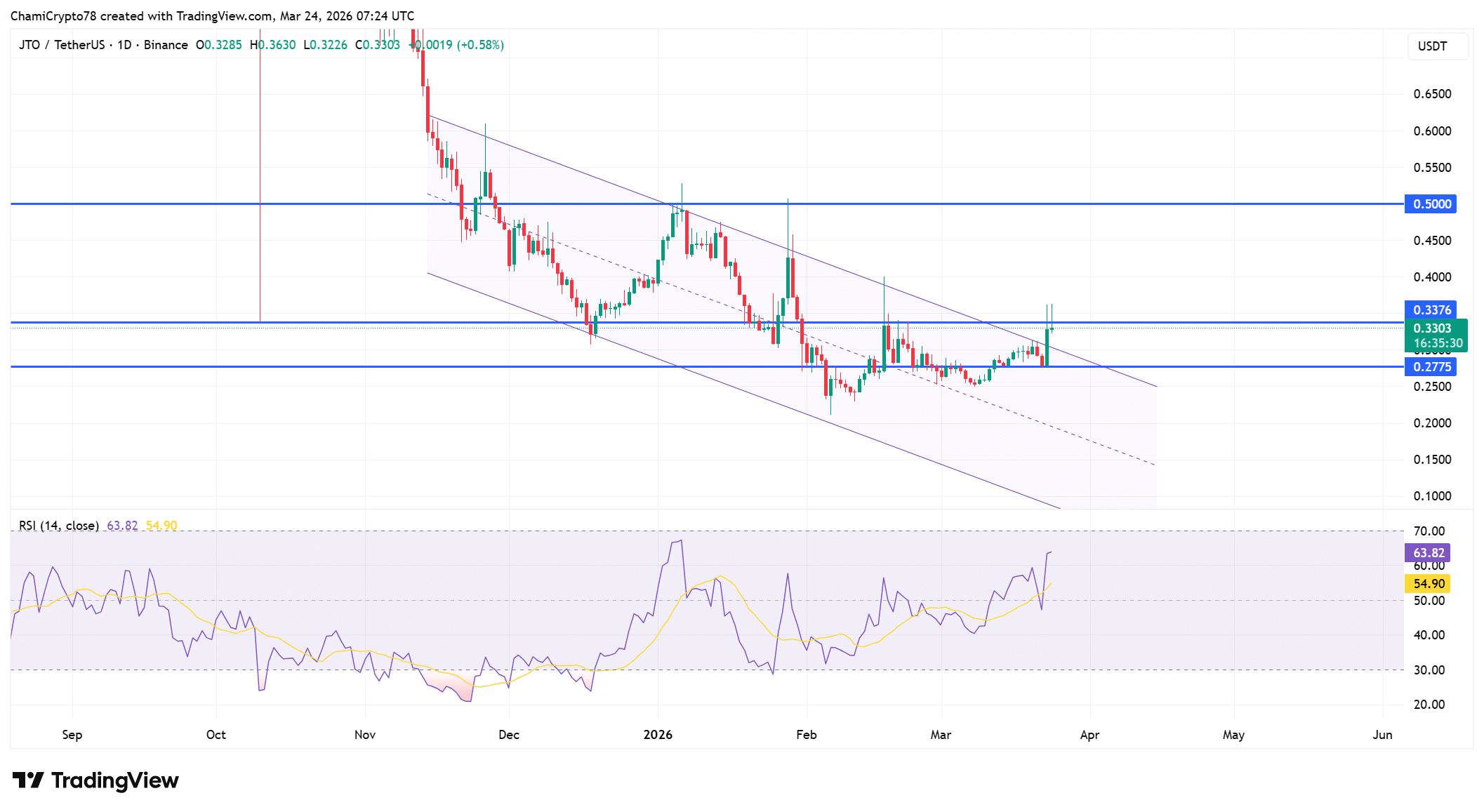
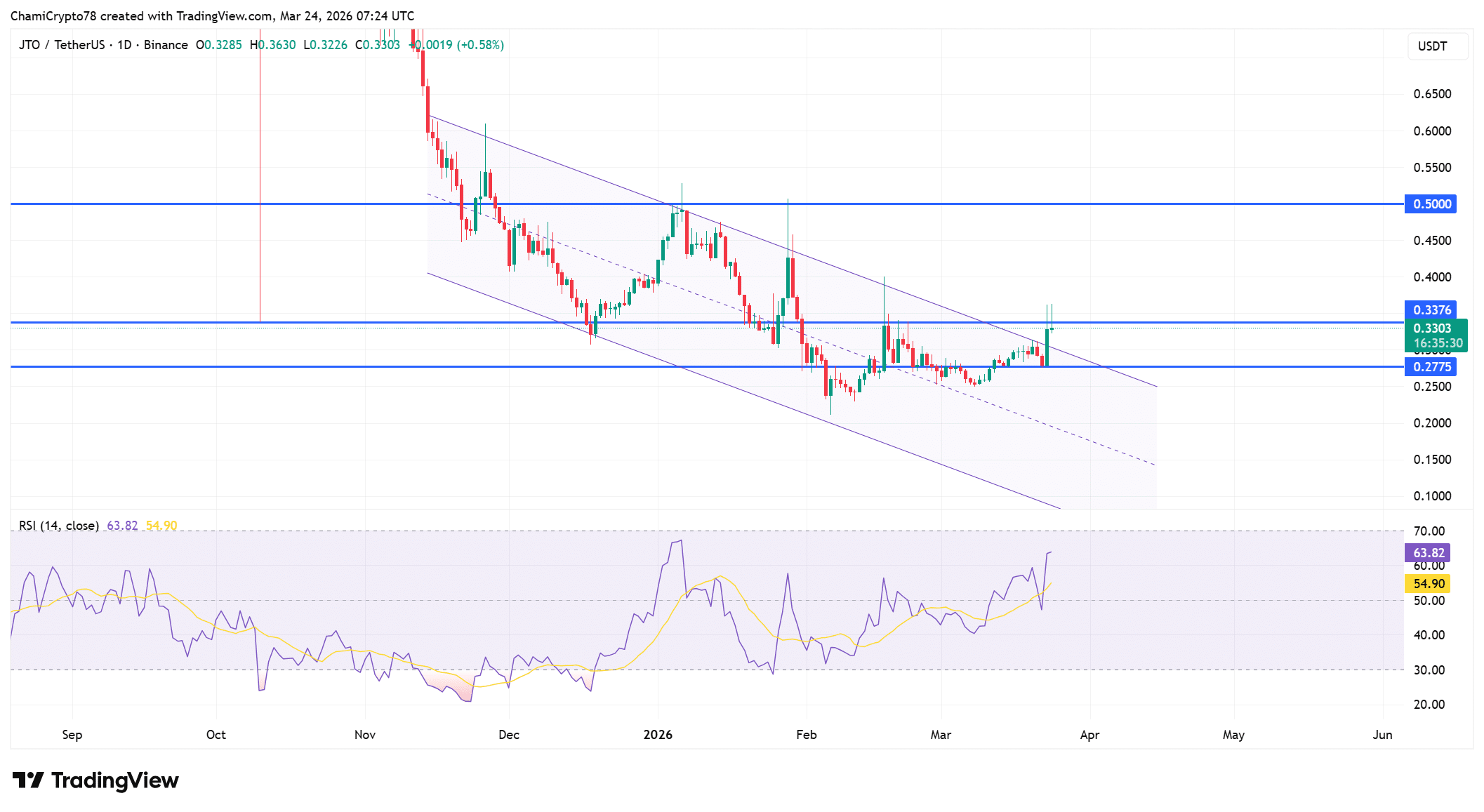
JTO has broken out of its descending channel after reclaiming the $0.2775 support, signaling a clear shift in short-term structure as buyers take control. This move reflects a transition from compression into expansion, with price no longer respecting the prior downward boundaries.

As a result, JTO now presses into the $0.3376 resistance, which acts as the next key level in this structure. At the same time, RSI has climbed toward 63 as of writing, reinforcing the strength behind this breakout without entering overbought territory. This positioning shows that the rally still has room to extend while maintaining stability.

Additionally, RSI has moved above its moving average, aligning with current price behavior and supporting continuation. However, holding above the breakout zone remains critical, as failure at this level could weaken the structure and pull the price back toward consolidation.
Source: TradingView

Sell pressure rises as retail locks profits

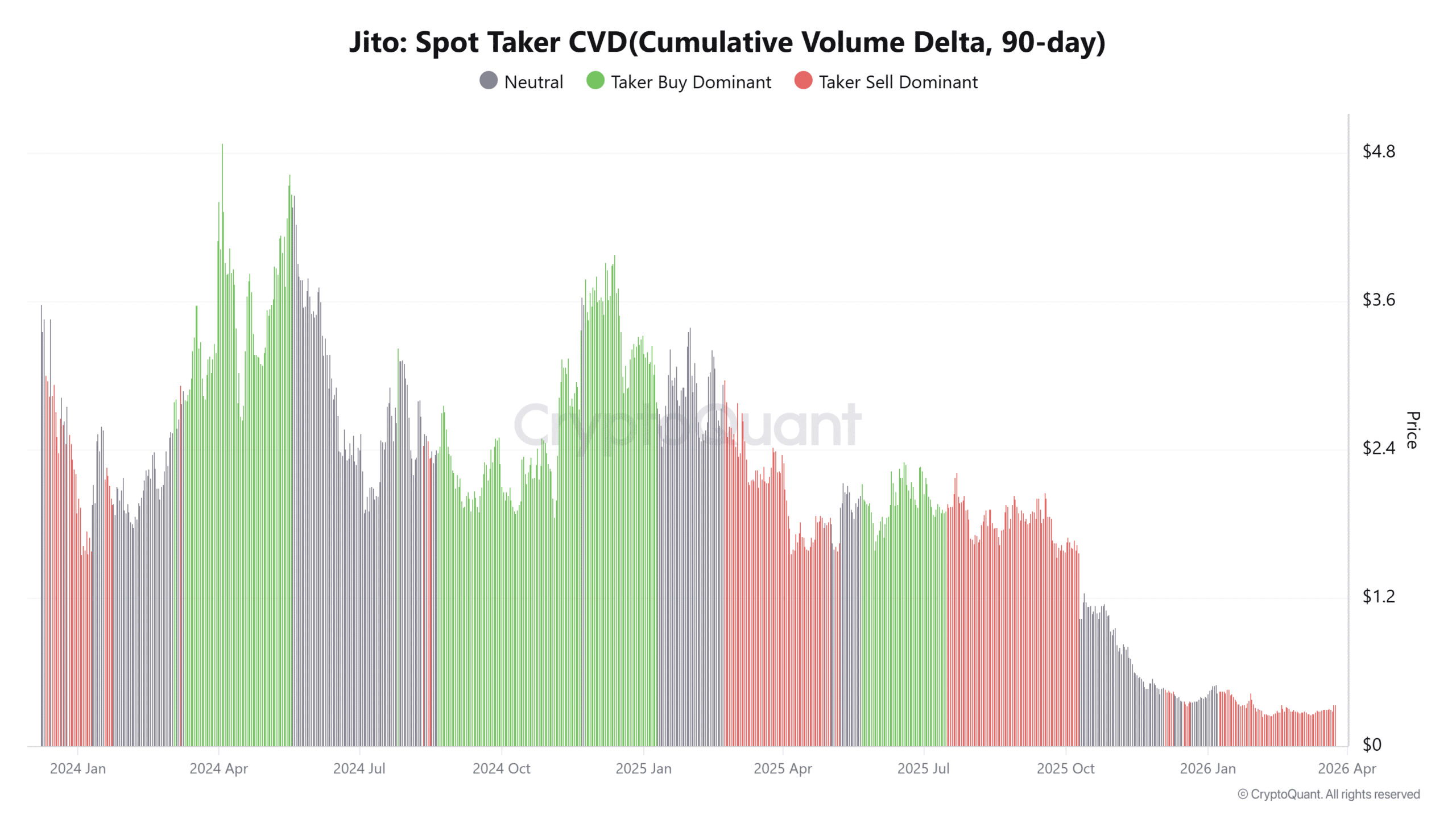
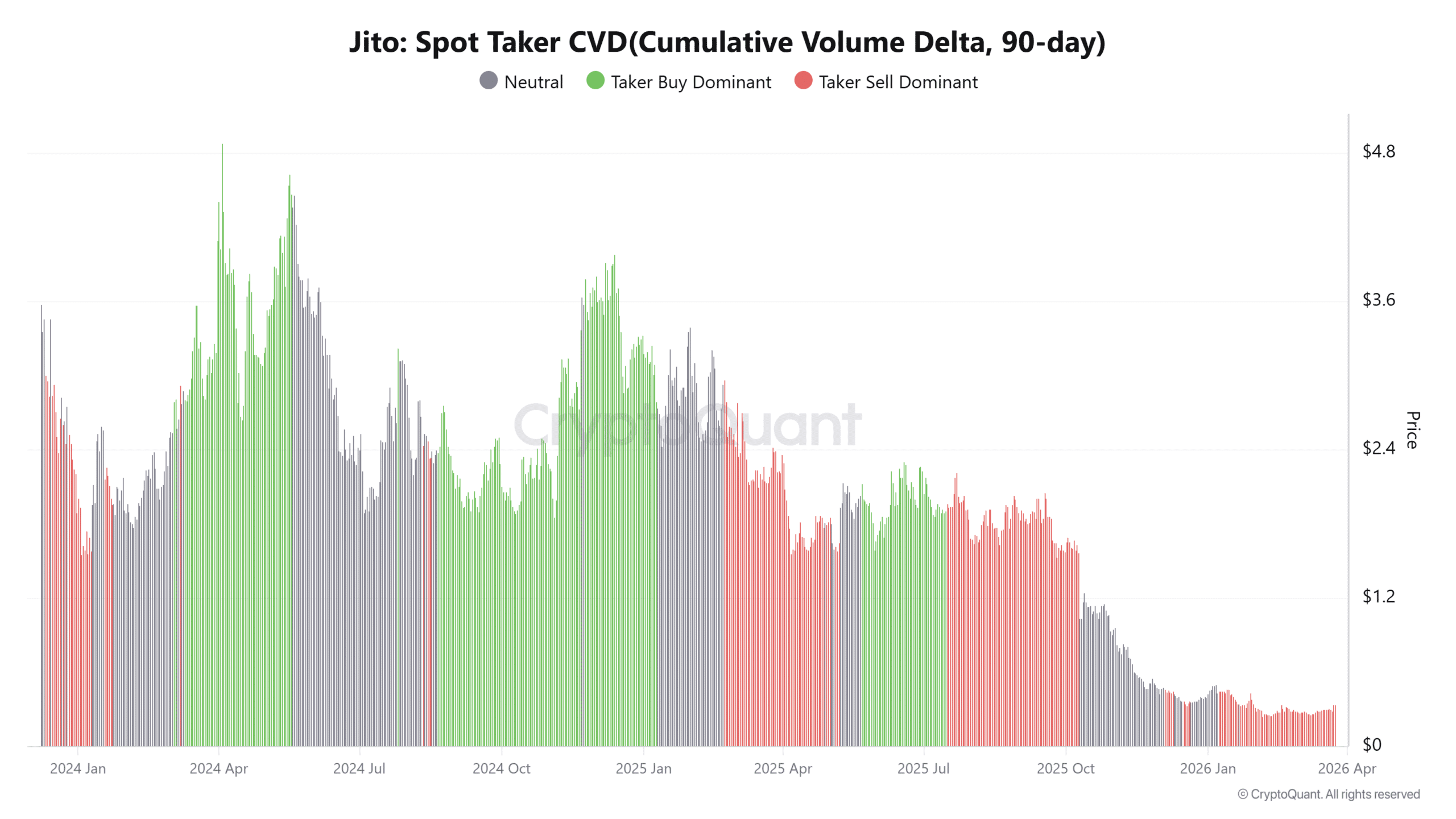
Despite the price breakout, Spot Taker CVD remains sell-dominant, revealing that market orders continue to lean toward selling rather than buying. This divergence highlights a key dynamic where price rises even as participants take profits into strength.

Such behavior often reflects retail traders exiting positions after the rally, while stronger hands absorb the supply. As a result, the ongoing move depends heavily on whether this selling pressure gets absorbed efficiently.

However, if sell dominance persists without sufficient demand, it could slow the rally and limit further upside expansion.
Source: CryptoQuant

Leverage builds fast as JTO open interest surges

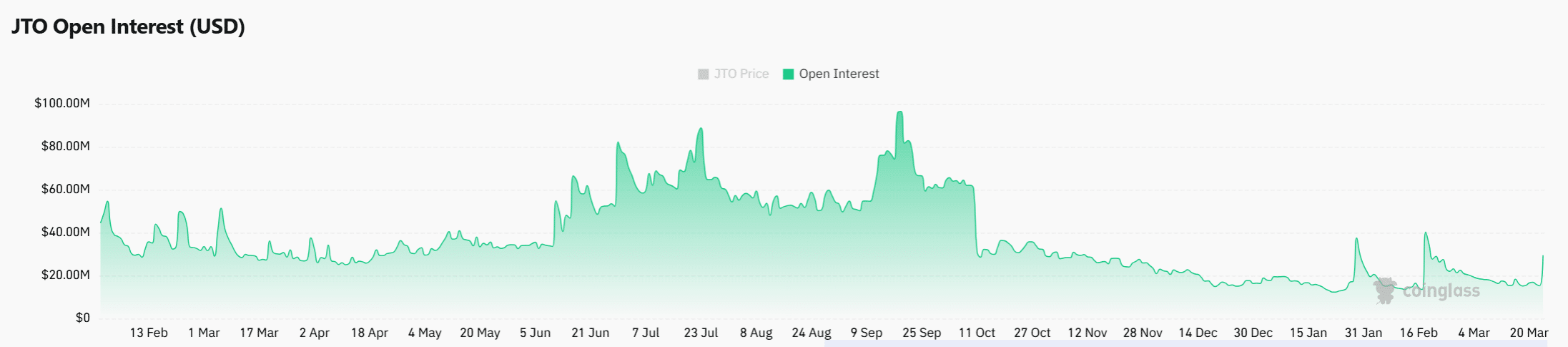
Open Interest (OI) has surged 89.51% to $28.97 million, indicating a sharp rise in leveraged positioning as traders enter the market aggressively. This increase reflects growing participation in derivatives, typically aligning with strong directional expectations.

As price and OI rise together, it suggests that traders are building positions anticipating continued upside. However, such rapid expansion also introduces risk, as crowded positioning can amplify volatility.

If prices continue higher, these positions could fuel further upside through forced liquidations. On the other hand, if price stalls near resistance, the same leverage could unwind quickly, triggering sharp downside moves driven by liquidations and position closures.
Source: CoinGlass

Conclusively, JTO’s breakout reflects strong structural recovery supported by volume expansion and rising leverage. However, sell-dominant order flow signals active profit-taking that could cap upside if demand weakens.

If buyers continue absorbing selling pressure, the breakout would likely sustain and extend higher. If not, the buildup in leveraged positions could accelerate a sharp pullback from current resistance levels.


Final Summary

  • JTO’s breakout reflects strong buyer control, but sustainability depends on absorbing persistent sell-side pressure near resistance.
  • Rising leverage alongside price would amplify gains, yet it also increases the risk of sharp liquidation-driven downside moves.


Связанные с этим вопросы

QWhat is the current price of Jito (JTO) and by what percentage has it surged at press time?

AJito (JTO) is currently priced at $0.3314, representing a surge of 15.96% at press time.

QWhat key technical indicator is used to confirm the strength of JTO's breakout, and what is its current value?

AThe Relative Strength Index (RSI) is used to confirm the strength of the breakout, and it has climbed toward a value of 63, indicating strength without being overbought.

QDespite the price increase, what does the Spot Taker CVD data reveal about market orders?

AThe Spot Taker CVD data reveals that market orders remain sell-dominant, indicating that participants are taking profits into strength.

QHow much has Open Interest (OI) increased, and what does this surge indicate?

AOpen Interest (OI) has surged by 89.51% to $28.97 million, indicating a sharp rise in leveraged positioning as traders enter the market aggressively.

QWhat are the two main factors that could lead to a sharp downside move in JTO's price according to the conclusion?

AAccording to the conclusion, a sharp downside move could be triggered if buyers fail to continue absorbing selling pressure, or if the buildup in leveraged positions unwinds quickly due to prices stalling near resistance.

Похожее

Has the Crypto Market Bottomed? Here's What Institutions Think

The crypto market is in a period of significant debate, with leading institutions offering differing views on whether a bottom has been reached. Three prominent firms have published detailed analyses: * **Galaxy Digital** argues Bitcoin has **not yet bottomed**. Their analysis of 13 historical indicators across six dimensions (valuation, profit-taking, miner pressure, etc.) shows only four are fully met. They project a potential bottom range between $30k and $54k. * **NYDIG** states a bottom is **possible but not likely**. While metrics are close to historic bear market extremes, they note the absence of a classic panic-selling event. They also suggest increased institutional adoption may have structurally altered the market cycle, potentially leading to a shallower downturn. * **Standard Chartered Bank** asserts the **bottom has already occurred** at around $59k. They cite two key factors: potential US-Iran diplomatic progress and the anticipated SpaceX IPO, which they believe absorbed capital and caused ETF selling pressure that is now subsiding. They forecast a year-end price target of $100k. Despite the surface-level disagreement, the reports share critical common ground more valuable for long-term investors: 1. All three believe the market bottom will form **within this year**. 2. All agree the current price is **closer to the bottom than to previous highs**. 3. All maintain a **bullish long-term outlook** for Bitcoin and a new cycle. The core takeaway is that while the exact bottom price ($40k, $50k, or $60k) is debated, the consensus is that a bottom is imminent. For long-term holders, the primary focus should not be pinpointing the absolute low, but on the future potential for prices to reach $100k, $200k, or higher. The fundamental thesis for Bitcoin—sovereign debt accumulation, inflation, declining trust in centralized institutions, global digitization, and improved accessibility—remains intact and is arguably strengthening. The overall landscape is viewed as more favorable than in previous crypto winters.

marsbit5 мин. назад

Has the Crypto Market Bottomed? Here's What Institutions Think

marsbit5 мин. назад

The 'Chip' Challenge and Breakthroughs in China's Optical Industry Chain

China's Photonics Industry: Bottlenecks and Breakthroughs In the global AI race, computing chips dominate the narrative, but the underlying bottleneck increasingly defining the scale of AI clusters is light—or more specifically, optical connectivity. Optical modules, which translate electrical signals to light and vice versa, are crucial for connecting thousands of GPUs in AI data centers, preventing data congestion and ensuring efficient model training. High-speed modules (800G, 1.6T) are now standard, with performance hinging on advanced DSP (Digital Signal Processor) chips. This is where a critical dependency lies. Two US giants—Marvell and Broadcom—collectively dominate over 90% of the high-end DSP chip market. Chinese optical module leaders like Zhongji Innolight and Eoptolink rely on these chips to manufacture modules for overseas AI customers, primarily in North America. While this creates a supply chain vulnerability, complete decoupling is difficult. Marvell derives over half its revenue from Greater China, and the US firms depend on Chinese partners for chip packaging and optical components. The risk from laser chips (e.g., from Lumentum), another key component, is considered more manageable due to multiple global suppliers and faster progress in domestic alternatives from companies like YOFC and Accelink. To mitigate risks, China's industry is pursuing a multi-pronged strategy: diversifying supply chains and locking in long-term orders; fostering a domestic market ecosystem to adopt homegrown DSPs from firms like Huawei HiSilicon and CETC; accelerating R&D in high-speed DSPs and advanced packaging; and investing in next-gen technologies like silicon photonics and Co-Packaged Optics (CPO) to reduce reliance on discrete DSPs. The ultimate solution lies not in short-term博弈 but in persistent advancement of domestic high-end chip R&D and manufacturing. While challenges remain in performance, certification, and ecosystem building, China's vast domestic market and manufacturing base provide a crucial buffer, buying time for the industry to achieve greater technological independence.

marsbit19 мин. назад

The 'Chip' Challenge and Breakthroughs in China's Optical Industry Chain

marsbit19 мин. назад

Behind SpaceX's $2 Trillion Market Cap: Why Does Musk Always Have the Next Move Planned?

On June 12th, SpaceX debuted on the Nasdaq, reaching a valuation that briefly touched $2 trillion. This marked the culmination of a 24-year journey from its founding in 2002, driven by Elon Musk's frustration at the high cost of buying rockets. The company's path was defined by early failures, with its first three Falcon 1 launches ending in explosions before a successful 2008 flight opened the era of commercial spaceflight. Key to its model was a fixed-price NASA contract, incentivizing cost reduction. SpaceX mastered rocket reusability, first achieving a Falcon 9 landing in 2015, which drastically cut launch costs. This enabled its profitable Starlink satellite internet constellation, envisioned years before reusability was proven, to create an internal market for frequent launches. Similarly, the next-generation Starship rocket was in development long before its first flight, with its business case evolving from Mars colonization to supporting the emerging concept of in-orbit data centers for AI—a story now central to its valuation. The company's recent IPO, a reversal of its long-standing "no IPO" stance, is funding this ambitious "space-based compute" vision. While major tech players like Google, Blue Origin, and others are investing heavily, significant technical and cost hurdles remain. Ultimately, SpaceX's history is one of creating its own demand: first with Starlink and now with space-based AI compute, betting that its next rocket will enable its next giant market.

marsbit22 мин. назад

Behind SpaceX's $2 Trillion Market Cap: Why Does Musk Always Have the Next Move Planned?

marsbit22 мин. назад

When Crypto Meets the World Cup: CoinW and Modrić's Art of "Navigating Cycles"

When Encryption Meets the World Cup: CoinW and Modrić's "Transcending Cycles" Philosophy In the context of the 2026 FIFA World Cup and its massive global audience, the crypto exchange CoinW announced football legend Luka Modrić as its global brand ambassador. This move is framed not merely as a marketing tactic, but as a strategic experiment in user profile migration. It targets mature, financially stable football fans—particularly in Europe, Southeast Asia, and Latin America—who traditionally have low crypto awareness but value trusted, time-tested authority figures like Modrić. The article draws parallels between Modrić's enduring, disciplined career—marked by consistency and success at the highest level over two decades—and CoinW's own development path. Founded in 2017 during a volatile industry period, CoinW focused on building robust infrastructure and risk management. It weathered the 2022 industry crisis without major security incidents, subsequently earning recognition like "Europe's Most Trusted Exchange" and growing to over 20 million registered users. This "long-termism" is translated into user-centric products. CoinW Academy lowers the initial knowledge barrier. Its integrated ecosystem (CoinW, GemW, DeriW, PropW) and the recent launch of a TradFi section—offering perpetual contracts on traditional assets like stocks, gold, and oil—aim to create a unified platform for diverse assets. For the World Cup, CoinW launched the "We Are The Game" campaign, collaborating with Alchemy Pay to offer zero-fee deposits and local payment options, aiming to transform spectators into participants and lower entry barriers. Ultimately, CoinW's sports partnerships and product strategy are presented as a concerted effort to build trust and accessibility for the "silent majority" still outside crypto—shifting the industry narrative toward inclusivity and long-term value.

Foresight News27 мин. назад

When Crypto Meets the World Cup: CoinW and Modrić's Art of "Navigating Cycles"

Foresight News27 мин. назад

Торговля

Спот
Фьючерсы

Популярные статьи

Как купить JTO

Добро пожаловать на HTX.com! Мы сделали приобретение Jito (JTO) простым и удобным. Следуйте нашему пошаговому руководству и отправляйтесь в свое крипто-путешествие.Шаг 1: Создайте аккаунт на HTXИспользуйте свой адрес электронной почты или номер телефона, чтобы зарегистрироваться и бесплатно создать аккаунт на HTX. Пройдите удобную регистрацию и откройте для себя весь функционал.Создать аккаунтШаг 2: Перейдите в Купить криптовалюту и выберите свой способ оплатыКредитная/Дебетовая Карта: Используйте свою карту Visa или Mastercard для мгновенной покупки Jito (JTO).Баланс: Используйте средства с баланса вашего аккаунта HTX для простой торговли.Третьи Лица: Мы добавили популярные способы оплаты, такие как Google Pay и Apple Pay, для повышения удобства.P2P: Торгуйте напрямую с другими пользователями на HTX.Внебиржевая Торговля (OTC): Мы предлагаем индивидуальные услуги и конкурентоспособные обменные курсы для трейдеров.Шаг 3: Хранение Jito (JTO)После приобретения вами Jito (JTO) храните их в своем аккаунте на HTX. В качестве альтернативы вы можете отправить их куда-либо с помощью перевода в блокчейне или использовать для торговли с другими криптовалютами.Шаг 4: Торговля Jito (JTO)С легкостью торгуйте Jito (JTO) на спотовом рынке HTX. Просто зайдите в свой аккаунт, выберите торговую пару, совершайте сделки и следите за ними в режиме реального времени. Мы предлагаем удобный интерфейс как для начинающих, так и для опытных трейдеров.

370 просмотров всегоОпубликовано 2024.04.12Обновлено 2026.06.02

Как купить JTO

Обсуждения

Добро пожаловать в Сообщество HTX. Здесь вы сможете быть в курсе последних новостей о развитии платформы и получить доступ к профессиональной аналитической информации о рынке. Мнения пользователей о цене на JTO (JTO) представлены ниже.

活动图片