Crypto market’s weekly winners and losers – KAIA, CC, ENA, ARB

ambcryptoPublished on 2026-01-25Last updated on 2026-01-25

Abstract

Bitcoin (BTC) fell 6% this week, while Ethereum (ETH) dropped 10%, marking their first significant weekly losses this year. Despite the downturn, the market reaction varied, with some cryptocurrencies posting gains. Weekly winners included Kaia (KAIA), which surged mid-week before a 20% pullback due to profit-taking, though its bullish structure remained intact. Canton Network (CC) defied the broader privacy coin decline with a 36% rally. MYX Finance (MYX) jumped 32% following its V2 upgrade. Tether Gold (XAUT) and PAX Gold (PAX) rose 9% and 10%, respectively, amid macroeconomic uncertainty, while LayerZero (ZRO) gained 11%. Weekly losers featured Ethena (ENA), which fell roughly 15% with sustained selling pressure and weak buyer interest. Arbitrum (ARB) slid nearly 15%, breaking key support levels. Artificial Superintelligence Alliance (FET) dropped over 8% as AI token momentum waned. Larger caps like Solana (SOL) and Chainlink (LINK) fell around 10-11%, and Sui Network (SUI) declined 16%. The week highlighted market rotation rather than collapse, with selective risk-taking and defensive moves shaping performance.

After weeks of holding steady, Bitcoin [BTC] slipped about 6% this week, while Ethereum [ETH] took a 10% hit. These are the top cryptos’ first meaningful weekly losses of the year.

What you really need to look at, though, is how the rest of the market reacted when the cracks started to show. So grab your coffee (or something stronger), and here are some of the big moves from the week gone by!

Weekly winners

Kaia [KAIA] surged high… until profits kicked in
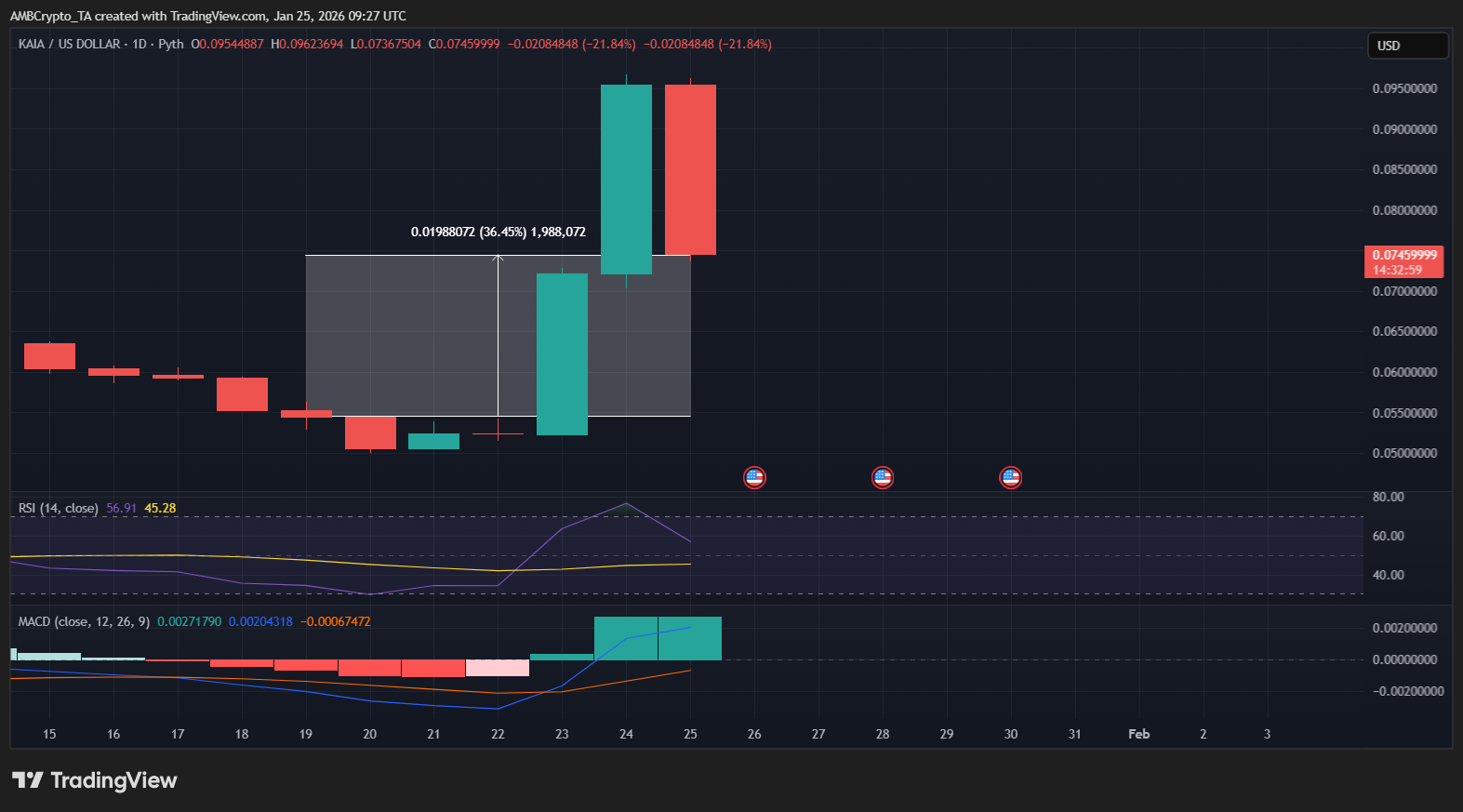
Kaia [KAIA] saw a huge breakout mid-week, before running into heavy profit-taking. That surge was followed by a steep 20%+ daily pullback, bringing prices back toward the $0.074 zone at press time.

Source: TradingView

Despite the drop, it wasn’t a full trend reversal. RSI went from near-overbought levels to the mid-40s, while MACD remained in positive territory; the bullish structure hadn’t fully broken down yet.

Kaia recently joined the Japan Blockchain Association and is developing Project Unify with Line Next, aiming to build an Asia-focused stablecoin hub for USD, JPY, and THB via a super app. The project is planned for late 2026.

Canton Network [CC] defied the privacy coin pressure trend

Canton Network [CC] stood out this week in an otherwise weak corner of the market. The privacy-coin posted a solid 36% rally, climbing from the $0.12 region to highs near $0.16 before slowing down.

Price began to consolidate near recent highs, with RSI holding around the mid-50s. Meanwhile, DMI readings continued to favor buyers, so the greater trend hadn’t yet changed.

Notably, CC was the only major privacy coin to post gains this week, so there’s selective risk-taking as traders avoid the wider segment.

MYX Finance [MYX] jumps with V2 upgrade

MYX Finance [MYX] had a strong week with a 32% surge; buyers stepped in following its V2 upgrade launch on the 22nd of January. Price rebounded from the $5.3-$5.4 zone and pushed toward the $7 level.

The rally was backed by favorable RSI numbers. CMF flipped back toward neutral, so capital is coming back after a dip. The new upgrade saw the launch of portfolio margining, expanded cross-chain support, and a 10 million MYX/ZKP airdrop.

Other notable winners

Tether Gold [XAUT] and PAX Gold [PAX] climbed 9% and 10% respectively, with demand for gold-backed tokens soaring with macro uncertainty. LayerZero [ZRO] also stood out, gaining 11% on the week. Capital has rotated both into defensive assets and select high-conviction bets!

Weekly losers

Ethena [ENA] slides as sellers take hold of the reins

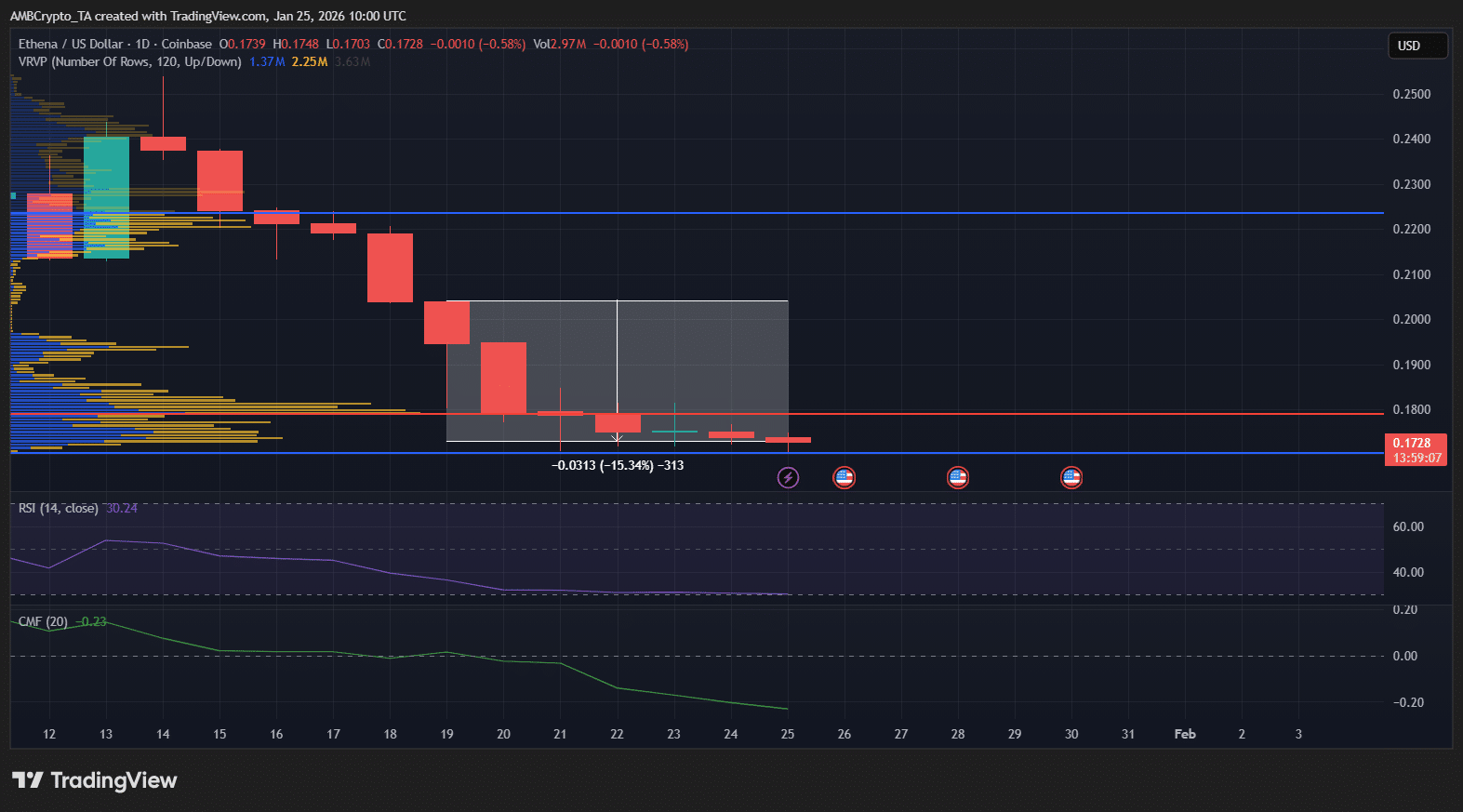
Ethena [ENA] had a rough week, extending its downtrend with a drop of roughly 15% over the last several sessions. There’s been a steady series of lower closes, with price slipping below the $0.18 support zone and failing to attract meaningful dip buying.

Source: TradingView

RSI was near oversold levels, while a negative CMF confirmed capital outflows. Volume thinned as the week progressed, so buyers don’t seem quite confident.

ENA seems to be in a consolidation-at-the-lows phase, with the market waiting before reassessing downside risk.

Arbitrum [ARB] is weak with a lesser pace

Arbitrum [ARB] slid close to 15% with higher selling pressure. The chart showed a breakdown from the $0.20-$0.21 zone, followed by a steady float toward the $0.17-$0.18 range. Attempts at short-term rebounds were quickly sold into, keeping price capped. RSI fell into the mid-30s, so bearish momentum is sustained.

With price consolidating near weekly lows, ARB is in a wait-and-watch phase.

Artificial Superintelligence Alliance [FET] falls as AI tokens lose momentum

Artificial Superintelligence Alliance [FET] ended the week on the back foot, slipping a little over 8% as selling pressure stayed steady. The chart showed a breakdown from the $0.25 region, followed by a slow grind lower toward $0.22-$0.23. Any short-lived bounce attempts were quickly absorbed by sellers.

RSI was below 40, while MACD remained firmly negative, a persistent bearish bias. This fall comes as most AI tokens finished the week with double digit losses.

Other notable losers

Losses were not limited to mid-caps. Solana [SOL] fell around 10%, while Chainlink [LINK] dropped nearly 11%. Another big decline came from Sui Network [SUI], which slid about 16% on the week.

Wrapping up…

This week was a good reminder that even when Bitcoin and Ethereum finally wobble, the rest of the market doesn’t all move the same way. Some traders rushed to lock in profits, and others chased strength where it showed up.

As always, these moves aren’t set in stone.

DYOR, manage your risk, and don’t let one rough week (or a good one) do the thinking for you.

Same time next week!


Final Thoughts

  • Bitcoin and Ethereum slipping triggered a rotation.
  • The market is correcting, and not collapsing. It’s a good sign.
Next: Bitcoin whales vs. retail panic: 3 factors define BTC’s next breakout
Share
  • Share
  • Tweet

Trending Cryptos

Related Questions

QWhat were the weekly price changes for Bitcoin (BTC) and Ethereum (ETH) mentioned in the article?

ABitcoin (BTC) slipped about 6% this week, while Ethereum (ETH) took a 10% hit.

QWhich cryptocurrency saw a huge breakout mid-week but then experienced a steep 20%+ daily pullback due to profit-taking?

AKaia (KAIA) saw a huge breakout mid-week, which was followed by a steep 20%+ daily pullback due to profit-taking.

QWhat was the standout performer among privacy coins this week, and what was its price increase?

ACanton Network (CC) was the standout performer among privacy coins, posting a solid 36% rally.

QWhat were two gold-backed tokens that saw significant gains this week, and what were their approximate increases?

ATether Gold (XAUT) climbed 9% and PAX Gold (PAX) climbed 10% this week.

QWhich two major cryptocurrencies, besides the AI tokens, were mentioned as notable losers with double-digit declines?

ASolana (SOL) fell around 10% and Chainlink (LINK) dropped nearly 11% this week.

Related Reads

You Use Claude and Codex Every Day, but Meta Has Restricted Internal Use

In May, Meta imposed internal restrictions on its engineers regarding the use of Claude Code and Codex, two widely used AI programming tools. Despite being a major client, Meta's guidelines, still in effect, prohibit these external models from being used for specific tasks to prevent potential "escalations with partners." The core concern is "distillation"—the risk that outputs from Claude or Codex could inadvertently contaminate the training data and evaluation processes for Meta's in-house AI coding assistant, MetaCode. If MetaCode is trained or evaluated using data generated by these external models, it risks learning their capabilities rather than developing its own, blurring the line of intellectual origin. The restrictions are precise: engineers cannot use the external models to generate test questions, debug source code, or suggest test cases. AI-generated content is also barred from environments accessible to MetaCode. However, AI can still assist with peripheral tasks like workflow setup and code organization, provided all outputs are manually reviewed. This caution reflects a broader industry dilemma. While distillation is a common technique, using a competitor's model output for training raises legal and ethical questions about the ownership of derived capabilities. Contractual terms from companies like OpenAI and Anthropic explicitly forbid using their outputs to build competing products, putting enforcement power in the hands of rivals. The move is also financially motivated, as Meta seeks to reduce its hefty internal AI spending, estimated in the billions this year. Meta's policy illustrates the delicate balance companies must strike: leveraging powerful external AI tools while safeguarding the integrity and independence of their own AI development. As AI systems increasingly help build other AIs, distinguishing the origin of capabilities becomes a fundamental challenge for the entire industry.

marsbit2h ago

You Use Claude and Codex Every Day, but Meta Has Restricted Internal Use

marsbit2h ago

Why Do We Need an AI Content Perspective Today?

The article "Why Do We Need an AI Content Perspective Today?" explores the complex and often contentious integration of AI into the cultural and creative industries, particularly film and television. It begins with the cancellation of Amazon's AI-generated animation "Punky Duck," highlighting the ethical debates surrounding AI content. AI's rapid advancement is transforming video production, enabling cost-effective, full-length AI films (e.g., "RAPHAEL," "Dreams of Violets") while sparking industry resistance over issues like "synthetic actors." The core debate has shifted from whether to use AI to how to use it responsibly. The article analyzes why AI's entry into film is uniquely unsettling. It distinguishes between "cultural fast food" (short-form, fast-paced content like micro-dramas) and "cultural main courses" (traditional, long-form film/TV). AI currently excels at the former, matching its fragmented narratives, shallow emotional needs, and free-to-consumer models. However, venturing into the latter challenges the human-centric essence of storytelling—creativity, emotional depth, and the unique value of human labor and experience. While AI can generate massive volumes of content and lower costs, it risks devaluing human creativity, leading to homogenized output, and creating unfair competition through potential intellectual property infringement. Its efficiency also amplifies content safety risks, making preemptive governance crucial. To counter these risks, the article proposes establishing clear boundaries guided by a human-centered AI content perspective. It outlines four principles: 1) Amplify, rather than displace, human creative space; 2) Respect and protect human creative output; 3) Ensure human creative control and responsibility remain paramount; and 4) Guarantee transparency and traceability in AI creation. The conclusion emphasizes that humans must act as the "helmsmen" of technology, steering AI development to enhance, not replace, the core human values at the heart of cultural expression.

marsbit3h ago

Why Do We Need an AI Content Perspective Today?

marsbit3h ago

Trading

Spot

Hot Articles

How to Buy ARB

Welcome to HTX.com! We've made purchasing Arbitrum (ARB) simple and convenient. Follow our step-by-step guide to embark on your crypto journey.Step 1: Create Your HTX AccountUse your email or phone number to sign up for a free account on HTX. Experience a hassle-free registration journey and unlock all features.Get My AccountStep 2: Go to Buy Crypto and Choose Your Payment MethodCredit/Debit Card: Use your Visa or Mastercard to buy Arbitrum (ARB) instantly.Balance: Use funds from your HTX account balance to trade seamlessly.Third Parties: We've added popular payment methods such as Google Pay and Apple Pay to enhance convenience.P2P: Trade directly with other users on HTX.Over-the-Counter (OTC): We offer tailor-made services and competitive exchange rates for traders.Step 3: Store Your Arbitrum (ARB)After purchasing your Arbitrum (ARB), store it in your HTX account. Alternatively, you can send it elsewhere via blockchain transfer or use it to trade other cryptocurrencies.Step 4: Trade Arbitrum (ARB)Easily trade Arbitrum (ARB) on HTX's spot market. Simply access your account, select your trading pair, execute your trades, and monitor in real-time. We offer a user-friendly experience for both beginners and seasoned traders.

5.7k Total ViewsPublished 2024.03.29Updated 2026.06.02

How to Buy ARB

Discussions

Welcome to the HTX Community. Here, you can stay informed about the latest platform developments and gain access to professional market insights. Users' opinions on the price of ARB (ARB) are presented below.

活动图片