YouTube enables PYUSD stablecoin payouts for US creators: Report

cointelegraphPublished on 2025-12-12Last updated on 2025-12-12

Abstract

YouTube has enabled US-based creators to receive payouts in PayPal’s stablecoin, PYUSD, according to a report. The feature, confirmed by PayPal’s head of crypto, allows creators to accept payments in PYUSD without YouTube directly handling cryptocurrency. This integration builds on PayPal’s existing payment relationship with the platform. The move signals a shift for YouTube, which has historically restricted crypto-related content, and could significantly boost stablecoin adoption given the platform’s large user base. PYUSD, launched in 2023, has grown rapidly, with its market cap surging from around $500 million in January to $3.9 billion, aided by recent integrations with platforms like Spark and Bitfinex.

Video-sharing giant YouTube has reportedly enabled US-based creators to accept payouts in PayPal’s stablecoin, PYUSD.

Fortune reported on Thursday that PayPal’s head of crypto, May Zabaneh, said the feature is live, but only for users in the US. The firm integrated the ability for recipients to accept payments in PYUSD earlier this year, with YouTube ultimately opting to open that choice up to its creators.

“The beauty of what we’ve built is that YouTube doesn’t have to touch crypto and so we can help take away that complexity,” she said.

PayPal has had a long-running relationship with YouTube, with the platform allowing users to pay via its services for many years, alongside utilizing it for creator AdSense payouts.

YouTube may be warming up to crypto, after its history of shadowbanning crypto content, as digital assets are making their way into the mainstream. The move could also be a potential boon for stablecoin adoption, given the size of YouTube’s platform.

Related: Visa pilots fiat-funded stablecoin payouts for US businesses

The stablecoin market has exploded over the past year as mainstream businesses, institutions and governments have moved to integrate the assets with traditional finance.

PSYUD was launched in mid-2023 and has a current market cap of $3.9 billion according to CoinGecko data. It has skyrocketed in market value since the start of the year, increasing from around $500 million in January.
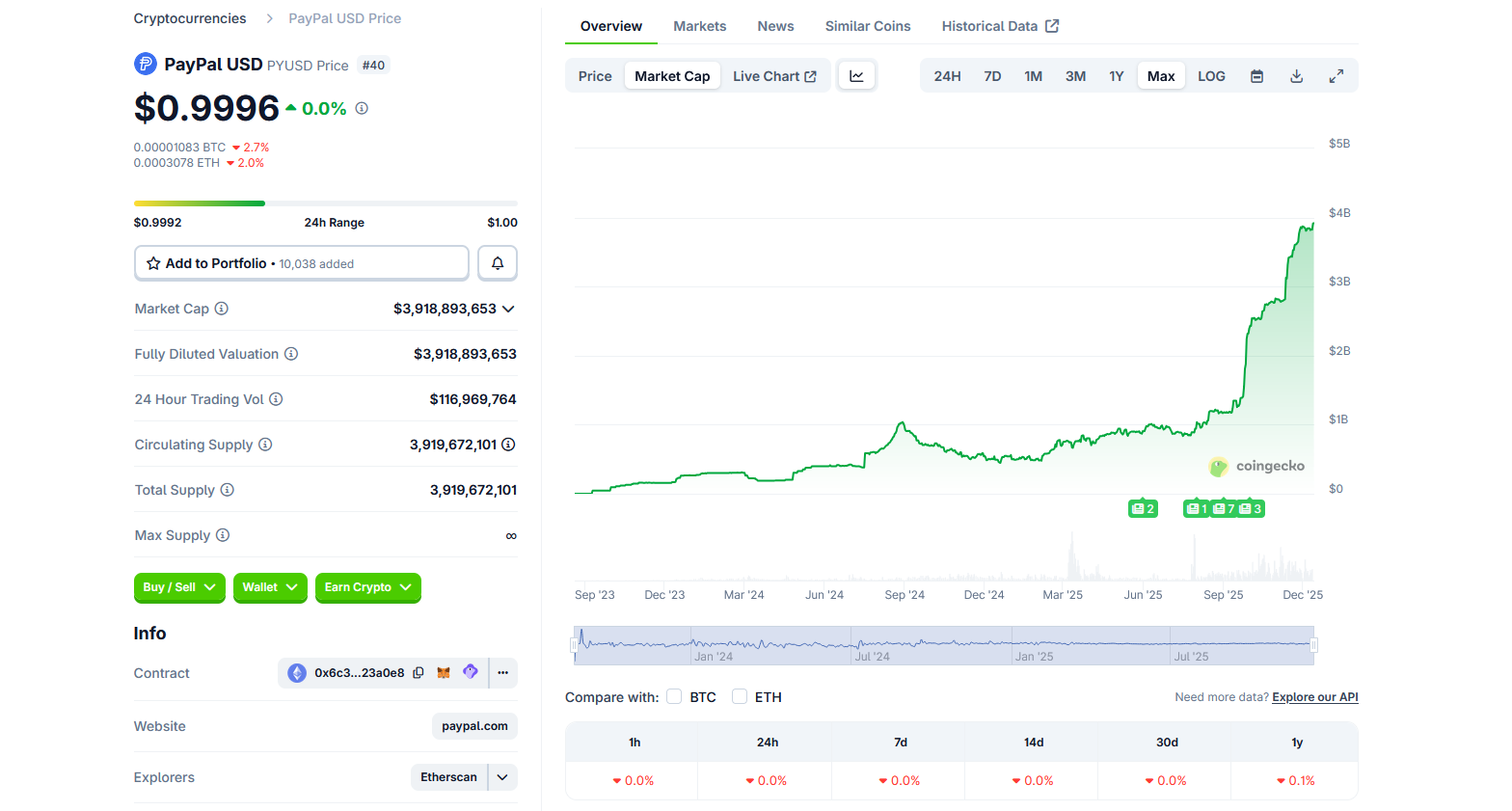
PYUSD market cap. Source: CoinGecko

A significant chunk of PYUSD’s growth has come since the start of September, when the market cap was sitting around $1 billion. During that month, PYUSD was integrated with Spark’s lending markets and Bitfinex’s Stable, an institutional-grade stablecoin blockchain.
Magazine: Stablecoins will see explosive growth in 2025 as world embraces asset class


Trending Cryptos

Related Reads

Breaking: GPT-5.6 Prices Slashed Effective Today

OpenAI has announced significant price cuts for its GPT-5.6 model API, effective immediately. The entry-level **GPT-5.6 Luna** sees the most drastic reduction, with input prices dropping 80% to $0.20 per million tokens and output prices falling to $1.20 per million tokens. The mid-tier **GPT-5.6 Terra** is reduced by 20%, now costing $2.00 (input) and $12.00 (output) per million tokens. The flagship **GPT-5.6 Sol** maintains its original price but introduces a new **Fast mode**, offering speeds up to 2.5 times faster for double the cost. The company attributes these price reductions to efficiency gains achieved through **GPT-5.6 Sol's own involvement in optimizing its production systems**. The model assisted in rewriting GPU kernels and improving speculative decoding, leading to a 20% reduction in end-to-end service costs and over 15% improvement in token generation efficiency. OpenAI emphasizes this process remained human-led. A key focus of the降价 is to lower the barrier for running **AI agent workflows**. By making the capable, tool-calling Luna model significantly cheaper, OpenAI aims to enable more frequent use in cost-sensitive, high-volume tasks like code review and monitoring. This creates a potential feedback loop: model-assisted efficiency gains lead to lower costs, which enables broader agent deployment, which in turn drives further optimization. The new pricing and features will also apply to Codex and ChatGPT Work subscriptions. The changes intensify competition in the large language model market, with OpenAI directly challenging rivals like Anthropic to respond.

marsbit18m ago

Breaking: GPT-5.6 Prices Slashed Effective Today

marsbit18m ago

South Koreans' 'Gambling Nature' is Actually Forced by Life

This article explores how systemic pressures in South Korea, rather than inherent "gambling" tendencies, drive widespread speculative financial behavior. It begins by noting the high frequency of flights from South Korea to Macau, symbolizing the search for outlets beyond domestic restrictions. The core argument is that ordinary life goals—stable employment, home ownership, and financial security—have become increasingly tied to asset markets due to structural economic factors. South Korea's development model, historically reliant on corporate leverage (chaebols), has evolved into a society where household debt and personal leverage are normalized as pathways to social mobility. Key mechanisms discussed include: * **Housing Policy:** Government measures to improve affordability, like extending mortgage terms to 50 years and the unique *jeonse* (key money) rental system, embed high leverage into the housing market. * **Financial Products:** The recent approval and explosive popularity of single-stock 2x leveraged ETFs (e.g., on Samsung and SK Hynix), easily accessed via mobile apps, lowered barriers to high-risk trading. * **Social Pressure:** Media narratives around soaring corporate profits (e.g., SK Hynix) and employee bonuses create a fear of missing out, pushing individuals to use leverage to "catch up." The article concludes that this "leveraged life" is a product of institutional history and policy choices. When traditional paths to success feel constrained, and policy facilitates debt-based solutions for housing and investment, speculative behavior becomes a rational, if risky, strategy for many. The rapid cycle of regulatory approval for leveraged ETFs followed by a market crash and official apology in mid-2026 exemplifies the system's inherent contradictions. Ultimately, the "bet" is not just on assets, but on using future earnings to secure a place in the present society.

marsbit18m ago

South Koreans' 'Gambling Nature' is Actually Forced by Life

marsbit18m ago

Trading

Spot

Hot Articles

How to Buy US

Welcome to HTX.com! We've made purchasing Talus Network (US) simple and convenient. Follow our step-by-step guide to embark on your crypto journey.Step 1: Create Your HTX AccountUse your email or phone number to sign up for a free account on HTX. Experience a hassle-free registration journey and unlock all features.Get My AccountStep 2: Go to Buy Crypto and Choose Your Payment MethodCredit/Debit Card: Use your Visa or Mastercard to buy Talus Network (US) instantly.Balance: Use funds from your HTX account balance to trade seamlessly.Third Parties: We've added popular payment methods such as Google Pay and Apple Pay to enhance convenience.P2P: Trade directly with other users on HTX.Over-the-Counter (OTC): We offer tailor-made services and competitive exchange rates for traders.Step 3: Store Your Talus Network (US)After purchasing your Talus Network (US), store it in your HTX account. Alternatively, you can send it elsewhere via blockchain transfer or use it to trade other cryptocurrencies.Step 4: Trade Talus Network (US)Easily trade Talus Network (US) on HTX's spot market. Simply access your account, select your trading pair, execute your trades, and monitor in real-time. We offer a user-friendly experience for both beginners and seasoned traders.

5.6k Total ViewsPublished 2025.12.11Updated 2026.06.02

How to Buy US

Discussions

Welcome to the HTX Community. Here, you can stay informed about the latest platform developments and gain access to professional market insights. Users' opinions on the price of US (US) are presented below.

活动图片