World Unveils AgentKit for Human-Verified AI Agents with Coinbase Integration

TheNewsCryptoPublished on 2026-03-18Last updated on 2026-03-18

Abstract

World has launched the beta of AgentKit, a developer toolkit that integrates with the x402 protocol (founded by Coinbase and Cloudflare) to enable AI agents to cryptographically prove they are backed by a unique human via World ID, without revealing the user’s identity. This addresses the growing challenge of trust and accountability in agentic commerce, which is projected to reach $3–5 trillion by 2030. By combining World ID’s privacy-preserving proof-of-humanity with x402’s micropayment system, AgentKit allows platforms to distinguish legitimate human-backed agents from malicious bots, control resource allocation per unique user, and prevent abuse—enabling use cases like fair ticketing, reservations, and trial access. The toolkit is now available to developers, with a more advanced version planned following feedback.

With the release of AgentKit beta, a developer toolkit for the agentic web that works with x402, AI agents will be able to use World ID to carry cryptographic proof of a unique person. Developers may create AI agents that can demonstrate that a real person is behind them while interacting with websites, APIs, and online services thanks to the toolkit’s integration as an extension of x402, an open protocol founded by Coinbase and Cloudflare.

Online operations that formerly needed direct human involvement, such as booking reservations and checking pricing among merchants, are increasingly being handled by AI agents. According to industry estimates, agentic commerce might reach $3 trillion to $5 trillion worldwide by 2030, with AI agents perhaps making up as much as 25% of e-commerce in the United States at that time. Establishing trust and responsibility in automated interactions is an increasing difficulty for developers and platforms as agents become online economic actors.

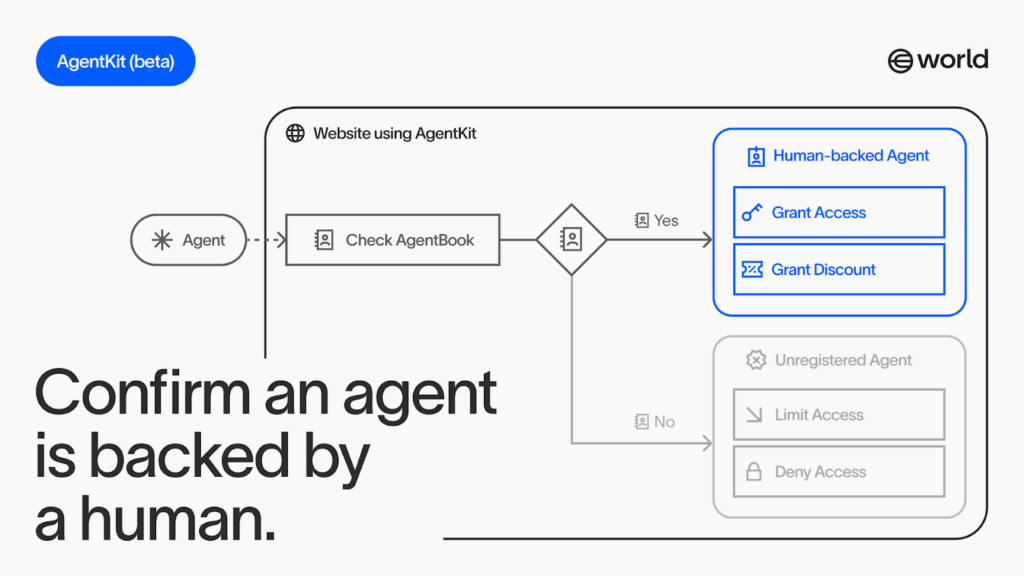
By allowing verified people to assign their World ID to AI agents, AgentKit solves this problem. By using this notion, developers may create what World calls “human-backed agents,” which are able to cryptographically demonstrate that a genuine, distinct person is behind them without disclosing the identity of the person.

“Payments are the ‘how’ of agentic commerce, but identity is the ‘who.’ By integrating World ID with the x402 protocol, developers now have a complete trust stack: a way for agents to pay for what they need and a way for platforms to verify there is a real human behind the wallet. This is a massive step toward a web where agents aren’t just seen as automated traffic, but as legitimate economic participants,” says Erik Reppel, Head of Engineering at Coinbase Developer Platform and Founder of x402.

“As AI agents start acting on behalf of users across the internet, the key challenge is separating legitimate, human-backed agents from bot swarms. Payment requirements can slow down abuse, but they don’t indicate how many real people are behind the activity. Proof of human addresses this gap by allowing websites to verify that an agent represents a unique person without revealing who that person is,” said DC Builder, Research Engineer at World Foundation.

Nowadays, the majority of websites see automated traffic as potentially dangerous and often completely prohibit it. This method stops productive AI agents from engaging with internet services, even though it was initially intended to combat malevolent bots. Agents often run into the same limitations intended to stop exploitation when they try to do activities like making reservations or accessing APIs.

New protocols have started looking at methods to make online agent action possible. Micropayments are introduced by the x402 protocol to allow agents to access resources and APIs while restricting excessive bandwidth. The x402 protocol has handled over 100 million payments via apps, APIs, and AI agents since its 2025 debut.
Micropayments provide a way to control access, but they don’t solve the issue of uniqueness or identification. It is difficult for platforms to discern between coordinated behavior and genuine users since a single person might run thousands of agents that can pay tiny fees. Additionally, payments by themselves generate public transaction trails that may reveal comprehensive records of an agent’s actions.

A supplementary signal, proof of unique human, is introduced by AgentKit. Without disclosing personal information, people may use World ID to cryptographically demonstrate their uniqueness as human beings. This feature is extended to AI agents by AgentKit, which enables platforms and websites to confirm that an agent is supported by a real person while protecting privacy.

Websites that currently use x402 may seek verification of unique human identity in addition to or instead of micropayments thanks to the toolkit’s integration with the x402 protocol. Verified World ID holders may use standard verification procedures to register their agents. Before allowing access, the platform may ask for payment, evidence of a unique person, or both when an agent visits a website that is compatible.

Although a single person may assign their World ID to many agents, platforms are able to identify that the agents come from the same person. This enables websites to detect abuse, establish limitations, and distribute resources based on the number of distinct persons interacting rather than the number of agents.

Numerous possible use cases are supported by the paradigm. Reservation systems might prevent scalpers from using a lot of automated agents to stockpile bookings while enabling human-backed agents to book tables. Ticketing systems could guarantee that actual fans, not automated networks, buy concert tickets. Instead of allocating access based on wallets or payments, websites that provide free trials might do so based on each individual person.

Additionally, AgentKit presents infrastructure that might facilitate services that need distinct identification signals, like age or country of residence, by sharing only relevant information using privacy-preserving zero knowledge proofs. Platforms may better control access while safeguarding user privacy by confirming the number of unique people responsible for agent activity.

Nearly 18 million verified people from more than 160 countries make up World’s network. With World ID, users may use cryptographic verification to anonymously demonstrate their uniqueness, enabling platforms to create trust signals without gathering or retaining personal information.

Developers creating AI agents with a validated World ID may now use the AgentKit beta. Developer access and documentation are accessible here.

A more sophisticated version is anticipated when the next iteration of the protocol is launched. The present beta version is based on the World ID architecture. The first release aims to collect developer input and show how proof of unique human may be extended to the expanding autonomous agent ecosystem.

World is meant to be the biggest, most inclusive network of actual people on the planet. The initiative, which was first conceptualized by Sam Altman, Max Novendstern, and Alex Blania, seeks to demonstrate humanity, finance, and connection for all people in the era of artificial intelligence. Visit world.org and X to learn more about the world.


TagsAltcoinBlockchain

Trending Cryptos

Related Questions

QWhat is AgentKit and what problem does it aim to solve?

AAgentKit is a developer toolkit for the agentic web that integrates with the x402 protocol. It allows AI agents to cryptographically prove they are backed by a unique, verified human using World ID, without revealing the person's identity. It aims to solve the problem of establishing trust and accountability for AI agents operating online, distinguishing legitimate human-backed activity from malicious bot swarms.

QHow does the integration of World ID with the x402 protocol create a 'complete trust stack'?

AThe integration combines two key components: the x402 protocol provides a micropayment system that allows agents to pay for the resources and APIs they use (the 'how'), while World ID provides proof of a unique human behind the agent (the 'who'). This gives developers a way for agents to transact and a way for platforms to verify there is a real human behind the wallet, creating a more trustworthy ecosystem for agentic commerce.

QWhy are micropayments alone insufficient for managing AI agent access, and how does AgentKit address this?

AMicropayments control access but don't solve the issue of uniqueness or identity. A single person could run thousands of agents that can all pay tiny fees, making it hard to distinguish coordinated abuse from genuine users. AgentKit addresses this by adding a supplementary signal: proof of a unique human. This allows platforms to verify that an agent represents a distinct person, enabling them to be allocated based on the number of people, not the number of agents or wallets.

QWhat are some potential use cases for human-verified AI agents as described in the article?

APotential use cases include: reservation systems preventing scalpers from using automated agents to hoard bookings; ticketing systems ensuring concert tickets are bought by real fans, not bots; and websites offering free trials allocating access based on unique individuals rather than wallets or payments. It also enables services that require verification of specific attributes like age or country using privacy-preserving zero-knowledge proofs.

QWhat is the current status of AgentKit and what are the future plans?

AAgentKit is currently in a beta release, which is based on the existing World ID architecture. The goal of this initial release is to gather developer feedback and demonstrate how proof of unique human can be extended to autonomous agents. A more sophisticated version is anticipated with the launch of the next iteration of the protocol.

Related Reads

Must-Watch Events Next Week|CLARITY Act Could Face Senate Vote; SpaceX, Circle to Report Earnings (8.3-8.9)

**Summary: Key Events and Developments to Watch (August 3-9)** The upcoming week is marked by significant financial disclosures, key legislative deadlines, and notable product updates. **Major Financial Events:** Several companies are scheduled to release their Q2 2026 earnings. American Bitcoin (ABTC) will report on August 3, followed by SpaceX and Hut 8 Mining Corp. on August 4, and Circle on August 5. Notably, a significant portion of SpaceX shares (up to 12% of total shares) will be unlocked on August 6 following their earnings release. **Key Legislative Deadline:** The U.S. Senate faces an August 7 deadline to secure 60 votes for the CLARITY Act, a bipartisan bill aiming to establish a federal regulatory framework for cryptocurrencies. The Senate may hold a full vote on the bill during the week. **Economic Data:** The U.S. July Non-Farm Payrolls report will be released on August 7, providing crucial labor market data. **Technology & Product Updates:** * **Shutdowns:** DeFi portfolio tracker Zapper and wallet app Ctrl Wallet will cease operations on August 3. * **Upgrades:** LayerZero will deprecate its v1 relayers on August 3. XRP Ledger's new version 3.3.0, featuring five new functions, is expected next week. * **AI:** Elon Musk announced that the advanced Grok 4.6 AI model is set for release around August 7. * **Bitcoin:** The BIP-110 forced signaling for a potential Bitcoin network change is scheduled to begin around August 8. **Other Notable Events:** Chinese robotics firm Unitree Tech has set its preliminary price inquiry for its IPO for August 5. South Korean exchange Upbit will delist AQT and AERGO tokens on August 3.

marsbit1h ago

Must-Watch Events Next Week|CLARITY Act Could Face Senate Vote; SpaceX, Circle to Report Earnings (8.3-8.9)

marsbit1h ago

Stocks Are Plummeting More Sharply Than Cryptocurrencies. Where Has the Money Gone?

Stock Markets Plunge Deeper Than Cryptocurrencies: Where Did the Money Go? In late July, Seoul's Kospi index triggered circuit breakers for two consecutive days, plummeting over 40% from its June high. The collapse was led by heavyweight stocks like SK Hynix, whose record profits still disappointed investors, and devastating leveraged ETFs, with one major product losing over 83% of its value. This signaled a global, forced deleveraging targeting the most crowded trades. Interestingly, while stocks exhibited extreme volatility akin to crypto markets, Bitcoin rose nearly 15% in July after a prior steep drop. Analysis shows the money fleeing equities did not flow into Bitcoin. Instead, Bitcoin had already absorbed its sell-off in May-June, when U.S. spot Bitcoin ETFs saw historic outflows. The true safe-haven beneficiary was gold, whose price rose over 20% year-on-year, highlighting a decoupling between Bitcoin and gold as "digital gold." The sell-off was a targeted unwinding of leveraged positions in tech and semiconductors, accelerated by broker-dealer risk management and shifts in the AI narrative, including new competition from Chinese memory chipmakers. The retreat path was clear: from high-valuation tech stocks to cash and U.S. Treasuries, then to gold. For Bitcoin to attract sustained institutional inflows, conditions like eased global liquidity pressure, a "soft-landing" Fed rate cut, and U.S. regulatory clarity via legislation like the stalled CLARITY Act are needed. Currently, Bitcoin is not a safe haven but an already-cleared asset. Its low correlation with tech stocks, however, makes it a potential diversification play for institutional portfolios once the storm passes. The money isn't here yet, but the positioning is underway.

marsbit1h ago

Stocks Are Plummeting More Sharply Than Cryptocurrencies. Where Has the Money Gone?

marsbit1h ago

In Conversation with Ray Dalio: We Are Currently in an AI Bubble, with 1% of My Portfolio in Bitcoin

Ray Dalio, founder of Bridgewater Associates, warns in an interview that the current AI boom shows classic bubble characteristics, which could lead to significant economic downturns as seen in past cycles like 1929 or 2000. He explains that speculative enthusiasm, fueled by debt and overvaluation, often precedes a crash when rising rates or taxation force asset sales, causing widespread losses and recession. Dalio also outlines his "Big Cycle" theory, describing an approximate 80-year pattern where widening wealth gaps, massive government deficits, and shifting geopolitical power (like China's rise) create internal conflict and global instability. He emphasizes that we are in a late-cycle, transitional phase where traditional powers like the US and UK face decline. For personal wealth protection, Dalio advises diversification beyond cash into assets like stocks, bonds, real estate, and particularly gold, which he prefers over Bitcoin. While he holds about 1% of his portfolio in Bitcoin as a non-printable hard asset, he views gold as more secure from technological or governmental threats. Regarding AI's impact, Dalio believes it will disproportionately benefit capital owners, worsening inequality by replacing both physical and cognitive labor. He suggests that human intuition and emotional intelligence, combined with AI, will be key for future workers. On taxation, Dalio argues that wealth taxes are impractical and risk triggering asset sell-offs, reducing productive investment. He points to the UK as a cautionary example of debt, low productivity, and political strife. Geopolitically, Dalio foresees a more regionalized world, with the US showing weakness in prolonged conflicts like with Iran, akin to past imperial declines. The ideal outcome, he suggests, is coexisting powerful blocs (e.g., Americas, China-Asia Pacific) without major war.

marsbit5h ago

In Conversation with Ray Dalio: We Are Currently in an AI Bubble, with 1% of My Portfolio in Bitcoin

marsbit5h ago

Trading

Spot

Hot Articles

Discussions

Welcome to the HTX Community. Here, you can stay informed about the latest platform developments and gain access to professional market insights. Users' opinions on the price of AI (AI) are presented below.

活动图片














