White House Ignites, BSC Spreads Like Wildfire: A Meme Carnival Bidding Farewell to the 'Imperial Decree Model'

marsbitPublished on 2026-01-21Last updated on 2026-01-21

Abstract

A meme coin frenzy erupted on January 21 after the White House posted on X mentioning "victory, eviction, and memes." Within minutes, meme tokens named "memes" were launched on both Solana and BSC chains. Contrary to expectations, the Solana version—typically favored due to its active ecosystem and "first is first" advantage—was outperformed by the BSC version. At its peak, the BSC meme reached a market cap of $28 million with 7,300 holders, while Solana’s version peaked at $3.6 million with 3,900 holders. Real-time user engagement also favored BSC, with nearly 3,000 simultaneous online participants compared to Solana’s sub-1,000. This outcome challenges the long-standing perception that BSC meme coins rely heavily on endorsements from Binance founders CZ and He Yi—a model often mockingly referred to as "Shandong style." Both CZ and He Yi have recently publicly discouraged the practice of creating meme coins based on parsing words from their social posts. CZ explicitly warned followers against buying tokens inspired by his tweets, while He Yi criticized “word-parsing” and “bootlicking” behaviors, urging the community to focus on real project development instead. The surprising success of the BSC memes token—launched 20 minutes after Solana’s version—suggests a possible shift in BSC’s meme culture, moving away from top-down influence toward more organic, community-driven momentum. Whether this marks a lasting change in BSC’s meme ecosystem remains an open question.

Author|Golem(@web 3_golem)
The Meme market today witnessed another legendary "golden dog" story.

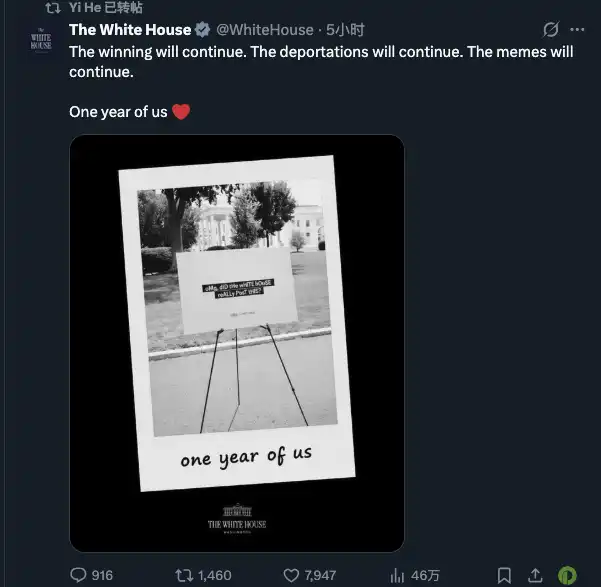
On January 21st at 11:10, the official White House account posted on X platform mentioning "victory, eviction operations, and memes". One minute later, a Meme token of the same name, $memes, quickly appeared on the Solana chain; 20 minutes later, a version on the BSC chain was also born. An official Meme race between the two chains began.

From an empirical perspective, the Solana version should have the advantage—not only is the ecosystem active, but it also aligns with the "First is first" consensus. However, the result was surprising: the BSC chain version of $memes surpassed it in market capitalization. According to GMGN data, the BSC version's market cap reached a high of $28 million, with 7,300 holding addresses; while the Solana version's peak was only $3.6 million, with 3,900 holding addresses.

The focus of player attention can also be seen through GMGN's new feature: 3 hours after the token's birth, the number of simultaneous online users for the Solana version remained below 1,000, while the BSC version once approached 3,000.

Although some questioned whether the BSC version's market cap was due to "pump and dump schemes by big players aiming to harvest," the genuine market attention doesn't lie—this time, BSC truly won.

The community often joked that BSC's Meme model was like "Shandong Studies in the crypto circle," where only projects related to CZ and He Yi could succeed, raising concerns about the ecosystem's sustainability. However, BSC's victory in this Meme sprint not only sparked a wave of regret from those who missed out (FOMO), but also prompted the community to reconsider the evolution of its Meme model. As GMGN founder Haze stated: "The BSC 3.0 era has arrived." (Odaily Note: Haze holds 1.93% of BSC chain $memes, ranking second on the holdings list.)

CZ and He Yi Publicly State They Do Not Support "Word-Picking Memes"

I previously shared my thoughts on the BSC Meme model during an Odaily editorial meeting, suggesting that CZ and He Yi were essentially "held hostage" by the community. The current BSC model, which relies on "imperial decrees" for cold starts, feigns continuous interaction, lists on Binance Alpha, and finally gets "poured out" (a likely reference to a meme or specific outcome), is actually a consensus within the BSC community. Although this model started with CZ's unintentional actions in early 2025, they don't actually like it. However,发展到目前这个地步 (developed to this point), CZ and He Yi are powerless to change the situation.

When I published this view, it was merely a conjecture. Recent public statements from CZ and He Yi have proven it to be true. On January 13th, CZ posted saying that while he likes Meme coins, if players blindly follow the trend and buy Meme coins "picked" from his tweets, they are almost certain to lose money.

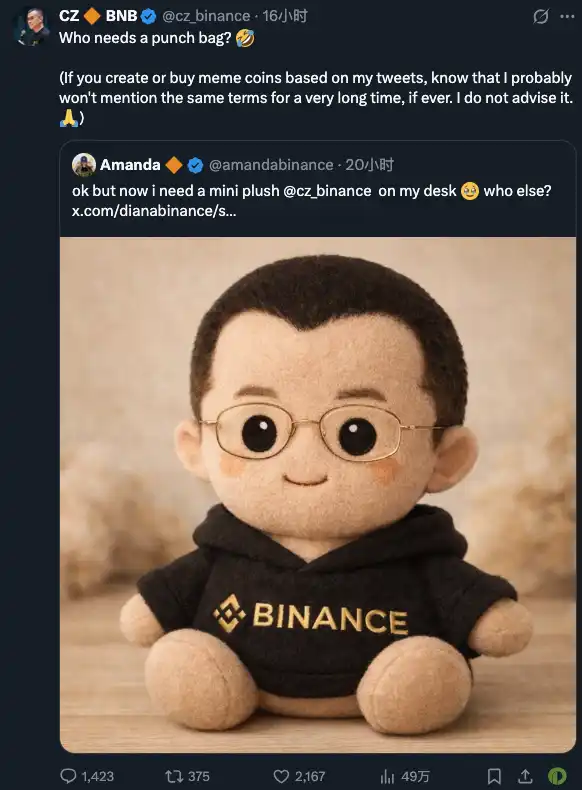
To prevent everyone from blindly chasing these "word-picking Memes," CZ's tweets have become more cautious. Yesterday, CZ reposted a plush toy created by a user based on his image, which was an ordinary thing, but CZ still specifically noted: If you create or buy Meme coins based on my tweets, please note that I may not mention the same words again for a long time, maybe never. I do not recommend you do this. He even added a 🙏 icon at the end, showing CZ's concern for the community.
Compared to CZ's tactfulness, He Yi's attitude towards the community's "word-picking Memes" was more blunt. In the early hours of January 21st, under a user's post, He Yi not only stated that Binance would severely punish all internal insider trading and bribery, but also "assertively" said that she does not need to rely on Binance Alpha listing Memes that pick words from her tweets for pleasure, and also advised the community to focus on real development, not to mistake "word-picking and flattery" as genuine constructive effort and be self-satisfied. He Yi also mentioned that she doesn't like eating fish (a likely reference to a specific meme or context, perhaps '山东学 Shandong Studies'), and told players not to cry "Shandong Studies" just because Binance Alpha didn't list the tokens she supported.
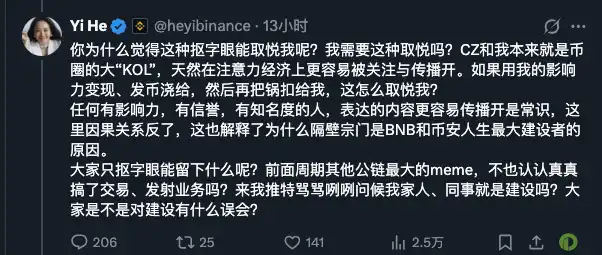
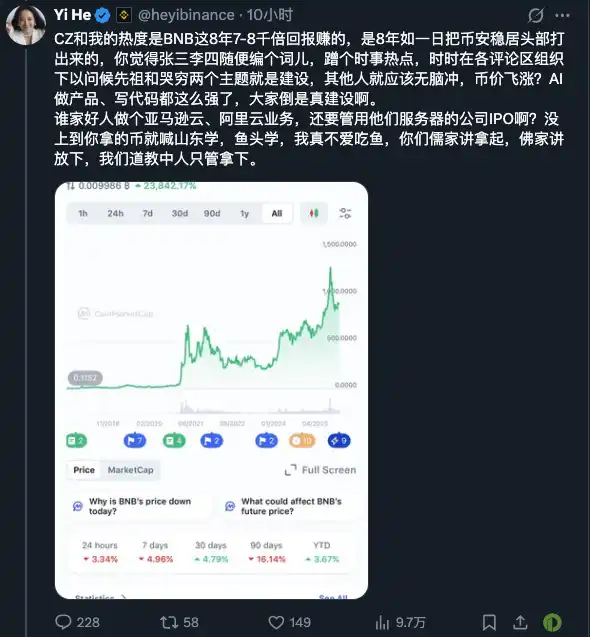
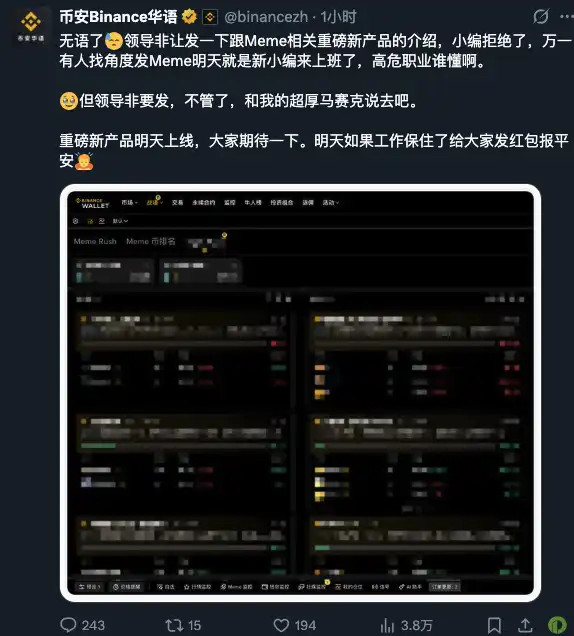
Under the influence of CZ and He Yi's public statements against "word-picking Memes," Binance's official announcements about Memes have also become cautious. On January 21st, Binance's Chinese-language account posted about launching a new Meme product feature, but to prevent the community from finding angles to launch Meme coins, the editor specifically added a very thick mosaic. Although somewhat戏谑 (playful/mocking), it sufficiently shows the cautious attitude of the entire Binance team, both towards Meme coins picking words from CZ and He Yi's tweets, and those picking words from Binance's official announcements.
Is BSC Meme Finally Going to Be Different?

Laymen watch the热闹 (excitement), experts watch the门道 ( intricacies). He Yi's remarks not only felt very "human" (活人感), but seasoned Meme players realized that the previous BSC Meme model is collapsing from the top down. The successful BSC chain $memes that outperformed on the morning of January 21st might be just an appetizer. Ironically, $memes was also born from the art of "word-picking," only this time it was the White House.

Additionally, after the White House posted the tweet, He Yi reposted it (now deleted). This repost, unrelated to Binance and He Yi herself, seemed slightly突兀 (abrupt/out of place) on her homepage timeline, and the community was confused about the reason for the repost. How much credit He Yi's repost deserves for the BSC version of $memes, launched 20 minutes later, outperforming Solana's $memes is also questionable.
Finally, we might still have to ask that unchanging question: Will BSC really be different this time?


Related Questions

QWhat was the unexpected outcome in the meme coin race between Solana and BSC following the White House's post?

AContrary to expectations, the Solana version of the 'memes' coin did not dominate. The BSC version achieved a higher market cap, reaching a peak of $28 million with 7,300 holder addresses, compared to Solana's $3.6 million with 3,900 holders.

QWhat is the 'Saint Edict Mode' or 'Shandong Mode' that the community often associated with BSC meme coins?

AIt refers to a meme coin model on BSC where projects were believed to only find success if they were related to or endorsed by Binance executives like CZ and He Yi, often by 'extracting keywords' from their social media posts.

QHow did CZ and He Yi publicly express their stance on 'keyword extraction meme' coins?

ACZ stated that while he likes meme coins, buying ones created by extracting keywords from his tweets will almost certainly lead to losses and he does not recommend it. He Yi was more direct, stating she does not need meme coins based on her posts for pleasure and advised the community to focus on real development.

QWhat evidence suggests that Binance is being cautious to avoid sparking new 'keyword extraction' meme coins?

AThe official Binance Chinese account posted an announcement about a new meme product feature but heavily pixelated the text to prevent the community from finding angles to create new meme coins based on the post.

QWhat does the success of the BSC 'memes' coin in this event potentially signal for the future of BSC meme coins?

AThe event, coupled with the executives' statements, suggests a potential shift away from the old 'Saint Edict Mode.' The success of a meme coin not directly tied to Binance executives might indicate the arrival of a new, more community-driven 'BSC 3.0' era for memes.

Related Reads

U.S. Stock Market Trend: Nasdaq Plunges 3.5% Intraday Before a Remarkable Recovery, All Eyes on CPI Tomorrow

"US Stock Market Trends: Nasdaq Plunges 3.5% Before Dramatic Recovery, Eyes on Tomorrow's CPI" On Tuesday, US markets experienced a wild swing. The Nasdaq initially surged nearly 0.7% before plummeting to a 3.5% intraday loss following a post by Donald Trump on Truth Social. He stated that Iran had shot down a US Apache helicopter in the Strait of Hormuz and that the US "must...respond." The index, however, staged a remarkable recovery in the final two hours, closing down only 0.97%, as subsequent remarks from Trump and Vice President Vance suggested a potential Iran deal within days. The S&P 500 fell 0.26%, while the Dow Jones gained 0.17%, supported by its non-tech components. This incident marked the first loss of a US military asset since tensions with Iran escalated in late February. Despite the event, crude oil prices fell sharply (WTI -3.93%) due to expectations of a near-term deal, OPEC+ plans to increase output, and fears that strong jobs data could lead to Fed rate hikes. Market attention is now laser-focused on the May CPI data release Wednesday morning. This report is seen as critical evidence for whether hot job growth is fueling inflation and will heavily influence expectations for the Federal Reserve's upcoming meeting. A hotter-than-expected reading could trigger further sell-offs, particularly in tech, while a cooler print could spark a significant rebound. The article notes a clear sector rotation, with money flowing out of tech (Nasdaq down over 5% in a week) into defensive sectors like healthcare and consumer staples. Other assets like gold and Bitcoin also remain under pressure. The overarching sentiment is one of "war fatigue," with markets desperately awaiting concrete results from the prolonged Iran negotiations rather than reacting to each new headline.

marsbit10m ago

U.S. Stock Market Trend: Nasdaq Plunges 3.5% Intraday Before a Remarkable Recovery, All Eyes on CPI Tomorrow

marsbit10m ago

Second Only to GPUs and Memory: MLCCs Are Becoming the Next Billion-Dollar Windfall for AI Computing Power

After GPU and memory, MLCC (Multi-Layer Ceramic Capacitors) is emerging as the next critical component in AI compute, potentially a multi-billion-dollar market. The article highlights a significant, industry-wide price increase for MLCCs, driven not by inventory cycles but by a fundamental, structural demand surge from AI and automotive sectors. AI servers require exponentially more MLCCs than traditional servers—from 2,000 to over 350,000 units per high-end AI rack—primarily to stabilize power for increasingly powerful, low-voltage GPUs. A key AI server's MLCC cost can reach thousands of dollars, making it the third-largest cost component after GPUs and memory. This demand is compounded by the automotive shift to EVs and advanced ADAS. Supply, however, struggles to keep up. Manufacturing high-end MLCCs involves extreme precision and faces six major barriers: proprietary technology, long customer certification cycles (12-18 months for AI), high capital intensity, patent thickets, specialized talent, and massive scale. Industry capacity grows at only ~10% annually, creating a persistent supply-demand gap projected to last until 2030. Three companies dominate this high-end market. **Murata** (40% global share) is the stable leader. **Samsung Electro-Mechanics** offers the highest growth elasticity with aggressive expansion. **Taiyo Yuden** is the purest MLCC play. While their current P/E ratios appear high, they are expected to compress rapidly as earnings surge, powered by significant pricing power and operational leverage. Key risks include a potential slowdown in AI capex, high valuations, competition from Chinese manufacturers in lower tiers, yen appreciation, and consumer electronics weakness. The article concludes that MLCCs are transforming from a commoditized component into a strategic, capacity-constrained asset essential for the AI-powered future.

marsbit40m ago

Second Only to GPUs and Memory: MLCCs Are Becoming the Next Billion-Dollar Windfall for AI Computing Power

marsbit40m ago

The First to Bring an AI OS to 1.4 Billion People Might Actually Be WeChat?

WeChat has introduced a significant AI update, allowing mini-program developers to integrate their services with WeChat AI. Developers can choose an "automatic mode," where WeChat AI autonomously analyzes and operates mini-programs without additional coding, or a "development mode" for creating customized skills. This move effectively transforms WeChat's vast ecosystem—including millions of mini-programs, WeChat Pay, and official accounts—into an execution layer for AI. The technical documentation reveals that WeChat's approach aligns with industry standards like MCP (Model Context Protocol) and incorporates practical lessons from AI-agent development. Key design principles include a clear "attention weight" system for API calls and a "fact + action" response structure to ensure reliable operations. Unlike Apple's Siri, which struggles with third-party app integration, WeChat's centralized control over mini-program code provides a "God's-eye view," enabling seamless AI orchestration across services. This development revives the concept of "WeChat OS," where the app could function as a natural-language-operated platform for daily tasks—from booking flights to ordering food—all within a chat interface. While challenges remain in areas like payment security and user trust, WeChat's existing service network and massive user base position it uniquely to advance AI agents from conversation to actionable assistance, potentially making complex tasks feel effortless for its 1.432 billion monthly active users.

marsbit1h ago

The First to Bring an AI OS to 1.4 Billion People Might Actually Be WeChat?

marsbit1h ago

Trading

Spot
Futures

Hot Articles

Discussions

Welcome to the HTX Community. Here, you can stay informed about the latest platform developments and gain access to professional market insights. Users' opinions on the price of MEME (MEME) are presented below.

活动图片