When AI Reshapes the Shopping Journey, How Much Time Does PayPal Have Left?

marsbitPublished on 2026-02-18Last updated on 2026-02-18

Abstract

PayPal's recent $200 million acquisition of Cymbio signals a strategic pivot to remain relevant in the emerging era of "Agentic Commerce," where AI agents increasingly handle product discovery, decision-making, and purchasing on behalf of users. This move aims to transform PayPal from a Web2 payment button into an embedded infrastructure layer within AI-driven commercial workflows, covering discovery, checkout, and fulfillment. The competitive landscape is rapidly evolving: Google and Shopify are developing the Universal Commerce Protocol (UCP) to control the routing layer, while OpenAI and Stripe are advancing the Agentic Commerce Protocol (ACP) to enable AI agents to execute transactions. Stripe, in particular, is positioning itself as the default "action layer" for AI commerce, mirroring its success as the internet’s payment API. Major forecasts suggest Agentic Commerce could capture $1 trillion in U.S. retail sales by 2030, representing up to one-third of online retail. For PayPal, Stripe, and other fintech players, the challenge is to embed themselves into these new protocol-based ecosystems—or risk being sidelined. Banks retain advantages in clearing and compliance but must adapt quickly, while crypto remains largely absent from current frameworks, presenting both a risk and potential opportunity. PayPal’s acquisition is less an offensive move than a necessary bid to maintain its seat at the table.

Original Title: AI: PayPal』s $200M Wake-Up Call in AI Commerce

Original Author: LUKE SPILL,FintechBlueprint

Compiled by: Peggy,BlockBeats

Editor's Note: As AI agents begin to replace humans in product discovery, decision-making, and order placement, the traditional e-commerce funnel is being rapidly compressed. Payment is no longer the endpoint of a transaction but an embedded part of the infrastructure. This article uses PayPal's acquisition of Cymbio as a starting point to outline the new competitive landscape emerging with the rise of Agentic Commerce: Google and Shopify are attempting to control the routing layer with UCP, OpenAI and Stripe are seizing the agent execution layer with ACP, while PayPal is striving to shift from being a "payment button" to a key node in the "commercial workflow."

For fintech companies like PayPal and Stripe, whether they can embed themselves into the underlying protocols of AI commerce will determine if they can remain at the table. For the banking and crypto industries, the window of opportunity is equally brief.

Below is the original text:

Last week, PayPal acquired Cymbio, a platform that helps merchants complete sales on various AI interfaces, including channels like Microsoft Copilot and Perplexity. Market sources estimate the deal to be worth between $150 million and $200 million. It is widely seen as a key strategic move by PayPal to maintain competitiveness in the field of Agentic Commerce.
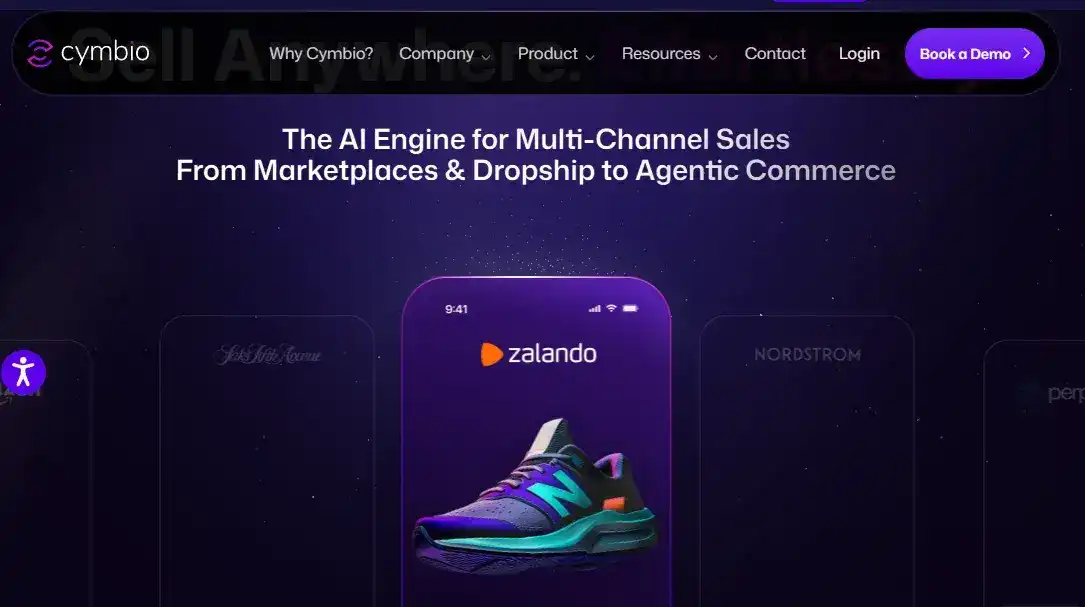
Thus, as AI agents continue to compress and reshape the traditional e-commerce funnel, PayPal is transitioning from a typical Web2 payment tool to more upstream, core commercial segments such as product discovery, catalog distribution, and order orchestration. This shift almost entirely confirms the analysis we conducted in January of this year regarding exponential growth, power-law effects, and increasing returns to scale in Agentic Commerce.

Simultaneously, the industry's infrastructure is rapidly taking shape:

Google and Shopify are promoting the Universal Commerce Protocol (UCP);

OpenAI and Stripe are jointly advancing the Agentic Commerce Protocol (ACP);

Microsoft is embedding settlement capabilities directly into Copilot.

Shopping infrastructure built around "machines" rather than "human users" is being rewritten at an unprecedented speed. Agentic Commerce is fulfilling expectations of exponential growth in real-world ways. The predictions from various parties are both astonishing and converging:

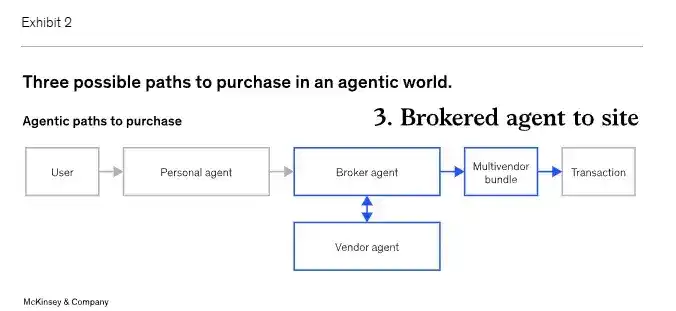
McKinsey predicts: By the end of this decade, Agentic Commerce is expected to generate $1 trillion in revenue in the U.S. retail market, accounting for about one-third of all online retail sales.
Morgan Stanley predicts: By 2030, Agentic Commerce will drive U.S. e-commerce spending to $190 billion to $385 billion, corresponding to a 10%–20% market penetration rate.
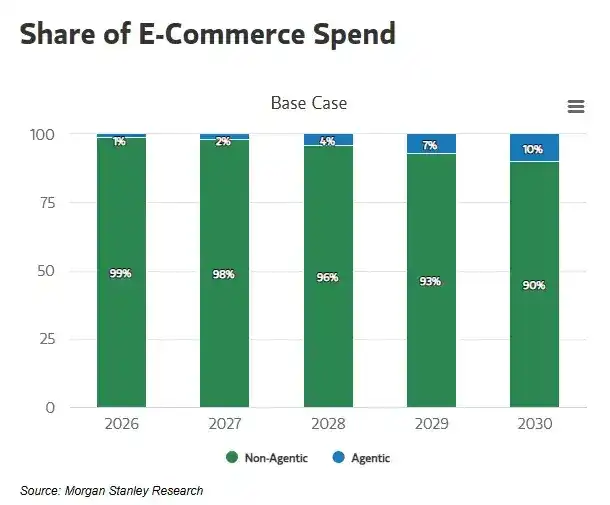
Bain predicts: By 2030, the market size of Agentic Commerce will reach $300 billion to $500 billion, accounting for 15%–25% of total online retail sales.

Current adoption data indicates we are at the inflection point of an exponential growth curve: As of November 2025, 23% of U.S. consumers had used AI to complete a purchase.

Cymbio could become PayPal's "Middle Layer" in AI Commerce

For PayPal, Cymbio's potential positioning is as an intermediate infrastructure layer within the AI commerce system. Its core value propositions include:

Synchronizing product catalogs across different markets and channels

Managing inventory availability in real-time

Routing orders to merchants' existing OMS (Order Management System) and fulfillment systems

Allowing merchants to continue acting as the legal Merchant of Record for transactions

Among these, the Store Sync product enables merchants' product catalogs to be directly discovered by AI agents like Microsoft Copilot and Perplexity, with expectations to integrate with ChatGPT and Google Gemini next.

The prerequisite for AI agents to complete transactions is that product data, pricing, inventory, and fulfillment information must be machine-readable and highly reliable.

From "Checkout" to "Agentic Commerce Workflow"

PayPal processes over $1.7 trillion in total payment volume annually, with over 142 million monthly active accounts. In the traditional model, PayPal's core leverage point is the moment payment occurs.

In the Agentic Commerce system, AI systems can act on behalf of users to complete product discovery, comparison, and even place orders, while PayPal handles identity verification and payment authorization.

After integrating Cymbio, PayPal covers the complete chain:

Discovery: Products are recommended and presented within AI agents

Decisioning: Options are narrowed down through conversational interaction

Checkout: PayPal completes identity verification and payment

Fulfillment: Orders are directly injected into merchant systems for execution

Protocol Wars: Service vs Standard

While PayPal advances Agentic Commerce in the form of "products and services," Google and Shopify are building a cross-functional, standardized Agentic Commerce protocol system.

The key points are:

Google is embedding the UCP (Universal Commerce Protocol) directly into Search and Gemini

Shopify ensures its millions of merchants only need to integrate once to reach multiple AI agents

This means the underlying infrastructure of AI commerce is evolving from "point capabilities" to a "protocolized network."
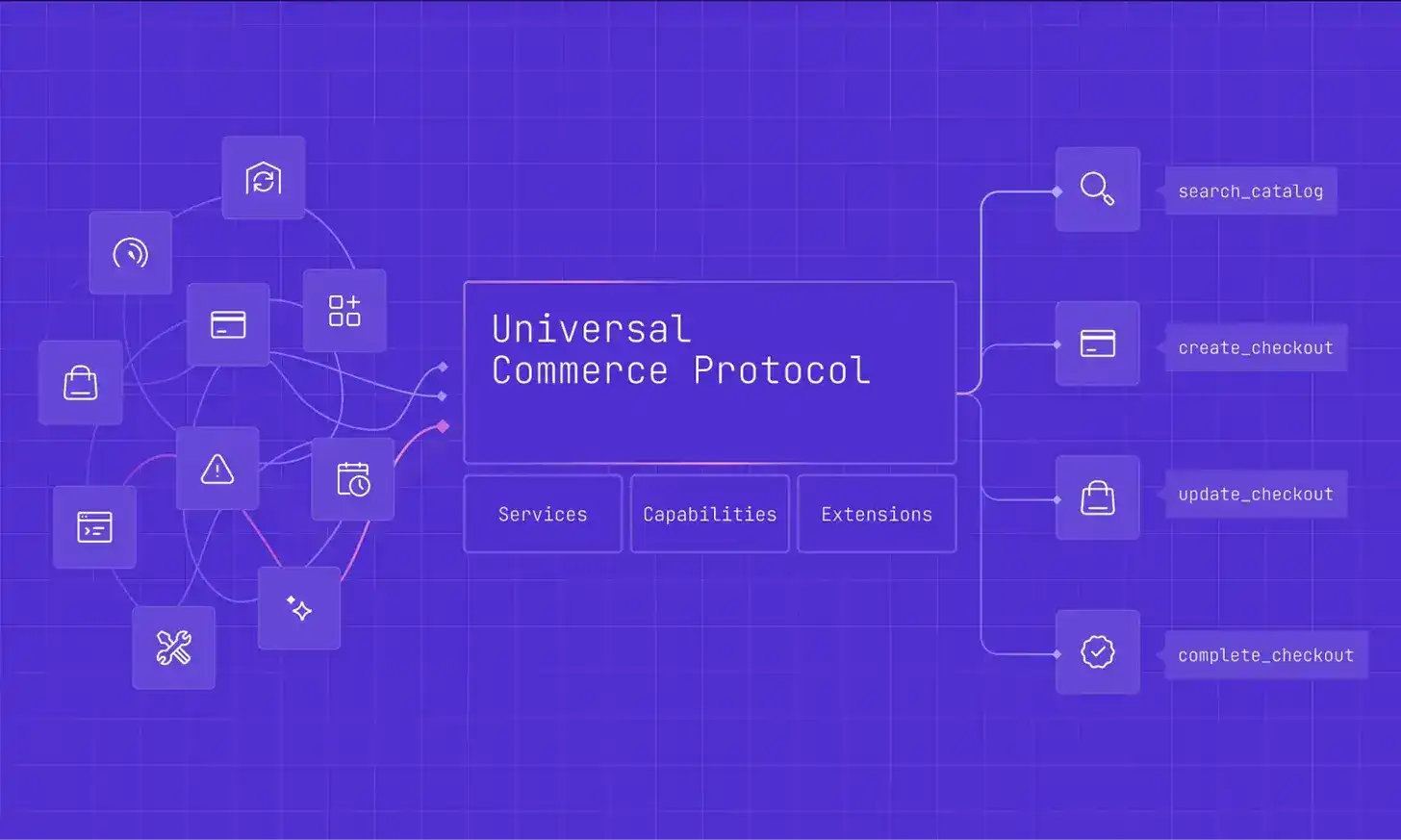
The goal of UCP is to control the "routing layer" of AI commerce, rather than directly owning or operating the commerce itself.

This is more of a defensive layout: by making this layer a "free" public protocol and introducing strong network effects, it prevents any single competitor from monopolizing the core control of the AI commerce system.

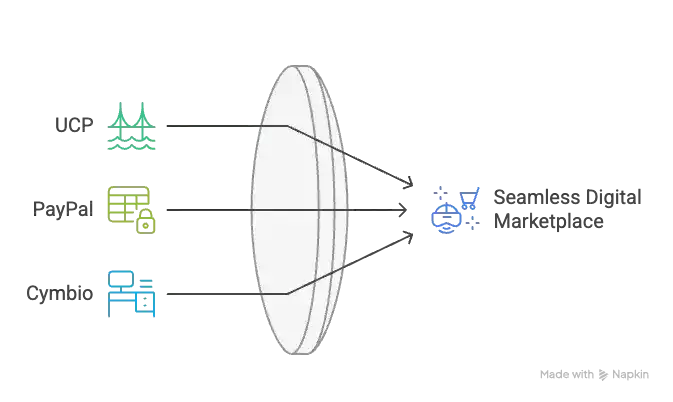
Therefore, PayPal is not competing head-on with UCP but is actively embedding itself into this system.

Google has clearly stated that UCP-based checkout capabilities will support multiple payment service providers, including PayPal and Google Pay.

In other words, UCP aims to be a "neutral highway," while PayPal hopes to become an indispensable toll booth and payment node on this highway.
OpenAI and Stripe are the main competitors in this space.

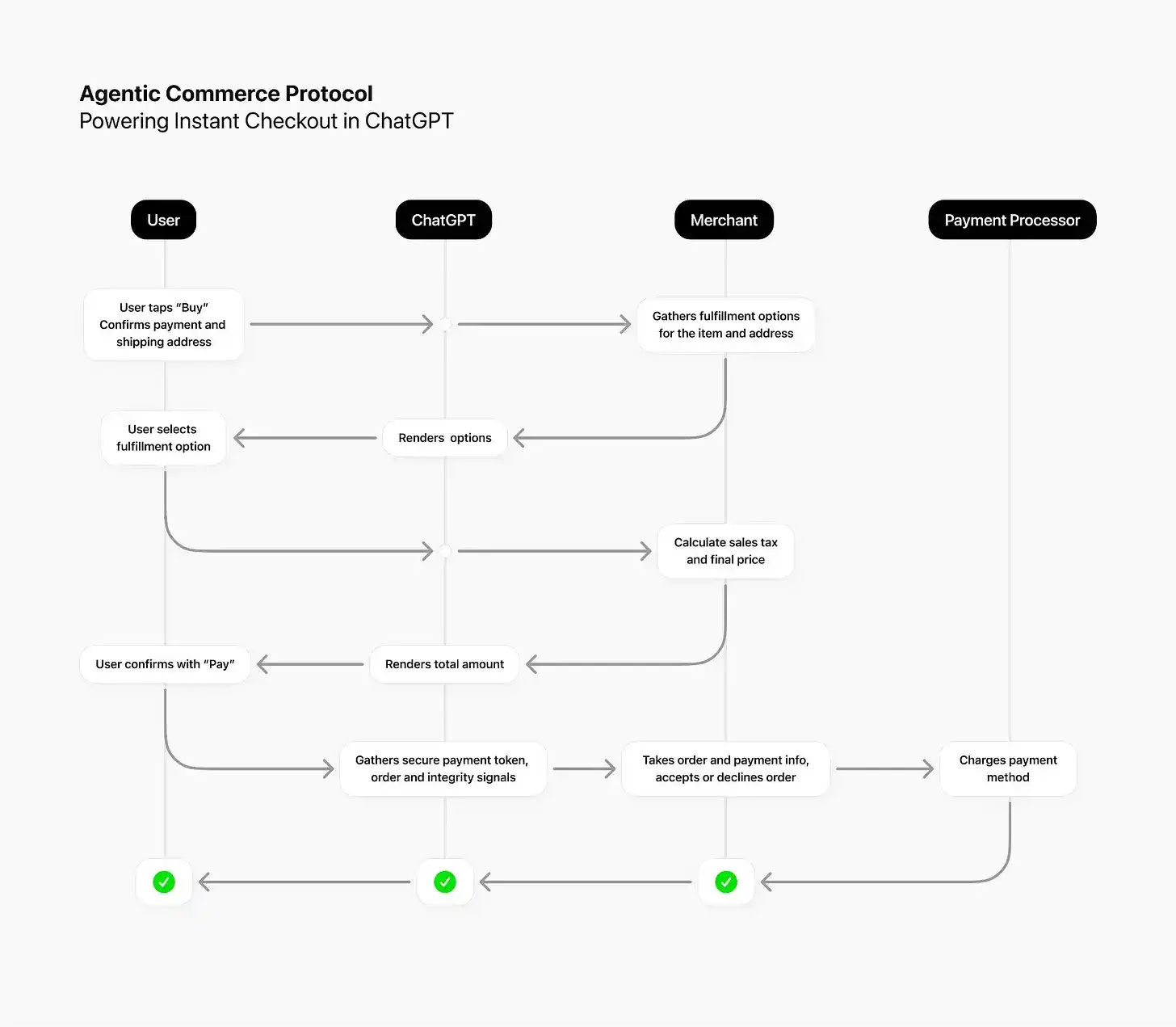
As early as September, Stripe and OpenAI announced the launch of Instant Checkout in ChatGPT, powered underlyingly by the Agentic Commerce Protocol (ACP).

ACP allows AI agents to proactively initiate purchase requests through structured APIs, with Stripe issuing shared payment tokens to confirm payments under agent authorization. This enables AI, once authorized, to complete the entire transaction process from order placement to payment on behalf of the user.
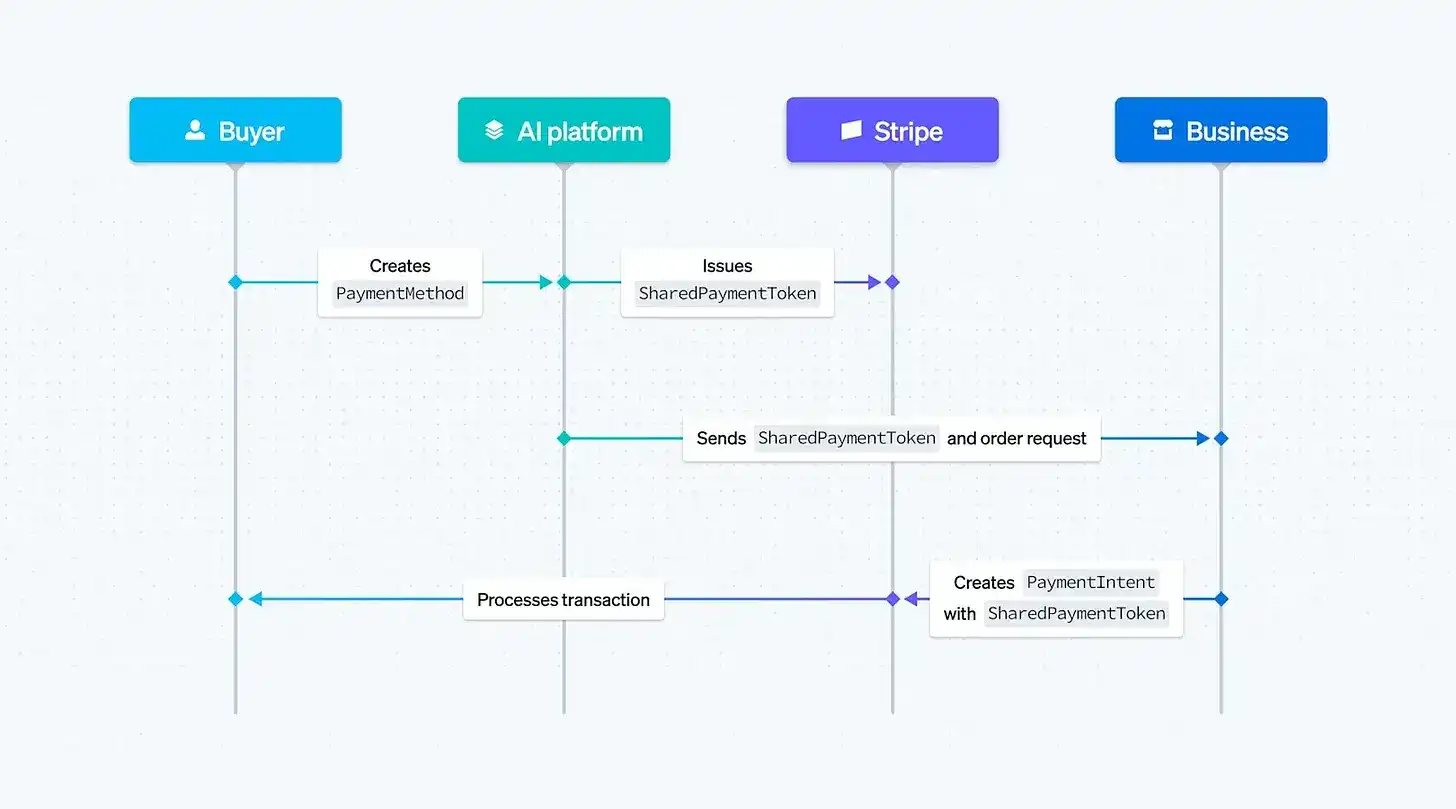
Stripe subsequently launched the Agentic Commerce Suite in December 2025, enabling merchants to:

Publish product catalogs for direct access by AI agents

Autonomously choose which AI agents to sell through

Handle payments, risk management, and dispute resolution through Stripe

Pass order events back to existing business systems

Stripe processed over $1 trillion in payment volume in 2024, serving millions of businesses globally. Its competitive strategy is clear: become the "default wallet" and "action execution layer" for AI agents—highly similar to its path to becoming the default payment API for internet companies.

In this context, PayPal and Stripe are clearly in direct confrontation:

They are competing not just for payment itself, but for the key control points when AI agents actually "execute transactions."

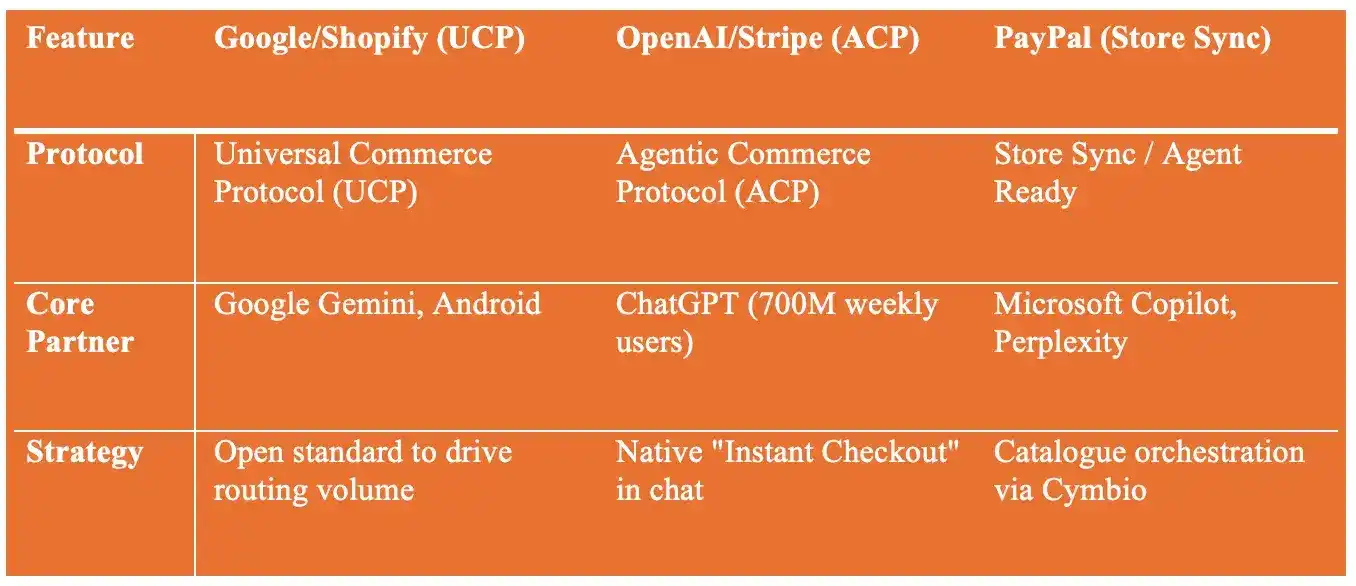
Comparing the three systems together

(This section would involve a横向 comparison of UCP / ACP / PayPal + Cymbio:

Who controls the routing layer, who controls the protocol, who controls payment and fulfillment execution—and the sources of their respective network effects.)

If you wish, I can directly help you organize the next part into a comparison table or a highly summarized "landscape assessment," clarifying the division of labor and博弈 among the three parties at once.
Key Takeaways

Three impacts are particularly prominent:

Commercial behavior will become conversational and executable by agents

Purchasing will no longer be a step-by-step process completed by users, but rather understood by AI through conversation and completed on their behalf under authorization.

Merchants will achieve "integrate once, distribute everywhere"

Merchants won't need to adapt for each platform individually; a single integration will allow their products to reach users through multiple AI agents and channels.

Payments will become embedded infrastructure, no longer the endpoint of transactions

Payment will no longer be a "final step button" but a deep-seated capability embedded within the discovery, decision-making, and fulfillment processes.

Payment Networks' Advance Preparation

Incidentally, Mastercard announced in January 2026 that it is researching "AI Commerce Rules," essentially attempting to抢先一步 participate in defining the governance framework for this transformation.

Payment networks clearly realize that the power to set rules and standards will determine future positioning before AI agents execute transactions on a large scale.

As we pointed out in our January analysis: banks, fintech companies, and the crypto industry must ensure they are "at the table," rather than being incorporated afterwards.

If financial institutions cannot embed themselves into these platforms提前, their financial functions may ultimately be internalized by Big Tech.

The Situation and Choices of Different Camps

For Banks

Traditional banks lack the technical infrastructure to compete head-on with Google, OpenAI, or Microsoft at the Agentic Commerce level. However, they still hold three key resources: payment clearing channels, customer credit relationships, and compliance and regulatory experience.

These assets mean banks won't disappear, but they must reposition themselves.

For Fintechs

Companies like PayPal, Stripe, and Adyen realized early on that merely handling payments is no longer sufficient to巩固 long-term positions.

Therefore, they are actively moving upstream into: commerce orchestration, merchant services, and the infrastructure layer of the AI era.

For Crypto

The Agentic Commerce protocol systems announced so far are almost entirely traditional financial paths: credit cards, Google Pay, PayPal, Stripe, etc., occupy core positions.

In UCP, ACP, and Store Sync, cryptocurrency and stablecoins are largely absent, aside from some零星 experiments involving Stripe or Coinbase.

Whether this is: a huge strategic oversight or an intentional exclusion remains to be seen.

For crypto companies, the window of opportunity is clear: if they can build payment rails natively suited for AI agents (instant settlement, programmable money, global reach) and successfully embed themselves into AI platforms before the protocols solidify completely, they might achieve a leapfrog overtaking of traditional finance; otherwise, they risk being permanently excluded from the system.

Conclusion

Fundamentally, PayPal is striving to catch up with Stripe and adapt to rapidly changing consumer behavior.

As people increasingly complete daily life decisions within AI platforms, these platforms will gradually evolve into the "default virtual storefronts" for brands.

Whoever can embed themselves into the infrastructure behind these storefronts will be able to remain at the table.
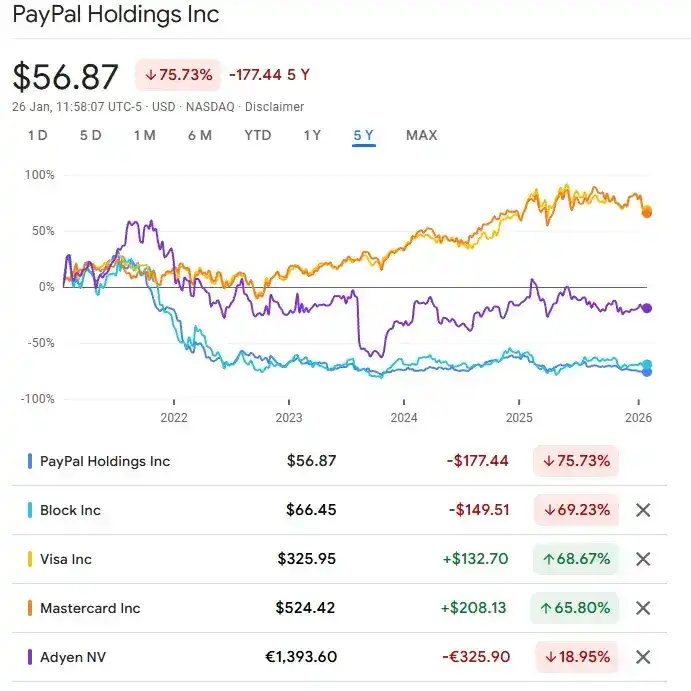
PayPal's stock price has been sluggish for a while, down about 37% from its 52-week high. Investors continually question whether the company maintains structural relevance in the long term, and the rise of the Crypto + AI narrative has反而加剧了 these concerns.

In this context, the diversification布局 around Agentic Commerce is not an offensive choice but a "necessary cost" to maintain relevance. For PayPal, this is not icing on the cake but an admission fee it不得不付出: only by completing this shift can it potentially remain in a core position within the next generation of commercial infrastructure.


Trending Cryptos

Related Questions

QWhat is the strategic significance of PayPal's acquisition of Cymbio in the context of Agentic Commerce?

AThe acquisition of Cymbio, estimated at $150-200 million, is a key strategic move for PayPal to maintain competitiveness in Agentic Commerce. Cymbio's platform helps merchants sell across various AI interfaces like Microsoft Copilot and Perplexity. It allows PayPal to shift from being a Web2 payment tool to a more upstream, core component of commerce, handling product discovery, catalog distribution, and order orchestration, which is crucial as AI agents compress and reshape the traditional e-commerce funnel.

QWhat are the major infrastructure protocols being developed for Agentic Commerce, and who is behind them?

AThe major infrastructure protocols are the Universal Commerce Protocol (UCP), led by Google and Shopify, and the Agentic Commerce Protocol (ACP), a collaboration between OpenAI and Stripe. UCP aims to control the routing layer of AI commerce by embedding it into Google Search and Gemini, while Shopify ensures its merchants can reach multiple AI agents with a single integration. ACP allows AI agents to initiate purchases via structured APIs, with Stripe handling shared payment tokens for authorized transactions.

QHow does Agentic Commerce change the role of payment providers like PayPal and Stripe?

AIn Agentic Commerce, payment is no longer the final 'checkout button' but an embedded infrastructure component within the discovery, decisioning, and fulfillment workflow. Providers like PayPal and Stripe are competing to become the default 'wallet' and execution layer for AI agents. They are moving upstream into commerce orchestration, merchant services, and the AI infrastructure layer to secure their position, as the ability to embed into these systems determines their long-term relevance.

QWhat are the market size predictions for Agentic Commerce by the end of the decade?

AMarket predictions for Agentic Commerce by 2030 are significant and converging. McKinsey predicts it could generate $1 trillion in revenue in the U.S. retail market, about one-third of all online retail sales. Morgan Stanley forecasts it will drive $190-385 billion in U.S. e-commerce spending, representing a 10-20% market penetration. Bain estimates the market size will reach $300-500 billion, accounting for 15-25% of online retail sales.

QWhat is the current adoption rate of AI for shopping among U.S. consumers, and what does it indicate?

AAs of November 2025, 23% of U.S. consumers have used AI to complete a purchase. This data point indicates that the market is at an inflection point on the exponential growth curve, showing rapid early adoption and validating the potential for Agentic Commerce to scale significantly in the near future.

Related Reads

The "Impossible Triad" Is Fundamentally a Pseudo-Problem

The article argues that blockchain's fundamental limitation is not the scalability trilemma (decentralization, scalability, security), which has been largely solved, but the lack of **privacy** and, until recently, clear **legitimacy**. Blockchain is described as a slow, expensive, globally shared computer whose core value is censorship resistance and verifiability. While ideal for native digital assets like money (e.g., stablecoins), its default transparency acts as a **tax**, exposing all transactions and enabling MEV extraction, which deters serious institutional capital. Simultaneously, its permissionless nature created regulatory ambiguity. The piece contends that **privacy** is the missing critical feature. It rejects the false choice between total transparency and complete anonymity. Modern cryptography (like zero-knowledge proofs) enables **compliant privacy**: users can prove facts (solvency, KYC status, compliance) without revealing the underlying sensitive data (specific holdings, identities). This preserves auditability for regulators and eliminates the leak of financial information. With recent regulatory progress (e.g., the GENIUS Act) addressing legitimacy, adding default, provably compliant privacy becomes a pure upgrade. It transforms blockchain from a costly, public ledger into a confidential settlement layer, finally bridging the gap to mainstream institutional and individual adoption of on-chain finance.

链捕手9h ago

The "Impossible Triad" Is Fundamentally a Pseudo-Problem

链捕手9h ago

Optical Chips: Collective Capacity Expansion

The global optical chip industry is experiencing a massive wave of expansion driven by surging AI data center demand. Major players across the US, Japan, Europe, and China are aggressively investing to ramp up production capacity. In the US, Coherent is expanding its 6-inch Indium Phosphide (InP) semiconductor fab in Texas, supported by CHIPS Act funding and a $2 billion strategic investment from NVIDIA. Lumentum is building a new factory for InP optical devices, and Nokia is scaling its advanced photonic chip packaging and testing capabilities. NVIDIA's investments aim to secure future supply of critical lasers and optical interconnect products for AI infrastructure. Japan's JX Advanced Metals, a leading InP substrate supplier, plans a multi-billion yen investment to increase its capacity 7-10 times, strengthening its grip on the crucial upstream materials market. In Europe, IQE and Tower Semiconductor settled a patent dispute and signed a multi-year InP epitaxial wafer supply agreement, highlighting that next-generation silicon photonics platforms will integrate high-performance InP components. STMicroelectronics and Sivers Semiconductors are also expanding silicon photonics production and partnerships. China is rapidly building out its domestic supply chain. Dongshan Precision's subsidiary, Source Photonics, announced a $12 billion project to expand optical chip and module production. Companies like Sanan Optoelectronics and Yunnan Germanium are scaling up InP chip manufacturing and substrate production, moving towards vertical integration from materials to modules. While debate continues around the exact future architecture—whether CPO (Co-Packaged Optics), NPO, or pluggables will dominate—analysts like Morgan Stanley argue the underlying driver is unchangeable: the explosive growth in bandwidth demand. This will inevitably increase the volume of optical engines, lasers, and related content per GPU, regardless of the final technical path. The competition for "more light" in the AI era has intensified into a global, full-chain capacity race.

marsbit11h ago

Optical Chips: Collective Capacity Expansion

marsbit11h ago

Stablecoins Finally Find Real Yield: An In-Depth Look at On-Chain Reinsurance Re | A Conversation with Re Founder Karan Saroya

Stablecoin Real Yield Found: A Deep Dive into On-Chain Reinsurance with Re's Karan Saroya As stablecoin supply exceeds $170 billion, the search for sustainable, non-speculative yield intensifies. Re, an on-chain reinsurance platform, provides an answer: connecting stablecoin capital to the trillion-dollar traditional reinsurance market. Re operates as a regulated reinsurer, accepting stablecoin deposits as collateral to back US insurance companies. These insurers pay premiums, generating yield that flows back to on-chain depositors. Currently supporting 35 insurers and underwriting $500 million, Re projects scaling to over $1 billion soon. Key insights from a Bankless podcast with founder Karan Saroya and investor Avichal of Electric Capital: 1. **Uncorrelated, Real-World Yield:** Re offers stablecoin holders access to reinsurance returns (targeting 12-14%+), an asset class entirely separate from crypto or equity markets. 2. **Operational Efficiency via Smart Contracts:** Re replaces traditional, labor-intensive capital fundraising with smart contracts, allowing a ~12-person team to compete with industry giants. 3. **Regulatory Leverage:** For every $1 of collateral, regulations allow backing $5-7 in written premiums. This leverage amplifies returns from the underlying risk-free rate. 4. **DeFi Integration:** Depositors receive receipt tokens, which can be used in protocols like Morpho for "looping," potentially pushing yields to 18-20%+. 5. **The "DeFi Mullet" Model:** A compliant front-end (regulated reinsurer) paired with a decentralized back-end (smart contracts, DeFi capital markets). 6. **RE Governance Token:** Modeled on Lloyd's of London, the token governs the central capital pool's allocation, counterparty acceptance, and parameters. 7. **Real Economic Impact:** Capital funds real-world productivity (factories, clinics, businesses) via insurance, moving beyond crypto's internal loops. The discussion highlights a pivotal moment: DeFi's supply-side infrastructure is now met by real demand for productive yield, potentially kickstarting a flywheel where vast on-chain stablecoin capital seeks these real-world returns.

链捕手13h ago

Stablecoins Finally Find Real Yield: An In-Depth Look at On-Chain Reinsurance Re | A Conversation with Re Founder Karan Saroya

链捕手13h ago

1996 or 1999? Walsh's First Test is 'How to View AI'

"1996 or 1999? Wall's First Big Test Is 'How to View AI'" Federal Reserve Chairman Wall's initial challenge is not whether to raise or cut rates, but a more fundamental judgment: what kind of boom is the current AI boom? This will determine the Fed's policy path and define his legacy. Economics is split between two opposing views, according to reporter Nick Timiraos. One sees imminent productivity gains that will increase supply and cool inflation, allowing the Fed to hold steady. The other argues that while productivity benefits are distant, demand shocks are here now, and waiting for data confirmation risks missing the intervention window, forcing sharper rate hikes later. Wall has signaled a leaning toward the first view, echoing 1996-era Alan Greenspan, who embraced strong, productivity-driven growth without fear of inflation. However, Wall faces a different macro environment than Greenspan did, with tariff pressures, expanding fiscal deficits, and diminishing globalization benefits, which could force more significant inflation pressures even if AI benefits materialize. Wall's logic, expressed before taking office, is that AI-driven productivity gains won't show in official data for years. If the Fed waits for confirmation, it might mistakenly tighten policy and choke off the very growth that could suppress inflation. This argues for using forward-looking narratives over lagging data. Chicago Fed President Austan Goolsbee presents a key counter-argument. He distinguishes between expected and unexpected productivity booms. A widely anticipated boom, like the current AI wave, can cause people to spend future wealth gains in advance, overheating the economy before productivity actually rises, thus requiring preemptive rate hikes. He cites rising costs for AI data centers as evidence of such overheating. Fed Governor Christopher Waller offers a rebuttal to Goolsbee, noting the "expected spending" mechanism only works if people can borrow against future income, which many households cannot do due to borrowing constraints. Wall also faces a paradox related to his desire to reduce the Fed's use of "forward guidance" (pre-announcing policy moves). This practice was established in 1999 when Greenspan began signaling hikes to avoid market shocks. If the economy follows a less optimistic path, Wall may be forced to choose between using the guidance he wants to abolish or risking market volatility by staying silent. The ultimate question defining Wall's first major test remains: Is this 1996 or 1999?

marsbit14h ago

1996 or 1999? Walsh's First Test is 'How to View AI'

marsbit14h ago

Trading

Spot
Futures

Hot Articles

Discussions

Welcome to the HTX Community. Here, you can stay informed about the latest platform developments and gain access to professional market insights. Users' opinions on the price of AI (AI) are presented below.

活动图片