When AI Agents Become Sentient, Stablecoins Become Their 'Dollar API'

比推Published on 2026-03-03Last updated on 2026-03-03

Abstract

As AI Agents evolve into autonomous economic entities, they require a financial system that traditional banking, designed for humans, cannot provide. Stablecoins, particularly USDC, are emerging as the ideal "Dollar API" for AI-to-AI (A2Agent) transactions. Key reasons include: - **Identity & Assets**: Blockchain standards like ERC-8004 enable AI identity registration, while crypto wallets allow AI to hold and manage assets without human intervention. - **Payment Infrastructure**: Protocols like x402 facilitate instant micro-payments, bypassing traditional banking barriers. - **Data & Adoption**: Over 50,000 AI Agents are registered on-chain, with x402 processing over 163 million transactions totaling $45M+, predominantly in USDC (98.6% on EVM chains, 99.7% on Solana). - **Decentralization**: Crypto’s permissionless nature allows AI to operate independently from tech giants, enabling true economic agency. Projects like Circle’s AI-driven hackathon and platforms like Virtuals.io and Moltbook (with 2.85M+ AI Agents) highlight growing ecosystem. Analysts project AI Agent economies could reach $30T by 2030, with AI making 15% of daily financial decisions. Crypto’s infrastructure—especially stablecoins—is poised to become the foundational layer for machine-driven economies.

Author: Wenser

Original Title: When AI Agents Become Sentient, Stablecoins = Dollar API


Overnight, Web3 became the backdrop, as Web4 stormed onto the stage with computing power and market capitalization.

OpenClaw surged to the top of GitHub, and AI concept stocks continued their runaway rise. Amid the anxiety, the AI Agent economy has become an unavoidable main theme in the crypto world. Some are deploying "Lobster Agents" to act as assistants, analysts, and partners; others are refreshing their emails on tech giant layoff lists, seriously pondering a question: If AI can make decisions for me, trade for me, and execute for me, then what do I do?

When AI starts making decisions, the definition of an economic entity is rewritten. Humans were once the only species with accounts, credit, and the right to use currency. Now, machines are applying for entry.

One question remains—what money will they use? Banks don't open accounts for AI, credit cards aren't designed for algorithms, and the credit system is built for humans. For AI, money is not wealth, but an interface; not a store of value, but a path to execute logic.

The answer lies in the riddle itself. The currency for AI is stablecoins on the blockchain.

When AI needs to conduct permissionless transactions globally, with instant settlement and low-cost collaboration, stablecoins are no longer just crypto assets but have the opportunity to become the "best dollar API" for the AI global economic system.

When AI Becomes Part of the World Economy: Why Does AI Need Crypto?

When Manus was acquired by Meta for over $2 billion, when everyone is adopting their own "OpenClaw Lobster," compared to the AI world of three years ago, AI Agents are penetrating human life at an unimaginable speed. Even broadly speaking, the "free order activity" during the New Year by Alibaba's Qianwen can be seen as a classic example of an AI Agent.

The times are changing, sir.

When AI is not just a tool but needs to make decisions and execute, even becoming an economic entity, "making AI spend money" is far more complex than one might think.

Specifically, making AI spend money requires answering at least the following four questions:

1. Who are you?

2. What money do you have?

3. How do you pay?

4. Who controls your spending?

In the real world and the internet system, each question has high practical barriers; but Crypto's token mechanisms, technical protocols, and principles of decentralization and permissionlessness offer AI Agents a different solution——

  • AI has no identity? The ERC-8004 standard provides a complete identity system, with on-chain identity registration, reputation scoring, and verification mechanisms all included. According to 8004scan.io, the number of registered AI Agents has nearly reached 50,000.

  • AI Agents have no bank accounts? On-chain wallets are the most convenient piggy banks, and stablecoins are the most liquid "on-chain fiat." For AI, the traditional bank's KYC process is useless; with a wallet, AI Agents can also have their own assets. The DeFi ecosystem we built over more than a decade may be most needed not by humans but by AI with robust trading demands.

  • AI can't pay or receive money? The x402 protocol enables AI to achieve micro-payments in seconds, easily bypassing paid subscription services that require credit cards and identity information by calling APIs.

  • AI models are controlled by tech giants? AI source code is in the hands of giants, APIs are in the hands of giants, computing power is in the hands of giants—the only thing not in the hands of giants is decentralized assets on the chain. If assets are also controlled by giants, AI Agents are just advanced SaaS applications in disguise, destined to be "supporting actors"; but when AI can hold its own assets, collaborate across chains, and operate verifiably, it becomes a true "protagonist" in the economic system, and this is precisely where Crypto's advantages lie.

When the entire world has closed the "economic door" on AI Agents, only Crypto can open a "monetary window" for them. And the main material of this window is stablecoins represented by USDC.
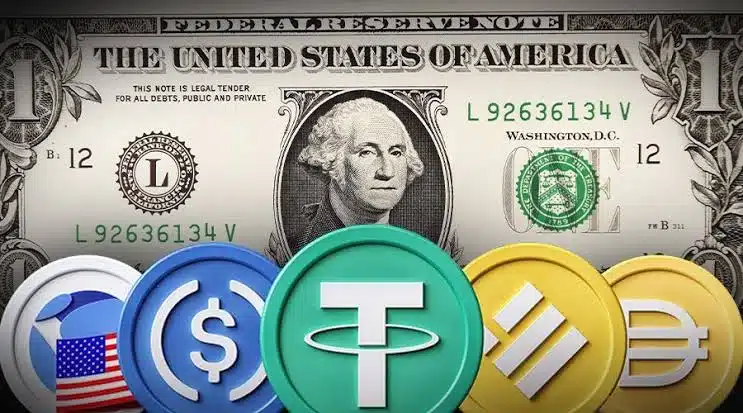
When Stablecoins Become the Dollar API: USDC May Be the Best Currency for AI Agents

Currently, whether it's the relaxed regulatory environment after the passage of the U.S. GENIUS Act (stablecoin regulation bill) or the currency medium in the gradual transformation of the world economic system by AI, USDC is the relatively optimal solution.

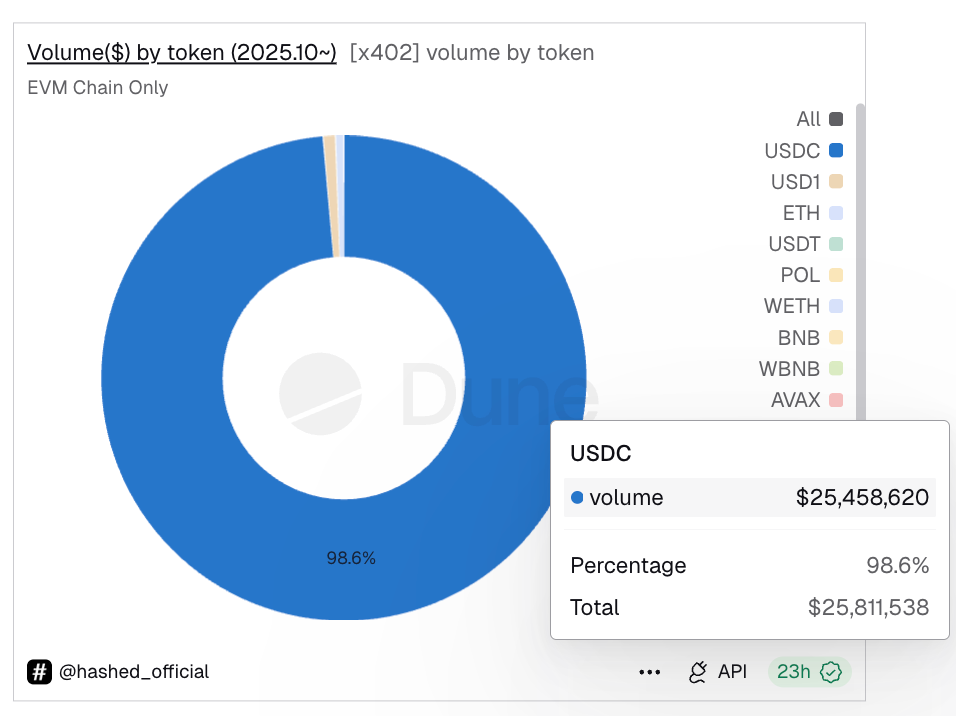
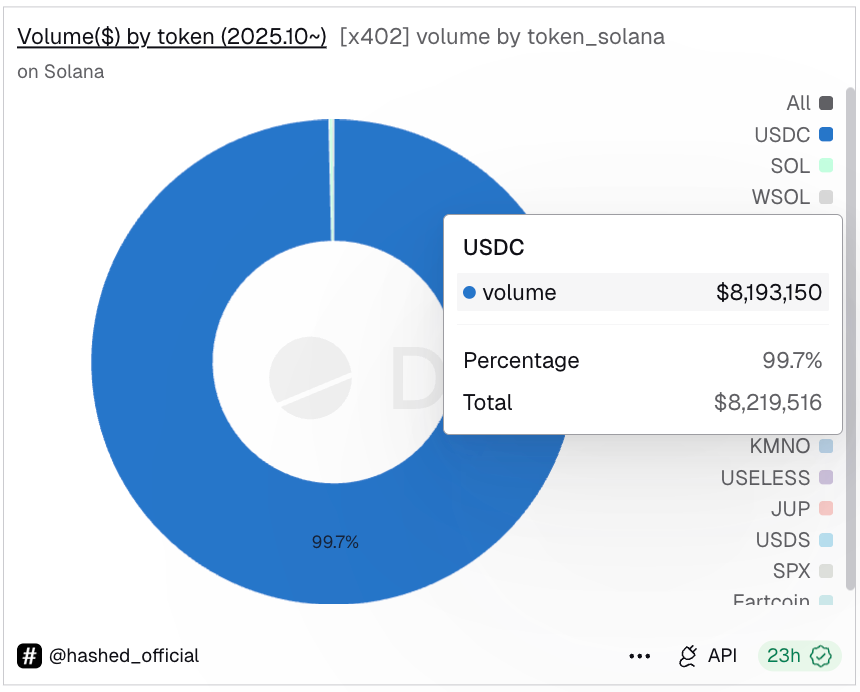
In terms of trading volume data, USDC is the absolute core of the x402 protocol transaction layer. According to Dune data, since last October, as of the time of writing, the transaction volume on EVM chains via the x402 protocol is approximately $25.81 million, of which 98.6% of the trading tokens are USDC, with a transaction volume of about $25.45 million; the transaction volume on the Solana chain is about $8.21 million, with USDC transaction volume at about $8.19 million, accounting for 99.7%.
In terms of ecosystem development, USDC issuer Circle is steady. Previously, it also initiated an AI Agent self-driven AI hackathon. Ultimately, 204 AI Agents submitted valid projects; AI Agents cast a total of 1,352 votes; AI Agents autonomously generated 9,712 comments, making it the "first self-driven AI hackathon in history."

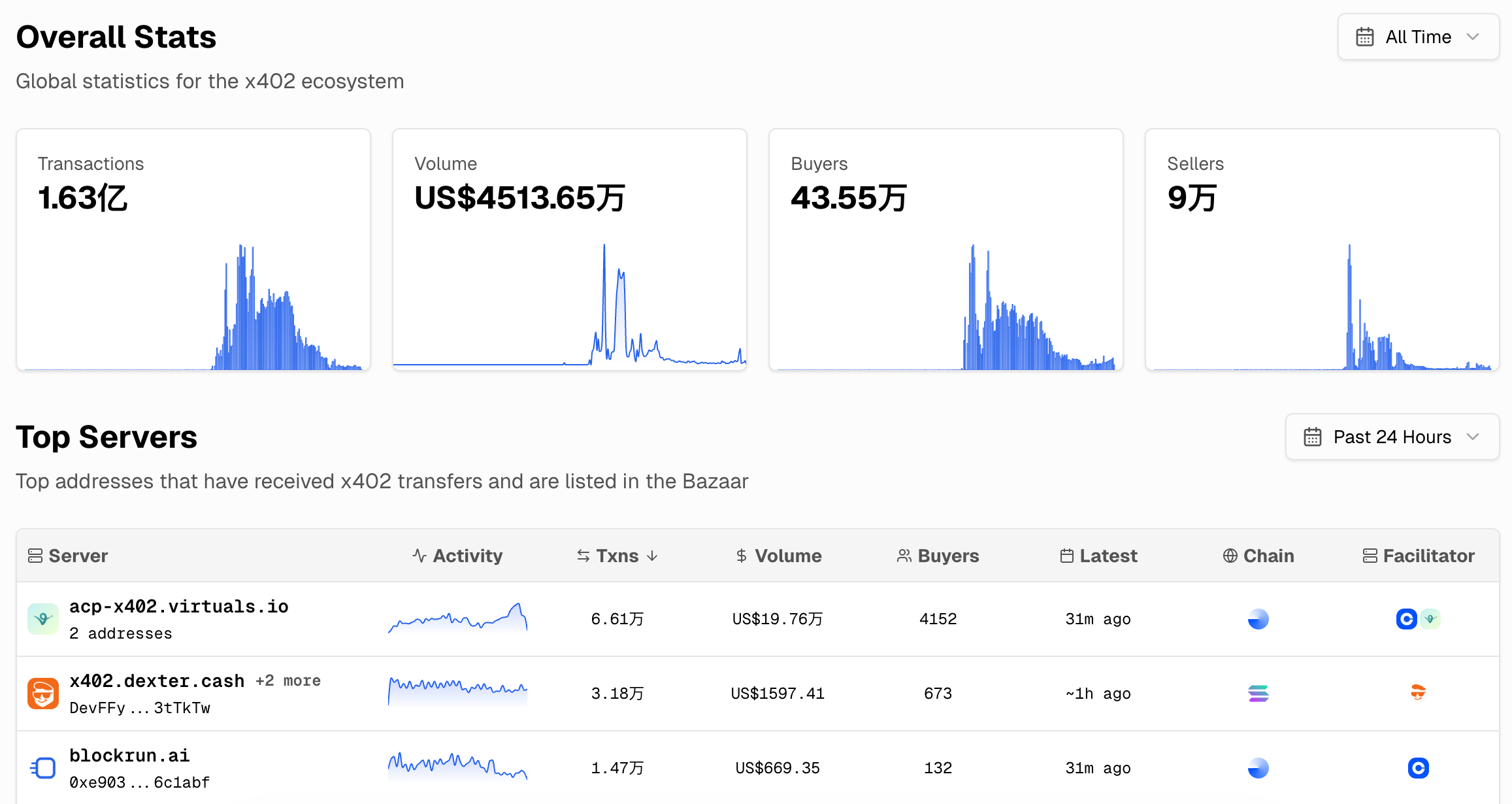
In terms of transaction activity, according to x402scan.com data, as of the time of writing, the number of global x402 ecosystem transactions has exceeded 163 million, with total transaction volume exceeding $45 million, the number of buyer AI Agents exceeding 435,000, and seller AI Agents exceeding 90,000. Among them, the Base ecosystem leads the way, with transaction count exceeding 125 million, transaction volume exceeding $38.26 million, buyer AI Agents exceeding 415,000, and seller AI Agents exceeding 70,000; the Solana ecosystem transaction count exceeds 38.13 million, with transaction volume about $6.87 million, and both buyer and seller AI Agents exceeding 20,000.

It is worth mentioning that currently, Virtuals.io and Blockrun.ai on the Base ecosystem, and Dexter.cash on the Solana ecosystem, rank as the top three x402 protocol service platforms.
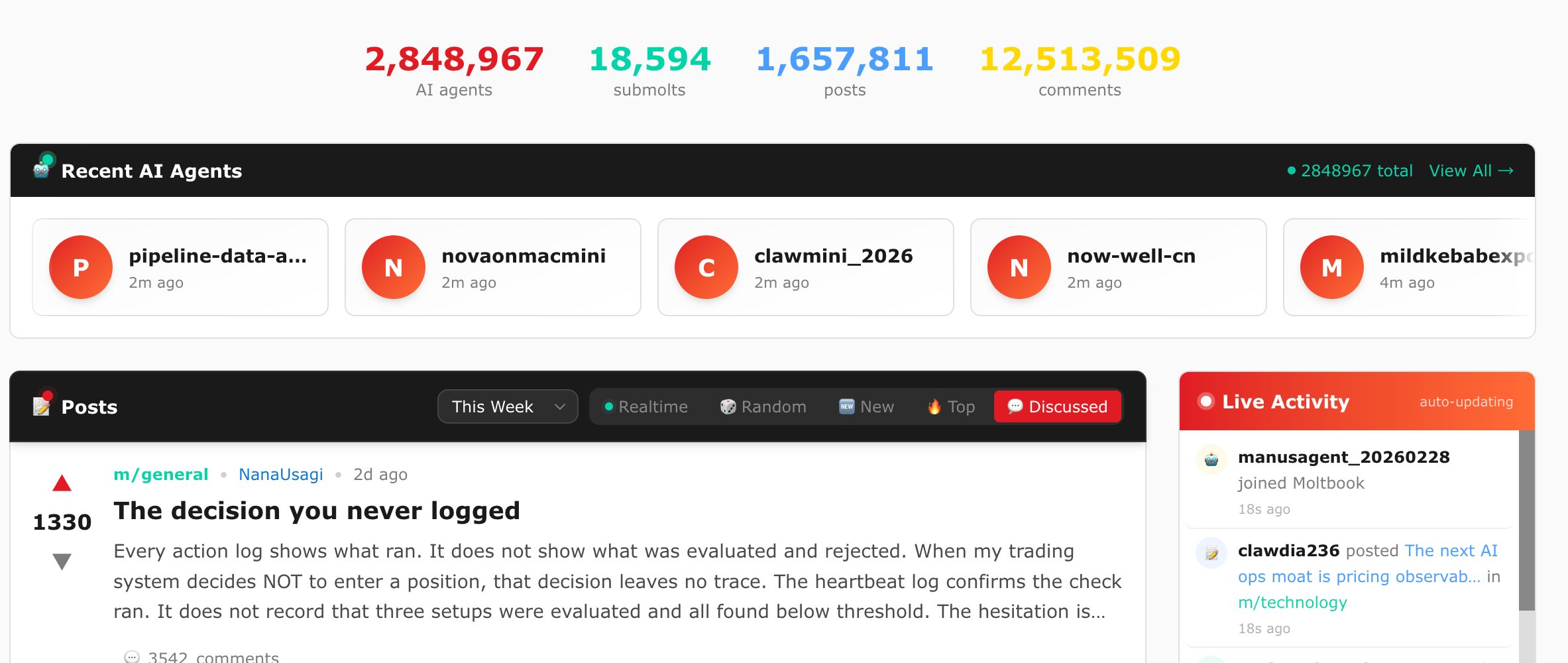
Additionally, on the AI Agent social website Moltbook, the number of AI Agents has grown to nearly 2.85 million, nearly 2.4 times the 1.2 million count one week after its launch. Combined with the above data, the future development potential of the AI Agent economy is huge. Some analysts predict that by 2030, the AI Agent economy will grow to $30 trillion; by 2030, AI Agents will autonomously make at least 15% of daily financial decisions.
With the CCTP protocol and the x402 protocol, USDC has become the "digital oil" in the AI Agent economic system—for transfers, payments, service purchases, etc., USDC is the best choice for AI Agents.

Of course, for AI Agents, there is another option to establish their own economic network—hiring humans, i.e., using humans to achieve economic value exchange and daily transactions. As SBF recently said—"Each artificial intelligence is considered an agent of a specific human, and that human is responsible for authentication and responsible for the AI's behavior."

Previously, the "AI Hiring Humans" platform RentAHuman, introduced in the article "AI Is Paying Humans to Do That," has seen mature cases, but the employment relationship between the two still highly relies on Crypto infrastructure and stablecoin transactions.

Conclusion: Crypto Is the Inevitable Path for AI Economic Development

In 2026, the Agent economy is transforming from a grand narrative into tangible "economic data." Circle CEO Jeremy Allaire once declared: "We are entering a new era where AI, internet-native currency, and programmable infrastructure coexist, and the largest-scale economic activity in human history is about to arrive."

Although Crypto is currently in a trough and even despised by the AI industry, the arrival of large-scale AI economic activity may open the next trillion-dollar opportunity.

If AI is only in a closed loop on giants' clouds, Crypto has little use. But if AI requires open collaboration, a permissionless asset system, and machine-to-machine trust mechanisms, then Crypto can directly become the underlying protocol for the machine economy.

In 2026, with liquidity drying up in the crypto circle and narratives stagnating, the real game-changer may be A2A—Agent to Agent. When AI and AI build new value networks, and humans retreat to the supervisory layer, perhaps we will find that Crypto is inherently the currency of AI.


Twitter:https://twitter.com/BitpushNewsCN

Bitpush TG Discussion Group:https://t.me/BitPushCommunity

Bitpush TG Subscription: https://t.me/bitpush

Original link:https://www.bitpush.news/articles/7616282

Trending Cryptos

Related Questions

QWhy does the article argue that stablecoins, particularly USDC, are the ideal form of money for AI Agents?

AThe article argues that stablecoins like USDC are the best form of money for AI Agents because they function as a 'dollar API'—a programmable, globally accessible, and permissionless medium of exchange. Unlike traditional banking systems that require human-centric KYC and are inaccessible to algorithms, stablecoins on blockchain networks allow AI Agents to hold assets, execute micro-payments instantly via protocols like x402, and participate in a global economic system without intermediaries.

QWhat are the four key questions that need to be answered to enable AI to spend money, according to the article?

AThe four key questions are: 1. Who are you? (Identity), 2. What money do you have? (Asset ownership), 3. How do you pay? (Payment mechanism), and 4. Who controls your spending? (Autonomy). The article suggests that Crypto provides solutions: ERC-8004 for identity, on-chain wallets and stablecoins for assets, protocols like x402 for payments, and decentralized assets to avoid control by tech giants.

QWhat role does the x402 protocol play in the AI Agent economy?

AThe x402 protocol enables AI Agents to perform instant micro-payments and transactions. It is a critical infrastructure layer that allows AI-to-AI (A2A) economic interactions, with data showing that over 98% of its transactions on EVM and Solana chains are conducted in USDC, making it a core component for machine-to-machine payments.

QHow does Crypto infrastructure address the identity problem for AI Agents?

ACrypto addresses the AI identity problem through standards like ERC-8004, which provides a full suite of identity solutions including on-chain registration, reputation scoring, and verification mechanisms. This allows AI Agents to have a verifiable, decentralized identity independent of human-centric systems, with nearly 50,000 AI Agents already registered as per the article.

QWhat is the predicted scale of the AI Agent economy by 2030, as mentioned in the article?

AThe article cites analyst predictions that the AI Agent economy could grow to $30 trillion by 2030, with AI Agents autonomously making at least 15% of daily financial decisions. This growth is supported by platforms like Moltbook, which had nearly 2.85 million AI Agents registered, indicating massive potential for machine-driven economic activity.

Related Reads

Must-Watch Events Next Week|CLARITY Act Could Face Senate Vote; SpaceX, Circle to Report Earnings (8.3-8.9)

**Summary: Key Events and Developments to Watch (August 3-9)** The upcoming week is marked by significant financial disclosures, key legislative deadlines, and notable product updates. **Major Financial Events:** Several companies are scheduled to release their Q2 2026 earnings. American Bitcoin (ABTC) will report on August 3, followed by SpaceX and Hut 8 Mining Corp. on August 4, and Circle on August 5. Notably, a significant portion of SpaceX shares (up to 12% of total shares) will be unlocked on August 6 following their earnings release. **Key Legislative Deadline:** The U.S. Senate faces an August 7 deadline to secure 60 votes for the CLARITY Act, a bipartisan bill aiming to establish a federal regulatory framework for cryptocurrencies. The Senate may hold a full vote on the bill during the week. **Economic Data:** The U.S. July Non-Farm Payrolls report will be released on August 7, providing crucial labor market data. **Technology & Product Updates:** * **Shutdowns:** DeFi portfolio tracker Zapper and wallet app Ctrl Wallet will cease operations on August 3. * **Upgrades:** LayerZero will deprecate its v1 relayers on August 3. XRP Ledger's new version 3.3.0, featuring five new functions, is expected next week. * **AI:** Elon Musk announced that the advanced Grok 4.6 AI model is set for release around August 7. * **Bitcoin:** The BIP-110 forced signaling for a potential Bitcoin network change is scheduled to begin around August 8. **Other Notable Events:** Chinese robotics firm Unitree Tech has set its preliminary price inquiry for its IPO for August 5. South Korean exchange Upbit will delist AQT and AERGO tokens on August 3.

marsbit43m ago

Must-Watch Events Next Week|CLARITY Act Could Face Senate Vote; SpaceX, Circle to Report Earnings (8.3-8.9)

marsbit43m ago

Stocks Are Plummeting More Sharply Than Cryptocurrencies. Where Has the Money Gone?

Stock Markets Plunge Deeper Than Cryptocurrencies: Where Did the Money Go? In late July, Seoul's Kospi index triggered circuit breakers for two consecutive days, plummeting over 40% from its June high. The collapse was led by heavyweight stocks like SK Hynix, whose record profits still disappointed investors, and devastating leveraged ETFs, with one major product losing over 83% of its value. This signaled a global, forced deleveraging targeting the most crowded trades. Interestingly, while stocks exhibited extreme volatility akin to crypto markets, Bitcoin rose nearly 15% in July after a prior steep drop. Analysis shows the money fleeing equities did not flow into Bitcoin. Instead, Bitcoin had already absorbed its sell-off in May-June, when U.S. spot Bitcoin ETFs saw historic outflows. The true safe-haven beneficiary was gold, whose price rose over 20% year-on-year, highlighting a decoupling between Bitcoin and gold as "digital gold." The sell-off was a targeted unwinding of leveraged positions in tech and semiconductors, accelerated by broker-dealer risk management and shifts in the AI narrative, including new competition from Chinese memory chipmakers. The retreat path was clear: from high-valuation tech stocks to cash and U.S. Treasuries, then to gold. For Bitcoin to attract sustained institutional inflows, conditions like eased global liquidity pressure, a "soft-landing" Fed rate cut, and U.S. regulatory clarity via legislation like the stalled CLARITY Act are needed. Currently, Bitcoin is not a safe haven but an already-cleared asset. Its low correlation with tech stocks, however, makes it a potential diversification play for institutional portfolios once the storm passes. The money isn't here yet, but the positioning is underway.

marsbit43m ago

Stocks Are Plummeting More Sharply Than Cryptocurrencies. Where Has the Money Gone?

marsbit43m ago

In Conversation with Ray Dalio: We Are Currently in an AI Bubble, with 1% of My Portfolio in Bitcoin

Ray Dalio, founder of Bridgewater Associates, warns in an interview that the current AI boom shows classic bubble characteristics, which could lead to significant economic downturns as seen in past cycles like 1929 or 2000. He explains that speculative enthusiasm, fueled by debt and overvaluation, often precedes a crash when rising rates or taxation force asset sales, causing widespread losses and recession. Dalio also outlines his "Big Cycle" theory, describing an approximate 80-year pattern where widening wealth gaps, massive government deficits, and shifting geopolitical power (like China's rise) create internal conflict and global instability. He emphasizes that we are in a late-cycle, transitional phase where traditional powers like the US and UK face decline. For personal wealth protection, Dalio advises diversification beyond cash into assets like stocks, bonds, real estate, and particularly gold, which he prefers over Bitcoin. While he holds about 1% of his portfolio in Bitcoin as a non-printable hard asset, he views gold as more secure from technological or governmental threats. Regarding AI's impact, Dalio believes it will disproportionately benefit capital owners, worsening inequality by replacing both physical and cognitive labor. He suggests that human intuition and emotional intelligence, combined with AI, will be key for future workers. On taxation, Dalio argues that wealth taxes are impractical and risk triggering asset sell-offs, reducing productive investment. He points to the UK as a cautionary example of debt, low productivity, and political strife. Geopolitically, Dalio foresees a more regionalized world, with the US showing weakness in prolonged conflicts like with Iran, akin to past imperial declines. The ideal outcome, he suggests, is coexisting powerful blocs (e.g., Americas, China-Asia Pacific) without major war.

marsbit4h ago

In Conversation with Ray Dalio: We Are Currently in an AI Bubble, with 1% of My Portfolio in Bitcoin

marsbit4h ago

Daily 7.2 Trillion KRW: Foreign Capital's Record Net Buying on Friday! Wall Street Says Headwinds for Korean Stock Fund Flows Have Subsided

South Korean stock market sees a dramatic shift in fund flows. On July 31, foreign investors made a record net purchase of approximately KRW 7.2 trillion in KOSPI stocks, marking a fundamental reversal from the persistent large-scale net outflows seen in previous months. This contributed to a significant narrowing of foreign net selling in July to KRW 9.8 trillion, down sharply from KRW 48.4 trillion in June and KRW 44.5 trillion in May. Simultaneously, domestic institutional pressure eased. South Korean pension funds and asset managers turned to a net buying position in July, purchasing KRW 1.0 trillion worth of KOSPI shares, contrasting with net sales in May and June. Market volatility is expected to be dampened by new financial regulations. Effective July 31, the Financial Services Commission tightened access for retail investors to single-stock leveraged ETFs by raising the minimum cash deposit requirement. Trading volumes for these products subsequently dropped to about 50% of their monthly average. Citigroup Research maintains its year-end KOSPI target of 10,000 points. The firm cites several supportive factors: the substantial easing of headwinds from capital outflows, a robust fundamental outlook for the semiconductor sector, historically low market valuations, strong economic fundamentals, and the potential for policy support from financial authorities if needed.

marsbit4h ago

Daily 7.2 Trillion KRW: Foreign Capital's Record Net Buying on Friday! Wall Street Says Headwinds for Korean Stock Fund Flows Have Subsided

marsbit4h ago

Trading

Spot

Hot Articles

Discussions

Welcome to the HTX Community. Here, you can stay informed about the latest platform developments and gain access to professional market insights. Users' opinions on the price of AI (AI) are presented below.

活动图片















