What Is the Cost of Bitcoin Mining Companies Going All-In on AI?

marsbitPublished on 2026-08-18Last updated on 2026-08-18

Abstract

Bitcoin mining companies are undergoing a massive transformation, pivoting from cryptocurrency mining to AI infrastructure and high-performance computing (HPC) services. This shift is driven by the severe profitability crisis in Bitcoin mining following the 2024 halving and the October 2025 market crash, which pushed mining costs as high as $140,000 while Bitcoin's price fell to around $63,000. In response, major public miners like Core Scientific and TeraWulf are rebranding as "energy infrastructure platforms" or "AI cloud service providers." Their revenue structures have flipped, with AI/HPC hosting now constituting over 70-80% of quarterly revenue, dramatically surpassing declining Bitcoin mining income. They are securing massive, long-term contracts worth tens of billions of dollars with tech giants like AMD, CoreWeave, and Anthropic, locking in future cash flow. However, this all-in bet on AI carries significant risks. The AI compute market lacks Bitcoin's self-correcting mechanism, where unprofitable miners exit, reducing network difficulty and boosting profitability for those who remain. An AI compute supply glut could rapidly drive prices down, making today's lucrative long-term contracts burdensome. Furthermore, the transition is largely one-way; retrofitting facilities for AI and signing decade-plus contracts makes it nearly impossible to return to mining when its profitability eventually rebounds. Some companies, like Marathon Digital and Hut 8, are taking a mor...

Written by: Prathik Desai

Compiled by: Luffy, Foresight News

Over the past year, every major publicly-traded Bitcoin miner has faced a survival crisis. A look at their financial reports reveals they are shedding their identity as "miners."

Now they are repackaging and repositioning themselves, calling themselves "energy infrastructure platforms," "vertically integrated AI cloud service providers," or "digital infrastructure enterprises built on electricity, land, and computing power."

Behind this rebranding lies a transformation in their revenue structure, with their market capitalization now exceeding valuations from when they were purely Bitcoin mining companies.

On the surface, the story seems wonderful. Struggling miners have seized the opportunity, embraced the explosive demand for AI inference computing power, and found a path to self-rescue. But if we take a broader perspective, they are also giving up some crucial things.

This article will explain why a 180-degree shift away from Bitcoin mining could backfire on miners in the future.

What Sparked This Transformation?

The Bitcoin block reward halving in April 2024 forced miners to make a choice: either mine Bitcoin, hold it, and wait to sell at a higher price, or retrofit their hardware to diversify into high-performance computing (HPC). In October 2024, Bitcoin's price rose from below $70,000, peaking at $124,000 in October 2025. This rally led some miners to continue mining and hoarding their output.

However, the market liquidation event on October 10, which wiped $19 billion from the crypto market's capitalization within 24 hours, triggered a downturn that has yet to be fully recovered from.

The current Bitcoin price of around $63,000 is nearly halved from last October's high. At this level, selling mined Bitcoin yields almost no profit. Bitcoin mining costs are affected by both electricity prices and network difficulty. The comprehensive mining cost rose from about $40,000 in February 2024 to a range of $90,000-$110,000 between October 2025 and July 2026. By August this year, Bitcoin's comprehensive mining cost hit a new high, soaring to $140,000.
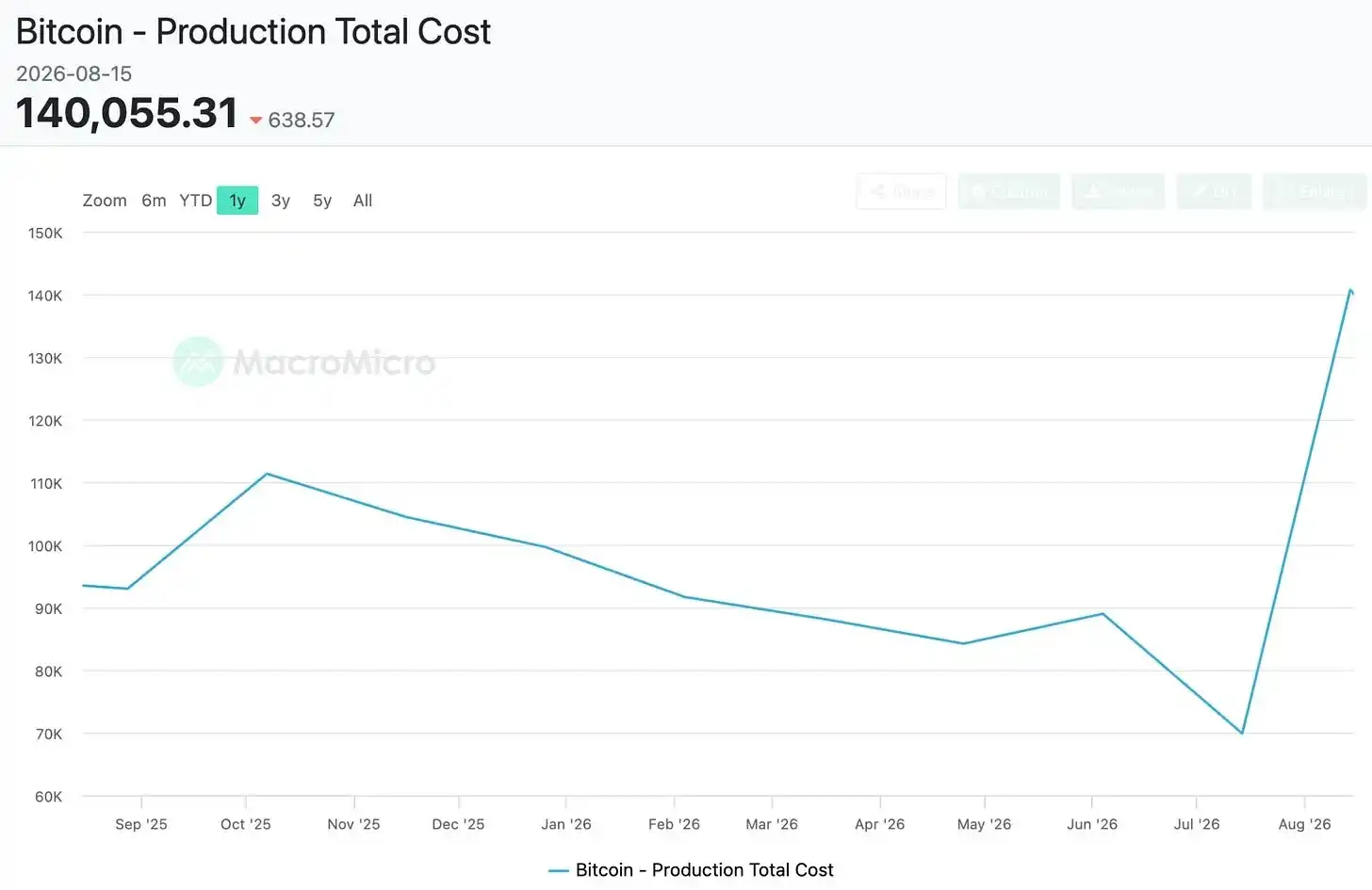
Source: MacroMicro

During the same period of worsening mining conditions, massive capital has flooded into the AI inference sector.

Bitcoin miners use ASIC chips to run complex algorithms and obtain block rewards. This hardware infrastructure is highly similar to the underlying requirements for high-performance computing and AI inference. This makes the transition to AI inference less daunting for miners, significantly lowering the barrier to entry. For miners seeking profitable outlets, pivoting to AI seems like a natural move.

Almost the entire listed mining sector has collectively changed course. The shift in revenue structure over the past few quarters vividly illustrates the scale of this transformation.

Take Core Scientific as an example: In Q2 2025, data center hosting services for AI and HPC generated only $10.6 million in quarterly revenue; during the same period, revenue from mining and selling Bitcoin was $62.4 million. Twelve months later, their positions were almost completely reversed. In Q2 2026, hosting revenue was $136.7 million, while mining revenue shrank by 65% to $21.5 million.

The proportion of hosting revenue to total company revenue skyrocketed from 14% last year to 83%.

TeraWulf's HPC leasing revenue already accounts for 71% of its total revenue. This business line had no revenue in the same period last year but reached $32 million in Q2 2026; during the same period, crypto asset mining revenue shrank by about 75%, remaining at only $13 million.
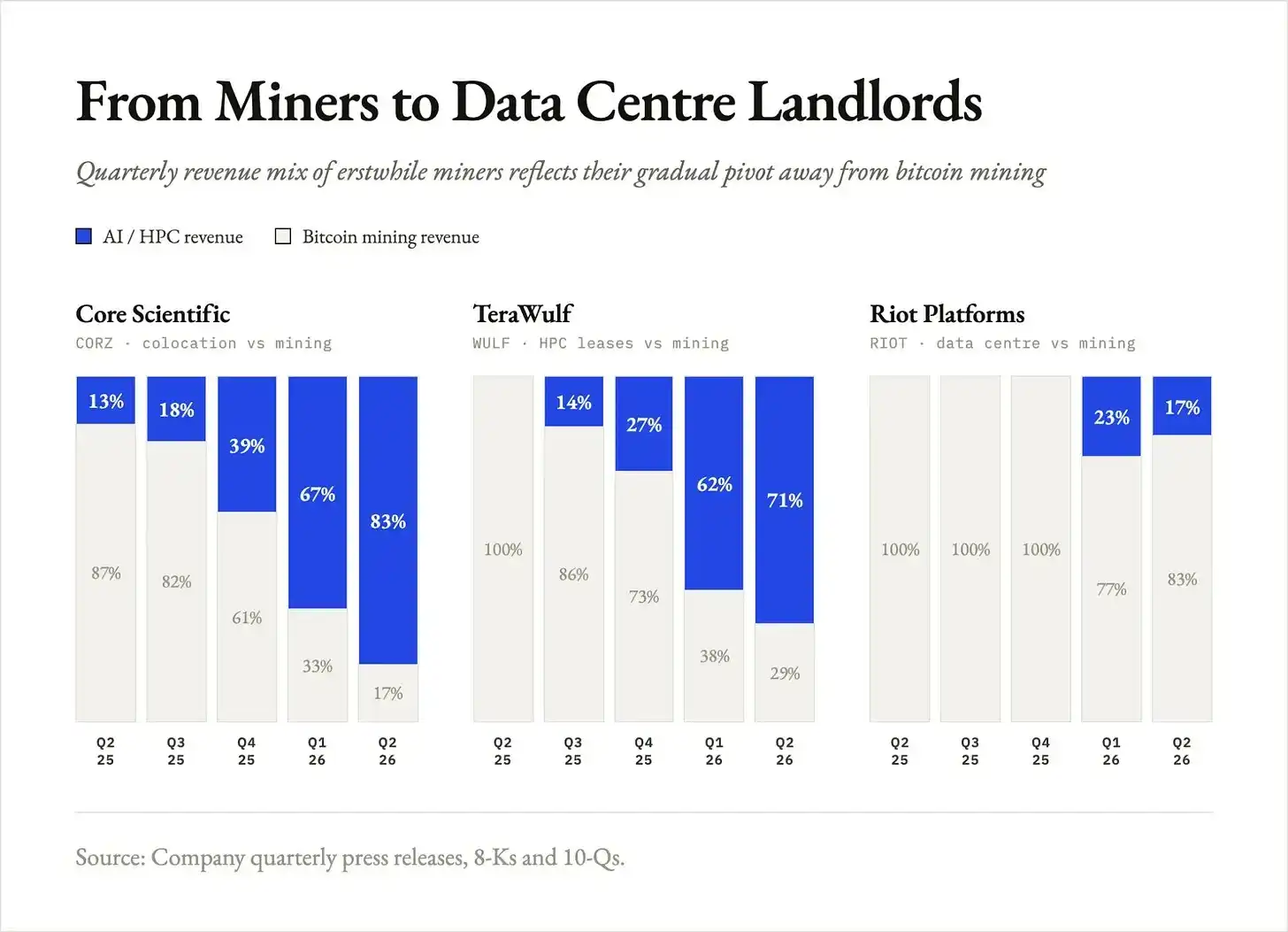
Many miners are also retrofitting their existing mining facilities and hardware to accommodate AI and HPC businesses.

A Worrisome Land Grab

The shift from Bitcoin mining to AI computing power has turned into a collective stampede. Beyond allocating existing capacity to AI, former Bitcoin miners are frantically securing electricity, land, and signing numerous demand orders. The total value of contracts already in place amounts to tens of billions of dollars.

Core Scientific has committed up to 2.5GW of available computing capacity to AMD and CoreWeave, with potential total revenue exceeding $24 billion over the contract period. Hut 8 holds 949 megawatts of contracted computing power with a base contract value of $26.6 billion and has secured $7.5 billion in new project financing.

TeraWulf signed a 20-year lease agreement worth approximately $19 billion with Anthropic and acquired a gigawatt-scale campus in Kentucky to meet computing demand. Over the past six months, Riot Platforms completed multiple leases totaling 241 megawatts, corresponding to a contract size of about $10 billion. Just last week, IREN delivered its first batch of AI cloud deployment nodes to Microsoft—a five-year contract valued at $9.7 billion; it also secured a 5GW partnership with Nvidia and continues acquiring power sites in Texas and Spain to supply computing needs.

This series of massive contracts has ignited market enthusiasm. Compared to miners' past businesses, signing 20-year leases with leading cloud providers promises more stable cash flow. After a full year of mining losses, locking in contracts for up to fifteen years seems like solid, tangible reality.

However, much market commentary underestimates the hidden risks.

Despite the hardship of mining, Bitcoin mining possesses a characteristic that AI hosting lacks: a self-healing mechanism. When mining becomes unprofitable, miners shut down their machines; when enough miners exit, the Bitcoin network difficulty automatically adjusts downward. The remaining miners, with the same equipment and electricity costs, can achieve higher returns.
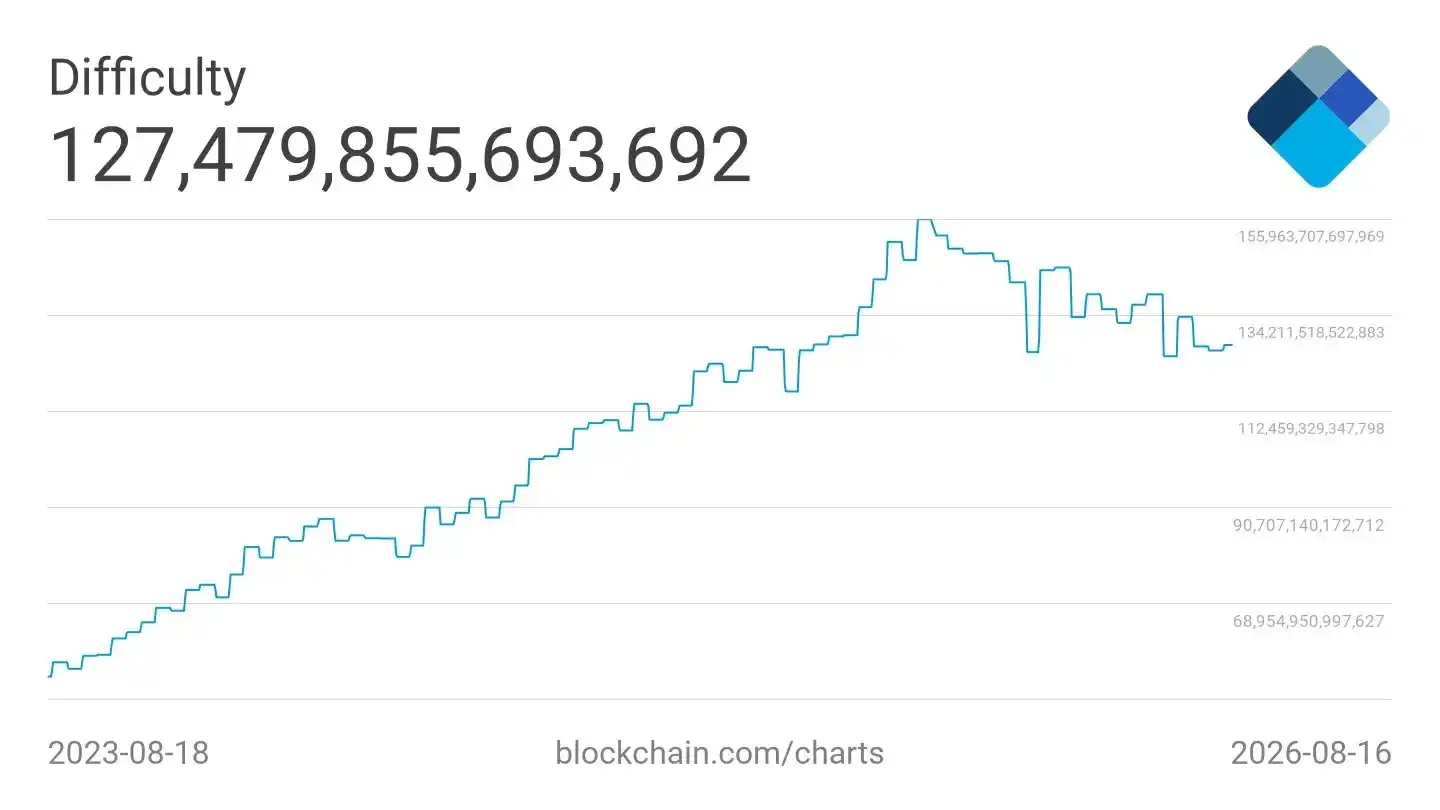
After many miners switched to the AI sector, Bitcoin's network difficulty has dropped from its peak of around 156 trillion in 2025 to 127.5 trillion. Every company exiting mining is making the mining rewards higher for those who remain.

However, the AI computing power industry lacks this automatic adjustment mechanism. If too many players flood in, causing an oversupply of computing power, prices will be driven down.

Although overall demand for AI computing is rising, prices may actually fall—seemingly contrary to basic economic principles. In fact, several AI companies have already lowered their service prices. In the early days of the industry, with hardware and supporting resources scarce, service providers could charge high premiums. Now, cloud giants worldwide are competing for megawatt-level power resources, and this scarcity has attracted a large number of Bitcoin miners and data center operators to massively expand capacity. Once new supply fills the demand gap, computing power prices will decline rapidly.

When prices fall, the 15-20 year long-term leases miners are signing at today's high prices will look prohibitively expensive in hindsight.

There is another tricky aspect to this transition: the path is largely one-way. Converting a mining facility into an AI computing campus is straightforward; the power infrastructure is already in place. But once you replace ASIC miners with H100 GPUs and sign a 20-year lease, you'll be tightly bound by this contract for the next two decades, unable to easily switch back to mining.

When market cycles reverse in the future, with Bitcoin prices breaking away from the $60,000 low and network difficulty decreasing, mining will inevitably become profitable again. By then, former miners who have completely transformed, constrained by multi-year long-term leases, can only watch the opportunity pass by. Worse still, if the actual revenue from AI computing falls short of the optimistic expectations at signing, a double blow will follow.

So, should miners not transform and just wait patiently for the mining cycle to turn? I don't think so. For most companies, transformation is a forced choice for survival. With a comprehensive mining cost of $140,000 and the coin price at only $63,000, continuing to mine is commercially unviable; AI is the only immediate lifeline.

But the will to survive drives companies to make extreme choices. The risk lies precisely with those players who go all-in on AI: forced by survival pressure, they completely abandon Bitcoin mining, destroy/replace all ASIC miners, and lock themselves into decades-long contracts in a nascent industry that will still experience price corrections.

However, not all miners have chosen a complete 180-degree turn; some companies have been more cautious.

Those With Hedging Options Hold the Advantage

Marathon Digital, the listed mining company with the largest Bitcoin treasury, has taken a cautious path. In Q2 2026, it sold 30% of its Bitcoin holdings to reduce debt, but it has not abandoned its Bitcoin mining equipment. Instead, it chose another way to fund its AI expansion.

MARA used its remaining Bitcoin as collateral to secure $150 million in funding through a 2026 credit facility to finance its AI business expansion. As of June 30, its balance sheet still holds over 35,000 Bitcoins while maintaining a flexible, load-adjustable mining operation.

Hut 8 has also not abandoned mining. It spun off its Bitcoin mining business into a new, wholly-owned subsidiary, American Bitcoin Corp, while the parent company focuses on HPC and AI infrastructure.

By keeping mining machines running and maintaining Bitcoin inventories, these companies hold an option abandoned by those who have gone all-in on the transformation. When mining becomes profitable again, they can switch their power load back to mining; companies deeply tied to long-term AI contracts can only watch from the sidelines.

Treating old mining operations as baggage and betting everything on AI computing is gambling on an unproven future. But historical patterns are easy to predict: chips, computers, smartphones—every emerging technology sees product prices fall as the industry matures. Signs of price softening have already appeared in the AI computing power industry.

Companies like Marathon and Hut 8 are not missing out on the AI boom. They haven't liquidated everything to buy GPUs. Instead, they retain some mining capacity and Bitcoin holdings, treating AI as a diversification strategy rather than betting all their capital on an immature sector that will undergo price re-evaluation. As long as the ASIC miners are still there, when mining becomes more profitable and AI computing premiums fade, they can switch the load back to mining Bitcoin.

From a broader perspective, these companies are essentially power operators; the hardware on top is either ASIC miners or H100 graphics cards. Companies that can flexibly allocate power resources between mining and AI computing based on which business yields higher returns will not be entirely at the mercy of market cycles and narratives.

Trending Cryptos

Related Questions

QWhat is the main reason leading major listed Bitcoin mining companies to shift their focus towards AI and high-performance computing (HPC)?

AThe primary driver is a severe survival crisis triggered by the Bitcoin block reward halving in April 2024 and a subsequent sharp drop in Bitcoin's price. With the current price of Bitcoin around $63,000 and the all-in mining cost having soared to as high as $140,000, continuing to mine and sell Bitcoin is largely unprofitable. Simultaneously, the explosive growth in demand for AI inference computing power offers a seemingly viable and lucrative alternative business model.

QWhat is a key long-term risk for miners who sign large, multi-year contracts for AI compute capacity at current high prices?

AA major risk is being locked into long-term (e.g., 15-20 year) contracts at peak prices. As more players enter the AI compute market and supply expands, the scarcity premium is likely to diminish, leading to a decline in compute pricing. Companies that signed contracts based on current high valuations may find their contracts economically burdensome in the future, while being unable to easily switch back to Bitcoin mining.

QHow does the Bitcoin mining industry's self-adjusting mechanism contrast with the dynamics of the AI compute market?

ABitcoin mining has a built-in self-healing mechanism: when mining becomes unprofitable, miners shut off machines, leading to a decrease in the network's mining difficulty. This automatically improves profitability for the remaining miners. In contrast, the AI compute market lacks such an automatic adjustment. If an oversupply of compute power develops, prices can be driven down without a corresponding automatic mechanism to restore profitability for suppliers.

QWhich mining companies are cited as examples of taking a more cautious, diversified approach to the AI shift, and what does this approach involve?

AMarathon Digital (MARA) and Hut 8 are cited as examples. Their cautious approach involves not fully abandoning Bitcoin mining. Marathon used part of its Bitcoin treasury as collateral for loans to fund AI expansion while retaining its mining hardware and a significant Bitcoin reserve. Hut 8 spun off its Bitcoin mining into a separate subsidiary while focusing the parent company on HPC/AI. This preserves the optionality to switch power back to mining if it becomes more profitable again.

QAccording to the article, what fundamental capability gives flexible miners a strategic advantage over those who are 'all-in' on AI?

AThe fundamental advantage is being able to act as flexible power operators. Companies that retain both Bitcoin mining hardware (ASICs) and AI computing hardware (GPUs) can dynamically allocate their electricity and infrastructure resources based on which application—Bitcoin mining or AI compute—offers higher returns at any given time. This flexibility protects them from being solely dependent on the volatile cycles of either market.

Related Reads

Dutch Prosecutors Seize $2.55 Million in Cryptocurrency Linked to Bankrupt Company Knaken

Dutch prosecutors have liquidated all remaining cryptocurrency assets belonging to the bankrupt trading platform Knaken, recovering $2.55 million for creditors. However, the court-appointed trustee warned that the platform's 6,300 affected clients will likely recover only a small portion of their investments, estimated between $11.6 and $13.9 million. The trustee, Carl Hamm, stated that the platform operated with a significant structural deficit, mixing client investments with operational expenses, rather than fully covering user deposits. Investigations reveal that Knaken's owner, Ronald J., transferred $2.67 million from company accounts to a private entity he owned—a transaction the court described as a conflict of interest. Despite financial troubles beginning as early as 2020, Knaken continued to expand its client base and secured high-profile sponsorship deals with major Dutch football clubs, without disclosing its difficulties to the Dutch Central Bank. The platform also issued participation certificates and took loans from clients. Prior to the bankruptcy declaration, Dutch authorities seized and sold Knaken's remaining crypto reserves under a law permitting the liquidation of rapidly depreciating assets. This $2.55 million is currently the only liquid asset in the bankruptcy estate. Some legal counsel for the victims questioned whether authorities overstepped by liquidating client assets. In response, Ronald J. contested some of the trustee's claims, asserting that Knaken acted as a broker with verifiable trade logs and that separate banking structures were later implemented for client funds. He acknowledged an asset shortfall but is actively working on a creditor settlement plan. The trustee is currently assessing the feasibility of any proposed settlement.

cryptonews.ru26m ago

Dutch Prosecutors Seize $2.55 Million in Cryptocurrency Linked to Bankrupt Company Knaken

cryptonews.ru26m ago

Upbit and Bithumb Report Revenue Decline for the First Six Months of 2026

Major South Korean crypto exchanges Upbit and Bithumb reported their financial results for the first half of 2026. Both saw revenue decline by approximately 50% year-over-year, to $288.9 million for Upbit's parent company Dunamu and $119.5 million for Bithumb, attributed to lower market activity and trading volumes impacting commission income. Despite the revenue drop, both exchanges remained operationally profitable. Dunamu posted an operating profit of $78.9 million (27% margin), while Bithumb's was $10.5 million (8.8% margin). Bithumb significantly cut costs, including sales incentives and advertising. A key divergence emerged in net profit. Dunamu achieved a net profit of $76.7 million. In contrast, Bithumb reported a net loss of $76.9 million, driven by $109.8 million in non-operating expenses, including losses from digital asset disposals, revaluation, and provisions for regulatory proceedings. Both exchanges show high dependence on trading commissions, which constituted about 97% of Dunamu's and nearly 100% of Bithumb's revenue. Client assets on both platforms fell by around 35%. This trend reflects the broader South Korean market, where Q2 2026 trading volume across five major licensed exchanges fell 49.5% year-over-year. Both companies also faced operational challenges, including an investigation into Bithumb's CEO and a hacking incident at Upbit in November 2025.

cryptonews.ru29m ago

Upbit and Bithumb Report Revenue Decline for the First Six Months of 2026

cryptonews.ru29m ago

Ondo State-based Company QQQon Raises $2.3 Million in Ethereum Investment Amid Surge in Tokenized Stocks

Company QQQon from the state of Ondo attracted $2.3 million in Ethereum investment amid the growth of tokenized stocks. This follows a single Ethereum transaction where a trader spent $2,328,595.73 to purchase 3,167.53 $QQQon tokens. Ondo Finance stated this seven-figure purchase signals tokenized stocks are moving beyond an experimental phase. Ondo Stocks, the company's tokenized ETF platform, recently surpassed $1 billion in Total Value Locked (TVL), with total trading volume reaching $27 billion since its September 2025 launch. $QQQon allows blockchain investors access to various US stocks. The large transaction indicates growing institutional interest in a market traditionally dominated by small retail trades. Furthermore, Ondo has enabled its tokens, like $QQQon and $SPYon, to be used as collateral for DeFi loans, transforming them from passive assets into productive investment tools. Ondo has expanded trading to 24/7 operations across multiple blockchains and now offers over 430 tokenized stocks and ETFs. While the tokenized stock market remains small compared to traditional equities, it is growing rapidly, valued at over $1.7 billion as of June 2026, a 149% year-over-year increase. Regulatory bodies like the SEC have emphasized that securities laws apply regardless of tokenization. Ondo's TVL has seen remarkable growth, from approximately $192 million in January 2024 to about $3.51 billion currently, an 18.3x increase, positioning it as a leading platform in the Real-World Asset (RWA) sector alongside names like BlackRock's BUIDL and Circle's USYC.

cryptonews.ru32m ago

Ondo State-based Company QQQon Raises $2.3 Million in Ethereum Investment Amid Surge in Tokenized Stocks

cryptonews.ru32m ago

Trading

Spot

Hot Articles

What is $BITCOIN

DIGITAL GOLD ($BITCOIN): A Comprehensive Analysis Introduction to DIGITAL GOLD ($BITCOIN) DIGITAL GOLD ($BITCOIN) is a blockchain-based project operating on the Solana network, which aims to combine the characteristics of traditional precious metals with the innovation of decentralized technologies. While it shares a name with Bitcoin, often referred to as “digital gold” due to its perception as a store of value, DIGITAL GOLD is a separate token designed to create a unique ecosystem within the Web3 landscape. Its goal is to position itself as a viable alternative digital asset, although specifics regarding its applications and functionalities are still developing. What is DIGITAL GOLD ($BITCOIN)? DIGITAL GOLD ($BITCOIN) is a cryptocurrency token explicitly designed for use on the Solana blockchain. In contrast to Bitcoin, which provides a widely recognized value storage role, this token appears to focus on broader applications and characteristics. Notable aspects include: Blockchain Infrastructure: The token is built on the Solana blockchain, known for its capacity to handle high-speed and low-cost transactions. Supply Dynamics: DIGITAL GOLD has a maximum supply capped at 100 quadrillion tokens (100P $BITCOIN), although details regarding its circulating supply are currently undisclosed. Utility: While precise functionalities are not explicitly outlined, there are indications that the token could be utilized for various applications, potentially involving decentralized applications (dApps) or asset tokenization strategies. Who is the Creator of DIGITAL GOLD ($BITCOIN)? At present, the identity of the creators and development team behind DIGITAL GOLD ($BITCOIN) remains unknown. This situation is typical among many innovative projects within the blockchain space, particularly those aligning with decentralized finance and meme coin phenomena. While such anonymity may foster a community-driven culture, it intensifies concerns about governance and accountability. Who are the Investors of DIGITAL GOLD ($BITCOIN)? The available information indicates that DIGITAL GOLD ($BITCOIN) does not have any known institutional backers or prominent venture capital investments. The project seems to operate on a peer-to-peer model focused on community support and adoption rather than traditional funding routes. Its activity and liquidity are primarily situated on decentralized exchanges (DEXs), such as PumpSwap, rather than established centralized trading platforms, further highlighting its grassroots approach. How DIGITAL GOLD ($BITCOIN) Works The operational mechanics of DIGITAL GOLD ($BITCOIN) can be elaborated on based on its blockchain design and network attributes: Consensus Mechanism: By leveraging Solana’s unique proof-of-history (PoH) combined with a proof-of-stake (PoS) model, the project ensures efficient transaction validation contributing to the network's high performance. Tokenomics: While specific deflationary mechanisms have not been extensively detailed, the vast maximum token supply implies that it may cater to microtransactions or niche use cases that are still to be defined. Interoperability: There exists the potential for integration with Solana’s broader ecosystem, including various decentralized finance (DeFi) platforms. However, the details regarding specific integrations remain unspecified. Timeline of Key Events Here is a timeline that highlights significant milestones concerning DIGITAL GOLD ($BITCOIN): 2023: The initial deployment of the token occurs on the Solana blockchain, marked by its contract address. 2024: DIGITAL GOLD gains visibility as it becomes available for trading on decentralized exchanges like PumpSwap, allowing users to trade it against SOL. 2025: The project witnesses sporadic trading activity and potential interest in community-led engagements, although no noteworthy partnerships or technical advancements have been documented as of yet. Critical Analysis Strengths Scalability: The underlying Solana infrastructure supports high transaction volumes, which could enhance the utility of $BITCOIN in various transaction scenarios. Accessibility: The potential low trading price per token could attract retail investors, facilitating wider participation due to fractional ownership opportunities. Risks Lack of Transparency: The absence of publicly known backers, developers, or an audit process may yield skepticism regarding the project's sustainability and trustworthiness. Market Volatility: The trading activity is heavily reliant on speculative behavior, which can result in significant price volatility and uncertainty for investors. Conclusion DIGITAL GOLD ($BITCOIN) emerges as an intriguing yet ambiguous project within the rapidly evolving Solana ecosystem. While it attempts to leverage the “digital gold” narrative, its departure from Bitcoin's established role as a store of value underscores the need for a clearer differentiation of its intended utility and governance structure. Future acceptance and adoption will likely depend on addressing the current opacity and defining its operational and economic strategies more explicitly. Note: This report encompasses synthesised information available as of October 2023, and developments may have transpired beyond the research period.

1.9k Total ViewsPublished 2025.05.13Updated 2025.05.13

What is $BITCOIN

Discussions

Welcome to the HTX Community. Here, you can stay informed about the latest platform developments and gain access to professional market insights. Users' opinions on the price of BTC (BTC) are presented below.

活动图片