This week, a trader spent $2,328,595.73 to purchase 3,167.53 $QQQon in a single Ethereum transaction. According to Ondo Finance, this seven-figure purchase demonstrates that tokenized stocks are no longer in an experimental stage.
The deal was announced by Ondo on August 17th, with its posts confirming the same token quantity and monetary amount. For a market attempting to showcase its capacity to handle large capital flows, a $2.3 million transaction in one go deserves attention.
Tokenized stocks are making history.
— Ondo Finance (@Ondo) August 17, 2026
In a single transaction on Ethereum.
A seven-figure trade executed, only on Ondo Stocks. https://t.co/hBDBcycrS1
The trade occurred as Ondo's tokenized exchange-traded fund, Ondo Stocks, reached the $1 billion mark in total value locked. Since its launch in September 2025, the total trading volume has reached $27 billion. $QQQon is one of Ondo's tokenized ETFs, allowing blockchain technology investors access to various US stocks.
Why a Single Seven-Figure Order Matters
Traditionally, trading tokenized stocks was considered largely oriented toward small transactions for retail investors. However, the recent single transaction reportedly exceeding $2.3 million indicates that larger investors might be beginning to explore this format. According to Ondo, the transaction was executed on Ethereum, allowing users to access the blockchain record.
Based on data from Ondo's transaction tracking account, the deal was for a total of 3,167.53 $QQQon at a price of $2,328,595.73, implying a price of approximately $735 per token. Furthermore, as the buyer or counterparty is not specified in the two announcements, it would be incorrect to conclude the transaction was institutional. However, it signifies that the system can process a multi-million dollar order in a single operation.
From Passive Tokens to Collateral You Can Borrow Against
This deal also illustrates what Ondo has done with its stock tokens. In February, the company enabled $SPYon and $QQQon to be used as collateral on DeFi lending markets via Morpho, where risk parameters, including collateral factors and liquidation levels, were set by the risk management firm Gauntlet.
This is significant considering tokens once served solely as passive ownership instruments: they simply allowed the holder to store or transfer them. However, if $QQQon can be used as loan collateral, it can serve as a productive asset within cryptocurrency portfolios, rather than merely representing a physical holding.
Ondo began its journey with $SPYon and $QQQon because both ETFs track a broad range of ETFs and enjoy significant underlying liquidity. This provides a relatively stable financial opportunity to enter the DeFi lending market using tokenized stocks.
Constant Access to Wall Street Information
Ondo is also taking steps to expand the hours during which such assets can be traded. In June, it launched 24/7 instant creation and redemption for its six most traded tokens, including $QQQon, on Ethereum, BNB Chain, and Solana. This represents an expansion from the previous 24/5 model, which ceased operation on weekends.
This change removes one of the main advantages of using tokenization: global market participants can close and open their positions at any time, even on weekends and holidays when traditional stock market operations are inactive.
According to Ondo, its platform now features over 430 tokenized stocks and ETFs, making it the first platform of its kind to achieve a total value locked exceeding $1 billion. The tokens can be utilized across several different venues, including Ondo Perps, Morpho, and Euler, allowing tokenized stocks to gradually transform into assets capable of integrating into the broader blockchain financial ecosystem.
A Category Still Small but Growing Rapidly
Although the overall tokenized stock market is quite small compared to traditional stocks, it is growing at an exponential rate. According to a research report published in June 2026, the tokenized stock market was valued at over $1.7 billion, a 149% increase from the previous year. Monthly blockchain trading volume during that period exceeded $6.7 billion.
In January, Coinbase researchers warned that tokenized stocks still occupy a small share even within the real-world asset market, as many products are designed as foreign derivatives rather than direct ownership of US stocks.
Authorities are closely monitoring the situation. On January 28th, three SEC divisions emphasized in their statement that a security retains its regulatory status regardless of format, including in tokenized form. This principle will guide the evolution of companies like Ondo as trading volume grows.
What to Watch Next
The key question is whether transactions exceeding $2 million will become commonplace or remain exceptional. Ondo's achievements, including attracting $1 billion in total value locked and offering lending and perpetual options, allow tokenized stocks to attract and retain capital in various ways.
The next indicator will be whether both TVL (total value locked) and the size of individual orders continue to grow through the end of 2026. If so, stock tokenization may mark a shift from a cryptocurrency experiment to a genuine second layer for trading traditional stocks.
The most accurate starting point for comparison is January 2024, when Ondo's reported asset value was approximately $192 million. Subsequently, in June 2024, Ondo reported assets under management of $500 million, surpassed $1 billion in March 2025, reached approximately $1.93 billion in December 2025, exceeded $2.5 billion in January 2026, and currently stands at around $3.5 billion.
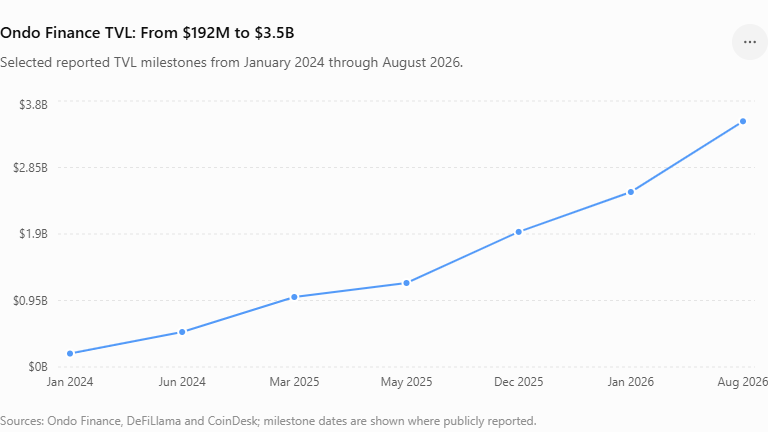
The growth is remarkable: from approximately $192 million in January 2024 to $3.51 billion currently, an increase of roughly 18.3 times. According to DeFiLlama, Ondo's aggregated TVL is currently about $3.51 billion.
For comparison, DeFiLlama currently lists the following major platforms operating with risk-weighted assets (RWA) and tokenized assets. These companies are not absolutely identical: some analogs represent separate tokenized funds or gold products, while Ondo is a broader platform encompassing USDY, OUSG, and tokenized stocks. DeFiLlama classifies Ondo as RWA and provides the following list of similar platforms. Nonetheless,
| RWA Platform/Product | Current TVL | Relative to Ondo |
|---|---|---|
| Ondo Finance | $3.51 billion | 100% |
| BlackRock BUIDL | $3.44 billion | 98% |
| Circle USYC | $3.01 billion | 86% |
| Tether Gold | $2.87 billion | 82% |
| Spico | $2.22 billion | 63% |
| Paxos Gold | $1.78 billion | 51% |
| Centrifuge | $1.63 billion | 46% |
| Midas RWA | $122 million | 3.5% |
| Open Eden Bill | $256 million | 7.3% |
| CAIO | $43 million | 1.2% |