What Happens To The XRP Price If The Senate Votes Yes On The Market Structure Bill

bitcoinistPublished on 2026-01-31Last updated on 2026-01-31

Abstract

The US Senate is moving closer to a full vote on the Crypto Market Structure Bill, which aims to establish a clear federal regulatory framework for digital assets. This legislation would assign oversight of spot markets to the CFTC and define rules for trading platforms. The bill recently passed the Senate Agriculture Committee along strict party lines, with only Republican support. A full Senate vote is anticipated around early July 2026. If passed, the bill could significantly impact the XRP price by reducing long-standing regulatory uncertainty. A clearer regulatory classification would allow XRP to be valued more on its usage and adoption rather than regulatory risk, potentially leading to a price surge. However, the long-term effect depends on implementation and market adaptation. The bill still requires support from at least seven Democrats in the Senate before it can be sent to the President for approval.

The US Senate is edging closer to a full vote on the crypto market structure legislation, which could be a turning point for the likes of XRP. The bill, which aims to establish clear federal rules for how cryptocurrencies are regulated and traded, is viewed as a turning point for crypto assets like XRP that have long operated in regulatory gray zones. A yes vote would not just represent a political milestone; it could materially alter how XRP is valued, traded, and adopted across the US market.

What’s Happening With The Crypto Market Structure Bill?

The Crypto Market Structure bill is designed to create a clear federal regulatory framework for digital assets, giving oversight of spot markets to the Commodity Futures Trading Commission and defining rules for trading platforms, brokers, and dealers. Notably, the legislation has been advancing through committees, most recently the Senate Agriculture Committee.

At the moment, the bill has cleared the Senate Agriculture Committee along strict party lines, but it has not yet been voted on by the full Senate. The Senate Agriculture Committee voted 12-11 along party lines to move its version of the bill forward after weeks of debate and amendment negotiations. All Democrats on the committee opposed it, meaning it passed only with Republican support.

On timing, senators and policy advisers have suggested that a floor vote by the Senate Banking Committee could happen later in the winter or early spring, possibly in February or March 2026. After this, the two committee versions can be reconciled into a single text that both parties can back. However, the full Senate vote on the legislation might not come until sometime around early July.

What Will Happen To The XRP Price?

XRP’s price history has been heavily influenced by regulatory questions and debates over whether it should be treated like a security. The cryptocurrency secured a regulatory victory in 2023 when a judge ruled that XRP was not a security in and of itself.

If the Senate passes the market structure bill, the clearer assignment of oversight to a single regulator would reduce that uncertainty. XRP would be valued more on usage and adoption, and that would remove the regulatory risk that has weighed on its price.

Unsurprisingly, this is the dominant sentiment among XRP investors and other crypto market investors. One XRP commentator, known as Cobb (@Cobb_XRPL) on the social media platform X, noted that XRP is going to pump so hard if the Crypto Market Structure bill passes. Still, the longer-term impact on XRP will depend on how the regulatory framework is implemented and how quickly exchanges, institutions, and developers adapt.

The bill would require the backing of at least seven Democrats in the Senate before it can eventually go to US President Donald Trump for approval. Republican lawmakers like John Boozman, backing the bill, say it is necessary to create clear rules for digital asset markets. Opposing Democrats say the bill lacks important rules to prevent conflicts of interest involving political figures and crypto holdings. Crypto exchange Coinbase, for one, has pulled its support for the bill.

Price continues to trend downward | Source: XRPUSDT on Tradingview.com

Trending Cryptos

Related Questions

QWhat is the main purpose of the Crypto Market Structure Bill discussed in the article?

AThe main purpose of the Crypto Market Structure Bill is to establish a clear federal regulatory framework for digital assets, giving oversight of spot markets to the Commodity Futures Trading Commission (CFTC) and defining rules for trading platforms, brokers, and dealers.

QHow did the Senate Agriculture Committee vote on the bill, and what does this indicate about its support?

AThe Senate Agriculture Committee voted 12-11 along strict party lines to advance the bill, with all Democrats opposing it and all Republicans supporting it. This indicates the bill currently lacks bipartisan support.

QAccording to the article, what was the significant 2023 regulatory event for XRP?

AIn 2023, a judge ruled that XRP was not a security in and of itself, which was a significant regulatory victory for the cryptocurrency.

QWhat is the expected impact on the XRP price if the market structure bill is passed, according to the dominant sentiment among investors?

AThe dominant sentiment among investors is that the XRP price will increase significantly ('pump so hard') as the bill would reduce regulatory uncertainty and remove the regulatory risk that has weighed on its price, allowing it to be valued more on usage and adoption.

QWhat is one major reason cited by Democrats for opposing the bill?

ADemocrats oppose the bill because they say it lacks important rules to prevent conflicts of interest involving political figures and their crypto holdings.

Related Reads

Capital is Moving from Cryptocurrency Speculation to Tokenized RWA Assets

In 2026, tokenized real-world assets (RWA) became one of the fastest-growing areas in crypto. Investors, weary of market volatility, are shifting capital from speculative crypto trading towards assets offering stable yield. These include tokenized government bonds (e.g., T-bills), private credit, real estate income, commodities, and money market funds. Data shows a clear preference for transparent, regulated products. Deposits into RWA protocols more than tripled year-on-year, reaching $7.4 billion in Q2, while spot trading activity surged 220%. The total on-chain value of tokenized RWAs exceeded $30 billion in 2026, more than doubling from the previous year, and approached $38 billion by August. RWA acts as a bridge between traditional finance and blockchain, not a replacement. It allows banks and asset managers to launch regulated products on public blockchains, while DeFi users gain access to previously unavailable real-world assets. Blockchain provides 24/7 settlements, transparency, programmability, and lower fees, while traditional finance contributes capital, regulation, and proven products. Tokenized private credit remains the largest RWA category (over $7 billion on-chain), benefiting from blockchain's cost reduction and transparency. Treasury bills are the fastest-growing institutional segment, driven by higher interest rates. Tokenized commodities, especially gold, are expanding, combining asset safety with blockchain trading ease. Real estate, though smaller, is also growing steadily. Tokenization is increasingly viewed as core financial infrastructure.

cryptonews.ru1h ago

Capital is Moving from Cryptocurrency Speculation to Tokenized RWA Assets

cryptonews.ru1h ago

Lone Bitcoin Miner Defies All Odds, Hits $200,000 Jackpot with Block Reward

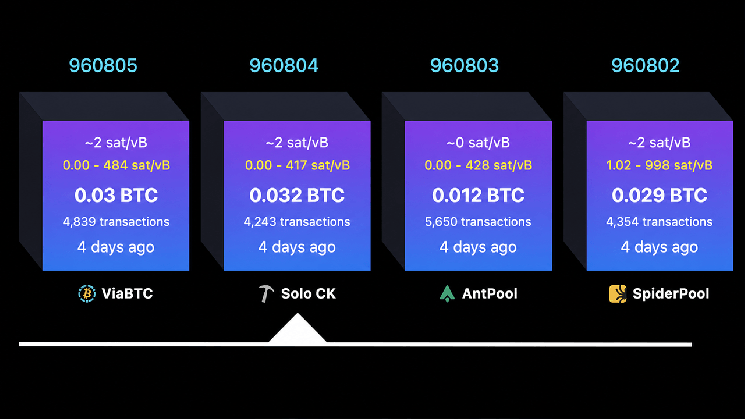
A solo Bitcoin miner, contrary to all predictions, won a $200,000 jackpot as a block reward. The payment went to an address linked to CKPool, a solo-mining service. This was the 317th solo block found by the pool. The reward consisted of the 3.125 BTC fixed subsidy and about 0.032 BTC in transaction fees from 4,243 transactions. CKPool operator Dr -ck (Con Kolivas) confirmed the win, noting the miner's hashrate was "extremely volatile, presumably rented," peaking at 100 PH/s. This represented about 0.011% of Bitcoin's total network hashrate. At that level, a miner could statistically expect to find a block roughly every 64 days, far more likely than for a typical small home setup. Solo mining differs from pool mining, where rewards are shared based on contributed work. In solo mining, a miner gets nothing unless they personally find a block, but then receives the entire reward. CKPool charges a ~2% fee on blocks found. Dr -ck noted the hashrate pattern suggested rented computing power, a practice making solo wins more accessible. He also highlighted this was the first mainnet block mined after integrating Stratum V2 code into ckpool, though the block itself was found using the older Stratum V1 protocol. Against a backdrop of mining concentration in large industrial pools, such solo finds remain rare but demonstrate that anyone with sufficient hashrate can claim a full reward without corporate or government permission. The block subsidy will remain 3.125 BTC until the next halving around April 2028. The miner's identity remains unknown, as is typical. Bitcoin's mining difficulty is due for an adjustment, and network hashrate has declined from late 2025 peaks, partly due to competition for power and hardware from AI data centers.

cryptonews.ru1h ago

Lone Bitcoin Miner Defies All Odds, Hits $200,000 Jackpot with Block Reward

cryptonews.ru1h ago

Blackrock Leads with $305 Million Inflow into Bitcoin and Ether ETFs

Money continued to flow rapidly into the largest cryptocurrency ETFs. Bitcoin and Ethereum ETFs collectively attracted over $305 million in inflows, with BlackRock again leading the charge, marking the third consecutive session of strong institutional demand. The broader market picture was mixed. Hyperliquid ($HYPE) ETFs finally saw renewed buying interest, while XRP ($XRP) ETFs faced outflows, and Solana-based products remained stagnant. In a strong session, Bitcoin ETFs recorded a net inflow of $244.42 million across five funds. BlackRock's IBIT dominated with $196.83 million, followed by ARK 21Shares' ARKB at $37.63 million and Fidelity's FBTC at $11.28 million. Vaneck's HODL was the sole fund to see an outflow (-$14.67 million), barely impacting the category's overall positive trend. Total trading volume reached $1.58 billion. Ethereum ETFs also continued their positive run, attracting $60.86 million. BlackRock's ETHA led with $50.34 million. The staking-oriented ETHB and Fidelity's FETH followed. No Ethereum ETF saw outflows. Among smaller tokens, Hyperliquid ETFs saw a minor but notable inflow of ~$966,690, potentially signaling easing selling pressure. Conversely, XRP ETFs experienced a $3.58 million outflow. Solana ETFs saw no net activity. The session solidified Bitcoin and Ethereum as the focal point for institutional capital, with BlackRock as the dominant source of demand, while activity in altcoin ETFs remained volatile.

cryptonews.ru1h ago

Blackrock Leads with $305 Million Inflow into Bitcoin and Ether ETFs

cryptonews.ru1h ago

Trading

Spot

Hot Articles

What is XRP 2.0

XRP 2.0: A New Frontier in the Cryptocurrency Landscape Introduction to XRP 2.0 In the ever-evolving realm of cryptocurrency, new projects continuously emerge, vying for attention and adoption. One such promising initiative is XRP 2.0, a novel cryptocurrency project designed to leverage advanced blockchain technology and robust encryption methodologies. While the name draws parallels with Ripple’s XRP, it’s crucial to note that XRP 2.0 operates independently, focusing on enhancing transaction security, privacy, and scalability. As the digital financial landscape increasingly embraces decentralized solutions, XRP 2.0 aims to contribute meaningfully to web3 and the overall expansion of crypto projects. What is XRP 2.0? At its core, XRP 2.0 is a cryptocurrency project that aims to create a secure and decentralized digital currency ecosystem. Its foundational technology integrates sophisticated blockchain principles with cutting-edge encryption techniques. The overarching goal of XRP 2.0 is to establish itself as a reliable and efficient platform enabling swift transaction execution while prioritizing enhanced privacy protections for its users. The project is promoted as a solution to many limitations faced by existing cryptocurrencies, proposing a system that can handle a higher volume of transactions with improved speed and privacy. This versatility positions XRP 2.0 as a significant contender in a marketplace riddled with various digital currencies. Who is the Creator of XRP 2.0? The identity of the creator behind XRP 2.0 has been flagged as ‘Wilbur.’ However, comprehensive details regarding Wilbur or their associated entity remain elusive. The anonymity of many cryptocurrency creators is not an uncommon phenomenon in the industry, often designed to maintain a degree of privacy and security. Who are the Investors of XRP 2.0? As of now, specific information related to the investment foundations or organizations supporting XRP 2.0 is not publicly available. In the cryptocurrency sector, the backing by reputed investors can significantly influence a project's credibility and success, yet the transparency regarding the financial supporters of XRP 2.0 has not been established. How Does XRP 2.0 Work? XRP 2.0 stands out by employing a combination of blockchain technology and advanced encryption algorithms that ensures secure and decentralized transactions. Its innovative structure includes unique features designed to foster user engagement and broaden functionalities beyond conventional cryptocurrency transactions. Among these features, XRP 2.0 incorporates AI-powered capabilities, such as text-to-image and text-to-speech functionalities. These additions are designed to enhance the interactive experience for users, promoting broader applicability across various sectors. By bridging technological advancements with user-centered design, XRP 2.0 aims to capture the attention of a diverse range of individuals and enterprises looking to integrate cryptocurrency solutions into their operational frameworks. Timeline of XRP 2.0 Understanding XRP 2.0 requires examining the milestones that have defined its journey thus far: July 23, 2023: XRP 2.0 is introduced as a novel cryptocurrency project, aiming to revolutionize secure and decentralized transaction capabilities in the blockchain domain. September 8, 2023: The launching of another project, XRP20, occurs, marking the emergence of an ERC-20 token on the Ethereum blockchain that remains unrelated to XRP 2.0. November 13, 2023: The XRP Ledger undergoes a significant update with the release of rippled server software version 2.0.0. It is essential to note that this development is disconnected from the XRP 2.0 cryptocurrency project. Key Points About XRP 2.0 To distill the essence of XRP 2.0, several critical factors emerge: Unique Features: The inclusion of features like AI-powered text-to-image and text-to-speech further diversifies the potential applications of XRP 2.0. Blockchain Technology: The framework utilizes advanced blockchain mechanisms and encryption protocols, ensuring a secure and decentralized environment for transactions. Scalability and Privacy: XRP 2.0 prioritizes enhanced privacy protections in transaction processes and the scalability necessary to accommodate a growing user base. No Affiliation with Ripple: Importantly, despite its name, XRP 2.0 does not have any allegiance or collaboration with Ripple’s XRP, distinguishing its operational framework and objectives within the cryptocurrency ecosystem. Conclusion XRP 2.0 represents an ambitious venture into the cryptocurrency sphere, aiming to offer a combination of security, privacy, and efficiency in digital transactions. By integrating sophisticated technologies and user-friendly features, the project sets out to broaden the horizons of what cryptocurrency can achieve in today's digital economy. While the anonymity of its creator and lack of disclosed investors might raise questions for some, XRP 2.0's focus on advanced functionalities and decentralisation enhances its appeal amidst an increasingly crowded crypto market. As the cryptocurrency landscape continues to evolve, XRP 2.0 may yet emerge as a pivotal player in the expansion of secure and scalable blockchain solutions.

1.4k Total ViewsPublished 2024.04.01Updated 2024.12.03

What is XRP 2.0

Discussions

Welcome to the HTX Community. Here, you can stay informed about the latest platform developments and gain access to professional market insights. Users' opinions on the price of XRP (XRP) are presented below.

活动图片